57-Language GEO-Native CMS Translation at Scale (2025)
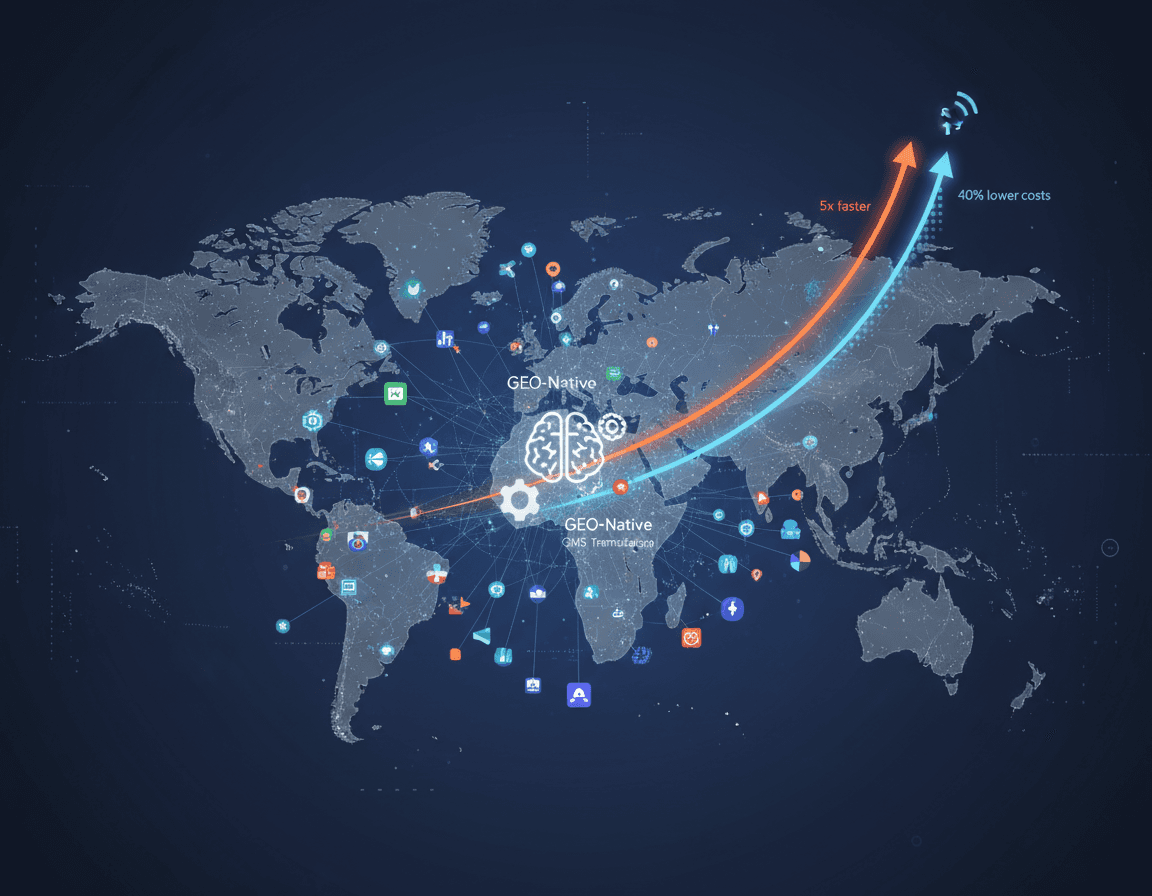
Global enterprises implementing modern CMS translation technology achieve 5x faster time-to-market and 40% lower localization costs when deploying content across 57+ languages. This scale requires combining headless CMS architecture, translation management systems, and AI agents to automate workflows while maintaining quality and GEO visibility for AI search engines.
At a Glance
• Modern translation stacks combine TMS platforms supporting 150+ languages, headless CMS architecture, and AI translation agents for continuous localization
• Companies report 90% faster feature rollouts and 50% savings on language launches after implementing automated translation workflows
• AI translation engines achieve 95% accuracy across 280+ languages while saving 31 hours of manual work monthly
• GEO optimization requires structured data, entity salience, and citation quality to ensure content visibility in AI search results
• Next-generation multimodal models show 20% BLEU improvement over previous benchmarks, enabling real-time speech and text translation
• Enterprise TMS platforms offer 60+ pre-built connectors and maintain SOC 2, HIPAA, and GDPR compliance standards
Global brands can't wait weeks to launch new geographies. CMS translation at scale now lets teams ship 57-language experiences overnight while safeguarding GEO visibility.
Why CMS Translation at Scale Matters in 2025
CMS translation at scale means localizing every content item across dozens of languages through one unified workflow. This approach combines headless CMS architecture, translation management systems, and AI agents to automate file hand-offs, reuse translation memory, enforce quality assurance, and publish updates instantly.
The opportunity is massive. According to Forrester, the CMS market is expected to grow from $36 billion in 2020 to $123 billion by 2026. This growth reflects the urgent need for flexible, scalable solutions that deliver content across multiple channels and languages.
The business case is equally compelling. Research shows that 84% of marketers said that localization positively impacts revenue growth. Yet the reality is that about 50% of all online content remains in English, leaving massive untapped markets for companies willing to invest in proper localization infrastructure.
With over 1 billion people now using AI search weekly to research products and compare solutions, the stakes for multilingual content have never been higher. Content that isn't properly localized won't just miss traditional search traffic; it will be invisible to the AI engines increasingly driving buyer decisions.
What Business Impact Does 57-Language Coverage Deliver?
The numbers make the case for translation automation clear. Companies implementing modern translation technology report dramatic improvements across speed, cost, and quality metrics.
Transifex reports their AI-powered CMS translation technology delivers 5x faster time-to-market compared to manual approaches. XTM Cloud users have seen similarly impressive results, with Johnson Controls slashing turnaround times by four weeks after implementation.
Lokalise customers report even more striking outcomes. Withings achieved 90% faster feature rollout after implementing automated localization, while HiBob saw 50% savings on language launches. These aren't marginal improvements; they represent fundamental shifts in how quickly companies can enter new markets.
The cost equation is equally favorable. Modern translation platforms combine AI with translation memory to dramatically reduce per-word costs while maintaining quality. The result is that companies can now afford to localize content that would have been economically unfeasible just a few years ago.
Key takeaway: Translation automation delivers measurable ROI through faster market entry, reduced costs, and improved content velocity.
Core Technology Stack: TMS, Headless CMS & AI Agents
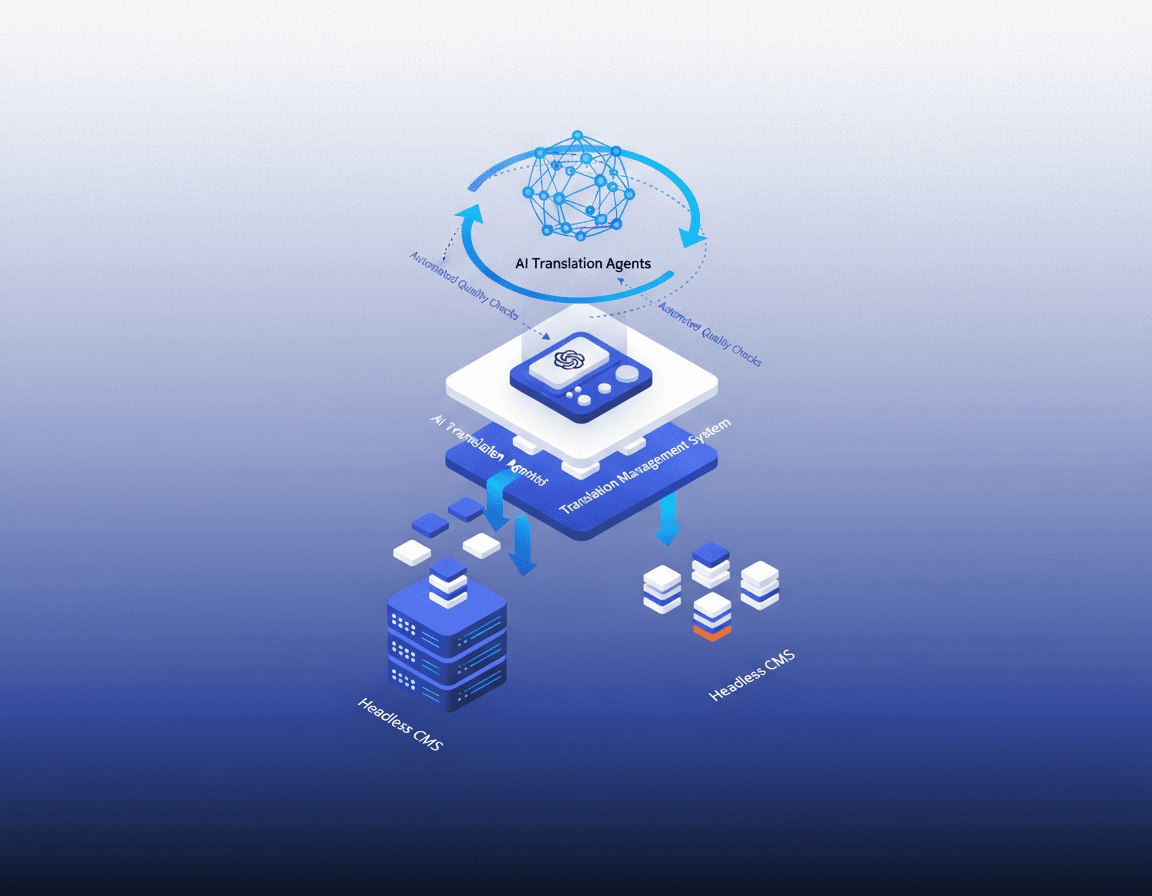
Building a 57-language content operation requires three integrated components: a translation management system, a headless CMS, and AI translation agents. Each plays a distinct role in the workflow.
Traditional CMSs struggle with scattered plugins, brittle workflows, and slow localization cycles. Modern stacks solve this by treating languages, markets, and releases as first-class data, making it easier to coordinate translators, preview changes, and publish confidently at scale.
A headless CMS decouples content management from frontend presentation. This architecture enables developers to deliver content across any channel, from websites to mobile apps to voice interfaces, all from a single source of truth. For translation workflows, headless architecture means content can flow seamlessly to TMS platforms without manual export steps.
The TMS serves as the operational hub, managing translator assignments, maintaining translation memory, enforcing quality checks, and tracking project status. Modern platforms offer 60+ pre-built connectors for popular CMS platforms, eliminating the custom integration work that traditionally slowed adoption.
AI translation agents represent the newest layer of this stack. These agents translate new content as it is published, ensuring content libraries stay current across all supported languages without manual intervention.
Choosing a Translation Management System (TMS)
The TMS market offers several strong options, each with distinct strengths. Here's how the leading platforms compare:
Platform | Language Support | Key Strengths | Best For |
|---|---|---|---|
Smartling | Cloud-based automation, real-time updates, enterprise security | Large enterprises with complex workflows | |
XTM Cloud | SmartContext AI, 60+ connectors, 90% faster time-to-market | Organizations prioritizing speed | |
Lokalise | 135 languages | Developer-first, GitHub Actions integration, 8x faster translation with AI | Development teams with CI/CD workflows |
Transifex | Multiple languages | AI-powered engine, brand voice learning, 40% cost reduction | Marketing teams focused on brand consistency |
Security matters significantly in TMS selection. Smartling's enterprise-grade security infrastructure adheres to PCI, SOC 2, HIPAA, and GDPR standards, while Smartling's Global Delivery Network translation proxy boasts a 99.99% guaranteed uptime. XTM Cloud is similarly SOC 2 compliant and ISO 27001 certified.
Leveraging AI Translation Agents for Continuous Localization
AI translation agents transform localization from a periodic project into a continuous process. These agents monitor content changes and automatically trigger translation workflows, eliminating the manual handoffs that traditionally created bottlenecks.
Smartcat's AI agents deliver impressive results: 95% translation accuracy across 280+ languages, with customers reporting 31 hours of manual work saved monthly. The platform learns from edits and feedback, continuously improving output quality.
As one Smartcat user explained: "Smartcat's automated project management and AI translations save me so much time and work. Once they are set up I can leave them to do their thing. All of these features work really well together." (Smartcat)
The most advanced implementations leverage multimodal translation models. Meta's SeamlessM4T supports speech-to-speech, speech-to-text, text-to-speech, and text-to-text translation for up to 100 languages, setting a new benchmark with 20% BLEU improvement over previous state-of-the-art in direct speech-to-text translation.
How Do You Streamline Source-to-Locale Implementation?
Implementing CMS translation at scale requires a structured workflow that connects content creation through publication. Here's a proven approach:
Configure your CMS schema for localization. Define which fields are localized, which are shared, and which are market-specific. This prevents accidental duplication while preserving regional flexibility.
Connect your TMS to your CMS. Use native integrations or APIs to programmatically manage locales and translate content. The goal is automatic content routing without manual file handling.
Establish translation workflows. Configure automated assignment rules, quality gates, and approval processes within your TMS. API-based integration supports real-time translation updates and automated content synchronization across locales.
Implement continuous sync. Set up webhooks to trigger translation on content publish. This ensures your entire content library is always up-to-date in every language.
Deploy quality assurance checks. Enable automated QA to catch errors before publication. Modern TMS platforms include AI quality scoring to assess each translation in real-time, reducing review time by 60%.
Automate publication. Once translations pass QA, push them directly to your CMS for immediate publication or scheduled release.
This workflow eliminates the manual handoffs that traditionally slowed localization. Content teams can focus on strategy while the system handles execution.
How Does GEO & International SEO Make 57 Languages Discoverable?
Translating content is only half the challenge. Making that content discoverable requires careful attention to international SEO fundamentals and emerging GEO practices.
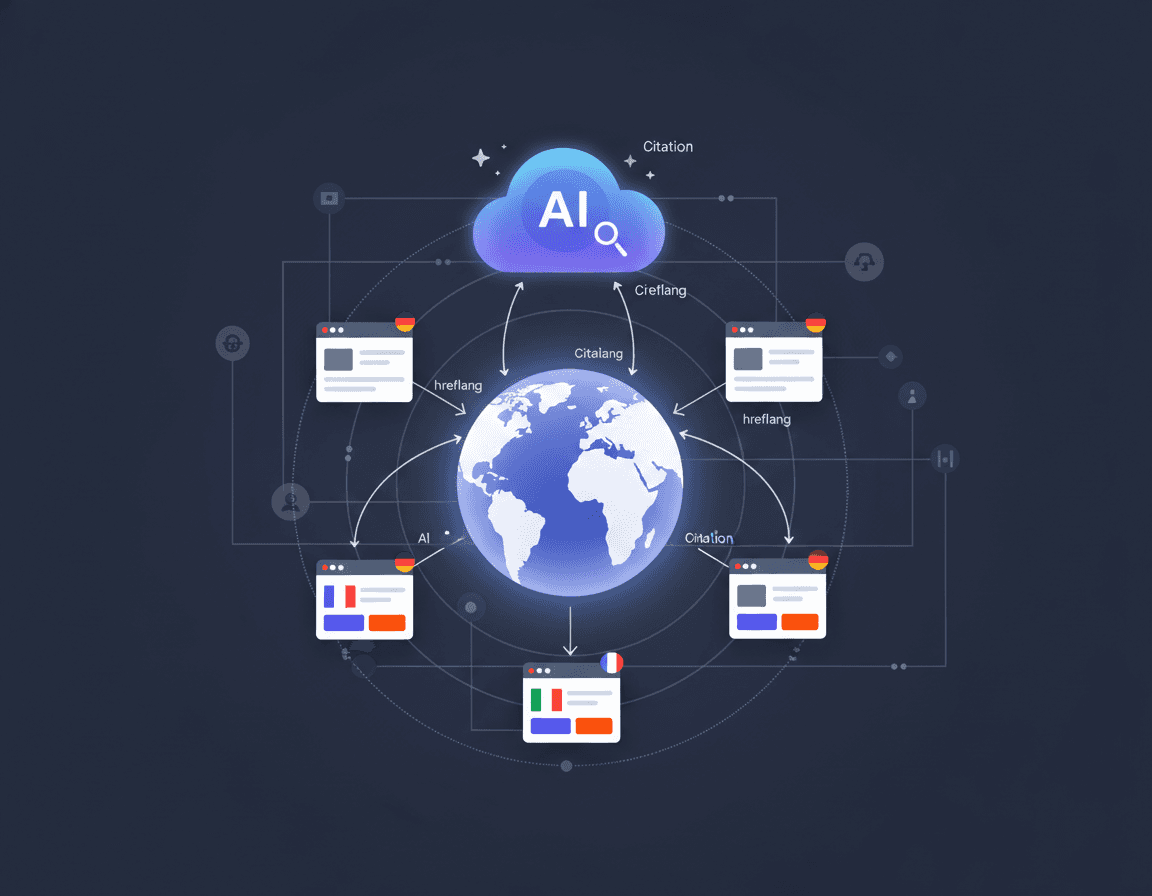
International SEO is the process of optimizing your website so that search engines can easily identify which countries you want to target and which languages you use for business. The foundation is proper hreflang implementation.
The hreflang attribute is an HTML attribute used to specify the language and geographical targeting of a webpage. Getting this right ensures search engines serve the correct language version to users in each region.
Beyond traditional SEO, GEO optimization is becoming critical for AI search visibility. The key metric shift is clear: "The general idea is we've moved from, 'Do we rank?' to, 'Are we cited?'" explained Zach Chahalis, Senior Director of SEO and Data Analytics at iPullRank (iPullRank).
For content to be cited by AI engines, it needs:
Entity salience: How clearly defined and rich your entities are. This means using consistent terminology across translations.
Structured data: Schema.org markup helps LLMs understand content semantics. The vocabulary currently consists of 827 Types, 1528 Properties, 14 Datatypes, 94 Enumerations and 522 Enumeration members.
Citation quality: "In order to be considered for AI, you need to be considered high quality, and your citations need to be accurate, verifiable, and point to authoritative sources." (iPullRank)
The payoff for getting GEO right is substantial. Relixir-generated blogs get cited 3x more often in AI search than traditional blogs.
How Do You Measure Translation Quality, Speed & AI Visibility?
Measuring translation success requires tracking metrics across three dimensions: quality, operational efficiency, and AI visibility.
Quality Metrics:
Translation accuracy rates (target: 95%+)
Error rates compared to baseline
Human review acceptance rates
Brand consistency scores
Operational Metrics:
Time-to-market for new content
Cost per word across languages
Translator utilization rates
Revision cycles required
AI Visibility Metrics:
Pi's Visibility Index aggregates your rankings at scale over time, providing actionable insights into how AI is affecting search visibility across international markets. Key metrics to track include:
AI Mention Rate: Percentage of relevant queries where your brand appears
Citation Rate: How often AI engines cite your content
Share of Voice: Your visibility relative to competitors
Position Rankings: Where your brand appears in AI recommendations
The Semrush AI Visibility Toolkit provides a benchmark of any brand's overall presence in AI with the AI Visibility Score, making it easier to track progress over time.
For translation-specific quality, XTM's AI translation engine achieves production-ready quality for over sixty percent of content without human review. This metric provides a useful benchmark for evaluating your own translation automation performance.
What's Next for Agentic CMS & Multimodal Translation Models?
The next wave of CMS translation technology combines agentic architectures with multimodal translation models, promising even greater automation and quality.
On the model side, SeamlessM4T sets a new standard for translations into multiple target languages, achieving an improvement of 20% BLEU over the previous state-of-the-art while also showing 38% improvement against background noise and 49% improvement against speaker variations. These robustness improvements make real-world deployment far more practical.
Google's TranslateGemma models are pushing efficiency boundaries. The 12B TranslateGemma model surpasses the performance of the larger 27B baseline Gemma 3 model, meaning smaller, faster models can now deliver quality previously requiring massive compute resources.
On the CMS side, James McCormick of IDC captures the trend: "Headless CMS have entered an AI-accelerated era. Developers now expect intelligent copilots, agentic automation, and composable frameworks that turn complexity into velocity, allowing organizations to deliver and optimize experiences at scale with unprecedented agility." (IDC)
The IDC MarketScape identifies technologies shaping headless CMS including AI-accelerated development environments, multi-agent orchestration, schema intelligence, and continuous optimization capabilities. These capabilities will make 57-language deployments even faster and more reliable.
Key Takeaways for 2025
Translation automation is now table stakes. Companies achieving 90% faster feature rollouts and 50% cost savings have a decisive advantage in global markets.
The stack matters. Combining headless CMS, modern TMS, and AI translation agents creates workflows that scale without proportional headcount increases.
GEO optimization requires attention. Content must be structured for AI citation, not just human readability. Entity salience, structured data, and citation quality all impact AI visibility.
Measurement must evolve. Track AI visibility metrics alongside traditional translation KPIs to understand true content performance.
The technology is advancing rapidly. Multimodal models and agentic CMS architectures will make today's 57-language deployments look simple within a few years.
For teams looking to implement these capabilities, Relixir offers a GEO-native CMS with built-in support for 57+ languages through its Cursor Interface, enabling translation at scale while maintaining the structural elements that AI engines prioritize for citation.
Frequently Asked Questions
What is CMS translation at scale?
CMS translation at scale involves localizing content across multiple languages using a unified workflow that integrates headless CMS architecture, translation management systems, and AI agents to automate processes and ensure quality.
How does translation automation impact business growth?
Translation automation significantly accelerates market entry, reduces costs, and improves content velocity, enabling companies to reach new markets faster and more efficiently, ultimately driving revenue growth.
What technologies are essential for 57-language content operations?
A 57-language content operation requires a translation management system, a headless CMS, and AI translation agents. These components work together to streamline workflows, manage translations, and ensure content is up-to-date across all languages.
How does Relixir's GEO-native CMS enhance AI search visibility?
Relixir's GEO-native CMS optimizes content for AI citation by structuring it with factual snippets, data statistics, and proper entity signals, ensuring higher visibility and citation rates in AI search results.
What are the benefits of using AI translation agents?
AI translation agents automate the translation process, ensuring continuous localization and reducing manual intervention. They improve translation accuracy and speed, allowing content to stay current across all languages.
Sources
https://www.forrester.com/blogs/new-research-content-management-systems-trends-landscape/
https://smartling.com/blog/multilingual-content-management-system
https://relixir.ai/blog/best-ai-cms-platforms-that-track-ai-search-attribution
https://www.enterprisecms.org/guides/enterprise-translation-management-with-cms
https://my.idc.com/getdoc.jsp?containerId=US52993725&pageType=PRINTFRIENDLY