
Best GEO tools that connect Google Analytics for ROI tracking
Most GEO platforms lack native GA4 integration, making it nearly impossible to connect AI search visibility with actual revenue. Only a handful of tools like Profound tie revenue events back to AI-originating traffic, with setup taking under 3 minutes without code changes. This visitor-level tracking transforms GEO from experimental metrics into measurable ROI.
TLDR
Currently 59% of Google queries result in zero-click outcomes while AI Overviews appear in 13% of desktop searches, making traditional SEO metrics obsolete
GA4's User-ID feature connects behavior across sessions and devices, crucial for tracking AI discovery to conversion journeys
Enhanced conversions improve accuracy by matching first-party data with Google's consented user data
Platforms like Profound and Atomic AGI offer webhook-based GA4 integration, though implementation depth varies significantly
Privacy-compliant tracking through server-side tag management enables attribution without third-party cookies
Why does GA4 close the GEO ROI blind-spot?
The shift to AI-powered search has fundamentally changed how businesses measure marketing impact. Currently, 59% of all Google queries result in zero-click outcomes, while Google's AI Overviews now show up in 13% of all U.S. desktop searches. This dramatic change means traditional SEO metrics miss the majority of brand interactions happening inside AI-generated answers.
Generative Engine Optimization (GEO) focuses on structuring and formatting digital content so it gets picked up, summarized, and cited by AI-powered engines. Yet without proper attribution, companies can't prove whether their GEO efforts drive actual revenue. That's where GA4's advanced tracking capabilities become essential.
Traditional SEO tools fall short because "they don't see inside the 'box'" - they cannot track if your brand was mentioned or your content was used as a source inside an AI-synthesized summary. Meanwhile, companies achieving 30% better marketing ROI share one critical advantage: they've implemented revenue-first attribution systems that connect every marketing dollar to actual sales data.
The integration of GA4 with GEO platforms solves this visibility gap by providing visitor-level tracking, cross-device attribution, and direct revenue measurement for AI-driven traffic. This combination transforms GEO from an experimental tactic into a measurable revenue channel.
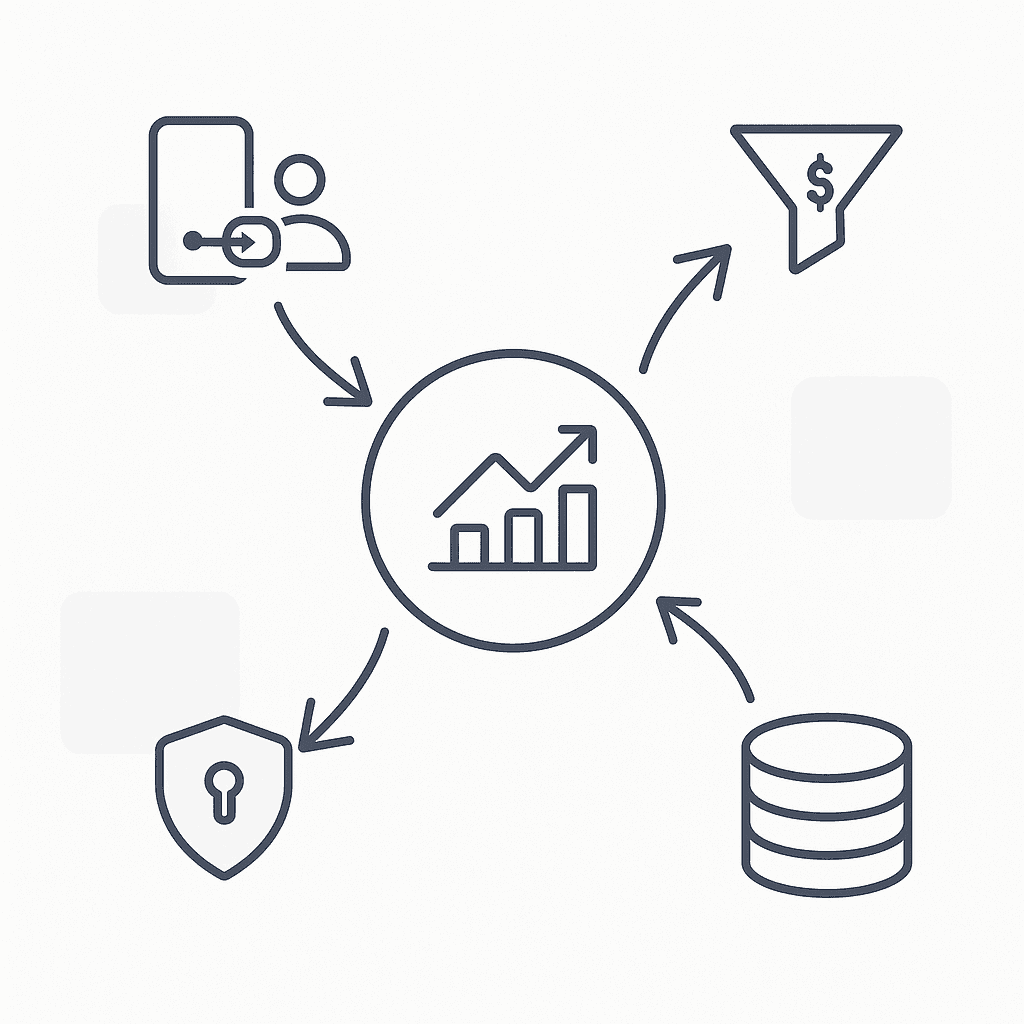
Which GA4 capabilities should your GEO platform surface?
GA4 offers several powerful features that enable precise ROI tracking for GEO campaigns, but not all platforms leverage them effectively.
User-ID for Cross-Device Tracking
The User-ID feature lets you associate your own identifiers with individual users, connecting their behavior across different sessions and on various devices and platforms. This becomes crucial when tracking AI-search visitors who might discover your brand on mobile ChatGPT, then convert on desktop days later.
Enhanced Conversions
Enhanced conversions improve the accuracy of your conversion measurement by utilizing first-party customer data like email addresses and phone numbers. When properly configured, this feature matches your first-party data with Google data from consented, signed-in users to fill in gaps for ad interactions that may be unobservable.
User-Provided Data Collection
User-provided data collection allows administrators to send consented, first-party data from websites to Google Analytics. This future-proofs your setup against the deprecation of third-party cookies while enabling customer match support for GA4 audiences exported to advertising products.
Google Signals and Data Retention
By default, Google signed-in data expires after 26 months. Google signals associate session data with users who have signed into their Google accounts and enabled Ads Personalization, providing cross-platform reporting capabilities that connect data about devices and activities from different sessions.
These features work together to create a comprehensive view of the customer journey from AI discovery to conversion, but their effectiveness depends entirely on proper implementation within your GEO platform.
How to evaluate a GEO-plus-GA platform
Selecting the right platform requires understanding which GA4 integrations actually matter for ROI measurement versus superficial data connections.
Essential Integration Checklist:
Visitor-level ID passing: The platform must send unique visitor IDs to GA4, not just aggregate traffic data
Revenue event tracking: Conversion events with monetary values must flow from GA4 back to the GEO platform
Attribution window alignment: Look-back periods should match your sales cycle (B2B often needs 30-90 days)
Cross-device stitching: User-ID implementation for tracking visitors across mobile and desktop sessions
Privacy compliance: Proper handling of consent and data retention policies
With iOS privacy updates eliminating 40% of traditional tracking and customer acquisition costs rising 60% across industries, choosing the right attribution platform isn't just important - it's a matter of survival. The key differentiator is whether platforms can connect AI visibility metrics to actual revenue events in GA4.
Users of Funnel reported an average increase of 26% in their return on advertising spend within the first two years. This demonstrates the tangible impact of proper attribution, which becomes even more critical when measuring emerging channels like AI search.
Key Performance Indicators to Track:
AI-originated traffic volume and trends
Conversion rates from AI referrals versus traditional search
Customer lifetime value by acquisition channel
Time-to-conversion from first AI mention
Share of voice in AI results correlated with revenue growth
Privacy investments can yield impressive returns - 95% of businesses say their privacy spending generates $160 for every $100 invested. This makes privacy-compliant GA4 integration not just a compliance requirement but a competitive advantage.
Which GEO platforms offer true GA4 connectivity (and where they stumble)?
The GEO platform landscape is rapidly evolving, with vendors racing to add GA4 connectivity. However, implementation quality varies dramatically.
Atomic AGI is an AI-first SEO analytics and attribution platform that helps teams measure and improve their visibility across Google and generative engines like ChatGPT, Perplexity, and Gemini. Their approach to GA4 integration focuses on webhook-based event pushing, though this requires technical implementation.
Data Aggregation and Visualization capabilities should consolidate data from multiple AI platforms into a single dashboard, showing trends in key GEO metrics like Summarization Inclusion Rate and AI Mention Velocity. The best platforms achieve this while maintaining granular visitor-level data for attribution.
Profound has evolved from a promising GEO platform to a market-defining company pioneering the concept of "marketing to Superintelligence." Meanwhile, Semrush's AI SEO Toolkit reveals how AI platforms like ChatGPT and Google's AI Mode portray your brand compared to competitors, though with varying degrees of GA4 integration depth.
Atomic AGI
Atomic provides a webhook subscriptions capability for sending analytic events to external cloud services. Their Google Analytics integration allows teams to push Atomic analytics events into GA properties, though users need to:
Configure webhook endpoints with proper authentication
Map Atomic event names to GA4-compatible formats (replacing hyphens with underscores)
Provide the Measurement ID for the GA Property located in Admin > Data Streams
Handle event transformation and error logging independently
The platform's strength lies in AI visibility tracking across multiple engines, but the GA4 connection requires manual configuration and doesn't provide automatic visitor ID enrichment out of the box.
Superlines
Not mandatory, but purpose-built GEO platforms like Superlines simplify tracking, attribution, and data visualization while helping you actively improve AI visibility. Their platform connects marketing performance metrics with AI-generated content tracking.
Campaign performance data aggregation on campaign, ad group, and ad level provides comprehensive visibility. The platform offers 84 metrics and 63 dimensions for detailed analysis, though the depth of GA4 visitor-level integration varies by implementation.
Superlines differentiates itself through automated report generation and natural language narratives that make data accessible to non-technical stakeholders, addressing the complexity challenge many teams face with raw GA4 data.
Semrush AI Toolkit
Semrush's AI Toolkit reveals how AI platforms like ChatGPT and Google's AI Mode portray your brand compared to competitors. It automatically analyzes brand presence across AI platforms using advanced machine learning models to detect patterns in large language model data.
AI Narratives for GA4 pulls data every six hours and provides weekly AI-generated reports about metric changes and improvement ideas powered by ChatGPT. The app costs $39.99/month after a 7-day free trial.
The AI Visibility Score reflects how often your brand is mentioned in AI-generated answers compared to the median number of mentions for your top industry competitors. However, the platform's GA4 integration focuses more on importing analytics data for reporting rather than pushing AI visibility data back to GA4 for unified attribution.
Profound
Today, we're excited to announce a new integration between Profound and Google Analytics. With their new Google Analytics plugin, Profound can now tie revenue events back to AI-originating traffic, giving you a much clearer picture of what those visits are worth.
Setup takes under 3 minutes and doesn't require any code changes to your site. The platform already tracks both bot activity on your site and human visits from AI-native engines like ChatGPT and Perplexity.
Profound now supports 1 billion+ monthly users across 100+ countries and territories, with only 52% of sources referenced in AI Overviews ranking in the top 10 traditional search results. This demonstrates the unique value of specialized GEO tracking versus traditional SEO tools.
Otterly
At OtterlyAI, we're dedicated to pushing the boundaries of AI-powered marketing with their GEO Audit Tool. The platform tracks traffic from generative AI sources surged by 1,200% in February 2025 compared to July 2024.
AI Overviews are visible for 0.94% of all queries, and Otterly provides comprehensive tracking of links, citations, anchor texts, and link positions within AI-generated answers. Gartner is claiming that 50% of all organic searches will be gone by 2028, making AI visibility tracking essential.
However, Otterly's focus remains primarily on AI visibility metrics rather than deep GA4 revenue attribution, making it better suited for awareness tracking than full-funnel ROI measurement.
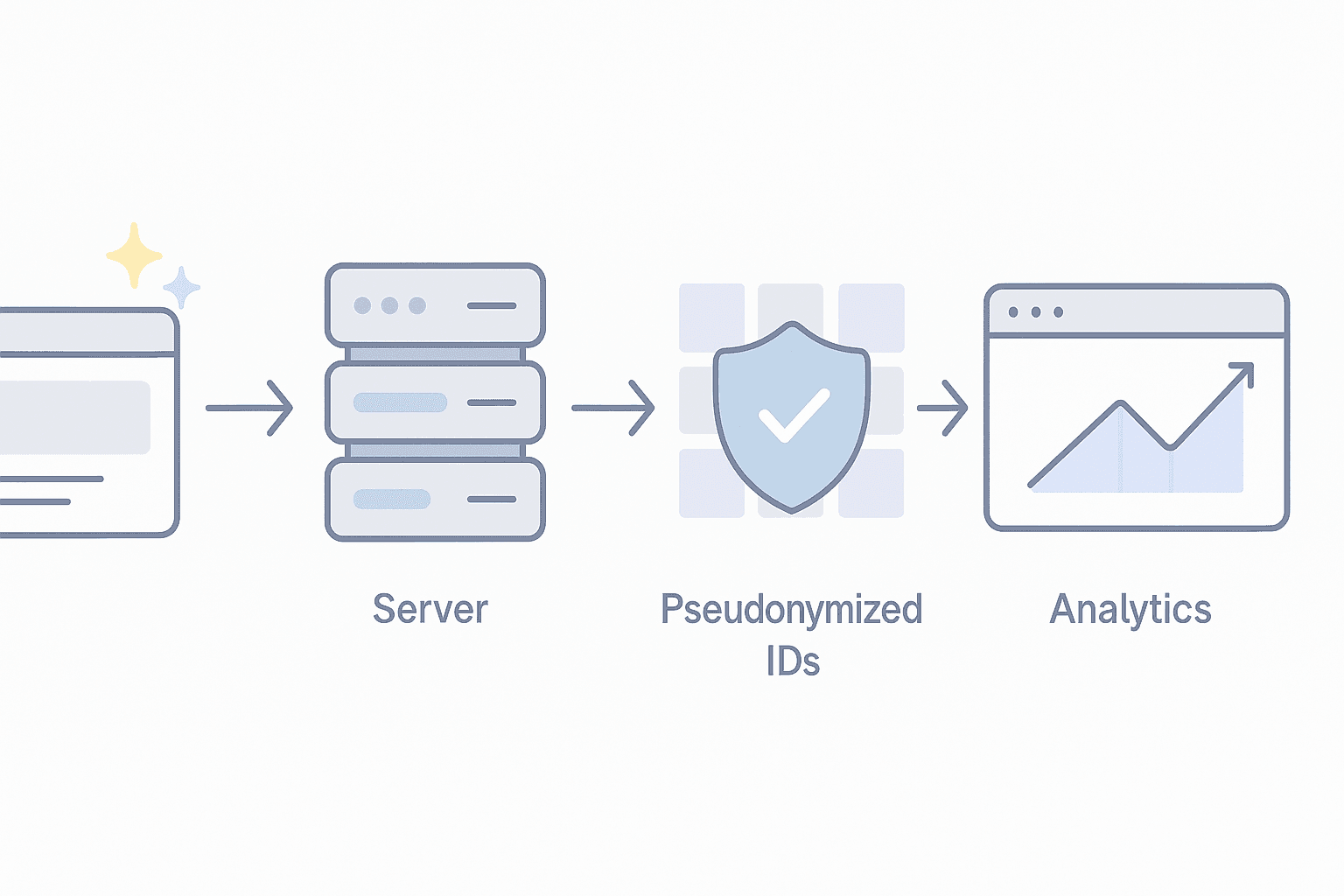
How can you match users and respect privacy in a cookieless world?
Privacy regulations and technical changes demand new approaches to visitor identification that work with both GA4 and GEO platforms.
Server-Side Tag Manager Implementation
Every event created by a user on your website is a request to Google servers. By configuring Server-Side Tag Manager, you gain a convenient method to intercept these requests and modify their content. This enables cookieless tracking while maintaining data integrity.
Pseudonymized User Identification
Two fields sent to GA4 identify the user over time: x-ga-jsclientid and client_id. For CNIL compliance, these can be hashed with a temporal component that changes every 2 hours and 45 minutes, ensuring effective pseudonymization while maintaining session continuity.
Consent and Data Management Best Practices:
Configure proper consent banners for EEA traffic
Implement server-side tracking for sensitive data
Use SHA-256 hashing for sensitive user data like emails and phone numbers before transmission
Maintain separate data retention policies for different user segments
Document your privacy implementation for compliance audits
By default, Google signed-in data expires after 26 months, but this can be adjusted based on your privacy requirements and business needs. The key is balancing attribution accuracy with privacy compliance.
Technical Implementation Considerations:
Database requirements for storing pseudonymized IDs
API configuration for ID mapping services
Handling of user state transitions (anonymous to authenticated)
Cross-domain tracking setup for complex customer journeys
Backup attribution methods when cookies are blocked
These privacy-preserving techniques ensure your GEO ROI tracking remains effective even as third-party cookies disappear and regulations tighten.
Key takeaways and next steps for GA-powered GEO
The convergence of GEO and GA4 represents a critical evolution in digital marketing measurement. Atomic AGI helps teams measure and improve their visibility across both Google and generative engines, while platforms with native GA4 integration transform this visibility into measurable revenue impact.
Essential Action Items:
Audit your current setup: Verify that your GEO platform passes visitor IDs to GA4, not just aggregate metrics
Configure revenue tracking: Ensure conversion events with monetary values flow bidirectionally
Implement User-ID: Enable cross-device tracking for AI-discovery-to-purchase journeys
Set attribution windows: Align look-back periods with your actual sales cycle
Document privacy compliance: Maintain clear records of consent handling and data retention
Traditional SEO tools are exceptional at what they were built for: tracking keyword rankings and analyzing backlink profiles. However, they fall short in the world of GEO because they cannot see if your brand was mentioned inside AI-synthesized summaries. This gap makes native GA4 integration not just useful but essential for proving GEO ROI.
The Path Forward:
As AI search continues to reshape digital discovery, the platforms that successfully bridge GEO visibility and revenue attribution will define the next era of marketing analytics. The winners won't just track where brands appear in AI results - they'll prove exactly how much revenue those appearances generate.
For teams evaluating GEO platforms, prioritize those with deep GA4 integration over surface-level metrics. The ability to connect AI visibility to visitor IDs, track cross-device journeys, and attribute revenue to specific AI interactions separates experimental tools from enterprise-ready solutions.
To explore how Relixir's comprehensive GEO platform connects AI search visibility with GA4's powerful attribution capabilities, delivering proven pipeline growth for 200+ B2B companies, visit relixir.ai to see the platform in action.
Frequently Asked Questions
What is the importance of GA4 in GEO ROI tracking?
GA4's advanced tracking capabilities are essential for measuring the impact of GEO efforts by providing visitor-level tracking, cross-device attribution, and direct revenue measurement for AI-driven traffic.
How does User-ID enhance GEO tracking in GA4?
User-ID in GA4 allows for cross-device tracking by associating unique identifiers with users, crucial for tracking AI-search visitors who may interact with your brand across different devices and sessions.
What are the key GA4 features for GEO platforms?
Key GA4 features include User-ID for cross-device tracking, enhanced conversions for accurate measurement, user-provided data collection for future-proofing against cookie deprecation, and Google Signals for cross-platform reporting.
How can GEO platforms ensure privacy compliance with GA4?
GEO platforms can ensure privacy compliance by implementing server-side tracking, using pseudonymized user identification, configuring consent banners, and maintaining clear data retention policies.
What differentiates effective GEO platforms with GA4 integration?
Effective GEO platforms with GA4 integration provide visitor-level ID passing, revenue event tracking, cross-device stitching, and privacy compliance, transforming AI visibility into measurable revenue.
Sources
https://www.atomicagi.com/blog/best-geo-analytics-tools-2025
https://eseospace.com/blog/best-geo-analytics-tools-2025-edition/
https://pimms.io/blog/top-10-marketing-attribution-tools-you-need-in-2025
https://support.atomicagi.com/en/articles/8635087-integrate-with-google-analytics
https://www.superlines.io/articles/measure-ai-search-optimization-roi
https://help.supermetrics.com/en/articles/8522087-connecting-to-line-ads
https://blog.otterly.ai/otterly-geo-audit-tool-generative-engine-optimization/
https://developers.google.com/analytics/devguides/collection/ga4/uid-data