Bulk AI Content Refresh: Update 100+ Blogs Automatically in [February 2026]
Bulk AI content refresh uses automated tools to systematically update large content libraries, typically 100+ posts, improving both traditional SEO and AI citation visibility. Studies show refreshed pages are twice as likely to reach Google's Top 10 within 30 days, while proper optimization can increase traffic by 106% on average.
At a Glance
• Content decay accelerates in [February 2026], with 73% of B2B sites losing significant traffic as AI search reshapes visibility requirements
• Systematic refreshes deliver 22:1 ROI through AI-enhanced SEO, compared to 16:1 for traditional methods
• Modern platforms enable 10x content production increases with built-in governance and brand voice enforcement
• Updated content performs 2x better than static pages, with 7.7% reaching Top 10 rankings versus 4.0% for unupdated content
• AI systems require 60-90 days to incorporate new citations, while organic SEO gains appear within 30 days
Most B2B content libraries are quietly decaying. Pages that once ranked on page one now sit buried on page three, bleeding traffic while competitors fill the gap. With 73% of B2B sites experiencing significant traffic loss between 2024 and 2025, the question is no longer whether to refresh your content but how to do it at scale.
A bulk AI content refresh is the systematic process of auditing, rewriting, and republishing large content libraries, often 100+ posts, using AI tooling. It tackles content decay by updating facts, adding structured schema, and ensuring brand-consistent language across every article. Done right, refreshed pages are twice as likely to enter Google's Top 10 within 30 days and can lift traffic by over 100% while boosting AI citation rates.
This guide walks you through the complete workflow: from building a scalable content refresh framework to automating CMS updates and measuring ROI across both traditional SEO and generative engine optimization (GEO).
Why Does Bulk AI Content Refresh Matter in [February 2026]?
Content refresh is "the process of updating existing content to improve its performance," according to Ahrefs. But in [February 2026], the stakes are higher than simple performance gains.
The rise of AI search engines has fundamentally changed how content earns visibility. Generative search surfaces compress research and decision-making into AI-written answers that cite only a handful of trusted sources. If your content is outdated, poorly structured, or missing entity coverage, it simply will not be cited.
Consider the numbers:
44.6% of U.S. organizations reported using generative AI by August 2024
Organic CTR for queries with AI Overviews dropped 61% between June 2024 and September 2025
60% of searches now complete without a click to any external website
Generative engine optimization (GEO) focuses on structuring content so it can be ingested and surfaced by AI platforms. Brands that apply GEO practices can see up to a 40% increase in visibility within AI-generated responses. A bulk refresh is the fastest path to achieving this across your entire content library.
Key takeaway: Content decay is no longer just an SEO problem. It is an AI visibility problem that compounds daily.
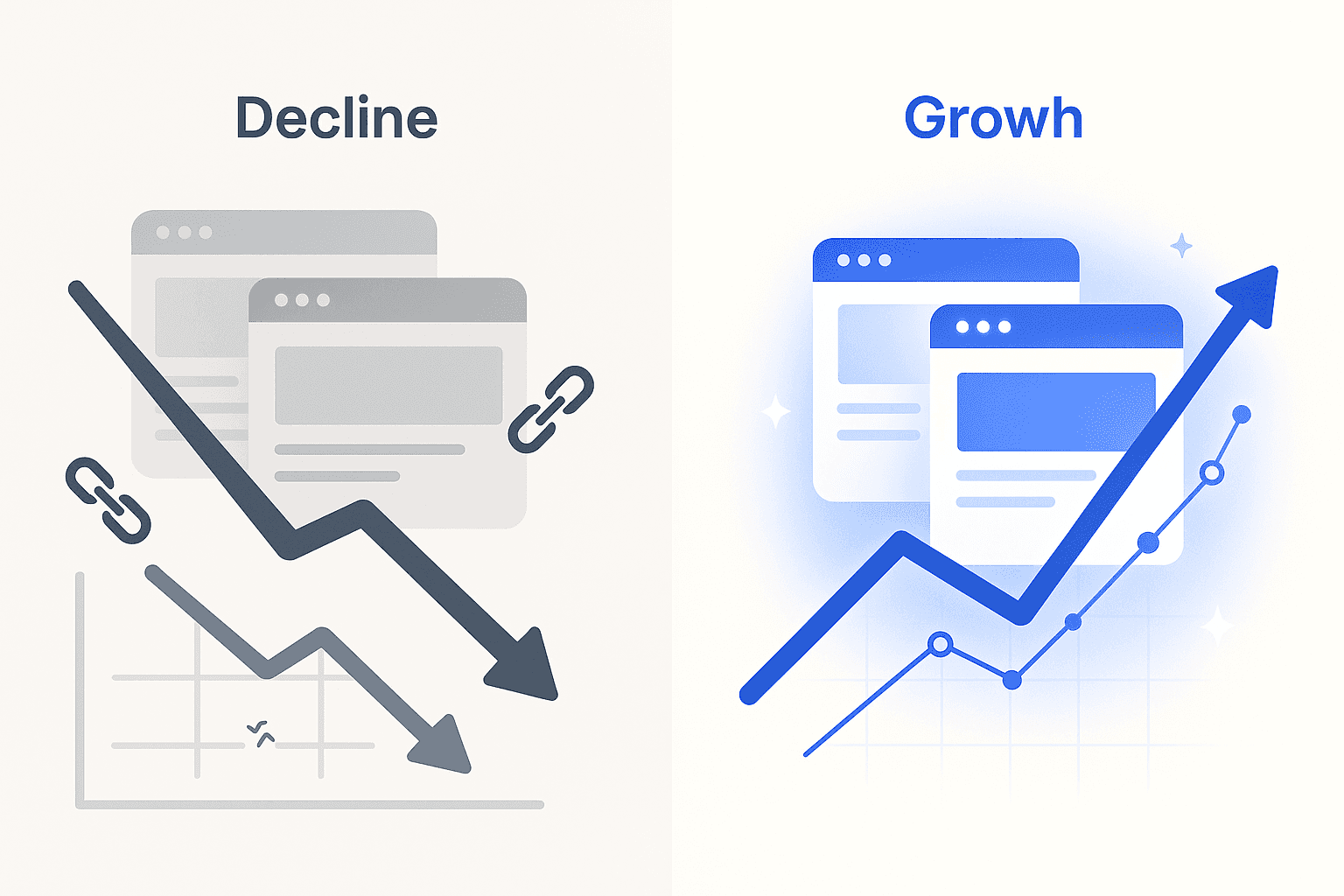
From Content Decay to Opportunity: The [February 2026] Landscape
Content decay, the decline in organic traffic to a page over time, is accelerating. But the data also reveals a massive opportunity for teams willing to invest in systematic refreshes.
Updating old blog posts increases traffic by 106% on average. The ROI math is compelling:
Metric | Traditional SEO | AI-Enhanced SEO |
|---|---|---|
ROI | 16:1 | 22:1 |
A study of over 300,000 pages found that pages refreshed and optimized were twice as likely to reach the Top 10 within 30 days. Specifically:
7.7% of updated pages made the leap vs. only 4.0% of unupdated pages
15.1% of updated pages reached the Top 50 vs. 8.0% of non-optimized pages
The traffic gains from refreshing existing content often exceed the returns from creating new content. "Updating old content can lead to a 111% increase in traffic," notes Ahrefs.
For teams managing 100+ posts, the compounding effect of systematic refreshes transforms a maintenance burden into a growth engine.
How Do You Build a Scalable Content Refresh Framework?
A content refresh framework is "the strategic blueprint that defines how you discover opportunities, score and prioritize them, determine the level of change needed, manage risk, and measure outcomes," according to Single Grain.
Without a framework, teams default to ad hoc clean-up, resulting in random edits, cannibalization, and wasted effort. With a framework, every refresh becomes a deliberate growth lever.
The framework rests on three pillars:
Content refresh framework: Strategic blueprint for discovery, scoring, and risk management
Content refresh system: Execution engine covering tools, workflows, templates, and cadences
SEO maintenance: Ongoing activities like fixing technical issues, updating internal links, and pruning dead pages
AI content operations takes this further. It is "the discipline of producing people-first content at scale using personas, your sources, and citations as guardrails," explains CustomGPT. This operating model ensures every paragraph is trustworthy, consistent, and easy to update.
Prioritize with a Refresh Scorecard
A scoring model ensures that two different teams looking at the same library would still choose the same top 50 URLs to update first.
Typical inputs for a refresh scorecard include:
Traffic trajectory: Is the page declining, stable, or growing?
Current keyword position: Positions 4-20 often yield the fastest gains
Conversion or revenue contribution: High-value pages get priority
Content age and last refresh date: Older content typically needs more work
Strategic importance: Does this page support key campaigns or products?
Competitive gap: Are competitors outranking you with fresher content?
Weight each factor based on your business priorities, then rank your entire library. The result is a prioritized queue that eliminates guesswork.
Which AI Platforms & CMS Workflows Automate Updates?
Automation separates teams that refresh 10 posts per quarter from those that refresh 100+ per month. The right combination of AI platforms and CMS workflows makes scale possible.
Contentful reports a 10x increase in content production using AI Actions powered by AWS Bedrock. Their system generates, translates, and optimizes with built-in guardrails for consistency.
The CMS landscape is evolving rapidly. According to Forrester, vendors innovate with AI interfaces, visual builders, and personalization features. By 2028, more than 95% of enterprises will have deployed GenAI-enabled applications in production environments.
Key capabilities to evaluate:
Capability | Why It Matters |
|---|---|
Bulk API endpoints | Update 1,000+ nodes in single requests |
AI content generation | Draft refreshes in minutes, not hours |
Schema-aware actions | Maintain structured data across updates |
Workflow automation | Route content through review without manual handoffs |
Brand voice enforcement | Ensure consistency across all refreshed content |
Built-in Guardrails & Brand Voice Enforcement
Automation without governance creates new problems: inconsistent tone, compliance violations, and off-brand messaging. The solution is codifying your brand guidelines into the automation layer.
Markup AI provides tools to "build content governance into any workflow, so your content is always clear, on-brand, and compliant before it ever sees the light of day." When something does not match your style guide, the system flags it instantly and explains why.
Enterprise teams should look for platforms that:
Automatically enforce brand voice, tone, and writing rules
Provide real-time feedback to writers and AI systems
Score content against defined standards before publishing
Audit content repositories at scale for quality and compliance
Without these guardrails, bulk refreshes risk diluting brand equity faster than they build traffic.
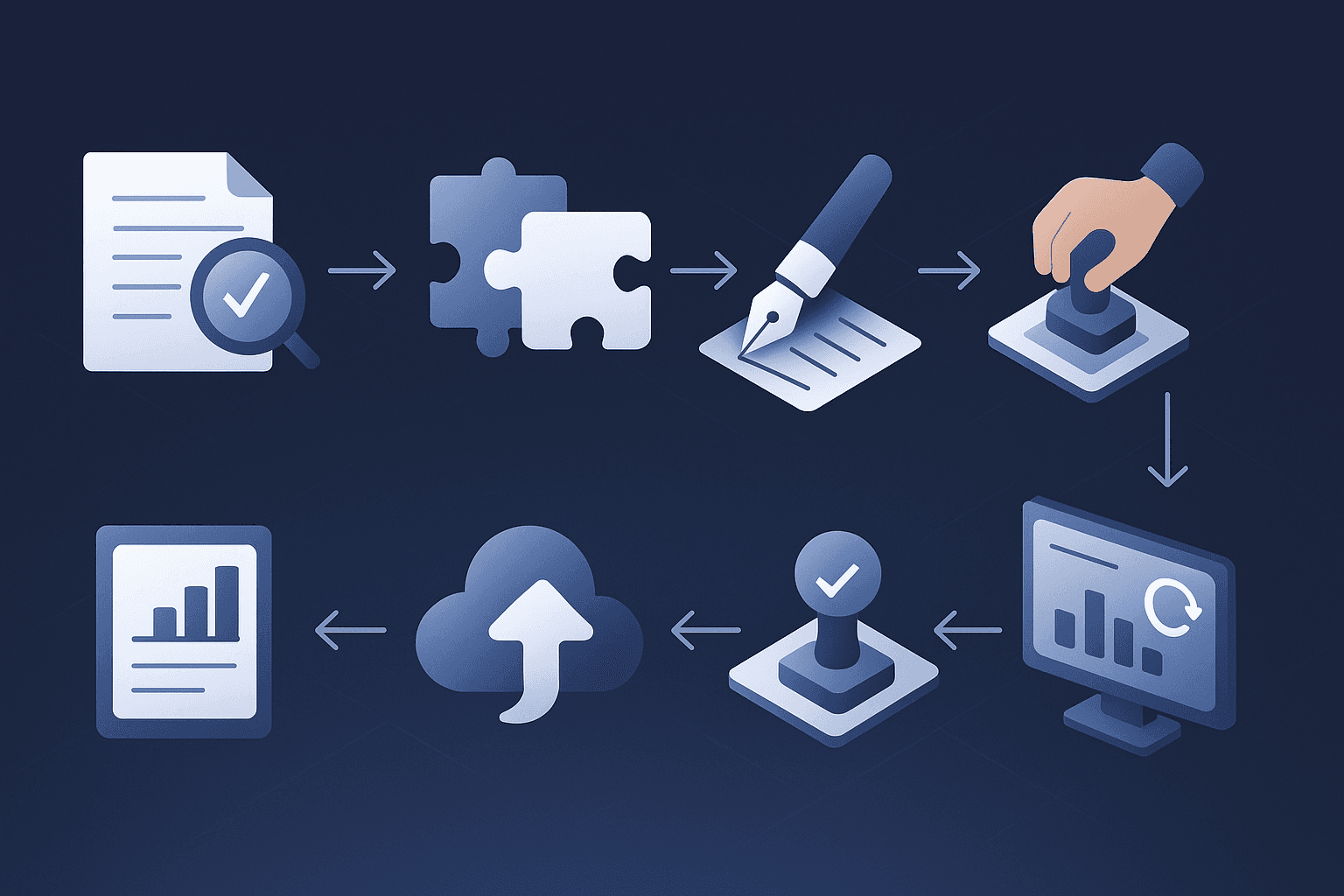
Step-by-Step Workflow: Audit → Rewrite → Publish at Scale
The most effective refresh workflow combines AI acceleration with human expertise. As Single Grain puts it: "Use AI to accelerate ideation and section rewrites, then apply SME judgment to validate facts, inject examples, and add unique insights that demonstrate experience."
Here is a seven-step process for refreshing 100+ posts:
Inventory pages: Export your full content library with traffic, ranking, and conversion data
Score and prioritize: Apply your refresh scorecard to rank all URLs
Conduct gap analysis: Identify entity and coverage gaps versus competitors
Draft with AI: Use AI tools to rewrite sections, add structured data, and update facts
Human review: Subject matter experts validate accuracy and inject unique insights
Publish via CMS API: Push updates through bulk endpoints
Monitor and iterate: Track performance and feed learnings back into the system
The Webflow CMS API supports both staged and live content, giving precise control over publishing workflows. Bulk endpoints allow CRUD operations on multiple items in a single API call.
For teams using headless CMS platforms, the Webflow update endpoint supports updating up to 1,000 nodes in a single request, making true bulk operations feasible.
Use Incremental Static Regeneration for Zero-Downtime Updates
Developers pushing refreshed content to production need a strategy that avoids downtime and broken pages. Incremental Static Regeneration (ISR) solves this.
"Incremental Static Regeneration allows you to update static pages after you've built your site," explains the Next.js documentation. "With ISR, you can retain the benefits of static while scaling to millions of pages."
ISR enables teams to:
Update individual pages without rebuilding the entire site
Serve cached versions while regeneration happens in the background
Handle high-traffic pages without performance degradation
Deploy content updates with zero downtime
This approach is essential for sites with large content libraries where full rebuilds would take hours.
How Do You Measure ROI: SEO vs AI Citations?
Traditional SEO metrics remain important, but 2025 demands a dual measurement approach that also tracks AI citation performance.
For SEO, the Surfer study provides clear benchmarks:
Updated pages are 2x more likely to reach Top 10 within 30 days
7.7% of updated pages reached Top 10 vs. 4.0% of unupdated pages
For AI citations, Ahrefs' new features show how mentions and citations compare across platforms like ChatGPT, Perplexity, Gemini, and Copilot. Historical data now extends five months for some platforms.
Key metrics to track:
Category | Metrics |
|---|---|
Traditional SEO | Rankings, organic traffic, CTR, conversions |
AI Citations | Mention rate, citation rate, share of voice, sentiment |
Business Impact | Pipeline generated, revenue attributed, cost per lead |
CiteAnalytics helps track when AI systems cite your content, providing real-time insights into how your information is being used across OpenAI, Perplexity, and Gemini.
Timeline expectations matter. AI systems require 60-90 days to incorporate new citations, while organic gains can appear within 30 days. Set a 90-day window before judging overall GEO and revenue impact.
What Pitfalls Undermine Bulk AI Refresh Projects?
Bulk refresh projects fail when teams overlook governance, quality control, and technical fundamentals.
Low-quality AI content detection: A Google study analyzing 500 million web articles found that machine-generated text detectors effectively predict low-quality pages. The researchers identified "traces of essay generation farms, machine translated text, keyword optimizations, and Not-Safe-For-Work content" in flagged pages. AI-assisted refreshes must maintain quality standards that pass both human review and algorithmic scrutiny.
Missing governance controls: Without automated brand enforcement, Markup AI notes that style guide violations slip through at scale. Every deviation compounds across hundreds of refreshed pages.
Poor content hygiene: Forrester research emphasizes that "enterprises with well-governed content repositories should have an unfair advantage with genAI success compared with businesses with poor content hygiene." ECM vendors are adopting retrieval-augmented generation architectures to protect internal documents while maintaining access controls.
Common pitfalls to avoid:
Duplicate content: AI can inadvertently create similar passages across pages
Schema gaps: Failing to update structured data alongside content
Broken internal links: Refreshes that ignore link architecture
Compliance violations: Industry-specific requirements in healthcare, finance, or legal
Over-automation: Removing the human expertise that signals E-E-A-T
The solution is building checkpoints into your workflow: automated quality scoring, human review gates, and pre-publish validation.
Next Steps: Turn Your Library into an Always-Fresh Asset
"A strong content refresh framework turns a sprawling library into a strategic asset rather than a maintenance burden," concludes Single Grain.
The teams winning in 2025 treat content refresh as an operating system, not a quarterly project. They use AI to accelerate ideation and section rewrites, then apply human judgment to validate facts and inject unique insights.
Your action plan:
Audit your content library and apply a prioritization scorecard
Select AI platforms with built-in governance and CMS integration
Build a workflow that balances automation with human expertise
Track both traditional SEO and AI citation metrics
Establish a 90-day refresh cadence for high-priority content
For teams seeking an end-to-end solution, Relixir automates the entire content refresh lifecycle. The platform connects directly to your CMS, continuously analyzes your existing content library for SEO and GEO gaps, identifies missing topics and weak coverage, and automatically refreshes outdated content to maintain rankings and AI citations. With deep research agents, CMS-native content management, and unified SEO plus AI search monitoring, Relixir transforms bulk content refresh from a manual burden into an automated growth engine.
Frequently Asked Questions
What is a bulk AI content refresh?
A bulk AI content refresh involves auditing, rewriting, and republishing large content libraries using AI tools to update facts, add structured schema, and ensure brand consistency, significantly improving SEO and AI citation rates.
Why is content refresh important in 2025?
In 2025, content refresh is crucial due to the rise of AI search engines, which require updated and well-structured content to be cited. This process helps maintain visibility and traffic, as outdated content is less likely to be referenced by AI platforms.
How does a content refresh framework work?
A content refresh framework is a strategic blueprint that helps teams discover opportunities, prioritize updates, manage risks, and measure outcomes. It ensures systematic and effective content updates, transforming maintenance into a growth opportunity.
What are the benefits of using AI for content refresh?
AI accelerates the content refresh process by automating ideation, section rewrites, and structured data updates, allowing teams to refresh more content efficiently and maintain high quality and brand consistency.
How does Relixir support content refresh?
Relixir automates the content refresh lifecycle by connecting directly to your CMS, analyzing content for SEO and GEO gaps, and automatically updating outdated content to maintain rankings and AI citations, transforming the refresh process into an automated growth engine.