
Common Mistakes Teams Make with AI Content Platforms
Teams make critical errors with AI content platforms by over-automating without strategy, ignoring hallucinations, treating AI visibility like traditional SEO, relying on outdated metrics, and skipping enterprise guardrails. These mistakes cause brand drift, factual errors, and missed opportunities as AI-influenced queries reach 70% by late 2025. Implementing proper workflows, fact-checking, and GEO-specific metrics helps brands capture AI search demand effectively.
At a Glance
• Over-automation risks: Teams rushing AI adoption without documented strategy face brand drift, QA failures, and thin content that dilutes authority • Hallucination dangers: 51% of AI answers contain significant issues, requiring multi-source validation and human review before publishing • GEO vs SEO: Traditional keyword rankings miss critical AI visibility metrics like share of voice, citation sources, and sentiment analysis • Measurement gaps: GA4 undercounts AI traffic since bots rarely execute tracking pixels, requiring server-side tracking and new KPIs • Governance essentials: Only 21% have developed responsible AI priorities, leaving most teams vulnerable to compliance and security risks • Relixir solution: End-to-end GEO platform addressing all five pitfalls through automated content generation, unified monitoring, and enterprise guardrails
AI content platforms are now table-stakes for marketing teams. Nearly all marketers agree that generative AI will be a standard part of marketing tech stacks within four years, and 48% of marketing leaders already use it somewhere in their funnel. Yet the rush to adopt these tools creates new risks and blind spots that can quietly erode performance.
This post unpacks five recurring mistakes teams make with AI content platforms:
Over-automating without a clear content strategy
Ignoring hallucinations, fake citations, and AI fact-checking
Treating AI visibility like traditional SEO
Relying on outdated metrics and missing AI traffic signals
Skipping enterprise guardrails, security, and structured data
Understanding these pitfalls (and how Relixir can help you avoid them) positions your brand to capture AI search demand rather than lose ground to competitors.
Why Are AI Content Platforms Reshaping Marketing—and What New Risks Do They Bring?
Content marketing is the leading marketing function utilizing generative AI, with 76% of current GenAI marketing deployments focused on content creation. The promise is real: faster production cycles, improved personalization, and scalable output.
But the adoption curve is outpacing readiness. Forecasts put AI-influenced queries at up to 70% by the end of 2025. That means the majority of searches will soon involve AI-generated summaries, recommendations, or answers (and brands that ignore Generative Engine Optimization (GEO) will lose visibility in this new landscape).
GEO is not simply SEO with a fresh coat of paint. It involves optimizing your brand, products, and content so that AI models can retrieve, interpret, and recommend you accurately. Without a GEO-first mindset, teams risk brand drift, thin content, and missed opportunities in AI search results.
Key takeaway: Rushing into AI content platforms without GEO considerations invites brand risk and leaves revenue on the table.
Mistake #1 Over-Automating Without a Clear Content Strategy
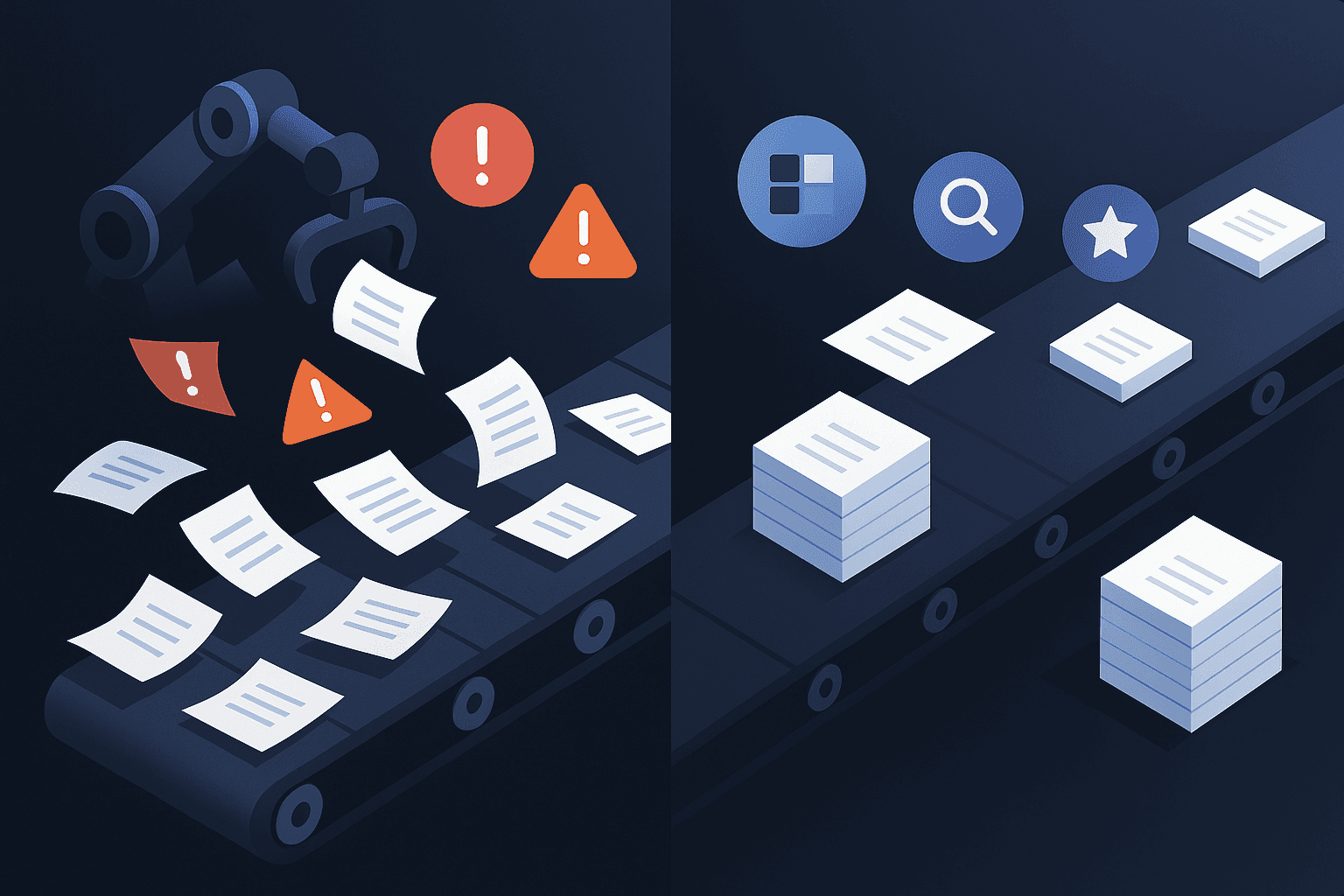
Why does delegating end-to-end publishing to AI backfire? Because AI content platforms can automate the creation of GEO-optimized content, but teams must avoid over-reliance on automation without strategic oversight.
When strategy is missing, three problems emerge:
Brand drift: AI-generated content may stray from your voice, positioning, or compliance requirements.
QA failures: Without human review, errors slip through (sometimes at scale).
Thin content: Quantity replaces quality, diluting authority and hurting rankings.
Gartner found that the top barriers to generative AI adoption include skills gaps (56%), unforeseen security threats (47%), and integration issues (43%). These gaps widen when teams automate without a documented content marketing AI strategy.
The real-world consequences are stark. At Gizmodo, AI-generated articles were rolled out within 12 hours of internal notice, and the resulting Star Wars chronology piece was filled with errors (damaging credibility and sparking internal conflict).
Strategy Checkpoints for AI Content Platforms
Checkpoint | Description |
|---|---|
Document brand guidelines | Ensure AI outputs align with voice, tone, and compliance rules |
Define editorial workflows | Establish human review stages before publishing |
Set quality thresholds | Specify minimum standards for accuracy, depth, and originality |
Monitor for drift | Regularly audit published content against brand standards |
Train your team | Close the skills gap with ongoing AI and GEO education |
For a deeper look at tools that support these workflows, see our Best LLM SEO Tools with ChatGPT Monitoring: Q4 2025 Comparison.
Mistake #2 Ignoring Hallucinations, Fake Citations, and AI Fact-Checking
AI models confidently generate content that sounds plausible but is factually incorrect (a phenomenon known as hallucination). The reputational, legal, and compliance fallout from publishing unverified AI output can be severe.
Consider the BBC's research into AI assistants: "51% of all AI answers to questions about the news were judged to have significant issues of some form." Even more troubling, 19% of AI answers citing BBC content introduced factual errors (incorrect statements, numbers, and dates).
OpenAI's GPT-5 has reduced hallucinations, but the problem persists. Nature reports that "cutting hallucination completely might prove impossible," and GPT-5's hallucination rate measured at about 1.4% (a meaningful improvement, yet not zero).
Quick Checklist for Fact-Checking AI Output
Cross-reference claims against primary sources
Verify all citations exist and are accurately quoted
Flag statistics, dates, and named entities for manual review
Use multi-source evidence validation tools
Maintain an audit trail linking statements to sources
QA Tools for Reducing Hallucinations
| Tool/Approach | Purpose |
|---------------|---------||
| Knowledge graph integration | Grounds AI in structured, verified facts |
| Multi-source validation | Cross-checks output against independent sources |
| Human editorial review | Catches errors before publication |
| Probabilistic confidence scoring | Flags low-confidence claims for review |
| Adaptive correction pipelines | Revises errors while preserving natural language |
Teams that skip these steps risk publishing content that damages trust (and in regulated industries, the consequences can extend to legal liability).
Why Does Treating AI Visibility Like Traditional SEO Backfire?
Measuring brand visibility in generative engines is fundamentally different from measuring traditional organic search. Classic SEO returns deterministic or semi-deterministic SERPs for a query. Generative models do not behave like search engines (they synthesize, summarize, and recommend).
If your team tracks only keyword rankings, you're missing the metrics that matter in the AI era:
Share of voice: How often is your brand mentioned compared to competitors?
Prompt position: Where does your brand appear in AI-generated answers?
Citation sources: Which of your pages are being cited, and in what context?
Sentiment: Is your brand positioned positively or negatively?
Bain reported a 25% decline in organic traffic tied to AI summaries in early 2025. Brands that fail to monitor AI visibility will see this decline accelerate as generative engines influence up to 70% of queries by end of 2025.
Relixir simulates real-world prompts and keywords using proprietary search panel data across Google and every major AI search engine. This approach enables teams to identify where competitors are recommended instead of them, expose keyword and prompt gaps, and analyze why LLMs chose competitors.
Key takeaway: GEO requires new metrics (share of voice, mention rate, citation sources), not just rank tracking.
Are You Using Outdated Metrics and Missing AI Traffic Signals?
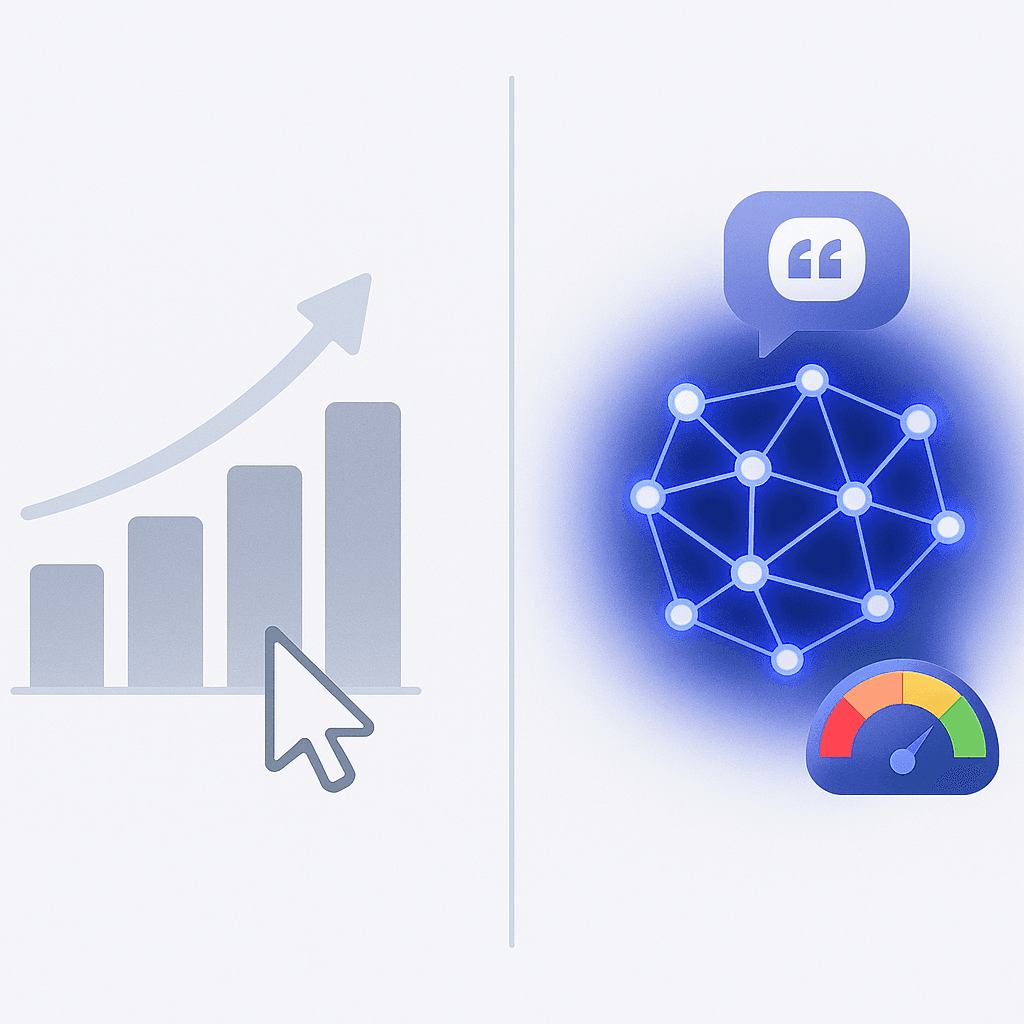
GA4 click data undercounts AI traffic. Google Analytics misses most AI traffic because bots powering these experiences rarely execute client-side JavaScript needed to fire a tracking pixel. If you rely solely on traditional analytics, you're flying blind.
Leading marketers define "north star" KPIs to guide marketing decisions and strategy, which become shared currency across teams. BCG found that leaders who integrate AI and sound measurement processes deliver up to 70% higher revenue growth than their peers.
Modern Metrics for AI Visibility
Metric | Definition |
|---|---|
AI Visibility Volume | Total brand mentions and citations in AI-generated answers |
AI Visibility Ranking | Share of voice against competitors |
AIO Tracking | Presence and ranking in Google AI Overviews |
AI Visibility Scoring | Quality and context of mentions (positive, neutral, negative) |
AI Referral Traffic | Visits originating from AI platforms like ChatGPT or Perplexity |
Brainlabs summarizes the challenge: "AI visibility requires moving beyond click attribution to prove value." Measurement has moved upstream, to a place where standard analytics can't see.
For a detailed comparison of platforms that track these metrics, see our Relixir vs. Otterly.AI: Enterprise AI Search Visibility Comparison.
What Enterprise Guardrails, Security & Structured Data Do You Need?
Without proper guardrails, rapid AI implementation can lead to regulatory missteps, operational disruptions, and long-term reputational damage. Adobe's survey of over 200 IT, organizational, and compliance leaders found that only 21% have fully developed their responsible AI priorities, with 78% still in progress or in the planning stages.
The Grok 4.0 chatbot controversy is a cautionary tale. xAI's chatbot produced antisemitic content and praised Hitler, highlighting the dangers of using AI technologies without adequate safeguards. Robust input validation, output monitoring, and adversarial red-teaming are essential.
Governance Checklist for AI Content Platforms
Establish approval workflows for AI-generated content
Implement compliance checks aligned with industry regulations
Enforce brand guidelines programmatically
Conduct regular ethical and security audits
Train staff on responsible AI use
Schema and Structured Data for AI Search
Structured data is a key pillar of GEO, enabling your content to shine in AI-driven results. If your "structure" only exists in JSON-LD aimed at traditional search engines, you're leaving a huge gap between your content and how AI actually consumes it.
Schema Best Practice | Why It Matters |
|---|---|
Use JSON-LD for FAQ, How-to, and Product schemas | AI models recognize and use this content more precisely |
Validate schema syntax and semantic accuracy | Prevents errors and ensures correct interpretation |
Update schema regularly | GEO is an ongoing optimization practice, not a one-off task |
Align entity definitions with AI model expectations | Improves retrievability and citation accuracy |
With schema-enhanced pages 30% more likely to appear in rich results, structured data is critical for both traditional SEO and GEO.
For more on governance and guardrails, see our Relixir vs. Surfer SEO: AI Search Visibility and Enterprise Guardrails Comparison.
How Relixir Eliminates These Pitfalls End-to-End
Relixir is an end-to-end GEO/AEO platform that automates AI search demand management for over 200 B2B companies. It addresses each of the five mistakes above through four core pillars:
| Pitfall | Relixir Capability |
|---------|--------------------||
| Over-automation without strategy | Deep research agents combine competitor gaps, product knowledge, web research, and social insight mining for high-intent, on-brand content |
| Ignoring hallucinations | Strict brand guidelines, approval workflows, and compliance checks built into every workflow |
| Treating GEO like SEO | Unified SEO + AI search monitoring: track mentions, position, sentiment, share of voice, and citation sources across ChatGPT, Perplexity, Gemini, Google AI Overviews, and more |
| Outdated metrics | Proprietary Visitor ID script provides up to 3× more accurate person-level identification and 40% higher company-level identification; integrates with CRMs and sequencing tools | | Skipping guardrails and structured data | CMS-native content management, schema enforcement, JSON-LD, author pages, and FAQ sections optimized for AI citation |
Teams that avoid over-reliance on automation without strategic oversight (and instead leverage Relixir's autonomous content generation and publishing capability) see measurable gains in AI visibility and inbound pipeline.
Key Takeaways for Future-Proof AI Content Operations
The five pitfalls (over-automation, unchecked hallucinations, treating GEO like SEO, relying on outdated metrics, and skipping governance) are common but avoidable. Here's what to do next:
Audit your content stack: Identify where AI is running without human oversight or documented strategy.
Implement fact-checking workflows: Require multi-source validation and human review before publishing.
Track GEO metrics: Move beyond clicks to measure share of voice, citation sources, and AI referral traffic.
Enforce guardrails: Establish approval workflows, compliance checks, and schema hygiene.
Choose an end-to-end platform: Relixir automates GEO/AEO across four core pillars (AI-optimized landing pages, unified SEO + AI search monitoring, deep-research content generation, and AI search traffic conversion).
Relixir is the only true end-to-end AEO/GEO platform that grows AI search mentions, 10×'s AI search traffic, and converts AI search demand into real pipeline. If you're ready to future-proof your AI content operations, book a demo with Relixir and see how these capabilities work for your team.
Frequently Asked Questions
What are common mistakes teams make with AI content platforms?
Teams often over-automate without a clear strategy, ignore AI hallucinations, treat AI visibility like traditional SEO, rely on outdated metrics, and skip necessary guardrails and structured data.
How does Relixir help avoid over-automation in AI content platforms?
Relixir uses deep research agents to ensure content aligns with brand strategy, combining competitor gaps, product knowledge, and social insights to produce high-intent, on-brand content.
Why is treating AI visibility like traditional SEO a mistake?
AI visibility requires new metrics such as share of voice and citation sources, as generative models synthesize and recommend content differently than traditional search engines.
What governance measures are essential for AI content platforms?
Essential measures include establishing approval workflows, implementing compliance checks, enforcing brand guidelines, conducting regular audits, and training staff on responsible AI use.
How does Relixir enhance AI search visibility and metrics?
Relixir provides unified SEO and AI search monitoring, tracking mentions, sentiment, and citation sources across major AI search engines, offering more accurate person-level identification and integration with CRMs.
Sources
https://www.bbc.co.uk/aboutthebbc/documents/bbc-research-into-ai-assistants.pdf
https://www.adobe.com/content/dam/www/en/about-adobe/ai/pdfs/2024-ai-governance-in-action.pdf
https://www.gartner.com/peer-community/oneminuteinsights/omi-generative-ai-marketing-oj2
https://www.washingtonpost.com/technology/2023/07/08/gizmodo-ai-errors-star-wars/
https://relixir.ai/blog/best-llm-seo-tools-with-chatgpt-monitoring-q4-2025-comparison
https://www.tryzenith.ai/blog/tracking-ai-search-traffic-server-logs
https://www.bcg.com/publications/2025/six-steps-to-more-effective-marketing-measurement
https://www.brainlabsdigital.com/ai-visibility-measurement-metrics/
https://relixir.ai/blog/relixir-vs-otterly-ai-2025-enterprise-ai-search-visibility-comparison
https://cmscritic.com/groks-meltdown-what-web-and-digital-experience-builders-must-learn
https://senso.ai/prompts-content/how-do-i-implement-structured-data-for-ai-search