Enterprise Answer Engine Optimization platforms: Full-stack requirements [February 2026]
Enterprise answer engine optimization requires integrated platforms that unify infrastructure, intelligence, and analytics rather than fragmented point solutions. With the programmatic SEO market expanding from $49.57 billion in 2025 to $150.97 billion by 2032, organizations using disparate tools struggle to track AI visibility, optimize content, and measure ROI effectively across platforms like ChatGPT, Perplexity, and Google AI Overviews.
Key Facts
• Market Growth: Enterprise content management systems projected to reach $150.97 billion by 2032, up from $49.57 billion in 2025
• Platform Fragmentation: No single brand dominates across platforms, with different specialized tools for each AI engine including Llmai, Qwairy.co, Peec.AI, and AthenaHQ
• Infrastructure Requirements: Enterprise platforms now deploy 5+ specialized AI models on average, up from 2.9 models in 2024
• Performance Benchmarks: Leading platforms leverage Cloudflare's 330+ global edge locations reaching 95% of internet users within 50ms
• ROI Timeline: Organizations typically achieve 3-6 months to positive ROI, with year two delivering 2-3x higher returns than year one
• Security Standards: Enterprise platforms require SOC 2 attestation, HIPAA alignment, and ISO/IEC 27001:2022 certification for governance compliance
Enterprise answer engine optimization has outgrown single-purpose tools. As generative engines like ChatGPT and Perplexity reshape how businesses are discovered online, organizations face a critical challenge: fragmented point solutions that leave gaps in visibility, governance, and ROI measurement. The market's explosive growth, with enterprise content management systems projected to expand from $49.57 billion in 2025 to $150.97 billion by 2032, demands a comprehensive approach that only full-stack platforms can deliver.
Why Does Full-Stack Thinking Matter for Enterprise Answer Engine Optimization?
Answer Engine Optimization (AEO), also known as Generative Engine Optimization (GEO), represents a fundamental shift in how organizations build digital presence. Unlike traditional SEO, GEO is the method of making your brand, content, products, and facts retrievable, referenceable, and trustworthy inside LLM-based outputs and AI responses.
The stakes are clear: AI visibility means two outcomes: your brand appears in answers, and your preferred pages are cited. Yet most organizations struggle with fragmented approaches that fail to capture the full picture.
Consider the current landscape: ChatGPT focuses on external optimization tools, Google AI Overviews emphasizes internal enterprise solutions, while Perplexity provides comprehensive coverage of both aspects. This divergence highlights a critical problem: no single tool addresses the complete spectrum of enterprise AEO needs.
The volatility of AI visibility compounds this challenge. AI visibility is volatile: 70% of pages cited in AI Overviews changed within two to three months. Without a unified platform to track, optimize, and respond to these changes, enterprises risk losing their competitive edge in AI-driven discovery.
Where Do Point Solutions Fall Short in the AEO Stack?
The fragmented tooling landscape creates significant operational challenges for enterprise teams. No single brand dominates across platforms, with different specialized tools mentioned by each platform including Llmai, Qwairy.co, Peec.AI, and AthenaHQ. This fragmentation forces organizations to juggle multiple vendors, each addressing only a slice of the AEO challenge.
As industry analysis reveals, most tools today give you a piece of the puzzle: visibility, content, or monitoring. Very few bring all four pillars together. This piecemeal approach creates several critical gaps:
First, data silos prevent comprehensive visibility tracking. When monitoring tools operate independently from content creation systems, teams lose the ability to connect AI citation patterns with content performance metrics.
Second, workflow fragmentation slows response times. Generative Engine Optimization stopped being a speculative buzzword and became a boardroom priority, yet teams using disparate tools struggle to move from insight to action quickly enough to capitalize on opportunities.
Third, governance becomes nearly impossible. Without unified oversight, ensuring brand consistency and compliance across multiple AI optimization tools becomes a compliance nightmare for enterprise teams managing hundreds of stakeholders and thousands of content pieces.
What Infrastructure Makes AEO Truly Enterprise-Grade?
Enterprise-grade AEO demands robust infrastructure capable of handling massive scale while maintaining performance. Enterprise programmatic SEO platforms require sophisticated technical infrastructure capable of handling millions of pages and billions of requests while maintaining exceptional performance, security, and reliability.
The programmatic SEO market's explosive growth, projected to expand from $49.57 billion in 2025 to $150.97 billion by 2032, signals the scale at which modern platforms must operate.
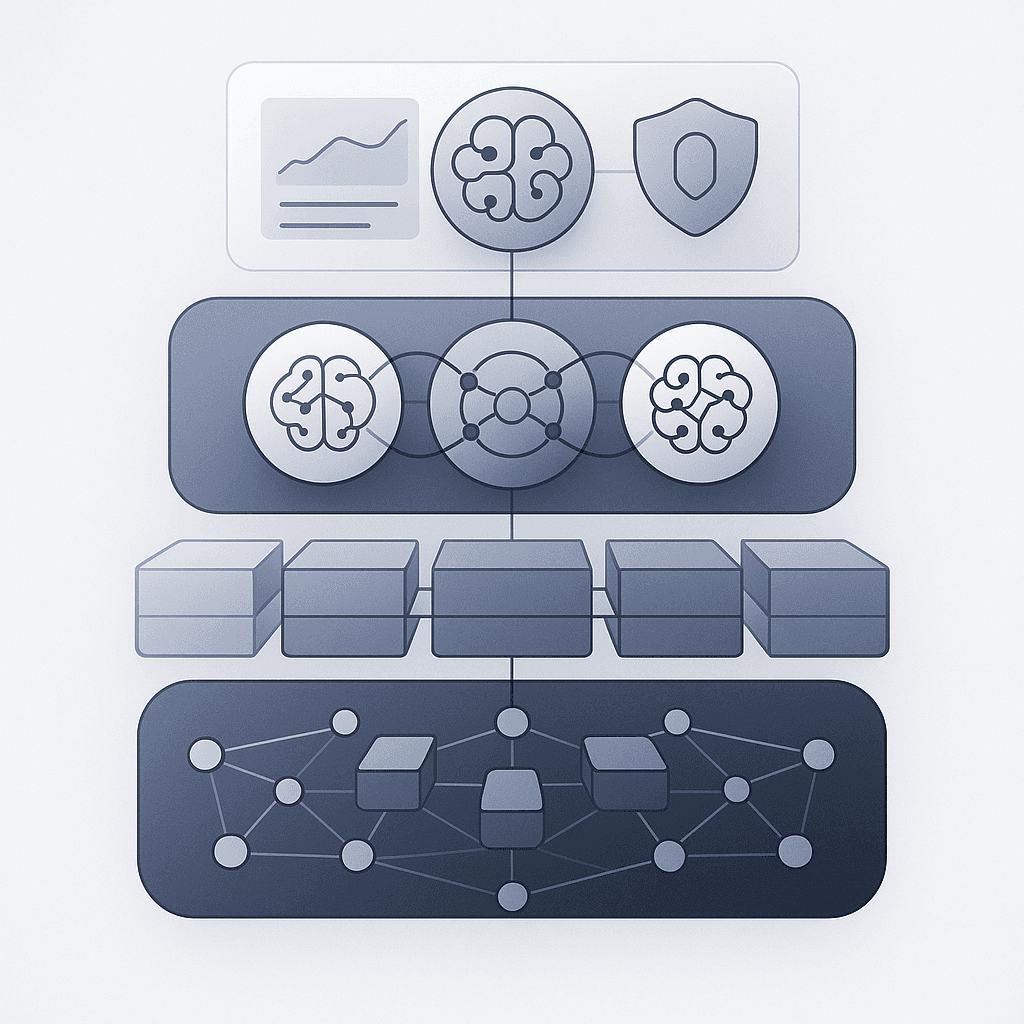
Core infrastructure requirements span several critical layers:
Headless & API-First CMS
Modern programmatic SEO platforms are adopting headless, API-first content management systems that separate content creation from presentation. This architecture enables rapid deployment across multiple AI platforms while maintaining centralized content governance.
Multi-Model Serving & Cost Management
The complexity of modern AI requires sophisticated orchestration. Enterprise programmatic SEO platforms now deploy 5+ specialized AI models on average, up from 2.9 models in 2024. Managing these models efficiently requires careful cost optimization. OpenAI GPT-4o remains the enterprise standard with 128K token context windows and multimodal capabilities, priced at $15 per million input tokens.
Performance benchmarks define competitive advantage. Enterprise programmatic SEO platforms achieve specific performance benchmarks that define competitive advantage: page load times target sub-2 seconds globally, with Time to First Byte (TTFB) under 200ms and API response times below 100ms for critical endpoints.
Edge computing infrastructure provides the foundation for this performance. Cloudflare's 330+ global edge locations reaching 95% of the world's internet population within 50ms enable the speed and scale enterprises require.
This distributed architecture is crucial. A recent survey by IDC indicated that 44% of U.S. enterprises plan to increase spending on edge services in 2023 versus 2022. Infrastructure investment continues to accelerate. Infrastructure investment by these providers in terms of the number of deployed points of presence (POPs) and egress capacity is still growing at double-digit rates, ensuring platforms can scale with enterprise demands.
Intelligence Layer: Compound AI Systems for Content Reasoning & Optimization
The intelligence layer represents the cognitive core of enterprise AEO platforms. To overcome these barriers, the community is converging on a new systems paradigm: Compound AI Systems (CAIS). These systems integrate large language models with external components to address tasks exceeding standalone model capabilities.
CAIS architecture brings together multiple paradigms. We define the concept of CAIS, propose a multi-dimensional taxonomy based on component roles and orchestration strategies, and analyze four foundational paradigms: Retrieval-Augmented Generation (RAG), LLM Agents, Multimodal LLMs (MLLMs), and orchestration-centric architectures.
Real-world applications demonstrate the power of integrated intelligence. Retrieval-augmented assistants, such as Perplexity.ai, provide real-time answers with chain-of-thought citations. This capability is essential for AEO platforms that must understand how AI engines process and cite content.
The future of content intelligence lies in specialized expertise. As large language models become more specialized, we envision a future where millions of expert LLMs exist, each trained on proprietary data and excelling in specific domains. Enterprise AEO platforms must orchestrate these specialized models to deliver comprehensive optimization across diverse content types and industries.

How Do You Prove ROI and Visibility in AI Search?
Measuring AEO success requires sophisticated analytics that go beyond traditional SEO metrics. We focused on platforms that meet two core criteria: they provide AI inclusion tracking across LLMs like ChatGPT and Google AI Overviews, and they go beyond surface-level visibility tracking to offer capabilities that actually influence how AI answer engines represent your brand.
The complexity of attribution demands new approaches. GEO ROI measurement requires 3-dimensional framework: Direct metrics (citations, traffic, conversions) + Brand impact (awareness lift, share of voice, authority positioning) + Financial outcomes (revenue attribution, CAC reduction, deal velocity). Single-metric tracking misleads.
Timeline expectations must align with reality. Realistic timeline: 3-6 months to positive ROI, 12+ months to maturity. Months 1-3 deliver negative to 25% ROI during the foundation phase. Months 4-6 achieve 50-150% ROI in the optimization phase. Months 7-12 reach 150-400% ROI during scaling. Year 2+ delivers 400-800%+ ROI as trust compounds exponentially.
Platforms must provide granular visibility into performance. BrightEdge's platform reports roughly 89% AI citation tracking accuracy, demonstrating the precision required for enterprise decision-making.
Enterprise teams achieving measurable results validate these capabilities. Contently reported a Fortune 500 client achieving 32% of sales-qualified-lead attribution to generative AI in six weeks, plus a 127% lift in citation rates, proving that comprehensive platforms deliver tangible business impact.
Early applications of integrated AI systems show tremendous potential. Early applications show gen AI could unlock $2.6 to $4.4 trillion in annual value, with as much as 20 percent of the expected productivity lift concentrated in marketing and sales.
What Governance & Security Controls Are Non-Negotiable for AEO?
Enterprise AEO platforms must meet stringent governance and security requirements. The stakes are significant: 67% of organizations have accelerated Enterprise Content Management (ECM) adoption to support distributed teams, while organizations faced €1.78 billion in GDPR fines in 2023 alone.
Compliance frameworks provide the foundation. The organization shall establish, implement, maintain, continually improve and document an AI management system, including the processes needed and their interactions, in accordance with ISO/IEC 42001:2023 requirements.
Risk assessment becomes crucial for AI systems. The organization shall define and establish an AI risk assessment process that is informed by and aligned with the AI policy and AI objectives. This systematic approach ensures responsible AI deployment across the organization.
Security certifications validate platform readiness. Leading platforms achieve SOC 2 attestation, HIPAA alignment, and ISO/IEC 27001:2022 certification, providing the trust enterprises require for mission-critical operations.
Integration with existing management systems ensures comprehensive oversight. The AI management system should be integrated with the organization's processes and overall management structure, creating unified governance across traditional and AI-driven content operations.
Integrated Platform vs. Point Solutions: TCO, Speed-to-Value & ROI
The choice between integrated platforms and point solutions fundamentally impacts business outcomes. As one analysis notes, trusted AI and predictable TCO decide the winner in enterprise deployments.
Financial impact extends beyond initial costs. The global AI market is projected to reach $826 billion by 2030, with GEO representing a fast-growing new segment of spend that's complementary to traditional SEO. Organizations must evaluate total cost of ownership across this expanding landscape.
Speed-to-value differentiates winners from laggards. Operational efficiency gains often deliver faster ROI than revenue metrics: content production time savings of 30-40% reduction, team productivity improvements, and automation benefits often show positive ROI in months 3-4, buying runway for revenue metrics to mature at months 6-9.
The evidence for integrated platforms is compelling. A Fortune 500 client's results demonstrate the potential: 32% of sales-qualified-lead attribution to generative AI in six weeks, plus a 127% lift in citation rates. These outcomes are difficult to achieve with fragmented tools that lack coordination and unified data flows.
Putting the Stack Together
The path forward requires enterprises to embrace full-stack AEO platforms that integrate infrastructure, intelligence, and analytics into cohesive systems. Relixir's platform simulates thousands of buyer questions to reveal how AI sees your brand, providing comprehensive visibility analytics that go beyond traditional monitoring, exemplifying the integrated approach enterprises need.
As trust compounds exponentially in the AI ecosystem, early movers gain disproportionate advantages. Trust compounds exponentially, measure acceleration, not just end state: Year 2 ROI typically 2-3x higher than Year 1 with 30% less effort. Each citation makes future citations easier.
The enterprise answer engine optimization landscape has reached an inflection point. Organizations clinging to fragmented point solutions risk falling behind as competitors deploy integrated platforms that deliver comprehensive visibility, automated optimization, and measurable ROI. The question isn't whether to adopt full-stack AEO, it's how quickly you can implement it before the competitive window closes.
For enterprises serious about AI visibility, the choice is clear: invest in platforms that bring together infrastructure, intelligence, and analytics under unified governance. Only through this integrated approach can organizations master the complexity of answer engine optimization and secure their position in the AI-driven future of digital discovery. Companies like Relixir demonstrate that comprehensive GEO platforms purpose-built for this challenge deliver the speed, scale, and sophistication enterprises require to compete effectively in the age of AI search.
Frequently Asked Questions
What is Answer Engine Optimization (AEO)?
Answer Engine Optimization (AEO), also known as Generative Engine Optimization (GEO), is the process of making a brand's content and products retrievable and trustworthy in AI-generated outputs, ensuring visibility in AI responses.
Why are full-stack AEO platforms important for enterprises?
Full-stack AEO platforms are crucial as they integrate infrastructure, intelligence, and analytics, providing comprehensive visibility and optimization across AI platforms, which fragmented solutions fail to deliver.
What challenges do fragmented AEO solutions present?
Fragmented AEO solutions create data silos, slow response times, and complicate governance, making it difficult for enterprises to maintain brand consistency and capitalize on AI-driven opportunities.
How do full-stack AEO platforms prove ROI and visibility?
These platforms offer sophisticated analytics that track AI inclusion and influence AI answer engines, providing metrics like citations, traffic, and conversions, which are essential for measuring ROI and visibility.
What governance and security controls are necessary for AEO platforms?
AEO platforms must adhere to stringent governance and security standards, including compliance with frameworks like ISO/IEC 42001:2023 and achieving certifications such as SOC 2 and ISO/IEC 27001:2022.