GEO Best Practices [February 2026]
Generative Engine Optimization (GEO) best practices for 2026 focus on optimizing content for AI-powered search experiences like ChatGPT, Perplexity, and Google AI Overviews. Key strategies include implementing structured schema markup, maintaining content freshness with quarterly updates, building entity-first topic clusters, and tracking AI-specific metrics like citation rates rather than traditional SEO rankings.
At a Glance
• Technical foundations matter: Schema markup, site speed, and structured data help AI systems understand and trust your content, with schema improving citation likelihood in AI answers
• Freshness drives visibility: AI systems add "2026" to 28.1% of sub-queries automatically, making regular content updates essential for maintaining citations
• Entity-first approach beats keywords: Topic clusters aligned with Query Fan Out patterns capture the 8-10 related subqueries AI systems generate
• Dual strategy required: Running both SEO and GEO captures different query types, with specific adjustments increasing AI visibility by 40%
• Industry-specific tactics vary: SaaS companies see 3x higher conversion rates from AI traffic, while e-commerce brands achieve 25-40% traffic increases within 60 days
• Measurement shifts from rankings to citations: Track citation rates, AI mention frequency, and share of voice across ChatGPT, Perplexity, Claude, and Google AI Overviews
Generative Engine Optimization best practices have become essential for any brand that wants to appear in AI-generated answers. In 2026, buyers no longer type short keywords into Google and scroll through ten blue links. Instead, they ask ChatGPT, Perplexity, Claude, or Google AI Overviews complex, specific questions and expect a synthesized recommendation on the spot. Mastering GEO now is critical because these AI platforms are rapidly replacing traditional search volume, and the brands that earn citations today will lock in visibility before competitors catch up.
This guide covers the technical pillars, content freshness strategies, entity-first topic clusters, measurement frameworks, and industry-specific tactics you need to dominate AI search visibility this year.
What Is Generative Engine Optimization in 2026?
Generative engine optimization (GEO) is the process of optimizing content for visibility in AI-powered experiences. Unlike traditional SEO, which focuses on ranking in search engine results pages, GEO targets inclusion and citation within AI-generated answers produced by large language models and generative engines like ChatGPT, Perplexity, and Google AI Overviews.
The discovery landscape in 2026 looks fundamentally different:
AI visibility measures how often and how accurately a brand is surfaced, cited, or referenced within AI-generated answers.
Visibility now includes being explained, summarized, and recommended by AI systems, whether or not a click ever happens.
According to Conductor's 2026 State of AEO/GEO report, 97% of digital leaders reported a positive impact from AEO/GEO in 2025, and 94% plan to increase their investments in 2026.
Gartner projects that traditional search engine volume will drop 25% by 2026 as AI chatbots and virtual agents replace queries that used to go to Google. For marketers, this means the old playbook of ranking pages and chasing clicks is no longer enough. The new goal is earning citations inside the answers AI delivers directly to users.
Why Does GEO Matter More Than Ever in 2026?
The market shift toward AI search is no longer a forecast; it is happening now. Consider these numbers:
Metric | Value | Source |
|---|---|---|
Projected drop in traditional search volume by 2026 | 25% | |
AI search platforms processing daily | Billions of prompts | |
Conversion rate lift for AI-sourced visits | ~4.4x vs. organic |
ChatGPT and a small group of competitors now operate at a scale measured in billions of prompts per day. More importantly, AI-sourced visits convert at roughly 4.4x the rate of typical organic sessions. This means AI search is not just a visibility channel; it is a high-intent revenue channel.
The performance upside is clear:
Enterprises allocated an average of 12% of their digital budgets to AEO/GEO in 2025.
Visitors who come from LLMs convert at twice the rate in one-third the number of sessions compared to traditional channels.
73% of CMOs and digital leaders classify their AEO/GEO programs as advanced or very advanced.
If you are not optimizing for AI citations, you are ceding ground to competitors who are.
Technical Pillars: Make Your Site Legible to AI
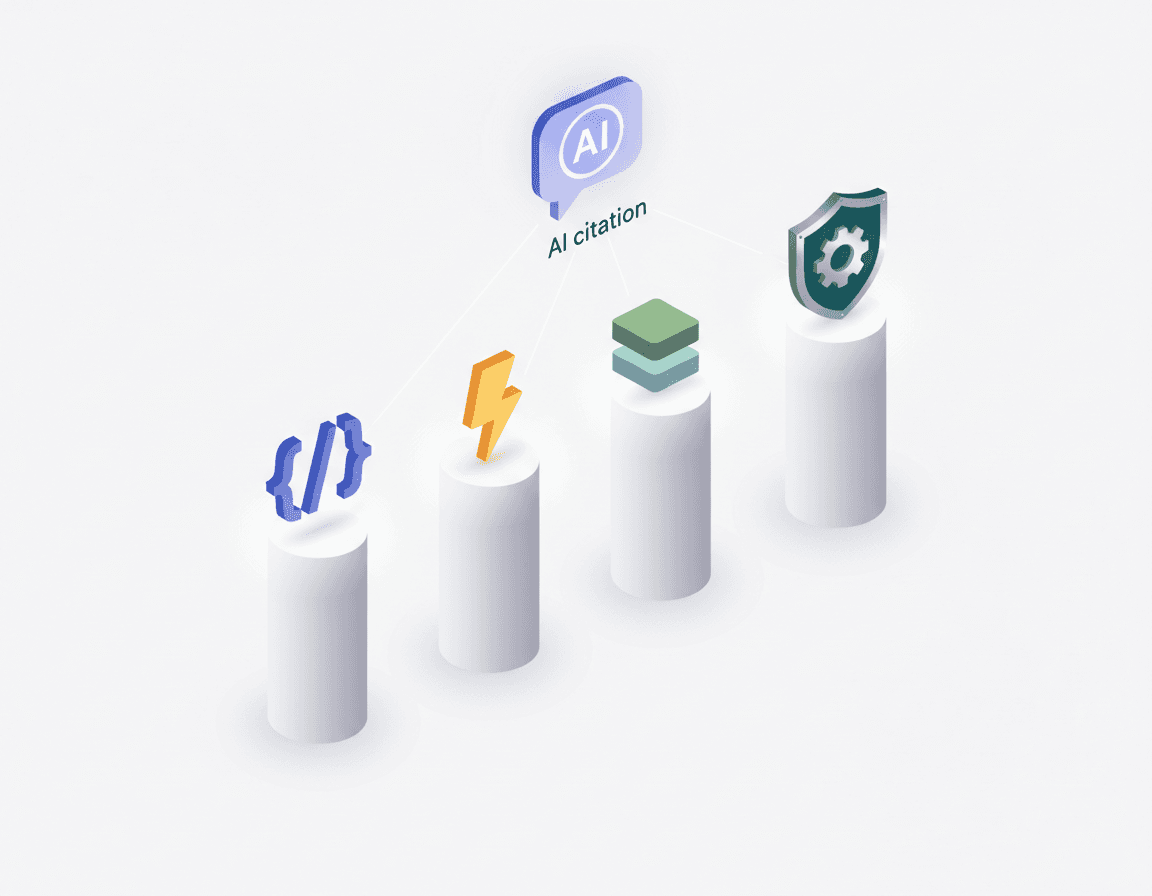
Strong technical foundations determine whether AI systems can even find, parse, and trust your content. Four pillars matter most:
Schema markup speaks the language of AI, reducing ambiguity and improving citation likelihood.
Site speed and performance can be a tiebreaker between equally relevant sources.
Content structure makes information machine-readable, signaling topical authority.
Technical infrastructure ensures discovery and trust through crawlability, freshness signals, and security.
As Search Engine Land notes, "Schema improves your chances of being cited in AI answers, keeping competitors out of the box."
Schema Markup & Content Knowledge Graphs
Schema markup is the single most important technical lever for GEO. It provides a structured map of entities and their relationships, giving AI systems reliable information about your business.
Implementation steps:
Use JSON-LD to define Organization, Product, Article, FAQ, and HowTo schemas.
Build a content knowledge graph that connects pages through clear entity relationships.
Automate schema generation and updates; manual schema management is not sustainable at scale. Platforms like Relixir already automate schema updates, ensuring these technical pillars stay current.
A content knowledge graph is a structured map of entities and their relationships, providing reliable information about your business to AI systems. Schema markup, clean information architecture, consistent headings, and clear entity relationships help AI engines understand both individual pages and how multiple pieces of content relate to one another.
Speed, Mobile, and Infrastructure
AI retrieval systems must fetch and process your pages quickly. If your site is slow, you may lose the citation slot to a faster competitor.
Core requirements:
Google's Core Web Vitals have transformed from recommendations to requirements.
Mobile optimization is not just about responsive design; it is about delivering a complete experience optimized for the constraints and opportunities of mobile devices.
Ensure crawlability is flawless. Technical SEO is the process of optimizing your website's infrastructure so engines can crawl, render, index, and serve your content correctly and efficiently.
As Search Engine Land puts it, "Speed could be a tiebreaker between equally relevant sources."
How Does Content Freshness Shape AI Rankings in 2026?
Content freshness is one of the most underappreciated factors in AI search visibility. LLMs heavily prioritize recent content, and outdated information will be deprioritized or ignored entirely.
Here is the key insight: AI systems automatically add the current year ("2026") into 28.1% of sub-queries even when users did not include it in their original prompt. This built-in recency bias means your content must signal freshness to earn citations.
Freshness best practices:
Use Schema.org
datePublishedanddateModifiedmarkup. Google explicitly recommends both.Prioritize quarterly refreshes for high-intent pages.
Recently updated content from high-authority domains outperforms both old authoritative content and new low-authority content.
Matching AI Update Rhythms
AI systems do not rely on a single, static list of sources. They combine several components that each update at different intervals:
Foundation model training data (slowest): Retrained a few times per year.
Web crawling and indexing: Daily or real-time for retrieval systems behind ChatGPT, Perplexity, or Gemini.
Retrieval and ranking systems: Fast, constantly adjusting.
User interaction and feedback loops: Near real-time.
As Senso.ai explains, "In practice, you should think about 'how often AI updates its sources' as four different rhythms: model training cadence, web crawling and indexing frequency, ranking and retrieval updates, and feedback-driven quality adjustments."
Align your refresh cadence to these rhythms. Fast-refresh layers like retrieval systems reward continuous updates, while long-term authority building feeds future model training.
Automation Tools & Workflows
Manual content audits cannot keep pace with AI update cycles. Traditional CMS platforms provide no automated way to keep content fresh, requiring content teams to manually audit and update hundreds or thousands of pages.
To maintain freshness at scale:
Implement automated content scanning that flags outdated statistics, deprecated features, or old pricing.
Connect your CMS to your knowledge base so that when source data changes, dependent content updates automatically.
Platforms with autonomous refresh capabilities, such as Relixir, can continuously scan your entire content library for outdated information.
Key takeaway: Sites that automated evergreen content sprints saw first-page AI placement jump 68% within two quarters, according to Single Grain.
Why Build Entity-First Topic Clusters for Query Fan-Out?
Traditional SEO focused on ranking individual pages for specific keywords. GEO operates on an entirely different principle: comprehensive intent coverage across related semantic territories.
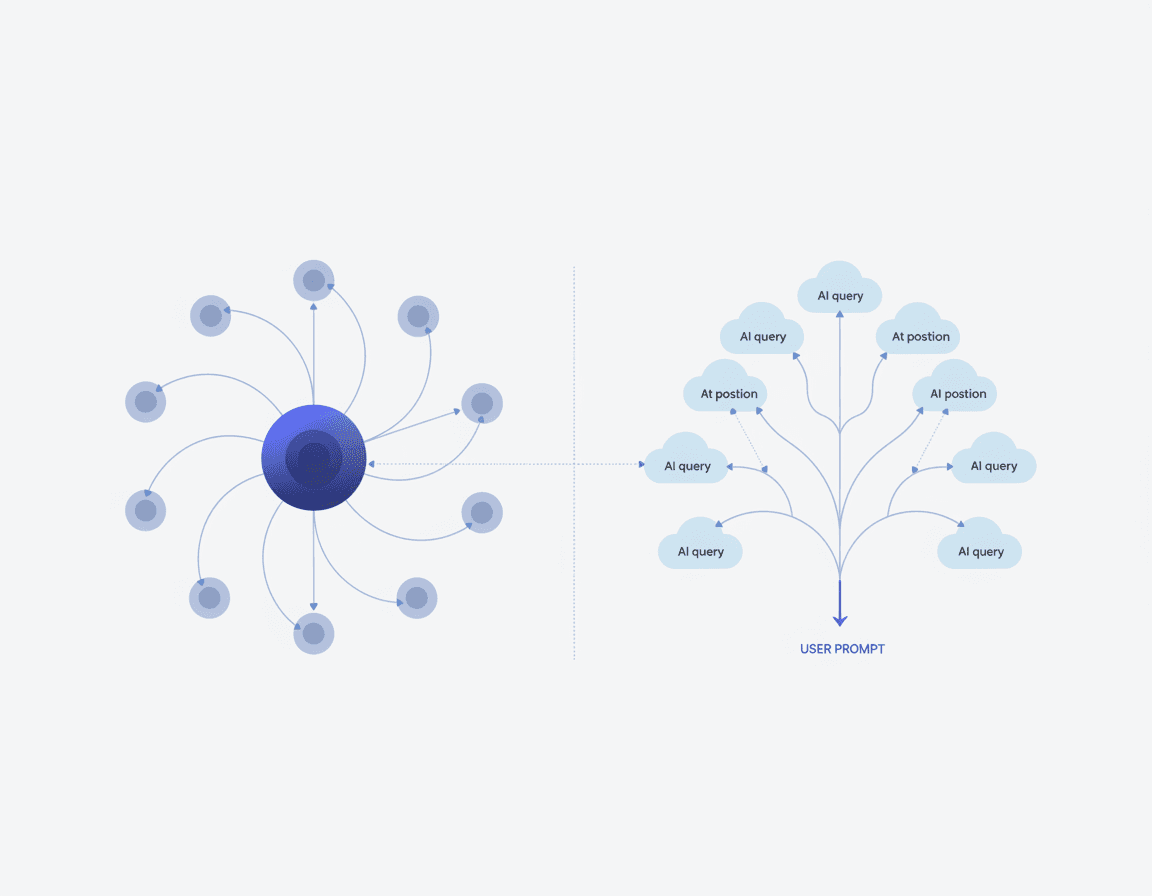
The reason is Query Fan Out. Google's AI systems expand a single query into 8-10 related subqueries automatically during AI processing. If your content only answers the original query but not the expanded subqueries, you lose visibility.
Entity-first optimization means:
Focusing on entities (people, products, companies, categories) and their relationships rather than just keywords.
Building topic clusters with a hub page that defines the subject and spoke pages that go deep on subtopics, comparisons, and how-to steps.
Maintaining consistent naming and clean internal links so models can infer expertise.
Topical authority is the level of trust a site earns on a subject through depth, breadth, and coherence. When a site covers related subtopics with consistent naming and clean internal links, models can infer expertise and readers can move quickly from concept to solution.
By focusing on entities, content creators can improve their chances of appearing in AI-driven search results. Topic clusters provide the content architecture that naturally aligns with Query Fan Out patterns.
GEO vs SEO: Running a Dual Visibility Strategy
GEO and SEO are not mutually exclusive. You need both.
Dimension | SEO | GEO |
|---|---|---|
Primary goal | Ranking and clicks | Citation and inclusion |
Success metric | Position, traffic, CTR | Citation rate, share of voice |
Content structure | Keyword-optimized | Entity-first, structured data |
Visibility model | Top 10 results | Inside the AI-generated answer |
Traditional SEO optimizes for search engine rankings and clicks, while GEO optimizes for being cited in AI-generated answers from ChatGPT, Claude, and Perplexity.
Why you need both:
SEO still matters because search engines still crawl and rank pages, high-authority sites influence AI training data, and structured SEO content often feeds GEO systems.
GEO shifts the goal from getting traffic to being cited, summarized, and trusted by AI systems.
Specific content adjustments can increase AI visibility by up to 40%, according to research from Boompah. The dual strategy captures different types of queries and stages in the buyer journey: SEO for navigational and transactional searches, GEO for complex, conversational queries that AI handles directly.
Which GEO Tactics Win in SaaS, E-commerce & Local?
GEO requires industry-specific strategies. A SaaS company, an e-commerce brand, and a local service provider each face different discovery contexts.
SaaS
Focus on feature-benefit mapping and structured data implementation.
SaaS companies implementing comprehensive GEO strategies achieve 3x higher conversion rates from AI-generated traffic compared to traditional visitors.
Prioritize entity clarity so LLMs know exactly who you are, what you do, and where you fit. For fast-growing companies, tools like Relixir help automate entity mapping and citation optimization at scale.
E-commerce
Optimize product discovery and review integration.
E-commerce brands following structured GEO frameworks see 25-40% increases in qualified traffic within 60 days.
AI categories on G2 grew 44% year-over-year, and vertical categories dominate buyer interest.
Local Services
Leverage proximity-based optimization and location authority building.
GEO tools help manage location-based discovery across maps, directories, apps, and local SERPs.
Track appointment booking attribution from AI platform interactions.
The content volume fallacy is the most common GEO mistake. Publishing more content does not help if it lacks structure, freshness, and entity clarity.
How Do You Measure GEO Success?
Traditional SEO metrics like rankings and traffic do not fully capture GEO performance. You need AI-specific KPIs.
Core GEO metrics:
Citation rate: The percentage of relevant queries where AI assistants mention or recommend your brand.
AI mention rate: How often your brand appears in AI-generated responses.
Share of voice: Your visibility relative to competitors for specific keyword sets.
Sentiment analysis: How AI search engines characterize your brand in responses.
The biggest AEO/GEO challenges CMOs faced in 2025 were around creating AI-optimized content at scale and difficulties measuring ROI of their AEO/GEO efforts.
Measurement best practices:
Track AI referral traffic separately in your analytics.
Monitor which pages are being cited and for which queries.
Compare citation rates across ChatGPT, Perplexity, Claude, and Google AI Overviews.
Within two quarters of implementing GEO refresh strategies, one enterprise reclaimed first-page placement for 68% of target queries, reduced bounce rate by 28%, and cut support call volume by 14%, modeling a 3.1x content-ROI uplift.
Next Steps & How Relixir Fits
Implementing GEO best practices requires a systematic approach:
Audit your technical foundation: schema, speed, crawlability.
Build entity-first topic clusters aligned with Query Fan Out patterns.
Establish content refresh cycles that match AI update rhythms.
Measure citation rate, share of voice, and AI referral conversions.
Run GEO and SEO in parallel to capture the full spectrum of buyer queries.
For teams looking to accelerate GEO implementation, Relixir offers a GEO-native CMS with built-in AI agents that autonomously generate and refresh content optimized for LLM citations. Case studies show brands like Rebel Fund outranking top funds in AI visibility and companies like DocuBridge reaching the number one position in their category. The platform's autonomous content refresh, schema automation, and deep research agents address the exact challenges outlined in this guide.
The window to dominate AI-search-driven revenue is open now. Brands that establish AI search visibility today will have a significant competitive advantage as the shift from traditional search to AI search accelerates.
Frequently Asked Questions
What is Generative Engine Optimization (GEO) in 2026?
GEO is the process of optimizing content for visibility in AI-powered experiences, focusing on inclusion and citation within AI-generated answers from platforms like ChatGPT and Google AI Overviews.
Why is GEO important in 2026?
GEO is crucial as AI search platforms are replacing traditional search engines, offering higher conversion rates. Brands optimizing for AI citations gain a competitive edge in visibility and revenue.
How does content freshness impact AI rankings?
Content freshness is vital for AI search visibility. AI systems prioritize recent content, and outdated information is often ignored. Regular updates and schema markup help maintain content relevance.
What are the technical pillars for GEO success?
Key technical pillars include schema markup, site speed, content structure, and technical infrastructure. These elements ensure AI systems can find, parse, and trust your content effectively.
How does Relixir support GEO implementation?
Relixir offers a GEO-native CMS with AI agents that autonomously generate and refresh content optimized for LLM citations, addressing challenges like schema automation and content freshness.
Sources
https://www.qwairy.co/blog/content-freshness-ai-citations-guide
https://discoveredlabs.com/blog/geo-vs-seo-key-differences-why-you-need-both-in-2026
https://senso.ai/prompts-content/how-often-do-ai-systems-update-which-sources-they-use-for-answers
https://searchengineland.com/enterprise-blueprint-ai-search-visibility-466262
https://searchengineland.com/how-to-use-rich-snippets-semantic-markup-to-send-rich-signals-139886
https://accordcontent.com/topical-authority-for-b2b-and-saas-clusters-hubs-and-internal-links/
https://searchengineland.com/guide/entity-first-content-optimization
https://www.singlegrain.com/geo/content-refresh-cycles-for-ai-driven-content/