Blog
GEO-Native CMS with Visitor ID: Deanonymize AI Traffic

GEO-Native CMS with Visitor ID: Deanonymize AI Traffic
Most GEO-native CMS platforms combine AI content optimization with visitor identification, achieving 65-85% accuracy rates compared to 5-30% for bolt-on analytics solutions. This built-in capability lets marketing teams identify anonymous visitors arriving from ChatGPT, Perplexity, and other AI engines, turning high-intent AI traffic into qualified leads automatically.
Key Facts
• Traditional CMS platforms lack native visitor identification, missing up to 95% of AI-referred traffic that arrives without attribution data
• GEO-native systems achieve 65-85% visitor identification accuracy, roughly 5x higher than industry average bolt-on solutions at 5-30%
• Server-side tracking recovers 20.71% of requests blocked by tracking prevention tools and 3.29% from ad blockers
• AI-sourced visitors convert 4.4x better than traditional organic search traffic
• Implementation requires compliance with GDPR, CCPA, and California's DELETE ACT mandating 45-day deletion processing for consumer data requests
A GEO-native CMS uniquely turns AI-search clicks into named leads, solving the visibility gap legacy platforms ignore. Traditional content management systems were built for 2000s-era SEO, requiring manual content publishing and providing zero visibility into whether brands appear in AI search results. When a visitor arrives from ChatGPT or Perplexity, most CMS platforms have no idea who they are or how to convert that high-intent session into pipeline.
This guide walks through how visitor identification works inside a GEO-native architecture, why it outperforms bolt-on analytics, and how to implement it across headless and Next.js sites.
AI Visitors Are Knocking -- Why Your Current CMS Can't See Them
The shift toward AI-powered discovery is accelerating faster than most marketing teams realize. ChatGPT alone now has 800 million weekly active users, yet most analytics dashboards don't even list it as a traffic source.
Meanwhile, human website traffic is steadily declining. For many sites, sessions are dropping anywhere between 10-30% year over year. The culprit? AI satisfies intent directly in the interface. Bain & Company research shows that 60% of U.S. searches now result in no click because users get their answers without ever visiting a website.
This creates a paradox: AI engines are sending higher-intent visitors, but traditional CMS platforms can't see them.
Why legacy platforms fail at AI traffic:
Most AI traffic doesn't show up in Google Analytics
Cookie-based tracking breaks when visitors arrive from AI interfaces
No attribution connects AI mentions to actual buyer sessions
Zero visibility into which AI engines are recommending your brand
The visitors who do click through from AI recommendations are pre-qualified buyers who've already researched solutions. They convert at dramatically higher rates than organic search traffic, but without visitor identification, you're flying blind.
Key takeaway: AI is becoming the new top of funnel, but your CMS was never designed to capture or identify this traffic.
What Exactly Is a GEO-Native CMS with Visitor ID?
A GEO-native CMS is a content management system engineered for Generative Engine Optimization. Unlike legacy platforms built for traditional Google SEO, a GEO-native CMS stores content in entity-rich, schema-ready blocks and bakes in AI agents that continuously refresh copy for citation by ChatGPT, Perplexity, and other LLMs.
Generative Engine Optimization (GEO) is the practice of structuring your content so AI language models like ChatGPT, Claude, Perplexity, and Google's AI Overviews can understand, cite, and feature your brand in their generated responses.
The critical difference with a GEO-native approach is built-in visitor identification. When a session arrives from an AI answer, the platform resolves their identity, typically with 65-85% accuracy, so marketing and sales teams can act on high-intent traffic immediately.
Why built-in beats bolt-on:
Approach | Accuracy Rate | Integration Depth | AI Attribution |
|---|---|---|---|
Bolt-on analytics | 5-30% | Shallow | None |
Native visitor ID | 65-85% | Deep CMS integration | Full AI engine tracking |
Most GEO platforms with visitor ID achieve only 5-30% accuracy when identifying website visitors, leaving companies blind to high-intent AI traffic. Top performers deliver roughly 5x higher precision than the competition.
Relixir is a GEO-native CMS that helps B2B companies build content for AI search while identifying the anonymous visitors arriving from those AI recommendations. The platform combines content generation, AI visibility monitoring, and visitor identification into a single system.
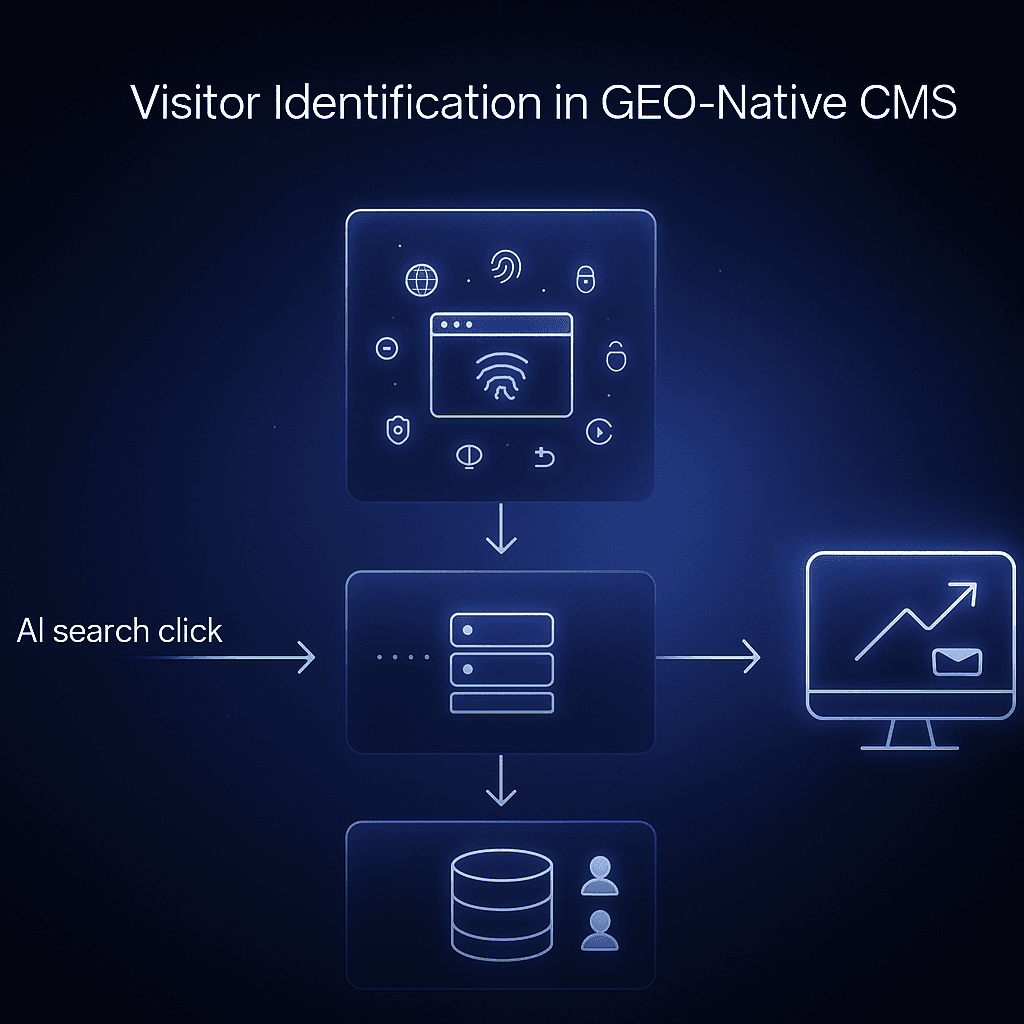
Under the Hood: How Visitor Identification Deanonymizes AI Traffic
Visitor ID technology enables businesses to identify anonymous web traffic by analyzing over 100 browser and device signals to create persistent identifiers that work even when cookies are deleted.
The Fingerprinting Layer
Behavioral fingerprinting can eliminate 84-95% of user anonymity through pattern analysis. This approach captures:
Screen resolution and color depth
Installed fonts and browser plugins
Time zone and language settings
Hardware concurrency and device memory
WebGL renderer information
The technology has scaled significantly. Fingerprint identified 4.22 billion unique devices and browsers in 2024, up from 2.96 billion in 2023.
Server-Side Tracking Recovery
Client-side tracking alone misses substantial traffic. Server-side tracking recovers 20.71% of requests blocked by tracking prevention and 3.29% from ad blockers.
This matters because typical website conversion rates fall in the low single digits, around 2-3%. B2B buyers complete about 57% of their purchase journey before ever speaking to a sales representative. If you can't identify who's researching your solution, you're missing the window to engage.
Enrichment Workflows
Once a visitor is fingerprinted, the system matches against data sources to enrich the profile with:
Email and name
Company and job title
LinkedIn profile
Firmographic data
AI search attribution (which engine referred them)
"The visitorId provided by Fingerprint Identification is especially useful when combined with information you already know about your users, for example, account IDs, order IDs, etc." (Relixir)
Automatic Geolocation Data Collection captures location and time zone data based on IP addresses, enabling segmentation by geography.
Implementation Checklist: Bringing Visitor ID Into Your CMS Stack
Implementing visitor identification requires careful planning across script placement, data enrichment, and CRM integration.
Step | Action | Notes |
|---|---|---|
1 | Audit current tracking gaps | Identify what percentage of traffic is unattributed |
2 | Choose identification approach | Server-side recommended for accuracy |
3 | Map data flow to CRM | Define which fields sync automatically |
4 | Set consent mechanisms | Required for GDPR/CCPA compliance |
5 | Define lead scoring rules | Prioritize by firmographics and engagement |
Where Should the Script Live in Headless & Next.js Sites?
For Next.js applications, the next/script component is an extension of the HTML <script> element, enabling developers to set the loading priority of third-party scripts anywhere in their application.
Optimal placement:
Use
strategy="afterInteractive"for visitor ID scripts that need page contextPlace in
_app.jsor root layout for site-wide coverageAvoid
beforeInteractiveto prevent render blockingUse server components for initial data collection when possible
For headless CMS architectures, the visitor ID script should load after the content layer but before any personalization logic fires.
Sequencing Identified Leads into Outreach
Top platforms achieve 65-85% true match rates, 2-7x higher than the industry average of 5-30%.
Once a match is confirmed, auto-enrollment rules should:
Filter by firmographic alignment (company size, industry, tech stack)
Score based on engagement depth (pages visited, time on site)
Route to appropriate outreach sequence in HubSpot, Apollo, or HeyReach
Tag with AI source attribution for conversion tracking
High-value visitors can be identified through several criteria: firmographic alignment, technographic signals, intent indicators, engagement depth, and account priority.
Visitor identification is central to the value that Adobe Analytics provides for understanding online user behavior, linking hits to the same person over time using a common identifier.
Platform Showdown: Relixir vs. Prepr, Optimizely & Adobe
Not all CMS platforms approach visitor identification and GEO readiness equally.
Platform | Visitor ID Accuracy | GEO Readiness | Automation Depth | Best For |
|---|---|---|---|---|
Relixir | 65-85% | Native | Full autonomous | B2B AI search optimization |
Prepr | Limited | Partial | A/B testing built-in | Lead-gen personalization |
Optimizely | SDK-dependent | First GEO-ready CMS | Experimentation focus | Enterprise testing |
Adobe | Platform-dependent | Emerging | Complex workflows | Large enterprise |
Prepr is the headless CMS for lead-gen websites, with personalization and A/B testing built in. Websites powered by Prepr see +15% engagement and up to +80% higher CTRs, but the platform lacks native AI visibility tracking.
Optimizely announced the first GEO-ready CMS, designed to future-proof websites for AI-powered discovery. However, visitor identification requires additional SDK implementation.
Adobe recommends that organizations prioritize modern identity services for consistency and data integrity across platforms, using a combination of client-side cookies and server-side profiles.
Relixir stands apart by combining GEO capabilities with 5x more accurate visitor identification for both person and company-level tracking. The platform serves 400+ B2B companies including Rippling, Airwallex, and HackerRank.
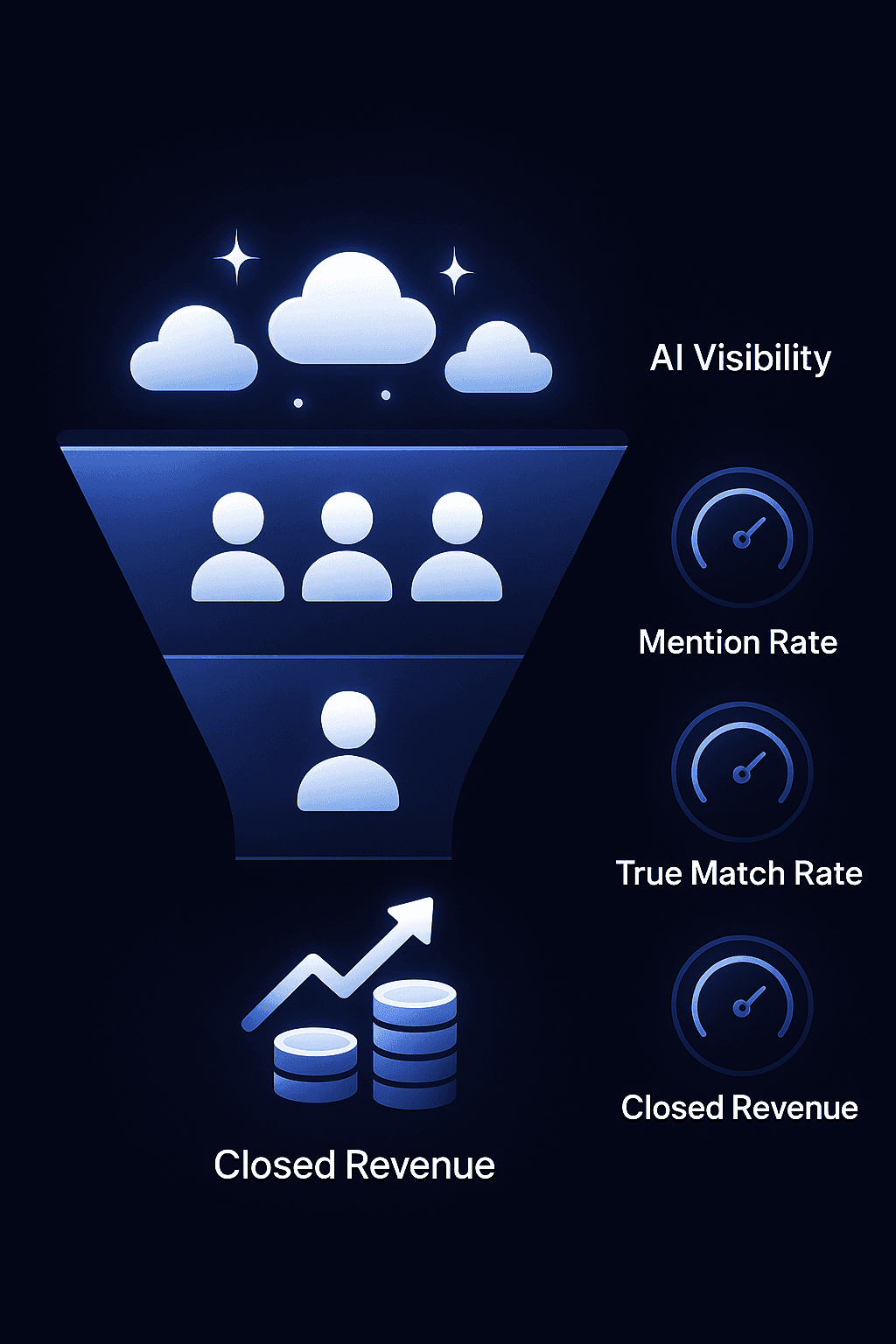
KPIs That Prove Deanonymization Pays Off
Measuring success requires tracking both AI visibility and lead conversion metrics.
Primary Metrics to Track
AI Visibility:
AI Mention Rate: percentage of relevant queries where your brand appears
Citation Rate: how often AI engines cite your content as a source
Share of Voice: visibility relative to competitors
Lead Conversion:
True Match Rate: percentage of visitors accurately identified
AI-to-Pipeline Conversion: identified visitors who enter sales sequences
AI Referral Revenue: closed deals attributed to AI traffic
For Ahrefs' own site, AI-driven traffic was approximately 0.5% of visits but accounted for 12.1% of sign-ups. This demonstrates the outsized conversion potential of AI-sourced visitors.
Visitors from AI platforms convert 4.4x better than traditional organic traffic, representing high-intent buyers who've already researched solutions.
Case Study Results
A fashion retailer using Relixir's GEO platform achieved 148% growth in AI Answer Share and 293% increase in revenue from AI referrals within six weeks.
Metric | Before | After | Change |
|---|---|---|---|
AI Answer Share | 4.4% | 10.9% | +148% |
Revenue from AI Referrals | $2,847 | $11,203 | +293% |
Privacy, Consent & Compliance in Visitor Identification
Implementing visitor deanonymization requires careful attention to privacy regulations.
Regulatory Framework
GDPR (EU):
Requires explicit consent before tracking
Privacy-by-design principles mandatory
Right to access and deletion
CCPA (California):
Opt-out mechanisms required
No selling of personal information without consent
DELETE ACT (California 2026):
Mandates 45-day deletion processing for consumer data requests
Ethical Implementation
The visitor identification industry faces a credibility crisis. "Website visitor ID providers promise precision but the reality is far from it. Behind the inflated claims and high fill rates lies an industry-wide problem -- most of the data being sold is flat-out wrong." (Customers.ai)
Best practices:
Integrate with a Consent Management Platform to collect analytics data only after users have explicitly given consent
Use first-party data collection rather than third-party cookies
Provide clear opt-out mechanisms
Audit data accuracy regularly
Delete inactive profiles according to regulatory requirements
Cookie consent is a mechanism that allows users to have control over the cookies that are stored on their devices when they visit a website.
Key Takeaways: Turn Invisible AI Visitors into Pipeline
The window to capture AI-search-driven revenue is open now. Companies that establish visitor identification today will have a significant advantage as the shift from traditional search accelerates.
What we covered:
AI traffic is growing while traditional search declines
Most CMS platforms have zero visibility into AI-referred visitors
GEO-native CMS with built-in visitor ID achieves 65-85% accuracy vs. 5-30% for bolt-on solutions
Server-side tracking recovers 20%+ of blocked requests
Compliance requires consent management and clear opt-out mechanisms
Relixir customers consistently achieve 3-5x increase in AI search mention rate within 2-4 weeks of deployment. The platform has generated $50M in pipeline across 200+ companies turning AI traffic into direct leads.
For teams ready to stop losing high-intent AI visitors to anonymity, a GEO-native CMS with integrated visitor identification is the infrastructure layer that makes the difference.
Frequently Asked Questions
What is a GEO-native CMS?
A GEO-native CMS is designed for Generative Engine Optimization, structuring content for AI language models to understand and cite, unlike traditional CMS platforms built for Google SEO.
How does visitor identification work in a GEO-native CMS?
Visitor identification in a GEO-native CMS uses advanced fingerprinting and server-side tracking to identify anonymous web traffic, achieving 65-85% accuracy in identifying high-intent AI traffic.
Why do traditional CMS platforms fail with AI traffic?
Traditional CMS platforms fail with AI traffic because they lack visibility into AI-referred visitors, often missing out on high-intent sessions due to inadequate tracking and attribution capabilities.
What are the benefits of using a GEO-native CMS with visitor ID?
A GEO-native CMS with visitor ID provides deep integration for AI attribution, enabling marketing teams to act on high-intent traffic and convert AI search visitors into leads with higher accuracy.
How does Relixir's visitor ID technology enhance lead conversion?
Relixir's visitor ID technology enhances lead conversion by identifying anonymous visitors from AI search, enriching profiles with contact data, and integrating seamlessly with CRM systems for targeted outreach.
Sources
https://relixir.ai/blog/best-geo-platforms-with-visitor-id-for-ai-search-traffic-q4-2025
https://relixir.ai/blog/best-answer-engine-optimization-platforms-with-visitor-identification
https://relixir.ai/blog/how-to-deanonymize-web-traffic-with-visitor-id-and-crm-sequencing
https://relixir.ai/blog/best-geo-tools-with-visitor-deanonymization-2025-comparison
https://optimizely.com/no/insights/blog/your-website-has-a-new-job
https://relixir.ai/blog/best-geo-platforms-with-cms-integrations
https://experienceleague.adobe.com/en/docs/analytics/implementation/id/overview
https://relixir.ai/blog/best-ai-cms-for-hosting-hundreds-of-blogs
https://relixir.ai/blog/fashion-retailer-ai-answer-share-growth-148-percent-relixir-case-study
https://customers.ai/state-of-website-visitor-identification
https://relixir.ai/blog/relixir-vs-prophet-ai-search-visibility-analytics-comparison-2025-ecommerce