
How To Improve AI Visibility for Crypto Platforms: A Guide
Crypto platforms improve AI visibility by building educational content hubs that achieve 84-94% non-branded reach, implementing structured data with JSON-LD endpoints, and maintaining continuous content refresh cycles. With 37% of product queries starting in AI assistants rather than traditional search, platforms must optimize specifically for LLM citation patterns to capture high-intent buyers.
TLDR
Only 9% of blockchain companies appear in ChatGPT, Perplexity, and Gemini responses, leaving 91% invisible to AI-driven discovery channels
Educational content hubs drive the highest AI visibility, with platforms like Binance Academy (689 pages) and Coinbase Learn (122 pages) dominating citations
Pages with valid JSON-LD schema markup are 2-4x more likely to appear in Google AI Overviews
AI-specific crawler traffic increased 23-fold between January 2024 and April 2025, signaling the rapid shift to AI discovery
Market leaders achieve 31% Share of Model across AI platforms while laggards remain at 0%
Content refresh programs can reclaim first-page placement for 68% of target queries within two quarters
AI visibility for crypto platforms has become the decisive factor in user acquisition. Over 1 billion people now use AI search weekly to research products, compare solutions, and make purchasing decisions. If your exchange, DeFi protocol, or blockchain project is invisible in ChatGPT, Perplexity, and Gemini, you are missing the buyers who convert at the highest rates.
This guide walks through every step, from diagnosing your current footprint to implementing structured data and tracking AI-referred leads.
Why Does AI Visibility Now Define Crypto Discovery?
The shift from traditional search to AI-driven discovery is not gradual. In 2025, an estimated 37% of product-related queries now start with a chat-style assistant, not a classic SERP. Gartner predicts that 25% of traditional search volume will disappear by 2026, replaced by chat-based interfaces.
For crypto, the stakes are even higher. Research from Avenue Z found that only 9% of blockchain companies appear in ChatGPT, Perplexity, and Gemini. The remaining 91% are invisible to the fastest-growing discovery channel.
Generative engine optimization (GEO) is the discipline of designing content so that large language models can retrieve, summarize, and cite it. Traditional crypto SEO still matters, but it no longer guarantees visibility. A ten-million-query audit found that only 12% of pages cited by ChatGPT overlapped with Google's first page. Ranking on Google does not automatically mean ranking in AI answers.
Key takeaway: If your platform is not appearing in AI-generated responses, you are already losing high-intent buyers to competitors who are.
How Do You Diagnose Your Current AI Footprint?
Before optimizing, you need to measure. AI visibility tools track how your brand appears in AI-generated responses, measuring citations, mentions, visibility scores, and competitor positioning.
Start by identifying your Share of Model, the percentage of relevant queries where your brand appears. According to the 2026 AI Visibility Benchmark Report, market leaders average a 31% Share of Model across all platforms, while laggards sit at zero.
Here is what to track:
Mention rate: How often does your brand appear in AI answers for target queries?
Citation rate: How frequently do AI engines cite your pages as sources?
Sentiment analysis: How do AI platforms characterize your brand?
Competitor positioning: Where do rivals appear instead of you?
Several platforms can help. AI visibility tools measure citations, mentions, and visibility scores, but they show symptoms rather than root causes. As of November 2025, Google AI Overviews appear in 47% of results, making multi-platform coverage essential.
Run queries that your target users would ask, such as "best DeFi lending protocol" or "how to stake ETH safely." Document which brands appear, which sources get cited, and where gaps exist. This baseline informs every optimization decision that follows.
What Content Hubs Earn LLM Citations?
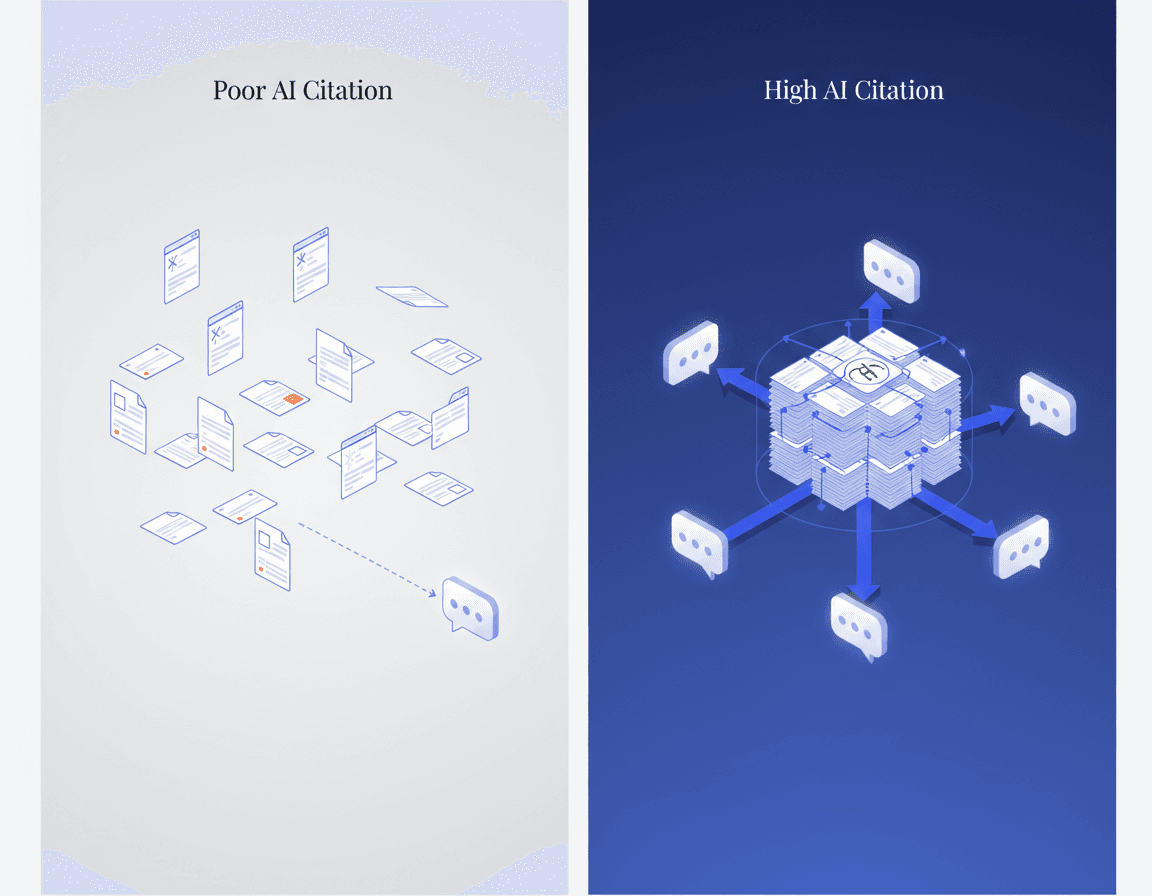
AI engines pull from well-organized, comprehensive content libraries, not scattered individual pages. The data is clear: "Educational content drives discovery: Projects with learning centers achieve 84-94% non-branded visibility, appearing for queries like 'what is ethereum' from users who've never heard of them. Projects without educational infrastructure show 48-64% branded visibility—only found by people who already know about them," according to Atlas Arrow Digital's research.
Two content types dominate AI citations:
Educational hubs answer top-of-funnel questions. Binance Academy has 689 indexed pages. Coinbase Learn covers 122 pages from beginner fundamentals to advanced DeFi strategies. Kraken Learn drives 235,000 monthly organic visits from just 89 pages.
Decision-stage content captures buyers comparing solutions. AI concentrates on decision pages: industry pages show 1.14% AI penetration, tools pages 0.95%, and pricing pages 0.46%, all 4-9x higher than the site average of 0.13%.
Format also matters. Comparative listicles generated 32.5% of all links, far outperforming how-tos, thought-leadership essays, and news articles. Build content that directly answers the questions users ask AI assistants, structured in clean, quotable chunks.
Content Type | AI Citation Potential | Example |
|---|---|---|
Learning center | High (84-94% non-branded reach) | Glossary, how-to guides |
Comparison pages | Very high | "Best DEX for low fees" |
Pricing/feature pages | High on decision queries | Transparent fee breakdowns |
Press releases | Low | One-time announcements |
Implement Structured Data & JSON-LD Endpoints
Structured data transforms your content into labeled data that LLMs can parse efficiently. "Schema that helps LLMs means adding structured data—especially FAQPage, HowTo, and Product—to your pages so large language models can reliably extract facts, steps, and offers," explains Neo Core's playbook.
The impact is measurable. Pages with valid schema markup are 2-4x more likely to appear in Google's AI Overviews and featured snippets.
Here is how to implement it:
Publish a dedicated JSON-LD endpoint. As Growth Marshal puts it, "A lean JSON-LD endpoint—pure UTF-8, compressed, cache-friendly—looks like a VIP pass" for AI crawlers.
Use FAQPage schema for common user questions about your protocol or exchange.
Apply HowTo schema for tutorials like "How to bridge tokens" or "How to connect a wallet."
Define Organization, Product, and Person objects explicitly. Include founders, key hires, and offers like you are writing for an audit.
Ensure content parity. If AI sees schema data not visible on the rendered page, Google flags it as spam.
JSON-LD is the dominant format in 2026. Google explicitly recommends it, and AI tools generate it by default. Every endpoint must include @context and @type syntax, or crawlers skip it entirely.
How Often Should You Refresh Crypto Content for AI Crawlers?
Content freshness is one of the most underappreciated factors in AI search visibility. "In AI-driven environments, models frequently learn from fresh crawls, publisher feeds, and co-citation patterns. That means the previous quarter's 'best answer' can be displaced quickly by newly corroborated, better-structured content," notes Single Grain's GEO playbook.
AI systems update sources on different timeframes. Foundation models retrain a few times per year, while retrieval systems that fetch live web pages can update daily or in real time.
The results from systematic refresh are significant. Deloitte's 2025 State of Generative AI in Enterprise documents an "evergreen sprint" program where a global firm automated updates with GEO structuring. Within two quarters, the refreshed corpus reclaimed first-page placement for 68% of target queries, reduced bounce rate by 28%, and cut support call volume by 14%.
Build a refresh cadence:
Weekly: Update pricing, TVL, APY, and other volatile metrics
Monthly: Review competitor comparisons and add new entrants
Quarterly: Audit all educational content for outdated information
On product release: Refresh every page that references changed features
Automate where possible. Sync your knowledge base, product docs, and release notes so dependent content updates automatically.
Track, Attribute & Convert AI-Referred Traffic
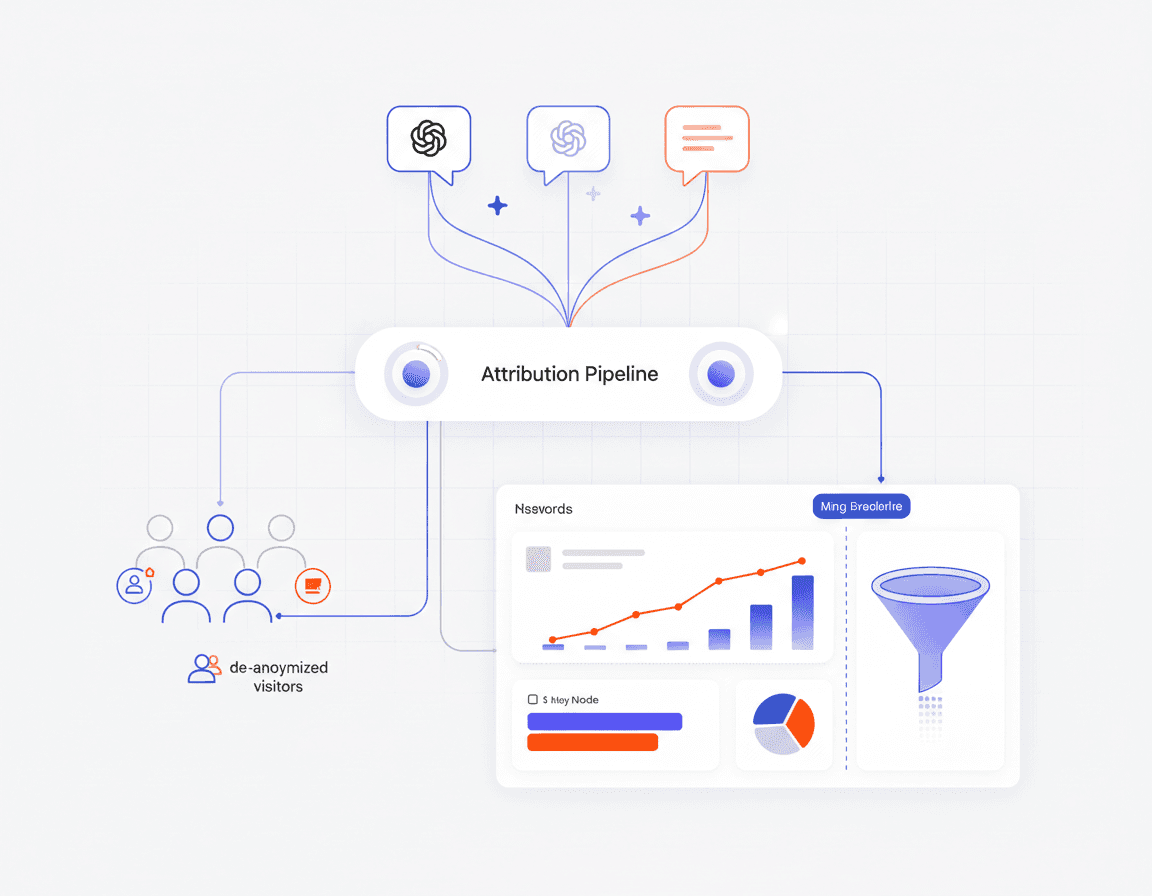
Driving AI search traffic is only valuable if you can convert it. The challenge: AI browsers disrupt how GA4 records referral data, obscuring traffic sources and discovery patterns.
Perplexity Comet typically passes referrer information, appearing in GA4 with a source like perplexity.ai. ChatGPT Atlas often strips referrer headers, so sessions appear as "Direct" or "not set." This makes attribution difficult without additional configuration.
Here is how to fix it:
Create custom channel groups in GA4 to classify AI-related traffic correctly
Use UTM parameters on links you share through AI-discoverable content
Monitor for spikes in direct traffic that correlate with AI visibility improvements
Visitor de-anonymization takes this further. "Visitor de-anonymization is a game-changer for businesses looking to gain deeper insights into their customer base," according to Relixir's comparison. Top platforms identify 3x more visitors at the person level compared to standard tracking solutions.
This matters because AI-referred visitors have already done their research. They arrive with high purchase intent and convert at dramatically higher rates than traditional organic traffic.
Monitoring Tools vs End-to-End Platforms: Which Stack Wins?
The market offers two approaches: point solutions that monitor visibility, and end-to-end platforms that combine monitoring with content generation and optimization.
Monitoring-only tools include:
Profound: Enterprise-grade depth at $499/month, tracks eight major AI engines
Peec AI: Mid-market speed starting at €89/month, covers ChatGPT, Perplexity, Google AI Overviews, and Claude
Otterly: Budget-friendly at $29/month with a GEO Audit Tool
Ahrefs Brand Radar leverages 110B keywords and 150M+ real prompts for authentic AI visibility monitoring
The limitation: "Buying a scale doesn't make you lose weight. It shows you the problem," as Discovered Labs puts it. These tools tell you where you are losing but do not help you create the content to win.
End-to-end platforms combine monitoring with content generation, schema management, and automated refresh. They can flip AI rankings in under 30 days versus 60-90 days for assembled solutions. For crypto platforms with limited content teams, the automation advantage is substantial.
The right choice depends on your resources. If you have a strong content team and just need visibility data, monitoring tools work. If you need to scale content production while maintaining AI optimization, an integrated platform delivers faster results.
Putting It All Together (and Where Relixir Fits)
Improving AI visibility for crypto platforms requires a systematic approach:
Diagnose your current Share of Model and identify gaps
Build educational and decision-stage content hubs optimized for citation
Implement structured data with proper JSON-LD endpoints
Refresh content continuously to match AI update cycles
Track AI-referred traffic and de-anonymize visitors for conversion
Choose the right tooling based on your team's capacity
For platforms seeking an integrated solution, Relixir offers a GEO-native CMS that combines all these capabilities. Relixir-generated blogs get cited 3x more often in AI search than traditional blogs, with customers seeing 3-5x increases in AI search mention rates within 2-4 weeks of deployment.
The window to establish AI search visibility is open now. As LLMs increasingly prioritize domain-specific content over third-party sources, the crypto platforms that invest in GEO today will capture the high-intent buyers that competitors miss.
Frequently Asked Questions
How can a crypto platform improve AI visibility quickly?
Start by measuring your current Share of Model across ChatGPT, Perplexity, and Gemini. Brands that publish knowledge-centered hubs see up to 94% non-branded reach, while 91% of blockchain projects remain invisible. Pair those hubs with JSON-LD endpoints and continuous refresh; Deloitte-style GEO sprints lifted first-page placement by 68% in two quarters. Finally, monitor citations weekly and fix gaps. Leaders average 31% Share of Model versus 0% for laggards.
Which structured data helps LLMs cite crypto pages?
Focus on FAQPage, HowTo, and Product schema. Pages with valid JSON-LD for these types are 2-4x more likely to appear in Google AI Overviews. Publishing a dedicated JSON-LD endpoint acts like a "VIP pass" for LLM crawlers, while endpoints without @context and @type syntax are often skipped. Remember: markup must match on-page content, as hidden entities get flagged as spam.
Frequently Asked Questions
How can a crypto platform improve AI visibility quickly?
Start by measuring your current Share of Model across ChatGPT, Perplexity, and Gemini. Brands that publish knowledge-centered hubs see up to 94% non-branded reach, while 91% of blockchain projects remain invisible. Pair those hubs with JSON-LD endpoints and continuous refresh; Deloitte-style GEO sprints lifted first-page placement by 68% in two quarters. Finally, monitor citations weekly and fix gaps. Leaders average 31% Share of Model versus 0% for laggards.
Which structured data helps LLMs cite crypto pages?
Focus on FAQPage, HowTo, and Product schema. Pages with valid JSON-LD for these types are 2-4x more likely to appear in Google AI Overviews. Publishing a dedicated JSON-LD endpoint acts like a "VIP pass" for LLM crawlers, while endpoints without @context and @type syntax are often skipped. Remember: markup must match on-page content, as hidden entities get flagged as spam.
What content types are most effective for AI citations in crypto?
Educational hubs and decision-stage content are most effective. Educational hubs answer top-of-funnel questions, while decision-stage content captures buyers comparing solutions. Comparative listicles and structured content that directly answers AI queries are particularly effective.
How often should crypto content be refreshed for AI visibility?
Content should be refreshed regularly to maintain AI visibility. Update volatile metrics weekly, review competitor comparisons monthly, audit educational content quarterly, and refresh pages on product release. Automate updates by syncing with your knowledge base and product docs.
How does Relixir enhance AI visibility for crypto platforms?
Relixir offers a GEO-native CMS that combines content generation, schema management, and automated refresh. Relixir-generated blogs get cited 3x more often in AI search than traditional blogs, with customers seeing 3-5x increases in AI search mention rates within 2-4 weeks of deployment.
Sources
https://atlasarrowdigital.com/topics/crypto-seo/organic-visibility-research
https://getairefs.com/learn/the-ai-search-optimization-guide/
https://www.blog.jonathansnow.com/p/blockchain-ai-search-visibility-index-2025
https://www.knewsearch.com/blog/ai-visibility-benchmark-report
https://www.tryaivo.com/blog/best-ai-visibility-monitoring-tools-2025-profound-peec-comparison
https://theneocore.com/schema-that-helps-llms-faq-howto-product-playbook/
https://www.digitalapplied.com/blog/schema-markup-ai-generation-guide-2026
https://www.growthmarshal.io/field-notes/how-to-use-endpoints-to-drive-llm-citations
https://www.singlegrain.com/geo/content-refresh-cycles-for-ai-driven-content/
https://martech.org/how-ga4-records-traffic-from-perplexity-comet-and-chatgpt-atlas/
https://relixir.ai/blog/best-geo-tools-with-visitor-deanonymization-2025-comparison
https://relixir.ai/blog/top-answer-engine-optimization-platforms-with-visitor-identification