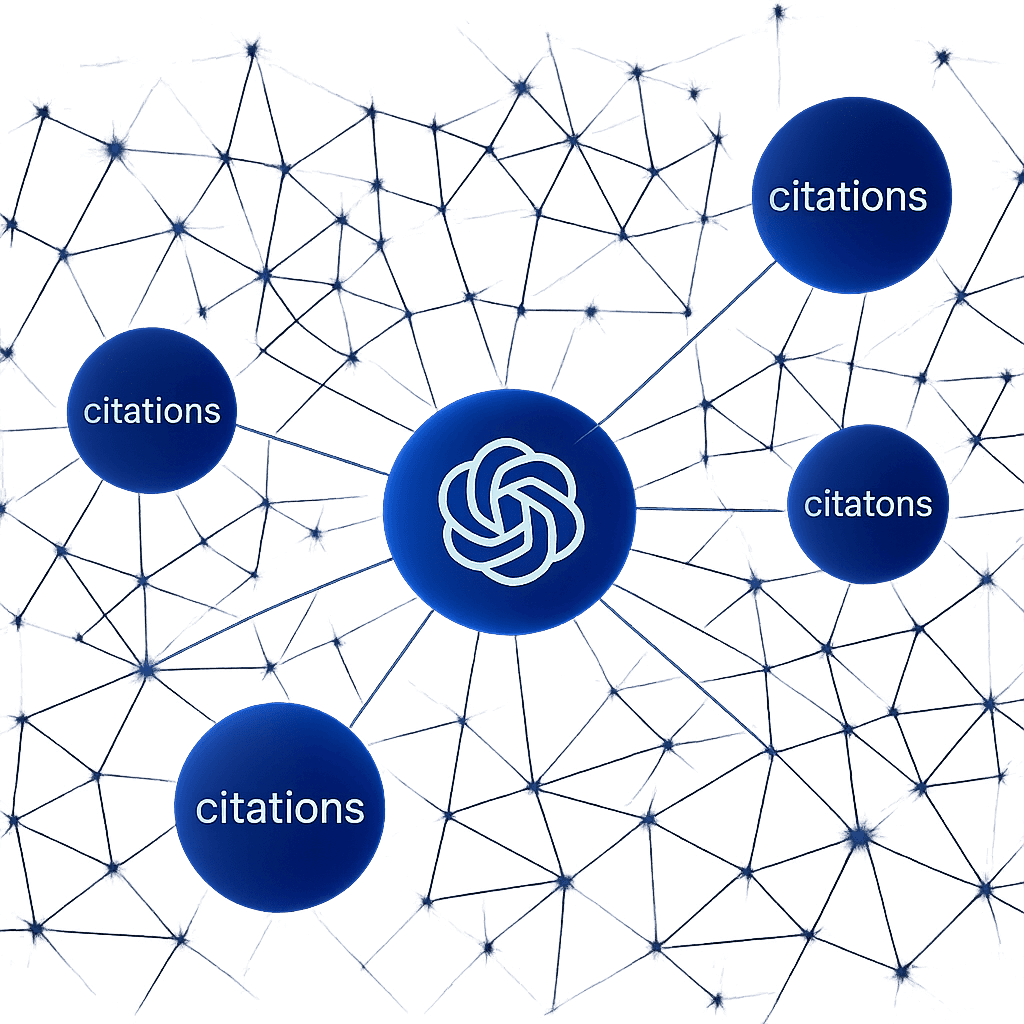
How to Monitor AI Search Citations & Convert Visitors to Leads
AI search citations determine whether brands appear in ChatGPT, Perplexity, and Gemini recommendations, with up to 70% of queries influenced by AI engines by 2025. Effective monitoring requires tracking share of voice across AI platforms, implementing visitor identification with 65-85% accuracy rates, and automating content optimization through closed-loop GEO systems.
Key Facts
• AI Traffic Growth: AI-generated B2B traffic represents 2-6% of organic traffic and grows at over 40% monthly, with ChatGPT alone reaching 416 million monthly users
• Citation Impact: Brands cited in AI Overviews earn 35% more organic clicks and 91% more paid clicks compared to uncited competitors
• Visitor Identification: Advanced platforms like Relixir achieve up to 3× more accurate person-level identification than traditional pixels, enabling direct lead conversion
• Market Evolution: Traditional search volume will drop 25% by 2026 as AI chatbots capture market share
• Platform Capabilities: Leading GEO tools now offer closed-loop publishing that can flip AI rankings in under 30 days
• Revenue Potential: AI platform traffic drives up to 12% of website visits, worth $750 billion in revenue potential by 2028
AI search citations now decide whether your brand even enters the conversation. When buyers ask ChatGPT, Perplexity, or Gemini for product recommendations, your presence in that answer determines whether you make the shortlist or disappear entirely. This post shows growth teams how to track those citations end-to-end and turn the resulting traffic into pipeline.
Why AI Search Citations Are the New Front-Door to Your Pipeline
The way buyers discover solutions has fundamentally shifted. "The AI revolution is reshaping how brands get discovered online. Generative engines like ChatGPT, Perplexity, Gemini, and Bing Copilot will influence up to 70% of all queries by the end of 2025."
This shift matters because traditional SEO strategies are losing their effectiveness. With 60% of Google searches ending without a click in 2024, ranking on page one no longer guarantees traffic. Instead, AI engines synthesize answers directly, citing sources they trust.
The stakes are significant:
90% of organizations now use generative AI in some aspect of their purchasing process
AI-generated B2B traffic represents 2-6% of organic traffic and grows at over 40% monthly
ChatGPT reaches 416 million monthly users with 5.4 billion total visits
Generative Engine Optimization (GEO) has emerged as the discipline of ensuring your brand appears in these AI-powered responses. Unlike traditional SEO, which aims to rank content on a results page, GEO aims to get your content quoted in a single, helpful answer.
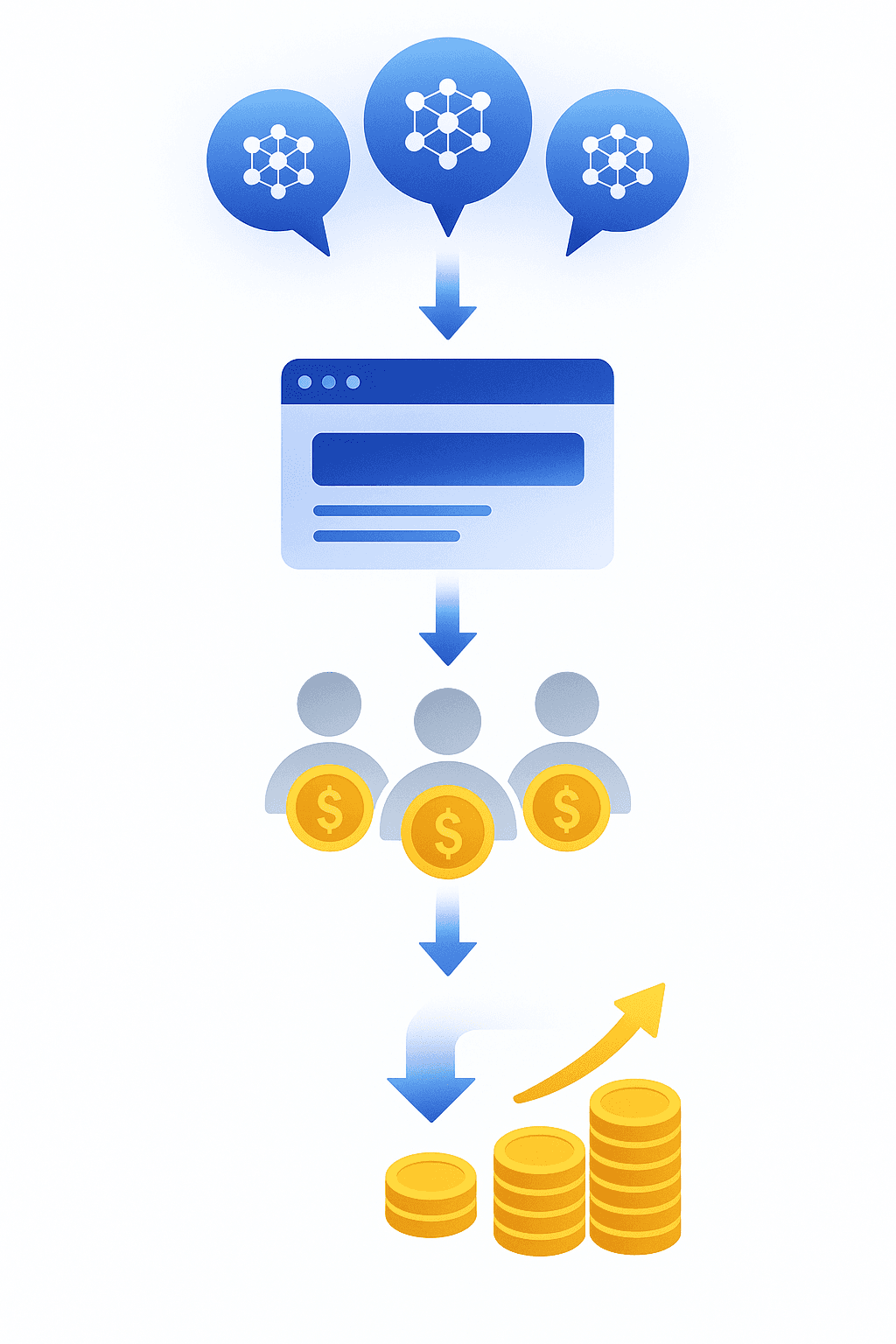
How Do Citations Translate into Traffic, Leads, and Revenue?
AI citations drive measurable business outcomes. The data shows that companies appearing in AI answers capture significantly more demand.
Traffic and Revenue Potential
AI platforms like ChatGPT and Perplexity now drive up to 12% of website traffic, worth $750 billion in revenue potential by 2028. This traffic also behaves differently than traditional search visitors.
Lead Generation Impact
Companies implementing GEO strategies have seen substantial results. Relixir demonstrates 17% increases in inbound leads within six weeks, with automated optimization reducing content costs by 22%.
Citation Value
Brands cited in AI Overviews earn 35% more organic clicks and 91% more paid clicks compared to those not cited. The difference between being mentioned and being invisible directly impacts your pipeline.
Metric | Impact |
|---|---|
Inbound lead increase | 17% in 6 weeks |
Content cost reduction | 22% via automation |
AI traffic revenue potential | $750B by 2028 |
Organic CTR lift when cited | 35% higher |
Key takeaway: AI citations are no longer optional for demand generation; they directly determine whether your brand enters the buyer's consideration set.
Tool Landscape: How Relixir Stacks Up Against Brand Radar, Semrush & Writesonic
The market for AI citation monitoring has evolved rapidly. Each platform approaches the problem differently, with distinct strengths and limitations.
Platform Comparison Overview
Feature | Relixir | Ahrefs Brand Radar | Semrush AI Visibility | Writesonic |
|---|---|---|---|---|
Price | $199-$499/mo | Varies | ||
Prompt Database | Proprietary | Monthly updates | 120M+ conversations | |
Closed-Loop Publishing | Yes | No | No | Limited |
Visitor ID | 65-85% accuracy | No | No | No |
Multi-Engine Coverage | All major AI engines | ChatGPT, Perplexity, Gemini | ChatGPT, Gemini, Perplexity | Multiple platforms |
Ahrefs Brand Radar: Largest Prompt Corpus, But No Closed-Loop Fixes
Ahrefs Brand Radar offers the most extensive AI visibility database, powered by search-backed prompts rather than synthetic ones. The platform processes over 263 million monthly prompts, giving marketers unprecedented visibility into how brands appear in AI conversations.
Brand Radar now works like Site Explorer, with an Overview and dedicated reports for different kinds of data. Users can track brand mentions in ChatGPT and Perplexity, with Gemini support expanding.
Strengths:
Largest prompt corpus in the market
Real AI-generated answer tracking
Topic clustering for content gap analysis
Limitations:
The platform excels at monitoring but stops short of action. Once you identify a citation gap, you need separate tools to create, optimize, and publish content. There's no automated workflow to close the loop between insight and execution.
Semrush AI Visibility Toolkit: Affordable Entry, Limited Visitor Intel
Semrush provides a visibility benchmark for any brand's presence in AI with the AI Visibility Score. At $99 per month, it offers an accessible entry point for teams exploring AI search monitoring.
The toolkit helps SEOs and marketers benchmark brand visibility in AI-generated answers, analyze brand perception and sentiment, and identify competitive gaps. The AI Visibility Score reflects how often your brand is mentioned compared to the median number of mentions for top industry competitors.
Strengths:
Affordable pricing for SMBs and agencies
Integration with existing Semrush SEO workflows
Daily prompt tracking updates
Limitations:
Semrush lacks a visitor identification layer. You can see that AI traffic is arriving, but you cannot identify who those visitors are or route them into sequences. For teams focused on pipeline generation, this creates a critical gap between visibility and conversion.
What Are the 5 Essential Steps to Monitor AI Search Citations?
Effective AI citation monitoring follows a repeatable framework. Here's how practitioners can build a scalable system.
1. Build Prompt Buckets by ICP & Use Case
Start by organizing keywords into folders by product, ICP, or use case. Relixir simulates real-world prompts and keywords using proprietary search panel data across Google and every major AI search engine.
Group prompts into categories that match buyer intent:
Exploratory prompts ("best payroll software for startups")
Competitor-based prompts ("alternatives to [competitor]")
Use-case specific prompts ("how to automate expense tracking")
For each keyword folder, auto-generate exploratory and competitor-based prompts, then bulk generate and add prompts at scale.
2. Track Share-of-Voice, Mentions & Sentiment
Define the KPIs that matter for executive reporting. The AI Visibility Score reflects how often your brand is mentioned in AI-generated answers compared to the median number of mentions for your top industry competitors.
Key metrics to track:
Mention rate: Percentage of prompts where your brand appears
Position ranking: Where you appear in the AI response
Sentiment: How AI engines characterize your brand
Citation sources: Which pages AI engines reference
3. Set Real-Time Alerts for Competitor Wins
Automate monitoring so you know immediately when a competitor displaces you. Google Profile Monitor tracks changes to profiles, and similar capabilities exist for AI visibility.
Configure alerts for:
New competitor mentions in your target prompts
Drops in your share of voice
Changes in sentiment or positioning
New citation sources appearing for competitors
4. Diagnose Why You Lost the Citation
When competitors win citations you should have, analyze backlink authority and relevance to understand why. Common root causes include:
Missing schema: AI engines can't parse your content structure
Weak backlink profile: Your content lacks authority signals
No proprietary data: Generic content gets skipped for unique insights
Outdated information: Stale content loses credibility
5. Publish or Refresh Content via GEO Automation
Close the loop by taking action on insights. Relixir provides a complete GEO Content Engine with auto-publishing capabilities, turning visibility gaps into published content without manual intervention.
The automated workflow should:
Identify high-priority gaps based on search volume and competitive position
Generate content optimized for AI citation patterns
Embed proper schema and structural elements
Publish directly to your CMS
Refresh outdated content to maintain rankings
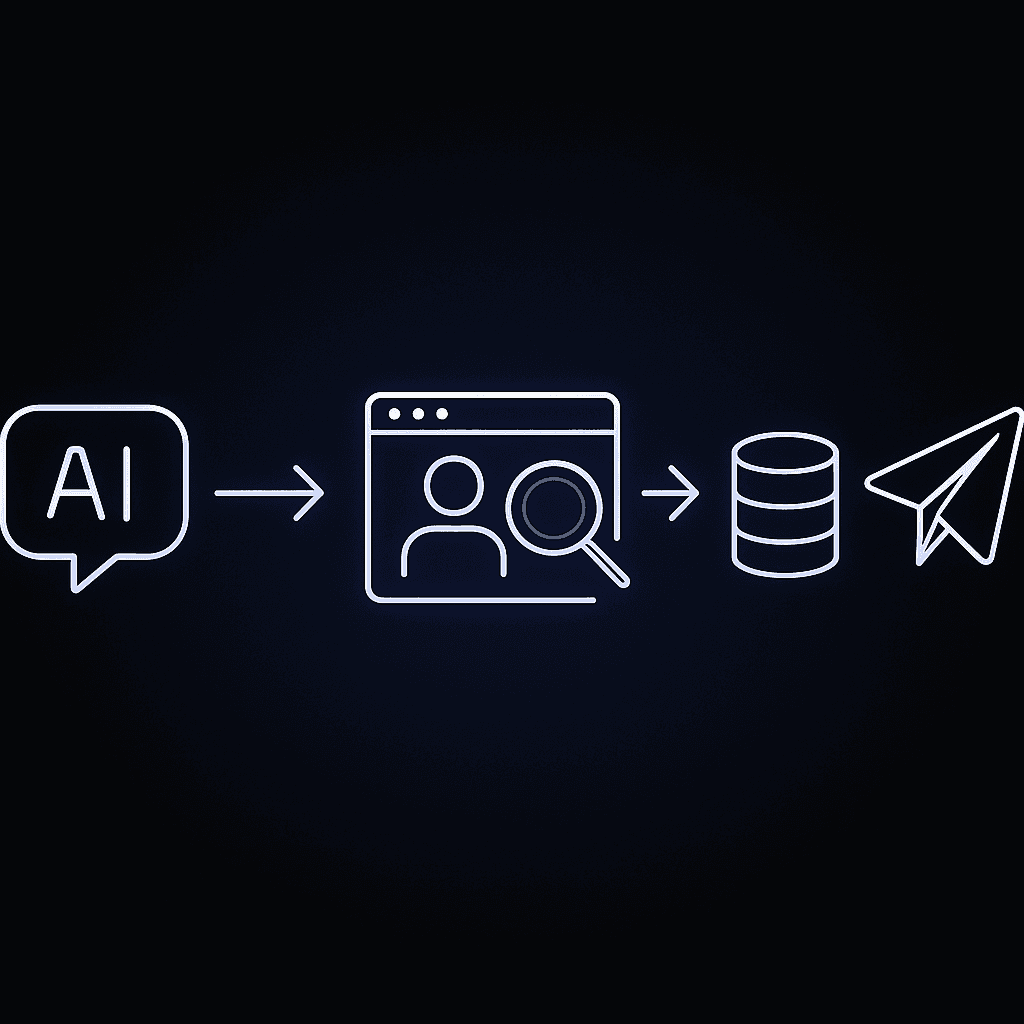
How Can You Turn AI Search Traffic into Identified Leads?
Visitor identification transforms anonymous AI traffic into actionable pipeline. Without it, you're blind to who's arriving from ChatGPT or Perplexity.
The Identification Gap
Most GEO platforms with visitor ID achieve only 5-30% accuracy when identifying website visitors, leaving companies blind to high-intent AI traffic. Traditional pixels miss the majority of visitors, especially those arriving from AI engines.
Relixir's proprietary Visitor ID script provides up to 3× more accurate person-level identification and 40% higher company-level identification. Top performers deliver 65-85% accuracy rates, a 5× improvement that translates directly to more qualified leads.
Map First-Party Intent Signals
Connect the prompt to the page to the CRM record. The industry needs platforms that combine GEO capabilities with accurate visitor tracking, delivering higher precision than alternatives.
Capture these data points:
Referral source: Which AI engine sent the visitor
Landing page context: What prompt likely triggered the visit
Firmographic data: Company name, size, industry
Contact information: Email, name, LinkedIn profile
Automated Sequences for High-Intent Visitors
Once visitors are deanonymized, trigger personalized outreach. Agents can scan news, podcasts, and reports to find the "why now" for every prospect, enabling relevant follow-up.
High-intent AI visitors convert at significantly higher rates because they've already researched your category. They discovered your brand through a trusted AI recommendation, which pre-qualifies their interest.
Key takeaway: AI-origin leads convert up to 20× higher than cold outreach because these buyers already have purchase intent from their AI research.
Optimizing Content & Schema to Win the Next Citation
Technical GEO fixes determine whether AI engines can understand and cite your content. Schema markup, proprietary data, and backlinks all influence citation selection.
Schema Implementation
Structured data helps AI engines understand and cite your content accurately. Essential schema types include:
FAQ schema: One of the most effective types for AI-generated responses
Product schema: Critical for ecommerce citations
Organization schema: Establishes brand entity recognition
Article schema: Signals content freshness and authorship
Backlink Authority
Schema markup serves as the foundation of technical GEO implementation, providing the structured data that AI systems require to understand and cite your content accurately. But backlinks remain crucial authority signals.
Backlinks with high Influence and high Relevance scores, sometimes called "Golden Links," carry the most weight. Focus on building links from topically relevant, authoritative sources.
Proprietary Data Advantage
AI engines prioritize unique insights over generic summaries. AI-generated answers drive higher-intent traffic with conversion rates up to 6× higher than traditional traffic when you're the cited source.
Content containing original research, case studies, and first-party data earns more citations than content that merely synthesizes existing information.
What's Next: Gemini 3, DR Agents & the Rise of Answer-Only SERPs
The AI search landscape continues to evolve rapidly. Understanding upcoming shifts helps teams prepare their monitoring strategies.
Gemini 3 and Enhanced Reasoning
Google's Gemini 3 represents the next frontier in AI search. The model offers state-of-the-art reasoning that grasps depth and nuance, unlocking new generative UI experiences with dynamic visual layouts and interactive tools.
Gemini 3 Pro tops the LMArena Leaderboard with a breakthrough score of 1501 Elo, demonstrating superior performance across reasoning, multimodality, and coding benchmarks. AI Overviews now have 2 billion users every month.
Traffic Decline Predictions
Gartner predicts that by 2026, traditional search engine volume will drop 25%, with search marketing losing market share to AI chatbots and other virtual agents. This trajectory makes AI citation monitoring increasingly critical.
AI Overview Expansion
In May 2025, Semrush data showed AIOs appeared in nearly 20% of all Google queries, up from just 6% in January. The expansion of answer-only results means traditional ranking positions matter less than citation inclusion.
Key takeaway: The window for establishing AI visibility is narrowing. Teams that build monitoring and optimization capabilities now will have significant advantages as AI-first search becomes dominant.
Key Takeaways & Next Steps
AI search citations have become the new front door to your pipeline. Here's how to move forward:
Immediate Actions:
Audit your current AI visibility across ChatGPT, Perplexity, and Gemini
Identify the top 20 prompts where you should appear but don't
Implement schema markup on high-priority content
Set up monitoring for competitor citation wins
Platform Selection Criteria:
Look for closed-loop capabilities that connect monitoring to action
Prioritize visitor identification accuracy above 60%
Ensure multi-engine coverage beyond just Google AI Overviews
Evaluate CRM integration for sequence automation
Relixir is an Inbound Engine for AI Search that helps 200+ B2B companies like Rippling, Airwallex, and HackerRank monitor, grow, and convert AI search demand across ChatGPT, Perplexity, Gemini, Google AI Overviews, and more. The platform builds and maintains landing pages optimized for both SEO and GEO, designed to maximize AI citations and inbound conversion.
For teams ready to capture AI search demand, the path forward combines monitoring, content automation, and visitor identification into a unified system. The brands that build this infrastructure now will dominate their categories as AI-first search becomes the default.
Frequently Asked Questions
What are AI search citations?
AI search citations refer to instances where AI engines like ChatGPT, Perplexity, or Gemini reference your brand or content in their generated responses. These citations are crucial for visibility and can significantly impact your brand's presence in AI-driven search results.
How do AI search citations impact lead generation?
AI search citations can drive significant traffic to your website, which can be converted into leads. Brands cited in AI responses often see increased organic and paid clicks, leading to higher inbound lead generation and revenue potential.
What is Generative Engine Optimization (GEO)?
Generative Engine Optimization (GEO) is the practice of optimizing content to ensure it appears in AI-generated responses. Unlike traditional SEO, GEO focuses on getting content cited in AI answers, which can drive more targeted traffic and leads.
How does Relixir help with AI search citation monitoring?
Relixir provides a comprehensive platform for monitoring AI search citations, offering tools to track share-of-voice, mentions, and sentiment across major AI engines. It also automates content optimization and visitor identification to convert AI traffic into leads.
What are the benefits of using Relixir for AI search optimization?
Relixir automates the process of monitoring and optimizing AI search citations, helping brands increase visibility and convert AI-driven traffic into leads. It offers features like prompt simulation, visitor ID, and content automation, making it a comprehensive solution for AI search optimization.
Sources
https://relixir.ai/blog/athenaq-vs-relixir-2025-geo-content-automation-comparison
https://relixir.ai/blog/best-visitor-id-tracking-for-ai-search-relixir-leads-5-alternatives
https://relixir.ai/blog/best-geo-platforms-with-visitor-id-for-ai-search-traffic-q4-2025
https://relixir.ai/blog/top-geo-platforms-for-enterprises-november-2025
https://relixir.ai/blog/best-tools-to-track-ai-search-citations
https://www.maximuslabs.ai/generative-engine-optimization/technical-geo-implementation