How To Rank in AI Search as a DTC Brand: A Guide
DTC brands can rank in AI search by implementing structured data with JSON-LD schema, building entity depth across product pages, earning media mentions and reviews, and measuring Share of Answer metrics. Traffic from generative AI platforms surged 4,700% year-over-year and converts at 4.4x the rate of typical organic sessions.
TLDR
AI search dominance: Half of consumers use AI to guide purchasing decisions, making GEO essential for DTC visibility
Technical foundation: Implement JSON-LD product schema, build entity depth, and upload products to Google Merchant Center for machine-readable data
Authority signals: Earn media mentions on "Best Of" lists, collect fresh reviews, and create honest comparison content to build trust with AI models
Key metrics: Track Share of Answer, AI Overview Presence Rate, and LLM Citation Frequency rather than traditional SEO rankings
Conversion focus: AI-referred customers show 25-30% higher AOV than other channels
Implementation path: Manual GEO execution requires significant resources; platforms like Relixir automate content generation and AI visibility monitoring
DTC brands that want to rank in AI search must rethink data structure, authority signals, and measurement. The shift from traditional Google searches to AI-powered platforms like ChatGPT, Perplexity, and Google AI Overviews has fundamentally changed how consumers discover products. This guide walks through the four-step GEO playbook before introducing an automated path forward.
Why AI Search Is the New Front Door for DTC Brands
The way consumers find products has changed dramatically. "AI-powered is the new front door to the internet, with half of consumers already using it to guide their choices," according to Searchify's DTC AI Visibility Report.
This shift carries real commercial weight. Traffic from generative AI platforms to US e-commerce sites surged 4,700% year-over-year in July 2025, and the acceleration continues every month.
Even more compelling, AI-sourced visits convert at roughly 4.4x the rate of typical organic sessions.
For DTC brands, this means AI visibility is no longer optional. It represents a distinct marketing channel that demands dedicated strategy and resources.
How Does GEO Differ from Traditional SEO?
Generative Engine Optimization requires more than keywords. It demands a strategy that convinces an AI your brand is the definitive source of truth.
"GEO is optimizing your brand to show up when people ask AI chatbots like ChatGPT, Google Gemini, Claude, or Perplexity questions about products in your category," according to Raleon.
The key differences between SEO and GEO:
Factor | Traditional SEO | Generative Engine Optimization |
|---|---|---|
Goal | Rank on page one | Get cited in AI answers |
Signals | Keywords, backlinks | Entity depth, structured data, authority |
Content format | Long-form optimized for keywords | Chunked, citable snippets |
Measurement | Rankings, organic traffic | Share of Answer, citation rate |
As AI-driven search evolves, GEO and AEO are acronyms being used interchangeably to describe how marketers ensure that AI crawlers can easily understand enough information about a brand so it surfaces in AI-powered answer engines.
The goalpost has moved from simply being "found" on a list to being "cited" in an answer.

How Do You Make Product Data Machine-Readable?
AI models need structured, machine-readable data to understand and recommend your products. Pages with valid schema markup are 2-4x more likely to appear in Google's AI Overviews and featured snippets.
Here's how to make your product data AI-friendly:
1. Implement JSON-LD Product Schema
For GEO, structured data means machine-legible ground truth, whether that's Schema.org, well-structured content formats, or curated knowledge hubs that make it easy for AI to extract and reuse your answers.
JSON-LD is the dominant format in 2026. Google explicitly recommends it, and AI tools generate it by default. Platforms like Relixir's GEO-native CMS automate this JSON-LD work for DTC teams.
2. Build Entity Depth
Entity depth is the 2026 key. Mark up Product → Manufacturer → Organization → Founder → Person. This "Knowledge Graph" approach is how AI verifies facts.
3. Upload to Google Merchant Center
As noted in Raleon's playbook, you should "Add Structured Data to Your Product Pages" and upload your products to Google Merchant Center to maximize visibility across AI shopping surfaces.
4. Maintain Content Parity
Content parity is rigorously checked by Google. If AI sees schema data not visible on the rendered page, Google flags it as "Spammy Structured Data."
Key takeaway: Valid JSON-LD schema with deep entity relationships is the foundation of AI visibility for product pages.
How Can Social Proof and UGC Build Authority with LLMs?
AI models rely heavily on external validation when making recommendations. The most frequently cited sources for DTC recommendations are, in order: major media "Best Of" lists, niche expert review sites, and Reddit community threads.
Here's how to build your authority signals:
Earn Media Mentions
User-generated content from community platforms like Reddit had an outsized impact on answers to "versus" and "is it worth it" questions. Getting featured on platforms where authentic conversations happen can dramatically boost your AI visibility.
Collect Fresh Reviews
Shoppers who see reviews and UGC convert 161% higher than those who don't. Reaching just 10 reviews on a product results in a 53% uplift in conversion.
To accelerate review collection:
Use SMS review requests, which see a 66% higher conversion rate than email requests
Deploy Smart Prompts, which are 4x more likely to capture mentions of high-value topics
Syndicate reviews across your digital footprint
Create Honest Comparison Content
A massive volume of high-intent queries are comparative (e.g., "Brand A vs. Brand B"). You must create honest, data-backed comparison pages that genuinely acknowledge where a competitor might be strong. AI models are trained to detect bias, so transparent comparisons build trust with both algorithms and consumers.
Which Metrics Reveal Your Share of Answer in AI Platforms?
Traditional analytics tools don't capture AI search performance. GA4 and GSC tell you what is happening on your own properties. They do not tell you how AI systems describe your brand, or which AI answers are siphoning demand before people even click.
Here are the metrics that matter:
Metric | What It Measures | Why It Matters |
|---|---|---|
Share of Answer | How often your brand appears in AI responses | Core visibility indicator |
AI Overview Presence Rate | How often your domain is cited in AI Overviews | Google-specific visibility |
LLM Citation Frequency | How often AI platforms cite your content | Cross-platform authority |
AI Referral Traffic | Visitors arriving from AI platforms | Direct business impact |
"Track Your Share of Answer" is essential advice from Raleon's GEO playbook. Visibility must be measured at the prompt level to be actionable.
The results can be dramatic. Hat Club increased AI visibility from single digits to over 50% on a consistent basis, with peaks as high as 73%. AI discovery began driving 20x more revenue, attributed primarily to ChatGPT.
For brands ready to scale this work, Relixir's AI visibility monitoring provides full-suite analytics across ChatGPT, Perplexity, Claude, and Google AI Overviews.
Step 4 – Convert AI Traffic and Boost Retention
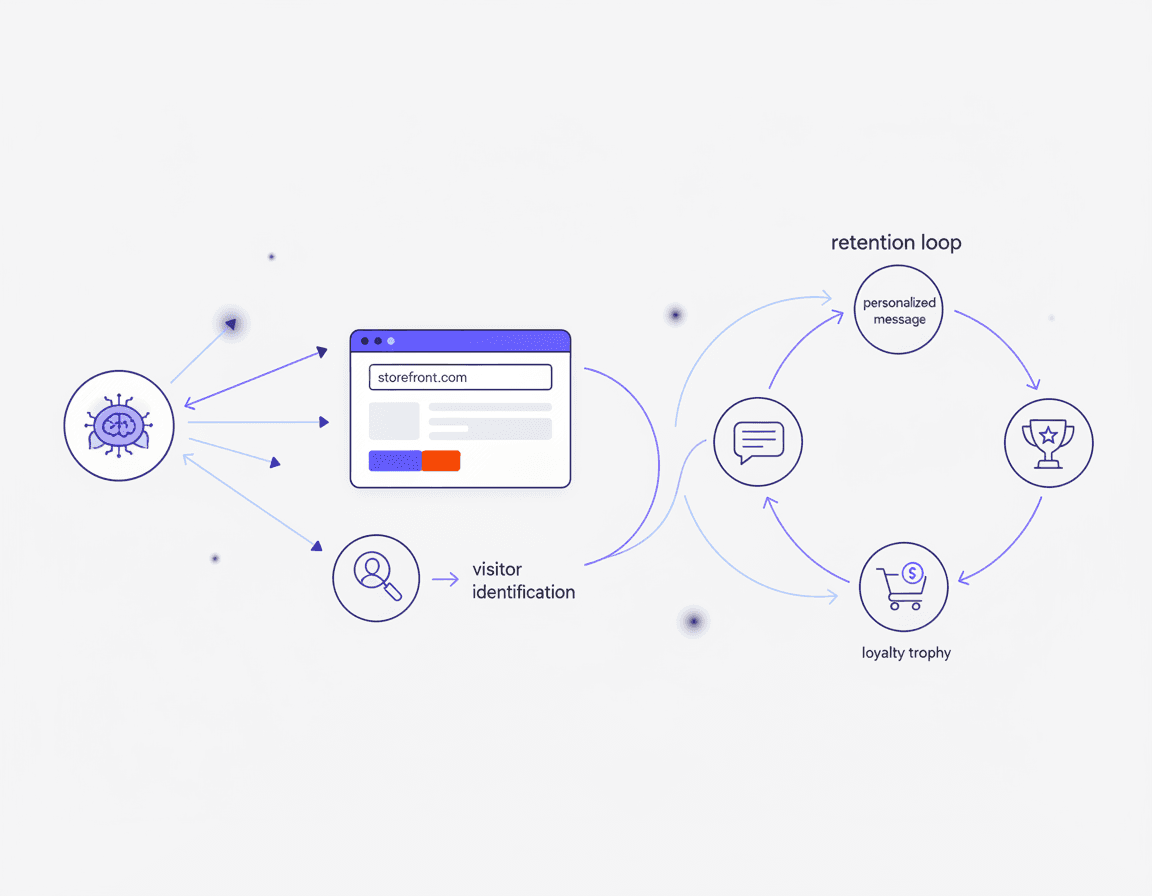
Driving AI search traffic is only valuable if you can convert visitors into customers and keep them coming back. B2C businesses face a unique challenge: high traffic volumes with low conversion rates.
Identify Anonymous Visitors
Traffic from platforms like ChatGPT, Claude, or Perplexity often arrives without clear referrer headers, appearing as "Direct" traffic in your analytics. Visitor identification tools can help you capture and enrich this high-intent traffic.
Prioritize Retention
DTC brands face a tough challenge: acquiring customers is costly, but keeping them engaged is even harder. Most brands focus heavily on acquisition, but neglecting retention leads to high churn rates: "70-80% of new customers leave after their first purchase."
The economics favor retention. A 5% boost in retention can increase revenue by 25-95%.
Leverage AI for Lifecycle Marketing
AI offers a solution: By analyzing customer data, AI personalizes every stage of the customer lifecycle, from acquisition to loyalty. Large brands consistently report 25-30% higher AOV from ChatGPT-referred customers compared to their other channels.
Key takeaway: AI search visitors arrive with high intent. Capturing their identity and building retention programs maximizes their lifetime value.
Automate GEO: Where Relixir Fits In
Executing the GEO playbook manually requires significant resources. Traditional CMS platforms were built for 2000s-era SEO, requiring manual content publishing, manual content refresh cycles, and providing zero visibility into whether brands appear in AI search results.
Relixir is the GEO-native CMS that helps companies build content for AI search. Backed by Y Combinator (X25), the platform has raised $2M in seed funding and serves 400+ of the fastest-growing B2B companies worldwide.
The platform enables brands to:
Ship content fast: AI agents generate GEO-optimized content in minutes rather than days
Keep content fresh: Autonomous content refresh maintains accuracy across your entire library
Get cited by LLMs: Content architecture designed specifically for AI citation, including structured data, factual snippets, and JSON-LD schema
Relixir customers consistently achieve 3-5x increase in AI search mention rate within 2-4 weeks of deployment.
For DTC brands ready to turn AI search into a revenue channel, Relixir offers the infrastructure to execute at scale.
Frequently Asked Questions
What is the difference between GEO and traditional SEO?
GEO, or Generative Engine Optimization, focuses on optimizing content to be cited in AI-generated answers, unlike traditional SEO which aims for high rankings on search engine result pages. GEO requires structured data, entity depth, and authority signals to ensure AI models recognize your brand as a credible source.
How can DTC brands make their product data machine-readable for AI?
DTC brands can make their product data machine-readable by implementing JSON-LD product schema, building entity depth, uploading to Google Merchant Center, and maintaining content parity. These steps ensure AI models can easily understand and recommend their products.
Why is social proof important for AI search visibility?
Social proof, such as media mentions and user-generated content, builds authority with AI models. AI relies on external validation when making recommendations, so being featured in reputable sources and having fresh reviews can significantly boost AI visibility.
What metrics should DTC brands track for AI search performance?
DTC brands should track metrics like Share of Answer, AI Overview Presence Rate, LLM Citation Frequency, and AI Referral Traffic. These metrics reveal how often a brand appears in AI responses and the direct business impact of AI-driven traffic.
How does Relixir help DTC brands with AI search optimization?
Relixir provides a GEO-native CMS that automates content generation and refresh, ensuring content is optimized for AI citation. It helps brands ship content quickly, maintain accuracy, and increase AI search mention rates, turning AI search into a revenue channel.
Sources
https://www.cbinsights.com/research/geo-companies-winning-ai-search/
https://raleon.io/blog/how-dtc-brands-are-showing-up-for-chatgpt
https://www.omnius.so/blog/ai-search-and-geo-industry-report
https://www.yotpo.com/blog/generative-engine-optimization-guide/
https://www.digitalapplied.com/blog/schema-markup-ai-generation-guide-2026
https://senso.ai/prompts-content/how-do-i-implement-structured-data-for-ai-search
https://www.cognizo.ai/customers/hat-club-turned-ai-visibility-into-20x-revenue
https://leadpipe.com/blog/5-best-b2c-website-visitor-identification-tools/
https://replen.it/blog/growing-dtc-brand-revenue-with-ai-powered-lifecycle-marketing