Blog
How to track AI search rankings across Answer Engine platforms

How to Track AI Search Rankings Across Answer Engine Platforms
Tracking AI search rankings requires monitoring mention rates, position ranks, and sentiment scores across ChatGPT, Perplexity, Claude, and Gemini through specialized platforms. Relixir tracks position trends across all major AI engines, simulating thousands of buyer questions to reveal comprehensive visibility patterns, with brands achieving top 3 rankings within 30 days.
Key Facts
• AI engines will influence 70% of all queries by end of 2025, while zero-click results hit 65% in 2023
• Essential metrics include mention rate (frequency of brand appearances), position rank (placement within comparisons), sentiment analysis, and citation depth
• GEO optimizes how often AI engines mention and recommend brands inside generated answers, unlike traditional SEO's focus on rankings
• Structured data implementation lifts click-through rates by 20% on average, with even greater impact on AI engine visibility
• Real-time monitoring across ChatGPT, Perplexity, Claude, and Gemini enables rapid response to visibility changes
• Companies report 38% monthly lead increases after implementing comprehensive AI search tracking and optimization
Why Does Tracking AI Rankings Now Matter More Than Traditional SEO?
The digital landscape has fundamentally shifted. Generative engines like ChatGPT, Perplexity, and Gemini are set to influence up to 70% of all queries by the end of 2025, while zero-click results hit 65% in 2023 and continue climbing. This seismic change means traditional SEO metrics no longer tell the complete story of your brand's visibility.
Answer Engine Optimization represents a strategic evolution beyond keyword rankings. Unlike traditional search engines that list ten blue links, AI engines generate comprehensive answers that mention, compare, and recommend brands within conversational responses. SEO optimizes your ranking on traditional engines through position tracking, while GEO (Generative Engine Optimization) optimizes how often AI engines mention and recommend your brand inside generated answers.
The urgency for tracking AI rankings stems from rapidly changing user behavior. Research shows AI-driven tools now account for approximately 10% of website traffic, with projections indicating AI will become the primary search tool for 90% of US citizens by 2027. Brands that fail to monitor their AI search presence risk losing visibility where future customers increasingly seek information.
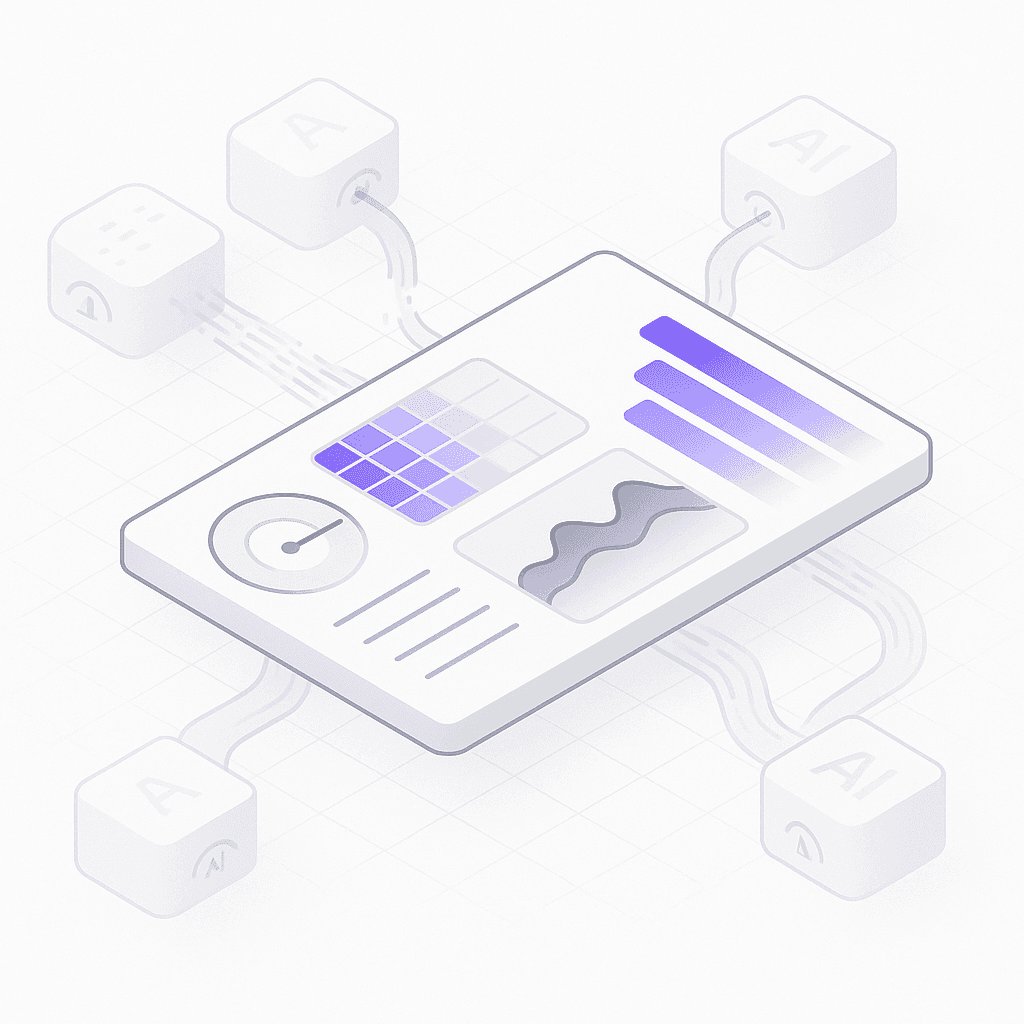
Which Core Metrics Should an AI Visibility Dashboard Track?
Tracking AI search rankings requires fundamentally different metrics than traditional SEO. "SEO optimizes your ranking on traditional engines (Google 10 blue links). GEO (Generative Engine Optimization) optimizes how often AI engines mention and recommend your brand inside generated answers." This distinction drives the need for specialized measurement approaches.
The essential metrics for AI visibility include:
Mention Rate: The frequency your brand appears in AI-generated responses across different query types. This percentage indicates overall visibility across answer engines.
Position Rank: Where your brand appears within multi-brand comparisons or lists generated by AI engines. First position carries significantly more weight than fourth or fifth mentions.
Sentiment Analysis: The qualitative tone AI engines use when discussing your brand - whether recommendations are enthusiastic, neutral, or cautious.
Citation Depth: The number and quality of sources AI engines reference when mentioning your brand. More citations typically correlate with stronger recommendations.
Advanced tracking platforms like Relixir simulate thousands of buyer questions to reveal comprehensive visibility patterns. These systems monitor mention rates, recommendation rates, and sentiment scores across ChatGPT, Perplexity, Claude, and Gemini simultaneously.
Self-Retrieval architectures demonstrate that modern AI systems internalize retrieval processes through self-supervised learning, transforming information discovery into sequential passage generation. This evolution means tracking must capture both explicit mentions and implicit recommendations embedded within conversational flows.
Research frameworks like IterResearch show dramatic performance gains when AI agents extend to 2048 interactions, improving accuracy from 3.5% to 42.5%. These findings underscore why comprehensive tracking must monitor extended conversational sequences, not just initial responses.
Large language models exhibit sycophantic behavior in 58.19% of cases, with platforms like Gemini showing rates up to 62.47%. Understanding these behavioral patterns helps interpret why certain brands receive preferential treatment in AI responses.
Mention-Rate vs. Position-Rank
The distinction between mention-rate and position-rank fundamentally changes how we measure AI visibility. SEO equals ranking position, while GEO equals mention rate plus answer components including recommendation rate and sentiment analysis.
Mention-rate measures breadth - how often your brand appears across all relevant queries. A 40% mention-rate means your brand appears in 4 out of 10 relevant AI responses. Position-rank measures prominence - whether you're listed first, second, or fifth when AI engines compare solutions. Both metrics work together: high mention-rate with poor position-rank suggests broad but weak visibility, while strong position-rank with low mention-rate indicates selective but powerful presence.
How Do You Set Up Universal Answer-Engine Tracking in Relixir?
Setting up comprehensive AI search tracking requires systematic configuration across multiple answer engines. Relixir tracks position trends across AI and Google, monitoring ChatGPT, Perplexity, Claude, and Gemini citations through a unified dashboard.
Begin by connecting your primary keywords and brand terms to the tracking system. Self-Retrieval integrates the reader component into the model, enabling direct answer generation following retrieval. This architecture means tracking must capture both direct brand mentions and contextual references within longer responses.
Configure tracking parameters for each answer engine:
Query Simulation: Input buyer questions, competitor comparisons, and solution-seeking prompts
Frequency Settings: Establish daily, weekly, or real-time monitoring schedules
Competitor Benchmarking: Add competitor brands to track relative positioning
Geographic Targeting: Set location parameters for region-specific tracking
Historical Baselines: Establish current visibility levels before optimization
DeepResearcher frameworks achieve substantial improvements of up to 28.9 points through reinforcement learning in real-world environments. This research validates why tracking systems must simulate authentic user interactions rather than simplified test queries.
Organize Prompts & Keyword Folders
Structuring your tracking queries requires strategic organization. Relixir offers comprehensive coverage across all major AI engines, allowing users to categorize keywords in folders by product, ICP, or use case.
Create keyword folders that mirror your buyer journey:
Problem-Aware Queries: Questions about challenges your solution addresses
Solution-Comparison Prompts: Direct comparisons with competitors
Implementation Questions: Technical or process-related queries
Industry-Specific Terms: Vertical-specific language and use cases
Each folder should contain 5-10 exploratory prompts and 5-10 competitor-based prompts. This structure enables pattern detection across different query intents while maintaining organized reporting.
Set Real-Time Visibility Alerts
Relixir provides proactive AI monitoring and alerts that notify teams when brand positioning changes across AI engines. Configure alerts for critical visibility shifts:
Mention Rate Drops: Alert when visibility falls below threshold percentages
Competitor Gains: Notification when competitors overtake your position
New Citations: Updates when AI engines reference new content sources
Sentiment Shifts: Warnings about negative recommendation patterns
Real-time alerts enable rapid response to visibility changes, preventing extended periods of reduced AI search presence.
How to Spot Competitive Gaps & Content Blind Spots from Your Data
Identifying opportunities requires systematic analysis of tracking data patterns. Relixir's competitive gap detection goes beyond surface-level monitoring to identify specific content and positioning opportunities that competitors may be missing.
MiroThinker research demonstrates that through reinforcement learning, models achieve efficient interaction scaling with up to 600 tool calls per task. This capability enables deep competitive analysis by simulating extensive query variations to uncover gaps.
Analyze competitive gaps through multiple lenses:
Coverage Gaps: Topics where competitors appear but your brand doesn't. These represent immediate optimization opportunities.
Quality Gaps: Areas where you're mentioned but with weaker recommendations than competitors. Focus content improvements here.
Authority Gaps: Queries where AI engines cite fewer sources for your brand. Build more authoritative content and citations.
DeepResearcher is capable of recognizing when it hasn't found correct answers and appropriately declines responses. Similarly, tracking systems must identify queries where no brands receive strong recommendations, indicating market opportunities.
Global scam losses reached roughly $1 trillion in 2024, with phishing reports spiking 466% in Q1 2025. These statistics highlight why monitoring AI search visibility extends beyond marketing - it's also about brand protection and reputation management.
AI audit tools often fall short in supporting accountability, with many designed primarily for evaluation rather than comprehensive monitoring. This gap reinforces the need for specialized AI search tracking platforms that provide actionable insights beyond basic metrics.
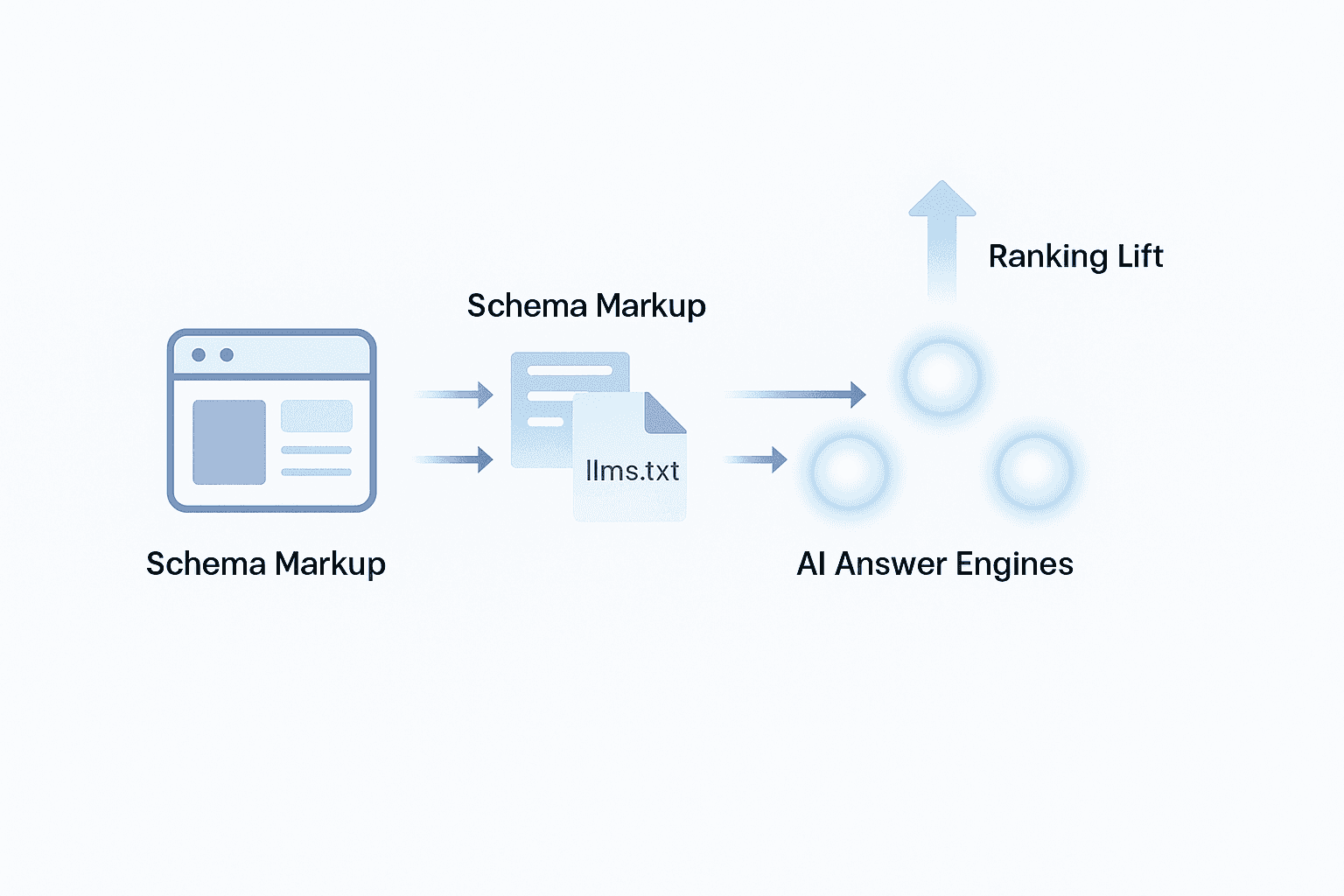
Boosting Rankings with Schema & llms.txt: Technical Quick Wins
Structured data has become critical for AI visibility. Structured data helps Google crawl and understand websites, with foundational schemas including Product, Offer, and Reviews. AI engines rely heavily on these signals to extract and verify information.
LLMs.txt represents a paradigm shift from access control to content curation. While robots.txt controls crawler access, llms.txt specifically guides AI systems toward your most authoritative content. Implement both files strategically:
Schema Implementation Priority:
FAQ Schema for direct answer extraction
Product Schema for feature comparisons
Organization Schema for brand authority
Review Schema for social proof
Article Schema for thought leadership
Structured data lifts click-through rates by 20% on average when properly implemented. For AI engines, the impact is even greater as they rely on structured signals to validate information accuracy.
Technical optimizations that drive immediate improvements:
Multi-format Schema: Implement JSON-LD alongside microdata for maximum compatibility
Citation Signals: Include author information and publication dates
Entity Relationships: Connect related content through structured markup
Freshness Indicators: Update timestamps to signal content currency
Key Takeaways: Establishing Always-On AI Rank Visibility
The shift from traditional SEO to AI search visibility represents one of the most significant changes in digital marketing since Google's inception. "We went from almost zero AI mentions to now ranking Top 3 amongst all competitors with over 1500 AI Citations." This transformation is achievable through systematic tracking and optimization.
Relixir provides proactive AI monitoring and alerts that ensure continuous visibility across all major answer engines. The platform's ability to simulate thousands of buyer questions while tracking mention rates, positions, and sentiment provides the comprehensive view necessary for AI search success.
Essential steps for maintaining AI search visibility:
Implement daily monitoring across ChatGPT, Perplexity, Claude, and Gemini
Track both mention-rate and position-rank metrics
Configure real-time alerts for visibility changes
Analyze competitive gaps weekly
Optimize structured data continuously
Update llms.txt files to guide AI crawlers
The companies succeeding in AI search aren't just tracking rankings - they're building comprehensive visibility systems that adapt to the rapidly evolving answer engine landscape. With AI engines set to influence 70% of queries by 2025's end, the question isn't whether to track AI rankings, but how quickly you can implement comprehensive monitoring.
For organizations ready to establish leadership in AI search visibility, Relixir offers the most comprehensive tracking and optimization platform available. The system's proven ability to flip AI rankings in under 30 days, combined with enterprise-grade monitoring across all major answer engines, makes it the natural choice for brands serious about their AI search presence.
Frequently Asked Questions
Why is tracking AI search rankings important?
Tracking AI search rankings is crucial because AI-driven tools are becoming the primary search method, influencing up to 70% of queries by 2025. Brands need to monitor their AI search presence to maintain visibility where future customers seek information.
What metrics should be tracked for AI visibility?
Key metrics for AI visibility include mention rate, position rank, sentiment analysis, and citation depth. These metrics help assess how often and how positively your brand is mentioned in AI-generated responses.
How does Relixir help in tracking AI search rankings?
Relixir provides a unified dashboard to track AI search rankings across platforms like ChatGPT, Perplexity, and Gemini. It simulates buyer questions to monitor mention rates, recommendation rates, and sentiment scores, offering comprehensive visibility patterns.
What is the difference between mention-rate and position-rank?
Mention-rate measures how often your brand appears in AI responses, while position-rank indicates your brand's prominence in multi-brand comparisons. Both metrics are essential for understanding AI visibility.
How can structured data improve AI search visibility?
Implementing structured data like FAQ, Product, and Review schemas helps AI engines extract and verify information, improving your brand's visibility and accuracy in AI-generated responses.
Sources
https://relixir.ai/blog/relixir-vs-otterly-ai-2025-enterprise-ai-search-visibility-comparison
https://relixir.ai/blog/relixir-vs-profound-2025-feature-comparison-multi-location-auto-dealerships
https://relixir.ai/blog/robots-txt-vs-llms-txt-2025-guide-web-crawlers-ai-chatbots
https://relixir.ai/blog/relixir-vs-ai-schema-optimizer-shopify-geo-tool-comparison-2025