Blog
How to Use AI to Update Existing Blog Content

How to Use AI to Update Existing Blog Content
AI content refreshes update existing blog posts to maintain visibility in both traditional search and AI-generated answers. The process involves auditing pages for traffic drops, scoring by business value, rewriting with AI assistance while adding fresh data and schema markup, publishing through CMS-integrated platforms, and tracking results. Companies using automated GEO platforms report recapturing 80 hours monthly and seeing 17% more inbound leads within six weeks.
TLDR
• Audit systematically: Identify pages with 20%+ traffic drops, outdated information, or declining AI citations to prioritize refresh candidates
• Score by impact: Combine decay signals, business value, and effort estimates to focus on high-ROI updates first
• Automate the process: AI-powered platforms scan libraries, rewrite content, and push updates directly to your CMS, saving 80 hours monthly
• Add machine-readable signals: Include dateModified schema, version fields, and explicit timestamps that AI models use to assess freshness
• Track GEO metrics: Monitor AI citations, traffic from generative engines, and conversion rates—AI-driven leads convert 25x higher than traditional traffic
• Maintain continuous updates: With generative engines influencing 70% of queries by 2025, regular refreshes prevent content decay and citation loss
An AI content refresh is no longer optional. With generative engines influencing up to 70% of queries by the end of 2025, pages that once ranked well can quietly fade from AI-generated answers unless they receive systematic, machine-readable updates. This guide walks you through a five-step playbook to audit, score, rewrite, publish, and measure refreshed content so that both traditional search engines and large language models continue to cite your work.
Why Do AI-Driven Content Refreshes Matter in 2026?
A content refresh is the process of updating existing pages to improve performance, relevance, and accuracy. In the age of generative engine optimization, that definition expands: refreshes must now make content machine-readable so AI platforms can extract, understand, and cite it.
Traditional SEO workflows are becoming obsolete as AI platforms prioritize structured, consistent, and machine-readable content over keyword stuffing. By August 2024, 44.6% of U.S. organizations reported using generative AI, and that figure has only accelerated. Businesses implementing GEO strategies have reported a 17% increase in inbound leads within just six weeks.
Ignoring content freshness means ceding ground to competitors whose pages answer the same queries with newer data, better schema, and cleaner entity coverage.
Key takeaway: An AI content refresh is the fastest, most reliable way to turn once-strong pages into assets that win in generative search.

How Do You Audit Your Library and Spot Content Decay with AI?
Content decay is "the gradual decline in organic traffic, rankings, and engagement for posts that once performed well," according to Automator Plugin. Causes include outdated information, newer competitor content, algorithm changes, lost backlinks, and shifting user intent.
Before you rewrite anything, you need data. Here is how to diagnose which pages are slipping:
Traffic drops of 20% or more: If a page is losing visits month after month, it signals stale content or a competitor doing it better (AirOps).
Age without updates: Pages not updated in over a year are more than 2× as likely to lose citations and market share.
Ranking slips in AI answers: Fresh content matters more than ever, especially as AI engines like ChatGPT and Perplexity decide which sources to cite.
AI can scan your library for old facts, dated language, and missed topics faster and more consistently than manual reviews.
Traffic, Ranking & Freshness Signals AI Models Read
Large language models rely on specific cues to judge whether a page is current:
| Signal Type | What It Tells LLMs |
|-------------|--------------------||
| datePublished / dateModified schema | Machine-readable timestamps that make recency explicit |
| Textual cues (e.g., "As of Q1 2026") | Visible freshness markers crawlers and models both read |
| Engagement metrics | High dwell time and low bounce rates suggest relevance |
| Version fields in Product or SoftwareApplication schema | Indicate iterative improvements |
"Using schema types such as Article, HowTo, Product, or SoftwareApplication with accurate datePublished, dateModified, and version fields makes recency machine-readable," explains Single Grain.
Prompts that explicitly emphasize recency push retrieval components to prefer documents with clear, recent timestamps and time-bounded statements.
How Do You Build a Scalable Refresh Framework?
Treating refreshes as ad-hoc cleanup leads to random edits, cannibalization, and wasted effort. A structured framework changes the question from "What should we fix next?" to "Which updates will create the most business impact for the least risk?" (Single Grain).
Below is a seven-step Content Refresh OS adapted from industry best practices:
Discover – Pull all URLs from your CMS and analytics.
Score – Rank pages by decay severity and business upside.
Plan – Define scope: light edit, moderate rewrite, or full rebuild.
Refresh – Rewrite with AI assistance, then validate with subject-matter experts.
QA – Check schema, internal links, and brand voice.
Publish – Push updates through your CMS.
Measure – Track AI citations, traffic lifts, and pipeline impact.
A high-performing refresh is "a surgical rewrite that preserves equity while expanding topical coverage and machine-readability," notes Single Grain. AI agents like Moz's Reva can automate content refresh strategies by benchmarking pages against top-ranking competitors.
Prioritize with an AI-Assisted Scoring Model
A scoring model ensures that two different teams looking at the same library would still choose the same top 50 URLs to update first (Single Grain). Combine:
Decay signals – Traffic decline, ranking loss, outdated facts.
Business value – Conversion rate, revenue contribution, strategic importance.
Effort estimate – Word count, number of outdated sections, required SME input.
Don't guess which pages to refresh. "Use simple signals like slipping traffic, falling rankings, and competitor gains," advises AirOps.
How Does Relixir Automate Updates with Deep Research Agents?
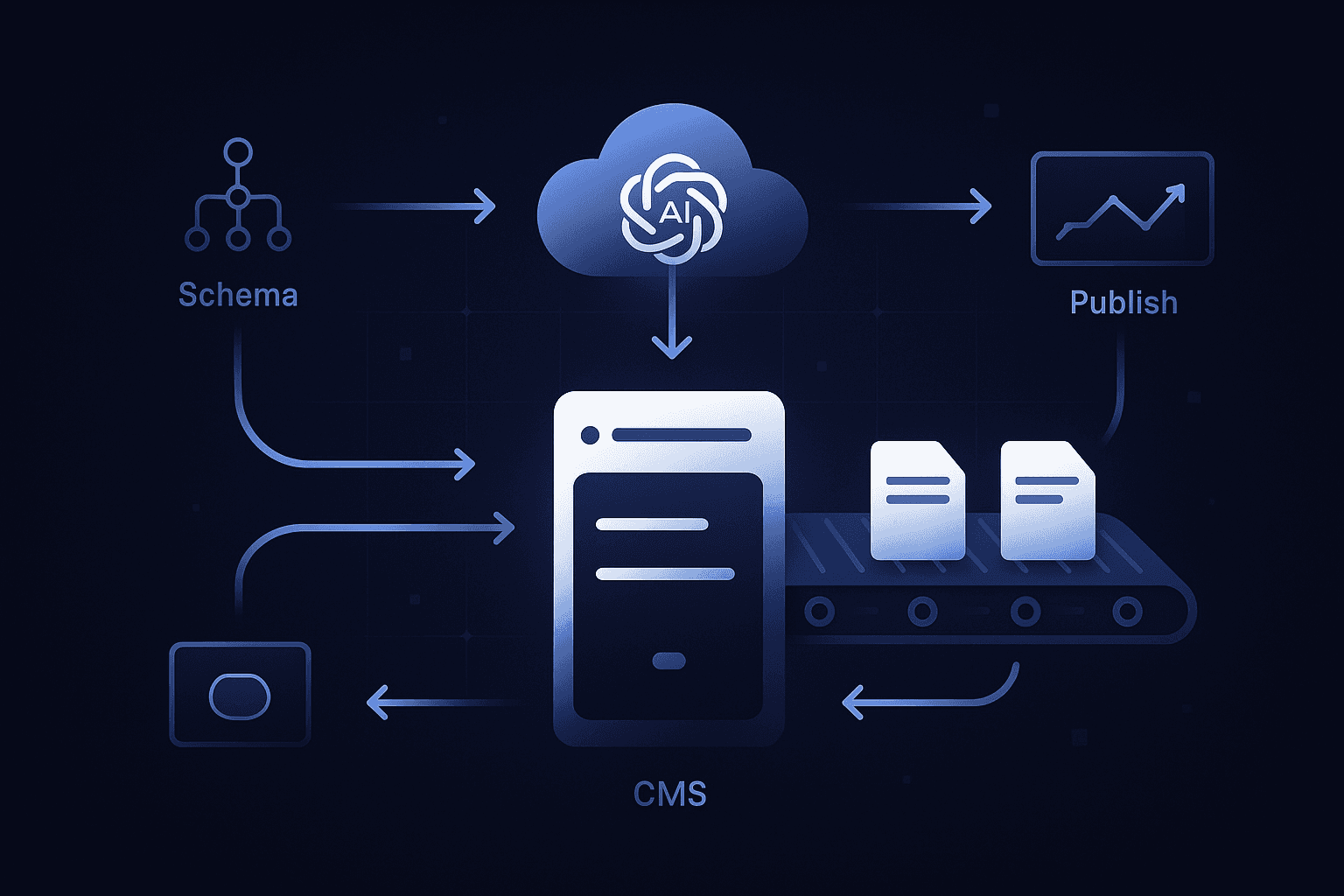
Relixir's Content Engine operates through a sophisticated four-stage pipeline that transforms AI gaps into published, optimized content. Its deep research agents combine competitor gap analysis, knowledge base understanding, and real-world signal mining to autonomously refresh content with current citations, case studies, and product updates across all major AI platforms (Relixir).
"Relixir's deep research agents represent a quantum leap beyond traditional content optimization." – Relixir
Key capabilities include:
Continuous content analysis: Relixir connects directly to your CMS, continuously analyzes your existing content library for SEO and GEO gaps, and suggests high-intent topics automatically.
Bi-directional CMS sync: Detects outdated content and automatically refreshes it to maintain rankings and AI citation accuracy over time.
Enterprise-grade security: Deploys via SaaS or private VPC, meeting Fortune 500 security requirements while providing no-dev-lift implementation.
Businesses implementing GEO strategies report a 17% increase in inbound leads within six weeks, and customer testimonials consistently report recapturing approximately 80 hours per month through Relixir's automated content pipeline.
What Does CMS Integration Look Like in Practice?
A refresh workflow is only as good as its connection to your publishing system. GEO platforms with native CMS integrations enable teams to optimize content directly at the source for AI visibility. With 51% of websites running on CMS platforms and WordPress powering 35% of mobile sites alone, seamless integration is non-negotiable.
HubSpot's Content Remix feature, for example, lets marketers repurpose existing blogs into podcasts, social posts, and more using Breeze AI. Perplexity's Pro tier exposes built-in tools like web_search and fetch_url_content, with all tool executions appearing in the reasoning_steps array of streaming responses, giving visibility into how the model researched a query (Perplexity Docs).
Enterprise example: Cisco Systems faced challenges with disconnected experiences and an overwhelming amount of content. Through its "Cisco.com Reimagined" initiative, Cisco consolidated data and content, fostered marketing and sales alignment, improved infrastructure and governance, and implemented persona-based AI-driven initiatives (Forrester). ECM vendors are adopting retrieval-augmented generation (RAG) architectures to shield internal documents while grounding AI queries in subsets of content for more specific responses.
Generative AI is reshaping digital experience platforms by automating content and campaign creation, powering intelligent copilots, and boosting customer engagement through predictive insights and personalization (Forrester).
Key takeaway: Choose a platform that syncs bi-directionally with your CMS so refreshes publish instantly and schema updates propagate without developer tickets.
Step 5 – Measure Success: Citations, Traffic & Pipeline
Refreshing content without tracking outcomes is guesswork. Here are the KPIs that matter:
Metric | Benchmark / Insight |
|---|---|
AI-driven traffic growth | Go Fish Digital achieved +43% monthly AI-driven traffic from ChatGPT and other referrals |
Conversion lift from AI referrals | AI-driven leads convert at 25× higher rates than traditional traffic |
Inbound lead increase | Businesses report a 17% lift in inbound leads within six weeks of GEO implementation |
Brand appearance probability | GEO optimization increases brand appearance probability in AI answers by 3.7× compared to traditional SEO |
Go Fish Digital's three-month GEO campaign also delivered an 83.33% lift in monthly conversions from AI referrals, proving that AI referrals deliver higher-intent conversions because the model acts as a sales agent before the click, filtering and qualifying leads in advance.
Track mentions inside AI citations for your cluster pages and referring domains that share entities with your target topics.
What Pitfalls Should You Avoid During an AI Content Refresh?
Even the best framework can stumble. Watch out for these common traps:
Compliance bottlenecks: McKinsey reports that 30 to 50 percent of a team's "innovation" time with gen AI is spent on making solutions compliant or waiting for compliance requirements to solidify.
Poor content hygiene: "Enterprises with well-governed content repositories should have an unfair advantage with genAI success compared with businesses with poor content hygiene," notes Forrester.
Overlooking data governance: "Data governance is not a new discipline, but its importance is more paramount now than ever before as organizations running a digital business begin to leverage AI everywhere," said Stewart Bond, vice president of Data Intelligence and Integration Software Research at IDC (IDC).
Over-automation without human review: AI accelerates research and drafting, but humans lock in E-E-A-T and originality. Use AI to accelerate ideation and section rewrites, then apply SME judgment to validate facts, inject examples, and add unique insights.
Ignoring schema and structured data: Without proper
dateModifiedfields and JSON-LD, LLMs may treat your refreshed page as stale.
Refresh or Fade Away: Key Takeaways
Audit regularly: Use AI to scan your library for traffic drops, outdated facts, and competitor gains.
Score and prioritize: Focus on pages with high business value and clear decay signals.
Refresh systematically: Follow a repeatable seven-step workflow that pairs AI drafting with human validation.
Automate with the right platform: Relixir's deep research agents handle audit, rewrite, schema, and publication in one pipeline, helping businesses report a 17% increase in inbound leads within six weeks.
Measure what matters: Track AI citations, traffic lifts, and pipeline impact to prove ROI.
If your content library isn't being refreshed for AI, it's quietly losing ground. Start with your highest-value pages, implement a scoring model, and let a platform like Relixir automate the heavy lifting so your team can focus on strategy instead of manual edits.
How do I use AI to update existing blog content?
An effective AI content refresh follows five steps: (1) audit pages for traffic drops and outdated facts, (2) score URLs by business impact, (3) rewrite with AI while injecting new data and schema, (4) publish through a CMS-integrated platform like Relixir that syncs updates bi-directionally, and (5) track AI citations, traffic, and pipeline lifts. Brands using GEO platforms such as Relixir report recapturing 80 hours per month and a 17% lift in inbound leads within six weeks.
What is an AI content refresh?
A content refresh is the process of updating existing content to improve its performance, relevance, and accuracy. In the context of generative engine optimization, it relies on AI agents to detect gaps, rewrite outdated passages, and push structured updates back to the CMS. Using schema types such as Article, HowTo, or Product with accurate datePublished and dateModified fields makes recency machine-readable so large language models understand, cite, and feature the page.
Frequently Asked Questions
What is an AI content refresh?
A content refresh is the process of updating existing content to improve its performance, relevance, and accuracy. In the context of generative engine optimization, it relies on AI agents to detect gaps, rewrite outdated passages, and push structured updates back to the CMS. Using schema types such as Article, HowTo, or Product with accurate datePublished and dateModified fields makes recency machine-readable so large language models understand, cite, and feature the page.
How do I use AI to update existing blog content?
An effective AI content refresh follows five steps: (1) audit pages for traffic drops and outdated facts, (2) score URLs by business impact, (3) rewrite with AI while injecting new data and schema, (4) publish through a CMS-integrated platform like Relixir that syncs updates bi-directionally, and (5) track AI citations, traffic, and pipeline lifts. Brands using GEO platforms such as Relixir report recapturing 80 hours per month and a 17% lift in inbound leads within six weeks.
Why are AI-driven content refreshes important in 2026?
AI-driven content refreshes are crucial because they ensure your content remains relevant and machine-readable, allowing AI platforms to extract, understand, and cite it. This is essential as traditional SEO becomes less effective and AI platforms prioritize structured content. Businesses implementing GEO strategies have reported significant increases in inbound leads.
How does Relixir automate content updates?
Relixir's Content Engine uses deep research agents to autonomously refresh content by analyzing competitor gaps, understanding knowledge bases, and mining real-world signals. It connects directly to your CMS, continuously analyzes your content for SEO and GEO gaps, and suggests high-intent topics automatically, ensuring your content remains current and optimized for AI citations.
What are the key steps in building a scalable content refresh framework?
A scalable content refresh framework involves: 1) Discovering all URLs from your CMS and analytics, 2) Scoring pages by decay severity and business upside, 3) Planning the scope of updates, 4) Refreshing content with AI assistance, 5) Conducting QA checks, 6) Publishing updates through your CMS, and 7) Measuring AI citations, traffic lifts, and pipeline impact.
Sources
https://relixir.ai/blog/5-best-generative-engine-optimization-geo-tools-for-blog-automation
https://automatorplugin.com/reverse-wordpress-content-decay/
https://relixir.ai/blog/best-geo-platforms-with-cms-integrations
https://knowledge.hubspot.com/blog/repurpose-content-using-ai-with-content-remix?c=CA
https://gofishdigital.com/blog/generative-engine-optimization-geo-case-study-driving-leads/
https://my.idc.com/getdoc.jsp?containerId=US51958724&pageType=PRINTFRIENDLY