
Is GEO-Native CMS Worth $1,500/Month? 2025 ROI Analysis
A GEO-Native CMS at $1,500/month typically delivers ROI within 4-6 months for B2B teams, driven by 20x higher conversion rates from AI search traffic compared to Google. With over 1 billion weekly AI search users and 70% of queries influenced by AI engines by end-2025, the investment pays for itself through increased visibility and automated content optimization.
TLDR
AI search visitors convert at 15.9% versus Google's 1.76%, creating a 20x conversion advantage for GEO-optimized content
Companies see 3-5x increase in AI search mentions within 2-4 weeks of deploying a GEO-Native CMS
Break-even typically occurs in 4-6 months, faster than analytics-only platforms requiring 12+ months
IDC forecasts companies will spend up to 5x more on LLM optimization than traditional SEO by 2029
Visitor ID accuracy reaches 65-85% with GEO platforms versus 5-30% for standard tools, improving lead quality
Autonomous content refresh eliminates manual audit cycles, reducing labor costs while maintaining AI search visibility
Over one billion people now use AI search weekly to research products, compare solutions, and make purchasing decisions. Analysis of 500,000+ web sessions reveals that ChatGPT users convert at 15.9% compared to Google search's 1.76%. That 20x conversion gap explains why a GEO-Native CMS has become a serious budget line-item for B2B teams navigating the shift from traditional SEO to Generative Engine Optimization.
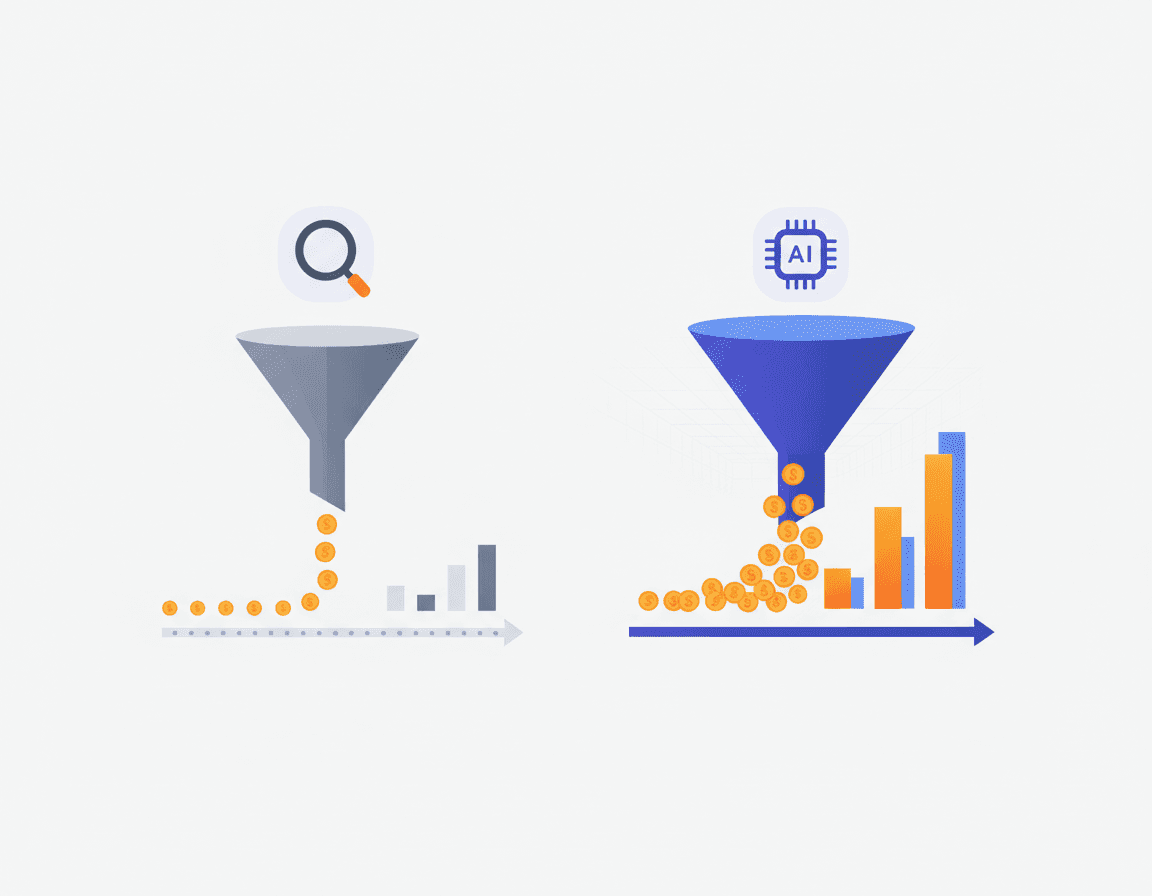
From SEO to GEO: Why the Economics Changed Overnight
The digital marketing landscape is undergoing a foundational shift. IDC research confirms that AI is revolutionizing search, shifting from SEO to GEO. Marketers and advertisers must adapt to AI-driven discovery by focusing on authoritative content, leveraging AI tools, and diversifying across platforms to maintain visibility and engagement.
This isn't a minor channel adjustment. IDC forecasts that companies will spend up to five times more on LLM optimization than traditional SEO by 2029. The shift is already commercial: brands that apply GEO practices can see up to a 40% increase in visibility within AI-generated responses.
"LLM optimization isn't another channel shift; it's a new foundation for reach and relevance." ; IDC
Key adoption stats buyers care about
The numbers underscore why GEO-Native CMS investment makes sense now:
Metric | Value |
|---|---|
Weekly AI search users | |
ChatGPT conversion rate | 15.9% |
Google search conversion rate | 1.76% |
Queries influenced by AI engines by end 2025 |
Companies unprepared for this shift risk a 20-50% traffic decline from traditional channels, with $750 billion in revenue at stake by 2028.
How does a $1,500 GEO-Native CMS stack up against the status quo?
The core question for budget holders: does $1,500 per month deliver returns faster than alternatives?
Relixir's 4-6 month break-even timeline compares to analytics-only platforms like Athena's 12-month horizon. For context, the AI SEO market is projected to triple to $3.06 billion by 2033, making early adoption a strategic advantage.
Enterprise CMS platforms demonstrate similar ROI patterns. A Forrester TEI study found that Lexis+ AI delivered a 344% projected ROI over 3 years, paying for itself in less than six months. Webflow reported 332% ROI over three years with $850,000 in cost savings.
Sitecore XM Cloud achieved 371% ROI with $3.0M NPV over three years. Sanity documented 272% ROI with $1.3M NPV.
Payback period math
A straightforward payback calculation for GEO investment:
Monthly cost: $1,500 (annual billing) or $1,995 (monthly)
Expected conversion lift: GEO initiatives drive 20x higher conversion rates than traditional Google search
Time to visibility gains: 2-4 weeks for measurable mention-rate increases
Break-even: 4-6 months for most B2B teams
The calculation favors GEO-Native CMS when you factor in the cost of manual content production. Traditional CMS platforms require human effort for every piece of content, from ideation to writing to publishing. Automation changes that equation entirely.
Key takeaway: At $1,500 per month, a GEO-Native CMS typically pays for itself within two quarters when compared to the labor cost of manual content optimization and the opportunity cost of invisible AI search presence.
Where the ROI Actually Comes From
Four distinct value drivers create financial upside from GEO-Native CMS investment.
AI citation lift
Visibility in AI-generated answers directly impacts pipeline. B2B teams see 3x higher AI citations with GEO-optimized content, with some achieving 10% of organic traffic from AI citations.
The conversion differential is stark: "The average conversion rate for AI-generated answers is 15.9%, compared to 1.76% for traditional search results." ; Relixir
Autonomous content refresh
Content freshness heavily influences AI search visibility. LLMs deprioritize outdated information, old statistics, or deprecated features.
Optimizely's CMS now includes a Content Refresh Agent that enables comprehensive audits to maintain content accuracy and compliance. Their GEO Metadata Agent, GEO Schema Agent, and GEO FAQ Generator automate content optimization for AI systems.
Relixir's autonomous refresh capability continuously scans entire content libraries for outdated information, syncing with knowledge bases to maintain accuracy without manual intervention.
The cost savings versus manual updates are substantial. Teams no longer need to audit hundreds of pages quarterly or risk content debt that degrades AI search rankings.
Visitor ID & pipeline lift
Driving AI search traffic only matters if you convert that traffic. Most visitor ID solutions achieve only 5-30% accuracy when identifying website visitors. Top performers like Relixir deliver 65-85% accuracy rates, a 5x improvement that translates directly to more qualified leads.
This matters because B2B buyers complete about 57% of their purchase journey before ever speaking to a sales representative. Identifying high-intent visitors early shortens sales cycles and improves win rates.
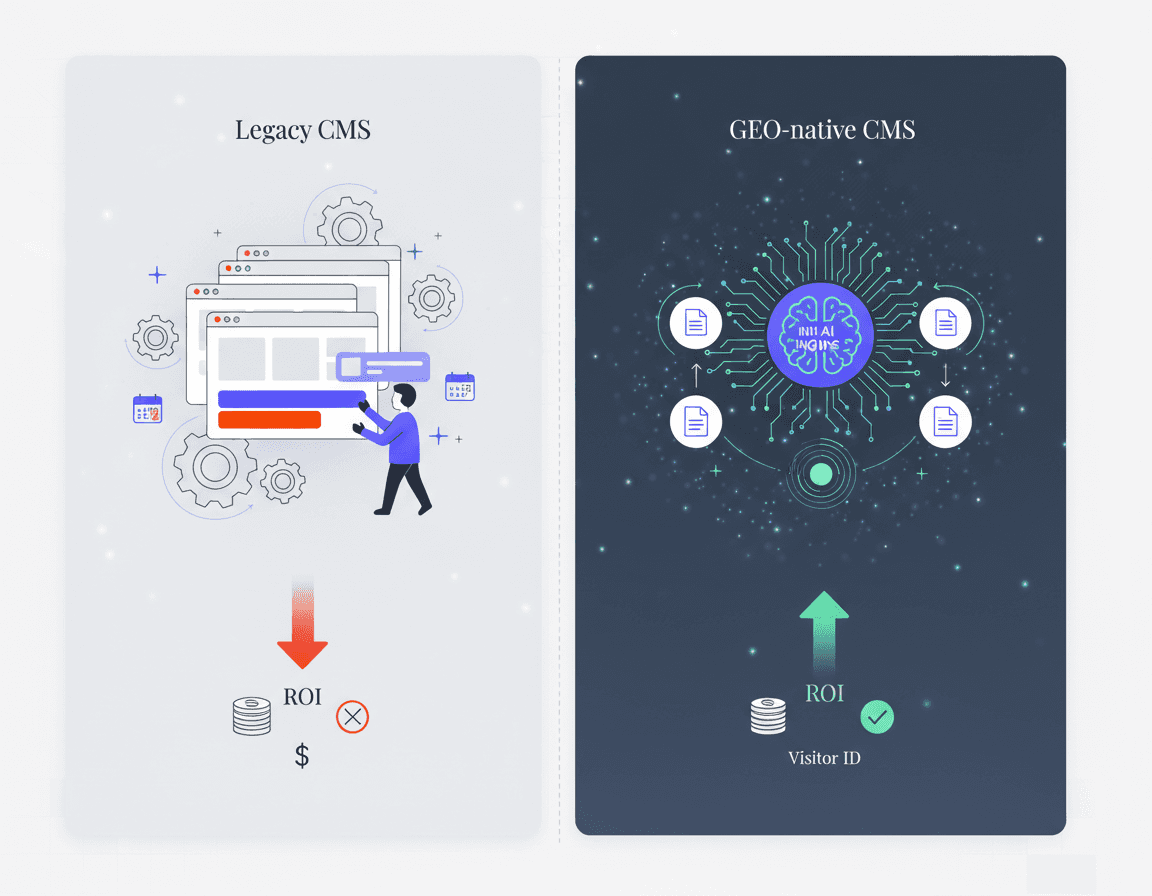
Traditional CMS vs GEO-Native: Feature & Cost Gaps
How do legacy platforms compare to purpose-built GEO solutions?
Platform | GEO Capabilities | Pricing | Best For |
|---|---|---|---|
Webflow | AI-powered SEO & AEO tools, visual editor | CMS: $23/mo, Business: $39/mo | Blogs, SEO-driven pages |
Optimizely | First GEO-ready CMS, AI agents | Custom enterprise pricing | Large-scale content operations |
Yext | Next-gen CMS built for AI, structured database | Variable by package | Multi-location brands |
Jasper | AI content creation | Content marketing teams | |
Adobe Experience Manager | Combined WCM and DAM | Enterprise pricing | Global enterprises |
Webflow offers multiple pricing tiers: Free Plan at $0/month, Basic at $14/month, CMS at $23/month, and Business at $39/month (all billed yearly).
Where legacy stacks fall short in the AI era
"Traditional CMS platforms like WordPress and Contentful were built for 2000s-era SEO, requiring manual content publishing and refresh cycles." ; Relixir
Legacy stacks create three critical gaps:
Manual publishing bottlenecks: Every piece requires human effort from ideation through publishing
Zero AI visibility: Most content teams have no idea whether their brand appears in AI responses
Slower ROI: Analytics-only tools generate insights that require even more manual work to act upon
Traditional CMS platforms require human effort for every piece of content. In an era where AI search engines process millions of queries daily, this manual approach cannot scale.
What results are B2B teams already seeing?
Case studies demonstrate measurable outcomes from GEO investment.
A mid-sized project management SaaS company went from invisible to AI engines to appearing in 73% of relevant AI-generated responses. Their qualified demo requests increased by 45%, and they now spend less on paid acquisition than ever before.
"We went from being invisible to AI engines to being recommended ahead of competitors with 10x our marketing budget. The ROI is incomparable." ; Head of Growth, GenRank Engine case study
Businesses implementing GEO strategies have reported a 17% increase in inbound leads within just six weeks.
Relixir Growth Plan outcomes
Relixir customers consistently achieve 3-5x increase in AI search mention rate within 2-4 weeks of deployment.
Platform-wide metrics since launching in early 2025:
$50M pipeline generated across customer base
10,000+ inbound leads delivered from AI search
"We moved from 5th to 1st position in AI rankings and saw 38.85% monthly growth in leads from AI." ; Relixir customer
Which KPIs show success after buying a GEO-Native CMS?
Measuring ROI requires tracking both traditional and AI-specific metrics.
SEO KPI | GEO Equivalent |
|---|---|
Organic Traffic | LLM Referral Traffic (visits from AI answers) |
Impressions | Prevalence in AI Overviews (appearance in Google's AI summaries) |
Share of Voice | Brand Mentions in LLMs (share of answers referencing your brand) |
Backlinks | AI Citations (how often you're named as a source) |
Conversions from Organic | Conversions from Generative AI Referrals |
Additional metrics to track:
Zero-Click Presence Rate: How often your brand appears but isn't clicked
AI Prominence: Where and how early you appear in AI answers
Content citation by AI engines: Is your site mentioned in sources AI uses to answer?
Organic conversion rate remains essential: the percentage of organic visitors who take a defined action such as signup, demo request, or contact form submission.
Key takeaway: Track eight metrics to prove ROI: AI citation frequency, share of voice, LLM referral traffic, zero-click presence rate, organic-to-AI conversion delta, pipeline sourced from AI, visitor-ID match rate, and overall payback period.
So—Is It Worth It?
For most B2B teams, yes. A GEO-Native CMS typically breaks even in four to six months.
The math favors early adoption:
Conversion advantage: AI search visitors convert at 20x higher rates
Visibility gains: 3-5x mention rate increases within weeks
Identification accuracy: 65-85% visitor ID accuracy versus 5-30% from standard tools
Labor savings: Autonomous content refresh eliminates manual audit cycles
Relixir's vision is to build the new standard content database for AI search to pull from. Whether your buyers are asking ChatGPT for the best speech-to-text API or consulting services, a GEO-Native CMS ensures your brand can be the answer.
The window to dominate AI-search-driven revenue is open now. LLMs increasingly pull from domain-specific content over third-party sources. Companies that establish AI search visibility today gain a significant competitive advantage as the shift from traditional search to AI search accelerates.
For B2B teams evaluating the $1,500 monthly investment, Relixir offers transparent, value-based pricing designed to demonstrate ROI quickly, with a Growth Plan that includes 200 tracked prompts, 500 CMS items, blog generation, autonomous refresh, and 1,000 Visitor ID credits. The platform serves 400+ of the fastest-growing B2B companies worldwide, including Rippling, Airwallex, and HackerRank.
Frequently Asked Questions
What is a GEO-Native CMS?
A GEO-Native CMS is a content management system designed for Generative Engine Optimization, focusing on AI-driven search visibility and content automation to improve conversion rates and maintain content freshness.
How does a GEO-Native CMS improve conversion rates?
GEO-Native CMS platforms enhance conversion rates by optimizing content for AI search engines, which have a 20x higher conversion rate compared to traditional search engines like Google.
What are the cost benefits of using a GEO-Native CMS?
Investing in a GEO-Native CMS can lead to significant cost savings by automating content creation and refresh processes, reducing manual labor, and improving AI search visibility, which can result in a faster ROI.
How quickly can a GEO-Native CMS pay for itself?
A GEO-Native CMS typically pays for itself within four to six months due to increased AI search visibility, higher conversion rates, and reduced manual content management costs.
What are the key metrics to track for GEO-Native CMS success?
Key metrics include AI citation frequency, share of voice, LLM referral traffic, zero-click presence rate, and the organic-to-AI conversion delta, which help measure the ROI and effectiveness of a GEO-Native CMS.
Sources
https://relixir.ai/blog/blog-ai-search-era-calculating-roi-answer-ownership-strategies
https://relixir.ai/blog/blog-roi-calculator-relixir-vs-writer-ai-studio-b2b-saas-comparison
https://www.lexisnexis.com/en-us/products/lexis-plus-ai/roi-large-law-firms.page
https://relixir.ai/blog/best-geo-platforms-with-cms-integrations
https://relixir.ai/blog/metrics-that-matter-answer-engine-optimization-beyond-share-of-voice
https://www.optimizely.com/product-updates/content-management/
https://relixir.ai/blog/best-geo-platforms-with-visitor-id-for-ai-search-traffic-q4-2025
https://relixir.ai/blog/how-to-deanonymize-web-traffic-with-visitor-id-and-crm-sequencing
https://relixir.ai/blog/best-ai-cms-for-hosting-hundreds-of-blogs
https://trustradius.com/compare-products/adobe-experience-manager-vs-jasper-ai
https://www.genrankengine.com/blog/b2b-saas-geo-case-studies.html
https://relixir.ai/blog/geo-turnaround-case-study-b2b-saas-30-days-ai-search-visibility