Blog
Relixir vs Contentful: Headless CMS vs GEO-Native CMS
Relixir vs Contentful: Headless CMS vs GEO-Native CMS
Relixir addresses the challenge that headless architecture alone doesn't solve: getting content cited by AI search engines. While Contentful excels at separating content from presentation for omnichannel delivery, Relixir builds GEO-native infrastructure that structures content specifically for how AI models retrieve and reference information at the passage level.
Key Facts
• Architecture difference: Contentful uses headless CMS for API-first content delivery, while Relixir combines headless with GEO-native optimization for AI search visibility
• Content automation: Contentful offers AI Actions for content-related tasks using GPT-4o and Claude, but Relixir provides fully autonomous content generation and refresh
• AI search performance: Blogs generated by Relixir get cited 3x more often in AI search, with ChatGPT users converting at 15.9% versus Google's 1.76%
• Implementation speed: Contentful delivers 8 weeks to launch redesigned sites with 2-minute deployments, while Relixir shows AI-referral traffic increases within 2-4 weeks
• Market context: With 71.5% of users relying on generative AI for information, traditional CMS platforms lack native AI visibility tracking and citation optimization
Choosing the right content management system in 2026 is no longer just about storing and delivering content. With half of consumers using AI-powered search and AI summaries appearing in over 50% of Google searches, the platform you select today determines whether ChatGPT, Perplexity, and Google AI Overviews will recommend your brand tomorrow.
Contentful pioneered the headless CMS category. Relixir built the first GEO-native CMS specifically for AI search. This comparison breaks down exactly what separates these two architectures and which one positions your content for the future.
Why This Comparison Matters in the AI Search Era
The shift from traditional search to AI-powered discovery is accelerating faster than most content teams realize.
According to research from Strapi, 71.5% of users already rely on generative AI for information before clicking a result. McKinsey projects that unprepared brands may see traffic declines of 20 to 50 percent from traditional channels as AI search continues to dominate.
This creates a fundamental problem for content infrastructure. AI search engines are prioritizing domain-specific, well-structured content over third-party sources like Reddit and review sites. Your CMS needs to do more than publish pages. It needs to structure content so LLMs can cite it.
A headless CMS like Contentful excels at separating content from presentation. A GEO-native CMS like Relixir goes further by building content specifically for how AI models retrieve, understand, and reference information.
How Does Headless Architecture Compare to GEO-Native Architecture?
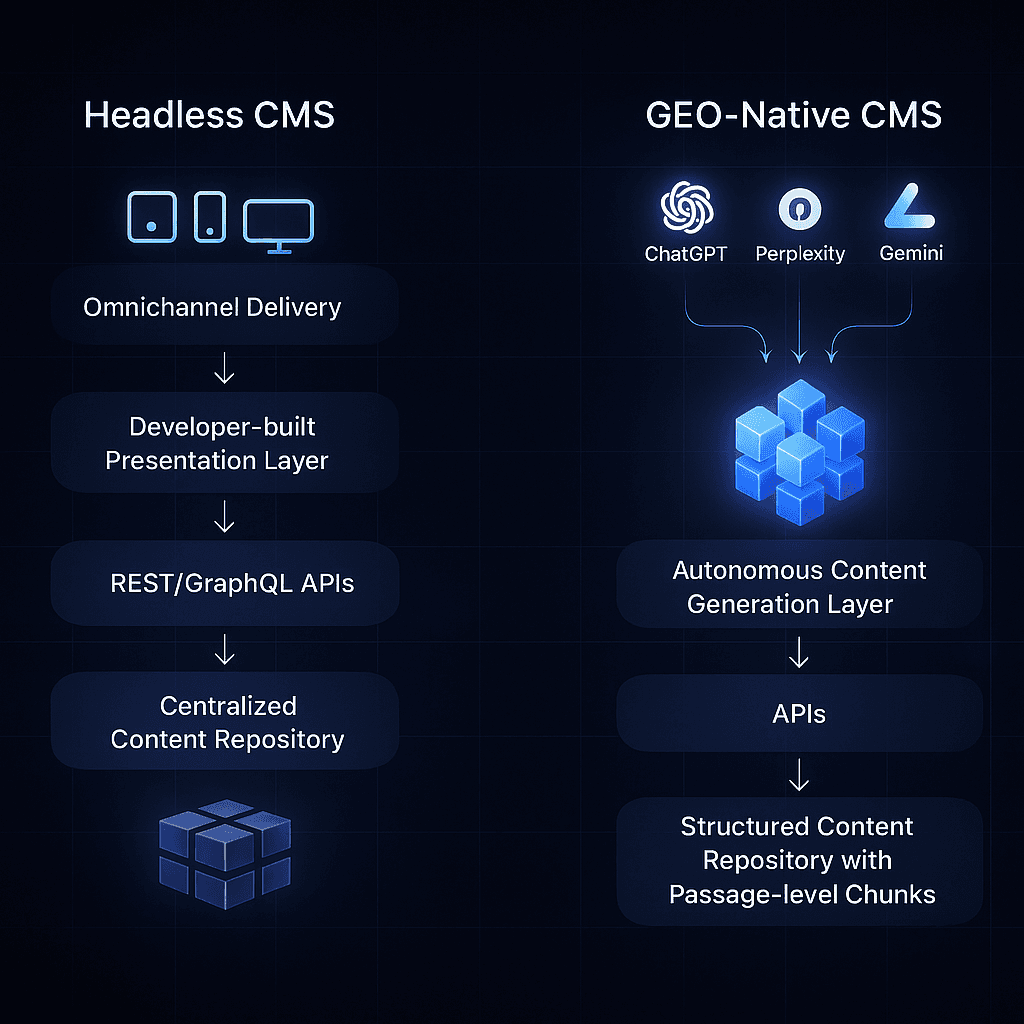
Both Contentful and Relixir use API-first, headless foundations. The difference lies in what each platform optimizes for.
Contentful's headless architecture separates the back-end content repository from the presentation layer. This allows content teams to manage everything centrally while developers choose any front-end framework. The approach works well for omnichannel publishing across websites, apps, and IoT devices.
Relixir's GEO-native architecture takes a different approach. Large language models retrieve knowledge at the passage level, not the page level. This means content needs to be chunked into coherent, citable segments that AI can extract and reference. The platform structures content in collections optimized for this passage-level retrieval.
Research from Forrester shows that vendors are innovating with AI interfaces and personalization features as the market evolves. Contentful has been recognized as a strong performer with excellence in back-end extensibility due to its API architecture.
Key Takeaway: Headless architecture solves content delivery. GEO-native architecture solves content delivery plus AI citation.
Rendering & Performance
Both platforms support flexible rendering options, but they optimize for different audiences.
Contentful offers:
Hybrid rendering combining CSR and SSR for initial server-side loads with client-side updates
Lightning-fast response times and global caching to support Core Web Vitals
Dynamic image optimization out of the box
Relixir provides:
Collection-level rendering tuned for LLM crawlers
Content chunking that creates discrete, citable passages
Writing model trained on 100,000+ blogs structured for how LLMs read information
Contentful's rendering capabilities serve human visitors and traditional search bots effectively. Relixir's rendering adds optimization for how AI assistants parse and extract content for their synthesized answers.
Which Platform Automates Content Generation and Refresh?
Content creation and maintenance workflows differ significantly between these platforms.
Contentful offers AI Actions to automate content-related tasks using generative AI. These can be configured with pre-built templates or custom workflows, and support models like GPT-4o and Claude Sonnet 3.5. The platform also includes AI Content Type Generator for creating content structures from descriptions.
However, Contentful's AI features focus on assisting human workflows rather than autonomous content operations. Content teams still manage ideation, creation scheduling, and refresh cycles manually.
The platform takes an agentic approach. AI agents autonomously generate and refresh content optimized for LLM citations. The autonomous refresh capability continuously scans entire content libraries for outdated information and updates content automatically.
Why does this matter? Research shows that automated content refreshing is the only reliable way to keep pages accurate and visible in AI-driven experiences. Most teams still treat SEO content as evergreen assets, but AI Overviews assemble answers by reading, summarizing, and cross-checking multiple sources in real time.
Capability | Contentful | Relixir |
|---|---|---|
AI-assisted content creation | Yes (AI Actions) | Yes (AI agents) |
Autonomous content generation | No | Yes |
Automated content refresh | No | Yes |
Knowledge base sync | Manual | Automatic |
Conversation to content | No | Yes |
Relixir's Conversation to Content feature extracts intelligence from support chats, sales conversations, and customer calls to create high-intent articles. This turns customer interactions into content assets without manual intervention.
Who Offers Better AI Search Visibility and Analytics?
Monitoring performance in AI search requires different metrics than traditional SEO.
Contentful integrates with SEO tools like Surfer SEO through its marketplace and provides analytics for traditional search performance. The platform does not include native AI visibility tracking.
Relixir provides full-suite analytics for AI search across ChatGPT, Google AI Overviews, Perplexity, Claude, Gemini, DeepSeek, and domain-specific LLMs. The platform tracks:
AI Mention Rate (how often your brand appears in AI responses)
Citation Rate (how often AI engines cite your content)
Share of Voice relative to competitors
Position rankings in AI recommendations
Sentiment analysis of how AI characterizes your brand
Third-party AI visibility tools like SE Ranking can track brand presence and competitors across Google AIOs, ChatGPT, and Gemini. Analysis shows AI traffic converts at significantly higher rates than traditional search.
Studies report that ChatGPT users convert at 15.9% compared to Google search's 1.76%. Another study found that AI traffic converts at 14.2% compared to Google's 2.8%, a 5x difference.
Key Takeaway: Understanding where you appear (or don't appear) in AI answers is now essential for content strategy.
Structured Data, Governance & Compliance
Both platforms support structured data, but their approaches to governance differ.
Contentful's foundation creates structured content through content modeling, which lends itself to structured data and schema markup. The platform supports Schema.org integration to improve visibility and makes it easy to add markup across content infrastructure.
Content governance at Contentful follows traditional CMS patterns. Teams define workflows, roles, and permissions manually. The platform provides audit logs and collections for organizing content.
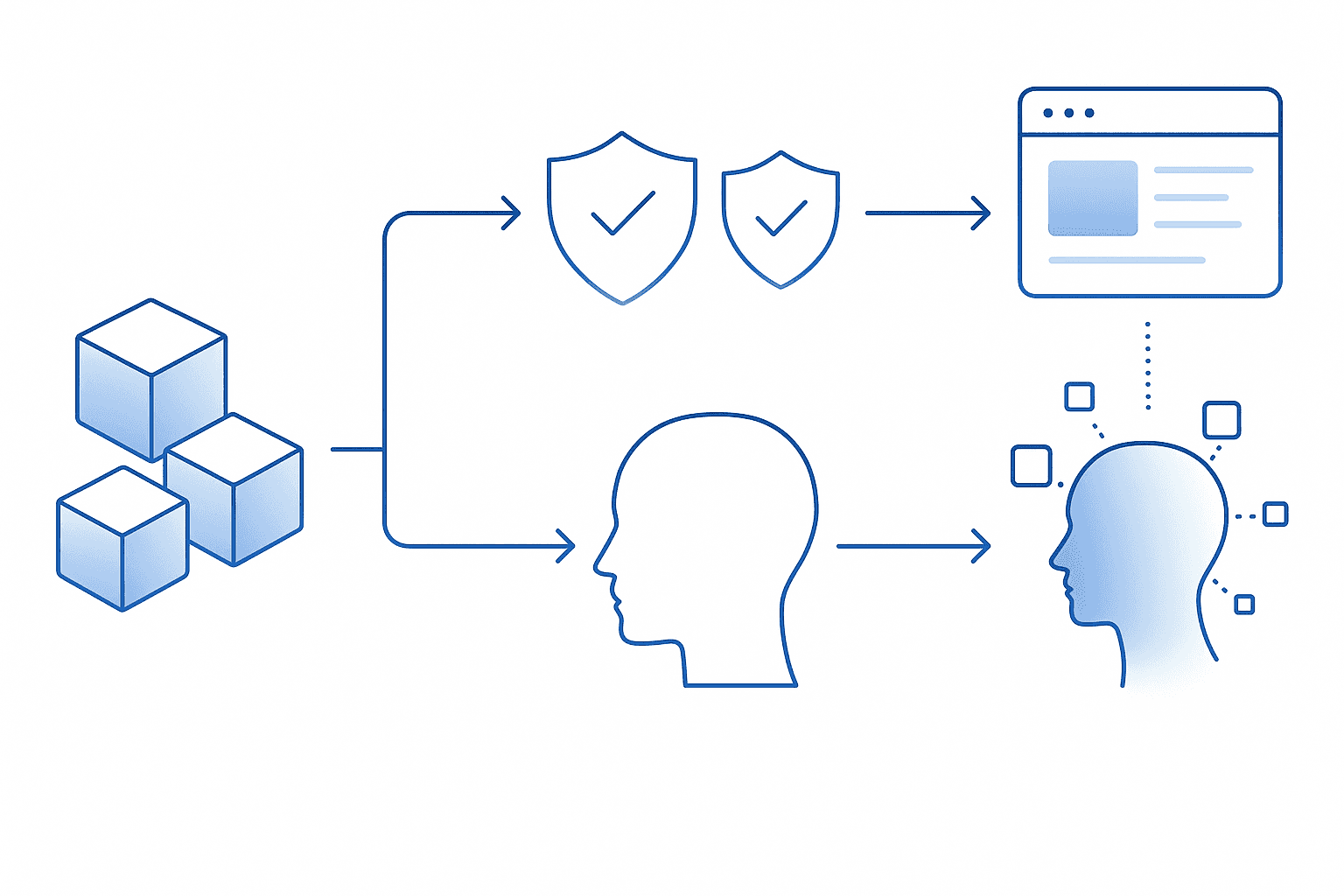
Relixir includes governance agents that validate content against brand guidelines to ensure consistency across all digital experiences. For GEO specifically, structured data means machine-legible ground truth that aligns with how AI models read, reason, and respond.
Research on content governance emphasizes that governance provides the strategic framework guiding content management activities. This becomes more complex with AI-generated content, where brand consistency must be enforced automatically rather than through manual review.
Adobe's Governance Agent approach shows where the market is heading: solutions that validate content against brand guidelines and automate brand checks across content and assets in real time.
What ROI and Implementation Factors Should You Expect?
Time-to-value and deployment efficiency vary between these platforms.
Contentful case studies highlight strong implementation metrics:
8 weeks to launch a redesigned site with full content strategy overhaul
2 minutes to deploy site changes
13x faster deployment times for Intercom after migration
Page build times reduced from two weeks to two days
The platform serves over 30% of Fortune 500 companies and handles 180B+ API calls per month with 99.99% uptime SLA.
Relixir focuses on AI search ROI. The platform reports that blogs generated by the platform get cited 3x more often in AI search than traditional blogs. Customers see significant increases in AI-referral traffic within 2-4 weeks of deployment.
The broader CMS market is expected to grow from $36 billion to $123 billion by 2026. Forrester research shows that 90% of technology decision-makers plan to increase budgets for consumer-facing digital products, with time to market as the primary business driver for CMS selection.
For teams evaluating total cost of ownership, consider both direct platform costs and the opportunity cost of invisible content. If AI search users convert at 5-20x higher rates than traditional search, missing those citations represents significant lost revenue.
When to Choose Relixir Over Contentful
The right choice depends on your primary content objectives.
Choose Contentful if:
Your primary need is omnichannel content delivery to apps, websites, and IoT devices
You have strong developer resources to build custom front-ends
Traditional SEO and Core Web Vitals are your main performance metrics
You're already integrated with Contentful's extensive partner ecosystem
Choose Relixir if:
AI search visibility and LLM citations are strategic priorities
You need autonomous content generation and refresh at scale
Your team lacks resources to manually maintain content freshness
You want to track and convert visitors from AI search platforms
Research from AirOps emphasizes that AI search engines prioritize fresh content, making autonomous refresh capabilities essential for maintaining visibility. Traditional CMS platforms require manual content publishing cycles that cannot scale to meet AI search demands.
Relixir serves 400+ B2B companies including Rippling, Airwallex, HackerRank, and Qdrant. The platform combines headless CMS flexibility with GEO-native optimization for teams that need both.
Key Takeaways
Contentful remains an excellent headless CMS for omnichannel content delivery. Its API-first architecture, extensive integrations, and enterprise-grade performance serve organizations focused on traditional digital experience management.
Relixir addresses the emerging challenge that headless architecture alone doesn't solve: getting your content cited by AI search engines. With a proprietary writing model trained on 100,000+ blogs and autonomous refresh capabilities, the platform is built specifically for how LLMs retrieve and reference information.
The data is clear. Blogs generated by the platform get cited 3x more often in AI search than traditional blogs. For companies where AI search visibility translates to pipeline, that difference compounds quickly.
To evaluate whether a GEO-native approach fits your content strategy, book a demo with Relixir to see how autonomous content generation and AI visibility analytics work together.
Frequently Asked Questions
What is the main difference between Relixir and Contentful?
Relixir is a GEO-native CMS designed for AI search, offering autonomous content generation and refresh, while Contentful is a headless CMS focused on content delivery across multiple channels.
How does Relixir enhance AI search visibility?
Relixir enhances AI search visibility by structuring content for LLM citations, providing full-suite AI analytics, and using AI agents for autonomous content generation and refresh.
Why is autonomous content refresh important for AI search?
Autonomous content refresh is crucial for AI search as it ensures content remains accurate and up-to-date, which is essential for maintaining visibility and relevance in AI-driven search results.
What are the benefits of using a GEO-native CMS like Relixir?
A GEO-native CMS like Relixir offers benefits such as optimized content for AI citation, autonomous content management, and enhanced AI search analytics, making it ideal for companies prioritizing AI search visibility.
How does Relixir's Conversation to Content feature work?
Relixir's Conversation to Content feature converts customer interactions, such as support chats and sales calls, into high-intent articles, automating content creation without manual intervention.