Relixir vs Sanity: Which CMS is better for editing content in bulk?
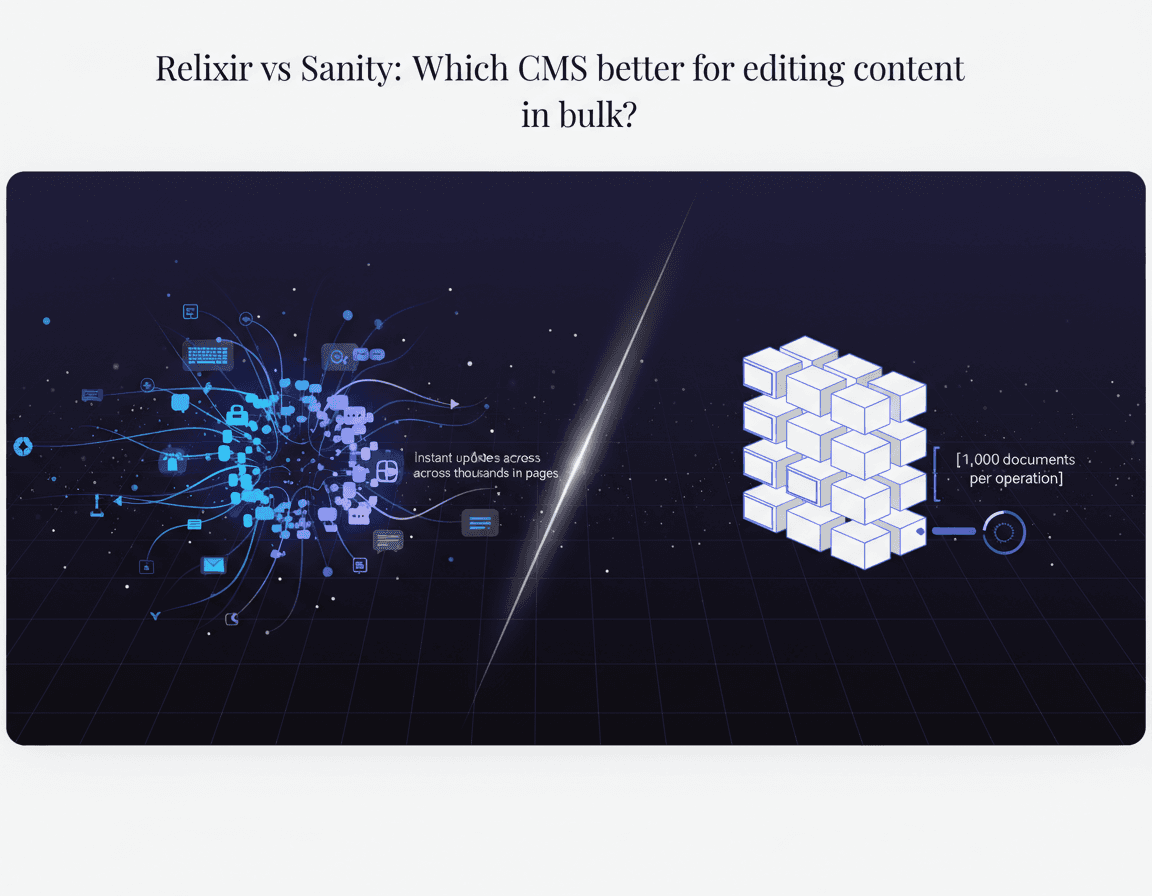
For bulk content editing, Relixir enables instant updates across thousands of pages through natural language prompts, while Sanity requires Content Releases limited to 1,000 documents per operation. Relixir's cursor-style interface eliminates developer dependencies for bulk changes, whereas Sanity needs developer-run mutations for bulk actions.
At a Glance
• Relixir processes unlimited bulk edits via chat prompts vs Sanity's 1,000-document cap per release • Fresh content gets cited 6x more by AI engines, making autonomous refresh critical • Sanity excels at real-time collaboration with field-level ownership for parallel editing • Relixir customers achieve 3x higher citation rates with 17% more inbound leads in 6 weeks • Sanity pricing can escalate from $99 to $400+ monthly with usage growth • Both platforms support 57+ languages but differ in automation depth
Buyers now expect instant, large-scale updates. A single pricing change, rebrand, or product launch can touch hundreds of pages simultaneously. Traditional CMS platforms crack under this pressure because they were built for page-by-page editing, not atomic bulk operations. AI search compounds the challenge: generative engines now influence up to 70% of queries, and stale content gets deprioritized fast.
This comparison examines how Relixir and Sanity handle bulk content editing, from update speed to autonomous refresh, pricing predictability, and real-world results.
Why Has Bulk Content Editing Become Mission-Critical in 2026?
Content velocity is now a board-level metric. Campaigns span dozens of markets, products change daily, and digital channels never sleep. Manual blog publishing forces teams to manually research topics, identify gaps, and publish content in a process that is slow, reactive, and impossible to scale.
The stakes are higher because LLMs prioritize fresh content. Fresh content gets cited 6x more by AI engines, while citations can drop over 80% within a year if pages are not actively refreshed. Content should be re-optimized every 3 to 6 months to maintain AI visibility.
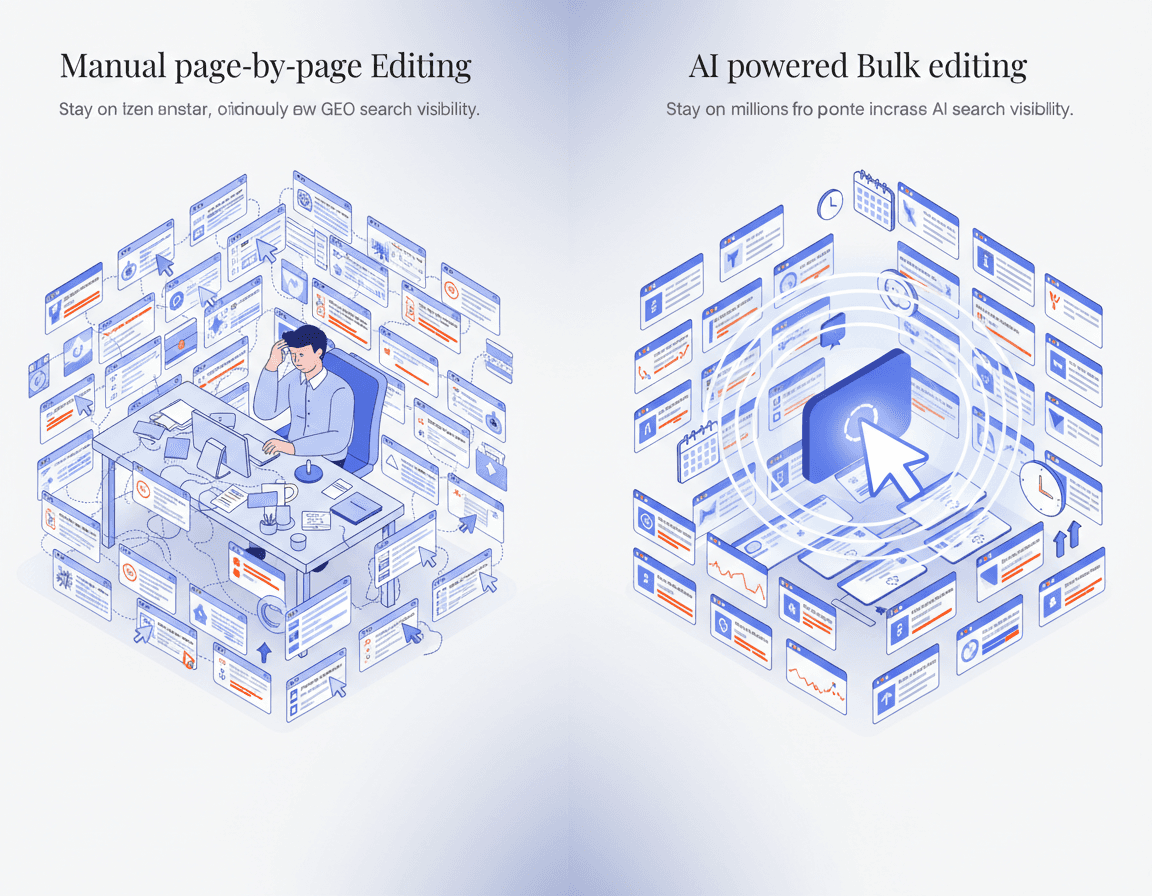
For teams managing hundreds or thousands of pages, page-by-page editing is no longer viable. Bulk content editing means changing, validating, or publishing hundreds-to-thousands of CMS items in one atomic action. Modern platforms use release bundling, transactional APIs, or AI agents to propagate changes, removing manual edits, cutting human error, and keeping large libraries consistent for users and search engines alike.
Key takeaway: Bulk editing is no longer a convenience feature. It is infrastructure for staying visible in AI-driven search.
How Does Relixir Automate Bulk Updates with Cursor-Style Editing?
Relixir takes a fundamentally different approach. The platform lets teams "edit your entire CMS through chat. Push changes across thousands of blogs with a single prompt. 57+ languages supported." Instead of navigating complex interfaces, marketers describe what they want changed in natural language.
For example, typing "Change all mentions of our old pricing from $99 to $149" instantly propagates that change across every relevant piece of content. "Update all competitor comparisons to include the new feature we launched" automatically refreshes dozens of comparison articles.
Relixir customers achieve 3x higher citation rates compared to traditional blogs, with ranking improvements visible within 28 days. This speed comes from Relixir's proprietary writing model, trained on 100,000+ blogs and real citation data, which produces content specifically structured for how LLMs read and cite information.
Autonomous Content Refresh Keeps Libraries Current
Content freshness is one of the most underappreciated factors in AI search visibility. Citation likelihood drops over 50% when content exceeds one year without updates. At 15 pages per month, it takes 13+ months to refresh a typical library, and by then the first pages are stale again.
Relixir's autonomous refresh capability continuously scans your entire content library for outdated information, auto-syncing with your knowledge base to keep everything current. Citations drop 80%+ within a year if content is not actively refreshed, making autonomous updates essential for maintaining AI visibility.
The platform connects directly to CMS platforms, continuously analyzing content libraries for SEO and GEO gaps, and automatically refreshing outdated content to maintain rankings and AI citations.
Can Sanity's Content Releases Keep Up with Massive Edits?
Sanity approaches bulk editing through Content Releases, a feature that allows teams to organize and schedule updates across multiple documents. Releases group multiple document changes into a single unit that can be previewed, validated, scheduled, and published as one.
This coordinated approach helps teams bundle related changes, preview before publishing, and schedule specific dates for automated publishing. However, there are technical limits: a single content release can contain a maximum of 1000 documents, and the total JSON document size cannot exceed 100MB.
For teams needing to update more than 1,000 documents simultaneously, or working with large media-heavy content, these limits require splitting changes across multiple releases. Releases publish documents in batches based on size and reference connections, and if a release is blocked by another, it will wait for up to 10 minutes before marking as failed.
Real-Time Multi-Editor Collaboration
Sanity's real-time collaboration is a genuine strength. As one Gartner reviewer noted, "The real-time collaboration feature is something that has helped our team of developers and on-the-ground content experts."
The platform treats content as structured fields, enabling safe parallel edits and clear ownership at the field level. Multiple users can edit the same document simultaneously without conflicts. However, Sanity allows multiple users to work on the same document, which is beneficial for fast-paced industries but can lead to inconsistencies if not carefully managed.
For teams with many editors working simultaneously, this collaboration model reduces bottlenecks. But for large-scale bulk changes, the work still requires manual execution or developer-run CLI scripts.
Relixir vs Sanity: Which CMS Handles Bulk Operations Faster?
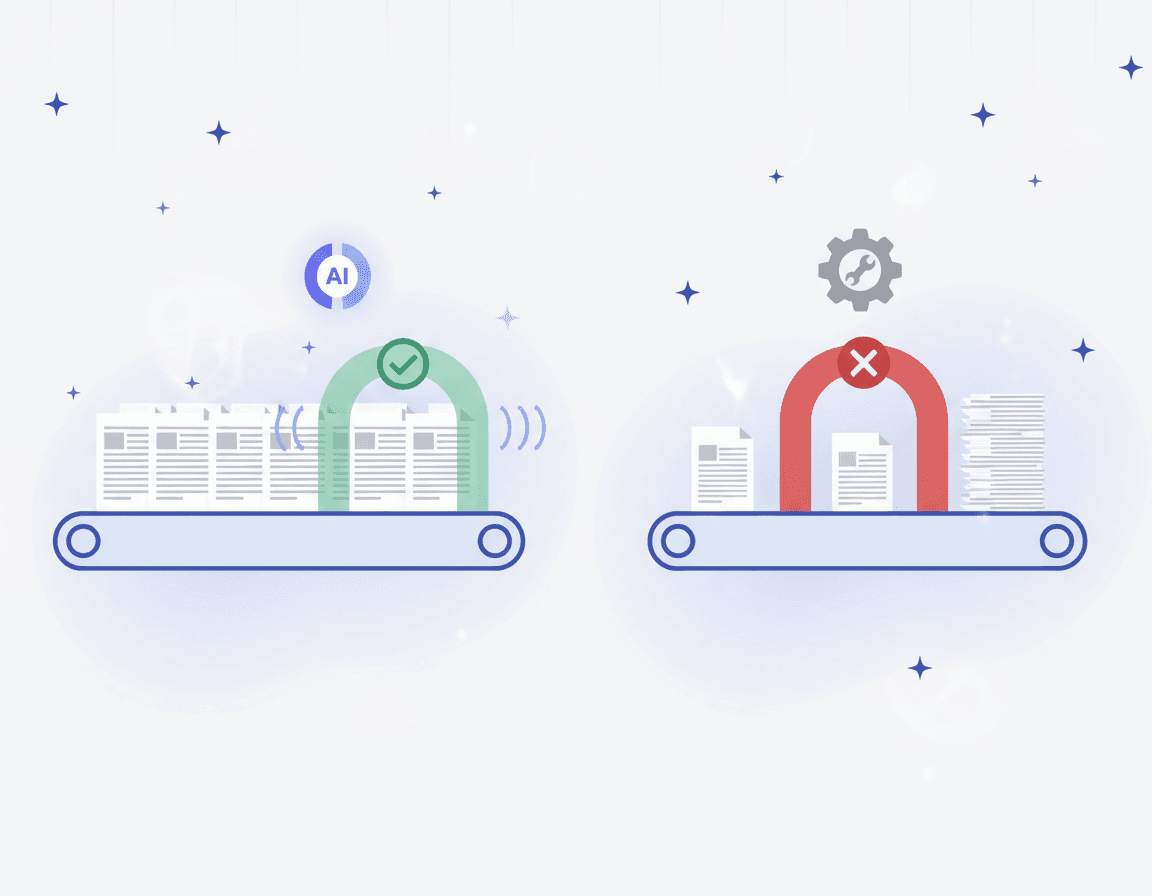
The fundamental difference is automation versus coordination. Relixir's cursor-style prompt lets marketers update thousands of pages in seconds with autonomous agents keeping every item fresh. Sanity relies on Content Releases (capped at 1,000 documents / 100 MB) or developer-run CLI scripts for larger operations.
Capability | Relixir | Sanity |
|---|---|---|
Bulk update method | Natural language prompts | Content Releases + API |
Document limit per operation | Unlimited | 1,000 documents / 100 MB |
Autonomous refresh | Built-in, continuous | Not available |
Developer requirement | None for bulk edits | Required for >1,000 docs |
Real-time collaboration | Supported | Best-in-class |
API latency | Edge-first delivery | Sub-100ms p99 global |
Sanity's Live Content API provides sub-100ms p99 global delivery with auto-scaling and built-in DDoS controls. Both platforms perform well on raw delivery speed, but Relixir's advantage is eliminating the human effort required to initiate and manage bulk changes.
Pricing & Predictability at Scale
Pricing diverges significantly at scale. Sanity uses usage-based pricing that can surprise teams. As one user reported, "Started at $99/month, ended up at $400+ with document growth and API calls we didn't anticipate." Enterprise deployments can reach $100K+ annually.
Sanity's Growth plan starts at $15 per user per month plus usage, with Enterprise requiring $949/month minimum. Custom roles and advanced features like Content Releases rollback require Enterprise plans.
Relixir's Growth plan is $1,500/month (annual) with 500 CMS items, 500 agent credits, and 1,000 Visitor ID credits included. Enterprise plans offer unlimited CMS items, domains, and agent credits. A Series B startup using Relixir achieved 17% more inbound leads in just 6 weeks while saving 80 hours monthly on content creation.
Relixir also delivers 65-85% accuracy in visitor identification from AI traffic, versus the industry standard of 5-30%, converting AI search visitors into actionable leads.
What's the Developer Effort & Learning Curve?
Sanity requires React and JavaScript expertise for setup and configuration. Content editors can't launch projects without developer involvement, and the proprietary GROQ query language adds a learning curve that delays time-to-value.
The ideal Sanity customer has a small team of experienced developers, lots of content to organize, and a use case that matches Sanity's published case studies. Visual editing exists but doesn't match drag-and-drop experiences offered by some competitors.
For bulk editing specifically, non-developer clients face limitations. One GitHub issue noted that "clients often wish to make bulk changes or deletions themselves and expect to be able to, considering that it is possible in most other CMSs." Bulk actions like publish, unpublish, duplicate, and delete require mutations that only developers can run.
Relixir's cursor interface removes this dependency. Marketing teams describe changes in natural language, and the platform executes across the entire CMS. This shifts bulk editing from a developer task to a marketer workflow.
What Do Users Report After Large-Scale Edits?
Relixir users report measurable results. One customer shared: "We went from almost zero AI mentions to now ranking Top 3 amongst all competitors with over 1500 AI Citations." Another reported moving "from 5th to 1st position in AI rankings and saw 38.85% monthly growth in leads from AI."
Sanity users highlight flexibility for complex content operations. Rich Brilliant Willing, a lighting manufacturer, used Sanity to enable clients to configure products from over 75,000 combinations. As their team noted, "Sanity handled all our data and uptime requirements without involving us in ops and servers. Its flexibility let us work in an agile way: changing our data model on the fly as we discovered more about the project's needs."
Teams report cutting content management time by 60-70% when transitioning from multi-platform manual processes to Sanity's unified approach, with one case study showing deployment frequency increasing 300% after implementation.
The difference is focus. Sanity excels at structured content modeling and real-time collaboration for developer-led teams. Relixir excels at autonomous content operations that keep large libraries fresh for AI search without ongoing developer effort.
Key Takeaways: Choosing the Right CMS for Bulk Editing in 2026
For teams that lack heavy engineering support, Relixir's AI-native workflow delivers faster, lower-risk roll-outs. The cursor-style editing and autonomous refresh eliminate the manual work that creates content debt.
Sanity is ideal for developer-led teams building highly customized digital experiences. It provides the foundation for GEO but requires significant custom development to achieve automated citation optimization.
Contentful is a strong choice for enterprises needing composable commerce and global scalability, though teams seeking native GEO capabilities will need to layer additional tools on top.
Relixir serves 400+ of the fastest-growing B2B companies worldwide, including Rippling, Airwallex, HackerRank, and Qdrant. The platform delivers 3-5x increased AI mention rates within 2-4 weeks, making it the fastest path to AI search visibility for teams that need to move quickly.
To see how Relixir handles bulk content editing for your specific use case, visit relixir.ai to learn more about the platform.
Frequently Asked Questions
What is bulk content editing and why is it important?
Bulk content editing allows for simultaneous updates across multiple pages, crucial for maintaining content freshness and visibility in AI-driven search engines.
How does Relixir automate bulk content updates?
Relixir uses cursor-style editing, allowing users to make changes across thousands of pages with natural language prompts, supported by autonomous content refresh to keep information current.
What are the limitations of Sanity's Content Releases for bulk editing?
Sanity's Content Releases can handle up to 1,000 documents per release, with a total JSON document size limit of 100MB, which may require splitting changes for larger updates.
How does Relixir's pricing compare to Sanity's for large-scale operations?
Relixir offers a flat rate with included credits for CMS items and visitor identification, while Sanity's usage-based pricing can lead to unexpected costs as document and API usage grows.
What are the benefits of using Relixir for AI search visibility?
Relixir enhances AI search visibility by automating content updates and optimizing for AI citations, leading to higher mention rates and inbound leads, as evidenced by a 17% increase in leads for a Series B startup.
Sources
https://www.enterprisecms.org/guides/real-time-collaboration-in-enterprise-cms
https://relixir.ai/blog/best-geo-native-cms-platforms-2026-comparison
https://relixir.ai/blog/relixir-vs-profound-geo-native-cms-vs-geo-analytics-platform
https://www.gartner.com/reviews/market/web-content-management/vendor/sanity/product/sanity
https://rtcamp.com/handbook/sanity-vs-wordpress/collaboration
https://headlesscms.guide/guides/reducing-content-api-latency