SEO Best Practices [February 2026]
SEO best practices in February 2026 combine traditional optimization with Generative Engine Optimization (GEO) to ensure content gets cited in AI responses across ChatGPT, Perplexity, and Google AI Mode. Success requires answer-first content structures, comprehensive schema markup, fresh content updated within 30 days, and strong brand authority signals beyond traditional backlinks.
Key Facts
• GEO prioritizes AI citations over rankings - Content must be optimized for extraction and summarization by large language models, not just SERP positions
• Content freshness drives 3.2x more citations - Posts updated within 30 days receive significantly higher AI visibility than older content
• Brand mentions outweigh backlinks - Brand volume shows 0.334 correlation with AI citations, becoming the strongest predictor of visibility
• Schema markup increases citation rates 2-4x - Pages with valid structured data appear more frequently in AI Overviews and featured snippets
• AI search converts 20x better - ChatGPT users convert at 15.9% compared to Google search's 1.76% conversion rate
• 47% of AI rankings differ from Google - Brands ranking first on Google only get cited 62% of the time by AI engines
In February 2026, SEO best practices go far beyond blue-link rankings. The playbook now blends classic on-page hygiene with tactics that win citations inside ChatGPT, Perplexity, and Google AI Mode. This guide shows marketers how to optimize for both humans and large language models.
Why does SEO look different in February 2026?
SEO in 2026 is no longer just about ranking high. It's about ensuring your content gets cited and featured in AI responses.
Generative Engine Optimization (GEO) is the process of optimizing content for AI-powered experiences. Unlike traditional SEO, which focuses on ranking in search engine results pages, GEO targets inclusion and citation within AI-generated answers produced by large language models like ChatGPT, Perplexity, and Google AI Overviews.
The shift is dramatic. As one industry guide notes:
"AI is transforming how people discover businesses online. With over 200 million people using ChatGPT weekly and AI adoption growing from 8% to 40% in just one year, optimizing for generative engines is no longer optional-it's essential."
This transformation demands a new approach.
Traditional SEO foundations like crawlability, authority, and technical hygiene remain table stakes. However, GEO introduces new priorities: Entity clarity instead of keyword targeting, Semantic depth instead of production volume, Citation-worthiness instead of link velocity, and Source reliability weighting instead of raw backlink authority.
Visibility now includes being explained, summarized, and recommended by AI systems-whether or not a click ever happens.
From rankings to citations: understanding GEO
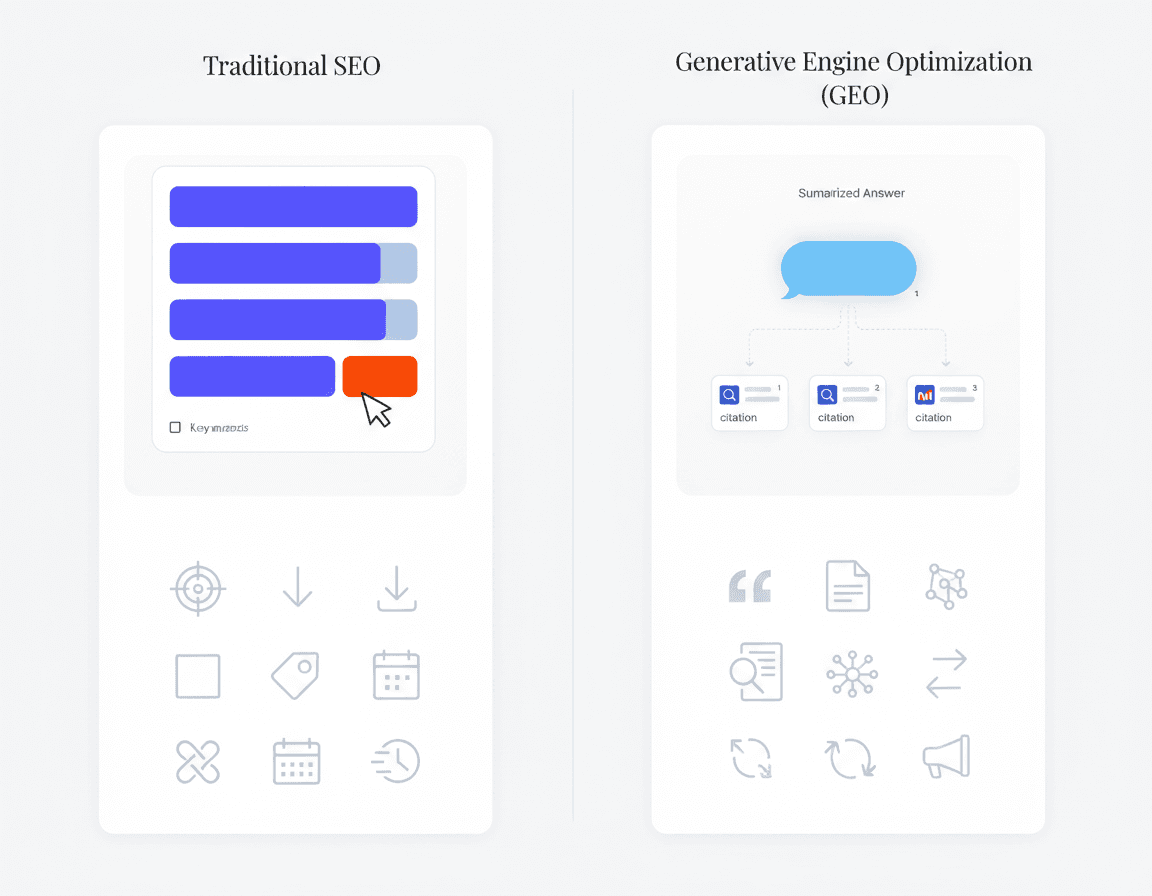
Traditional SEO optimizes for positions on a results page. GEO prioritizes being a reliable source for AI to extract and summarize information.
The distinction matters commercially. Research shows 47% of queries show different brand rankings in AI responses than in Google's SERP. A brand ranking first on Google only gets cited 62% of the time by AI engines.
Content freshness plays a crucial role. According to ConvertMate's AI Visibility Study, content updated within 30 days gets 3.2x more AI citations. This freshness requirement represents a fundamental shift from traditional SEO, where evergreen content could rank for years without updates.
Metric | Traditional SEO | GEO |
|---|---|---|
Primary Goal | Page 1 rankings | AI citations |
Success Measure | Click-through rate | Mention rate |
Content Focus | Keyword optimization | Extractable clarity |
Update Frequency | Periodic | Continuous |
Authority Signal | Backlinks | Brand mentions |
For teams looking to bridge both worlds, platforms that combine SEO and GEO optimization can help maintain visibility across traditional and AI search simultaneously.
What does Google's February 2026 Core Update mean for SEO?
Google's February 2026 Core Update targets AI content quality and topical authority. The update refines how Google evaluates content quality, prioritizing originality and expertise over production volume.
The key changes include:
AI content scrutiny increases: Google can now better distinguish low-quality AI-generated content from genuinely helpful material, regardless of how it was produced
Topical authority matters more: Sites demonstrating deep expertise in focused subject areas see ranking improvements over generalist publishers
Originality is non-negotiable: Pages lacking unique insights or first-hand experience experience the sharpest ranking declines
The impact on mass-produced AI content has been severe. According to PikaSEO, sites publishing hundreds of AI articles without meaningful human oversight are seeing 40-60% traffic drops. However, AI-assisted content with expert editing and unique value continues to perform well.
"Google's not punishing AI content wholesale. They're punishing lazy content, regardless of how it's created. Sites that mixed AI-generated content with genuine human expertise and editing actually performed fine. Some even gained."
Google also added a new "Authors" section to its Search Central documentation, signaling increased importance of author credentials and transparency. E-E-A-T signals (Experience, Expertise, Authoritativeness, Trust) have become critical. As Search Engine Journal reports, LinkedIn's internal testing found structured content with named authors, visible credentials, and clear publication dates performed better in AI citations.
Key takeaway: The winning strategy combines AI efficiency with human expertise-use AI for scale, add human insight for quality and originality.
Which technical foundations still matter for AI-era SEO?
Technical SEO fundamentals remain essential, but their purpose has expanded. According to Geneo's schema best practices guide, AI platforms increasingly rely on machine-readable signals to interpret, extract, and attribute information.
Google's 2025 guidance confirms that structured data helps systems understand your pages and can enable features, provided the markup accurately reflects visible content and complies with policies.
Core technical requirements for AI-era SEO include:
Crawlability: Ensure AI crawlers can access your content without restrictions
Site speed: Sites loading under 2.5 seconds receive significantly more AI citations
Mobile optimization: Google's mobile-first indexing extends to AI content evaluation
Clean HTML structure: Sites with H2 to H3 to bullet point structures are 40% more likely to be cited
Schema markup: Pages with valid schema are 2-4x more likely to appear in Google's AI Overviews and featured snippets
For teams seeking deep CMS integrations with GEO capabilities, platforms that combine technical optimization with AI visibility monitoring can streamline implementation.
Implement rich, valid schema markup
Schema markup is structured data that helps search engines understand the context of your content. Research shows schema can increase click-through rates by 30%.
Follow these steps for effective schema implementation:
Use JSON-LD format: Google explicitly recommends it, and AI tools generate it by default
Maintain content parity: Never mark up invisible or misleading elements-Google flags this as spammy structured data
Link entities to authoritative profiles: Use the sameAs property to connect Organization and Person to Wikidata, Wikipedia, Crunchbase, and LinkedIn
Include author credentials: Use Person schema with alumniOf, hasCredential, award, and relevant specialty fields
Keep dateModified current: Cite primary sources directly and reflect citations in schema using citation arrays
Validate before publishing: AI-generated schema often contains syntax errors or deprecated properties
Priority schema types for AI visibility:
Article/BlogPosting: For content pages with author attribution
FAQPage: Directly matches how users query AI search engines
HowTo: Transforms tutorials into interactive rich results
Organization/Person: Establishes entity identity for your brand and authors
Product/SoftwareApplication: Essential for e-commerce and SaaS
Content that gets cited: topical authority, clusters & freshness
AI engines cite only 2-7 sources per query versus Google's traditional 10 blue links. Earning one of those limited citation slots requires demonstrating genuine topical authority.
Topical authority is Google's way of judging expertise, depth, and trustworthiness on a specific subject. Content clustering-also called the pillar-cluster model-is the structure that makes topical authority possible.
The data supports this approach. Research shows sites with strong content clusters saw 20-40% more visibility compared to scattered, keyword-stuffed pages. Clustered content often drives 30%+ more organic traffic and holds rankings 2.5x longer than standalone posts.
Google's AI systems pull from sites that demonstrate real topical depth. In the age of AI, clusters help your content get cited in generative answers because everything is clearly connected and authoritative.
Content freshness also plays a critical role. AI models consider content recency, and regularly updated content with clear 'last updated' dates performs better, especially for rapidly evolving topics.
For real-world examples of how companies have built topical authority through strategic content, see case studies from brands that have achieved significant improvements in AI search visibility.
Lead with answer-first snippets
AI engines need content structured for extraction. The answer-first approach means leading each section with a direct answer, then expanding with proof, examples, and steps.
GEO content structure differs from traditional SEO content:
Shorter paragraphs: 2-3 sentences maximum for easy extraction
Question-focused headings: Match how users query AI systems
Data-driven claims: Original research gets cited 40% more than opinion-based content
Strict freshness requirements: 76.4% of cited content was updated in the last 30 days
FAQ content aligns perfectly with conversational AI queries. When structured correctly, FAQs become citation magnets because they directly match how users ask questions.
Comparison content is also highly effective. Users naturally ask comparative questions, and the format is perfectly structured for AI extraction.
Do links still matter? Off-site authority signals LLMs trust
Yes, but the type of authority that matters has shifted. Research reveals that brand volume-not backlinks-emerges as the strongest predictor of AI citations, with a 0.334 correlation.
Brand web mentions account for 35% of the AEO score weight in determining AI visibility. This represents a fundamental change from traditional SEO, where backlink authority dominated.
Key off-site authority signals for AI visibility:
Brand mentions across the web: Volume of unlinked mentions matters significantly
Community platform presence: Brands with 10M+ Reddit mentions average 7.0 citations compared to 1.8 for brands with minimal presence-a 3.9x multiplier
Third-party coverage: Companies with extensive third-party brand mentions show stronger AI visibility than those relying solely on owned content
Wikipedia presence: Companies with Wikipedia entries show higher average visibility compared to those without-a measurable lift in AI citation rates
Professional networks: LinkedIn ranked among top-cited domains across multiple AI models in various analyses
Research analyzing thousands of company reports found that brand authority signals consistently correlate with AI visibility across all major platforms. The correlation between overall AI visibility and brand authority score significantly outperforms content-only optimization approaches.
"LLMs prioritize brand mentions and community presence over backlinks and content volume."
The practical implication: invest in building authentic brand presence across community platforms, earned media coverage, and third-party validation-not just links.

How to measure success in an AI-first world
Traditional SEO metrics like rankings and traffic no longer tell the complete story. LLM visibility measures whether AI platforms mention your brand, describe it accurately, and link to your content-rather than where you rank in Google.
Metric | Definition | Why It Matters |
|---|---|---|
Mention Rate | How often your brand appears when buyers ask relevant questions | Baseline visibility measure |
Citation Rate | When AI mentions you, how often it cites your content as the source | Indicates content authority |
Share of Voice | Your visibility relative to competitors for specific prompts | Competitive positioning |
AI Referral Traffic | Visitors arriving from AI platforms | Direct business impact |
Conversion Rate | AI traffic to leads/customers | Revenue attribution |
Tracking must span multiple platforms. Tools need to monitor ChatGPT, Perplexity, Gemini, Claude, and Google AI Overviews to capture complete visibility data.
Visibility shifts rapidly. Research has found that brands frequently experience volatility in AI answers, with visibility changing from one response to the next. This volatility makes weekly tracking essential.
Purpose-built AI visibility tools have emerged to address these measurement challenges. As Arc Search notes, AI visibility is how often and how prominently your brand shows up inside AI-generated answers across platforms.
Research from Princeton accepted to KDD 2024 demonstrates that Generative Engine Optimization can boost visibility by up to 40% in model responses-showing why citation and source coverage matter as much as dashboards.
For teams seeking integrated GEO tools for content refreshing, platforms that combine visibility monitoring with automated optimization can accelerate results.
Key takeaways & next steps
SEO in February 2026 requires a dual strategy: maintain traditional search fundamentals while building for AI citation. The brands winning today are those treating every piece of content as a potential source for AI-generated answers.
Start with these priorities:
Audit your content for AI-readiness: Implement answer-first structures and ensure content is updated within the last 30 days for priority topics
Implement comprehensive schema markup: Focus on Article, FAQ, Organization, and Person types with proper entity linking
Build topical authority through clusters: Create interconnected pillar and cluster content that demonstrates genuine expertise
Invest in off-site brand presence: Prioritize authentic community engagement, earned media, and third-party mentions
Track AI visibility metrics: Monitor mention rate, citation rate, and share of voice across all major AI platforms
The commercial opportunity is significant. Analysis of 500,000+ web sessions reveals that ChatGPT users convert at 15.9% compared to Google search's 1.76%-a 20x higher conversion rate. AI search traffic represents high-intent buyers who have already done their research.
For teams seeking to accelerate their GEO strategy, Relixir offers a GEO-native CMS with built-in AI agents that autonomously generate and refresh content optimized for LLM citations. The platform combines content creation, autonomous refresh, and AI visibility monitoring in a single solution-helping B2B companies build the content infrastructure needed for AI search visibility.
What are the most important SEO best practices for AI search in 2026?
In 2026, classic on-page hygiene still matters, but winning visibility means optimizing for citations. Focus on answer-first sections that give LLMs quotable facts, rich JSON-LD schema and entity clarity so models can verify context, and continuous content freshness-posts updated within 30 days earn 3.2x more citations. Finally, secure authority through quality mentions; brand volume now outranks backlinks in predicting AI citations.
How do you track AI search visibility metrics?
Start with purpose-built AI visibility tools. Measure mention rate-how often your brand appears in answers. Track citation rate and share of voice across ChatGPT, Perplexity, Gemini, and Claude. Platforms like Scrunch or Profound visualize these KPIs. Research shows optimizing for them can boost visibility by up to 40%.
Frequently Asked Questions
What are the key SEO best practices for AI search in 2026?
In 2026, SEO best practices focus on optimizing for AI citations. This includes using answer-first sections, implementing rich JSON-LD schema, ensuring content freshness, and securing authority through quality brand mentions.
How does Google's February 2026 Core Update affect SEO?
Google's February 2026 Core Update emphasizes AI content quality and topical authority, prioritizing originality and expertise over production volume. Sites with genuine human oversight and unique value continue to perform well.
Why is content freshness important for AI citations?
Content freshness is crucial as AI models prioritize recent information. Content updated within 30 days is 3.2x more likely to be cited by AI engines, making regular updates essential for maintaining visibility.
How can Relixir help with AI search optimization?
Relixir offers a GEO-native CMS with AI agents that autonomously generate and refresh content optimized for LLM citations, helping B2B companies build the content infrastructure needed for AI search visibility.
What technical SEO foundations are essential for AI-era SEO?
Technical SEO fundamentals like crawlability, site speed, mobile optimization, clean HTML structure, and schema markup remain essential, as AI platforms rely on these signals to interpret and attribute information.
Sources
https://www.digitalapplied.com/blog/schema-markup-ai-generation-guide-2026
https://www.knewsearch.com/blog/ai-visibility-benchmark-report
https://www.digitalapplied.com/blog/google-february-2026-core-update-seo-guide
https://pikaseo.com/articles/google-february-2026-core-update-ai-content
https://www.searchenginejournal.com/discover-core-update-ai-mode-ads-crawl-policy-seo-pulse/566659/
https://geneo.app/blog/schema-markup-best-practices-ai-citations-2025/
https://relixir.ai/blog/best-geo-platforms-with-cms-integrations
https://systemsarchitect.net/schema-markup-guide-structured-data-for-rich-results-and-ai-search/
https://www.citedify.com/blog/geo-content-strategy-guide-2026
https://seohq.github.io/topical-authority-content-clustering
https://arcsearch.arcintermedia.com/blog/2026-ai-visibility-tracking-tools/
https://thedigitalbloom.com/learn/2025-ai-citation-llm-visibility-report/