Blog
Top AEO platforms with bulk prompt monitoring (Q4 2025)
Top AEO Platforms with Bulk Prompt Monitoring (Q4 2025)
Bulk prompt monitoring tracks hundreds to thousands of AI assistant queries simultaneously across ChatGPT, Gemini, Perplexity, and other engines to measure brand visibility at scale. Leading platforms like Evertune offer 1.25 million monthly prompts per brand, while Gauge provides custom enterprise solutions with comprehensive gap analysis and citation intelligence features.
At a Glance
Volume leaders: Evertune tracks 1,250,000 prompts monthly at $2.40 per thousand prompts, while Profound offers 9,000 prompts at $44.33 per thousand
Engine coverage: Top platforms monitor 10+ AI engines including ChatGPT, Gemini, Perplexity, Claude, and AI Overviews
Market context: 50% of Google searches already include AI summaries, expected to reach 75% by 2028
Citation volatility: AI citations can change by up to 60% monthly, requiring high-volume sampling for statistical confidence
Enterprise features: SOC 2 compliance, SSO, role-based access, and API integration distinguish professional platforms from basic trackers
Bulk prompt monitoring has shifted from a nice-to-have feature to an operational necessity for brands serious about AI visibility. Generative engines like ChatGPT, Perplexity, Gemini, and Bing Copilot will influence up to 70% of all queries by the end of 2025, and a single-prompt tracking approach simply cannot keep pace with the volatility of AI-generated answers.
This guide examines the leading AEO platforms that support high-volume prompt monitoring, compares their economics and engine coverage, and outlines a phased rollout plan for enterprise teams.
Why Bulk Prompt Monitoring Became Non-Negotiable in 2025
Bulk prompt monitoring is the practice of tracking hundreds to millions of AI-assistant prompts in parallel across ChatGPT, Gemini, Perplexity, Copilot, and Google AI Overviews to measure when, where, and how often a brand is mentioned.
The market shift toward AI answers accelerated rapidly. About 50% of Google searches already include AI summaries, a figure McKinsey expects to exceed 75% by 2028.
Meanwhile, agencies face mounting client pressure: "What does AI say about us?" has become a deceptively simple question that single-prompt tools struggle to answer with statistical confidence.
High-volume sampling matters because AI citations can change by up to 60% in just one month. Without statistically significant sample sizes, marketers are essentially guessing whether a visibility dip is noise or a real competitive displacement.
Key takeaway: Bulk prompt monitoring delivers the confidence intervals and trend data that single-prompt trackers cannot match, making it essential for any serious GEO or AEO program in 2025.

What Criteria Should You Use to Evaluate Bulk Prompt Trackers?
Not all platforms approach bulk monitoring the same way. Before committing budget, evaluate tools against these critical dimensions:
Criterion | Why It Matters |
|---|---|
Prompt volume per brand | Larger samples produce tighter confidence intervals and reveal edge-case queries competitors may ignore. |
Engine breadth | ChatGPT alone is insufficient; Gemini, Perplexity, AI Overviews, Claude, Copilot, and DeepSeek each surface different citations. |
Cost per thousand prompts | High per-prompt fees limit how many queries you can realistically track each month. |
Refresh cadence | Daily or weekly updates catch volatility faster than monthly snapshots. |
Action-center features | Gap analysis, citation intelligence, and prioritized recommendations turn data into strategy. |
Enterprise controls | SOC 2 compliance, SSO, role-based access, and approval workflows protect brand integrity at scale. |
Gartner research notes that failure to gain input from the organization and prioritize end-user success still dooms many automation initiatives. The same principle applies to AEO platforms: if the tool does not integrate with existing workflows or provide actionable outputs, adoption stalls.
Platform Deep-Dive: Who Handles Scale Best?
The table below summarizes five leading platforms by prompt volume, engine coverage, and approximate cost.
Platform | Monthly Prompts per Brand | Engines Covered | Cost per 1K Prompts | Free Trial |
|---|---|---|---|---|
Evertune | 1,250,000 | 10+ (ChatGPT API, Claude, Gemini API, AI Mode, AI Overviews, Meta, DeepSeek, Perplexity, Copilot) | ~$2.40 | No |
Gauge | Custom | ChatGPT, Gemini, Perplexity, others | Custom | No |
Profound AI | 9,000 (standard) | ChatGPT, Perplexity, Gemini, Copilot, AI Overviews | ~$44.33 | No |
Otterly AI | 15--400 (plan dependent) | ChatGPT, Perplexity, AI Overviews, Gemini (add-on) | Varies | Yes |
PromptEye | Plan dependent | ChatGPT, Perplexity | Varies | Yes |
Evertune: 1.25 M Prompts Monthly
Evertune leads the market with 1,250,000 monthly prompts per brand at a cost of roughly $2.40 per thousand prompts.
The platform tracks prompts across 10+ AI engines and offers direct API access to foundation models such as ChatGPT and Claude, which is critical for understanding base-model knowledge before consumer-layer personalization.
Evertune also classifies influential URLs into Strength, Opportunity, and Owned categories, helping teams prioritize backlink outreach and content updates. The founding team hails from The Trade Desk, bringing enterprise-scale infrastructure experience to a nascent category.
Gauge: Evaluation-First Monitoring for Enterprises
Gauge positions itself as a full-stack AI solutions provider, delivering data, evaluations, and outcomes to AI labs, governments, and Fortune 500 companies. The platform monitors AI-generated answers across platforms like ChatGPT, Gemini, and Perplexity to detect brand mentions.
Standout features include:
Gap analysis to identify prompts where competitors appear but you do not
Citation intelligence to surface high-impact placement opportunities
Action Center with prioritized recommendations backed by competitive data
Andrej Karpathy praised Gauge's SEAL Leaderboards: "Good evals are unintuitively difficult, highly work-intensive, but quite important, so I'm happy to see more organizations join the effort to do it well" (Gauge).
Profound AI: Compliance-Ready but Costly
Profound AI is an enterprise-grade platform that tracks brand visibility across ChatGPT, Perplexity, Gemini, Copilot, and Google AI Overviews. It emphasizes compliance, holding SOC 2 Type II certification and offering SSO plus role-based access.
However, the trade-off is cost. Profound's standard pricing includes 100 prompts tracked 300 times across 3 engines, totaling 9,000 monthly prompts at approximately $44.33 per thousand prompts.
The Lite plan starts at $499 per month, aimed at startups testing generative visibility tracking. For brands requiring high-volume sampling, Profound may require custom enterprise pricing.
Otterly & PromptEye: Agency-Friendly Options
Both Otterly AI and PromptEye target agencies and SMBs that need lighter-weight pilots before scaling.
Otterly AI monitors brand mentions and website citations across ChatGPT, Perplexity, AI Overviews, Gemini, and Copilot. The base plan costs $27 per month and includes 10 keywords, with add-on prompts available for purchase. Otterly also offers sentiment analysis via color-coded bar charts, making client reporting straightforward.
PromptEye is designed for agencies that want to see how brands appear in LLMs without jumping between spreadsheets. As one reviewer noted, "PromptEye fits into our workflow seamlessly, giving us the insights we need without adding complexity" (Krystian Szastok). The tool excels at baseline audits and snapshot reporting but lacks the volume-first economics of Evertune or Gauge.
Do More Prompts Really Boost AI Share-of-Voice?
Share of Voice (SOV) measures how often your brand appears relative to competitors for a given set of prompts. Nielsen defines SOV as a brand's media spending expressed as a percentage of all media expenditures in the category. In the AEO context, the same principle applies: brands with higher prompt coverage uncover more visibility gaps and can act faster.
Evertune argues that its confidence intervals and statistical significance set it apart from small-sample competitors. When you track 1.25 million prompts per month versus 9,000, you detect subtle shifts in AI sentiment before they cascade into market-share loss.
Gartner's 2025 Magic Quadrant for Search and Product Discovery reinforces the point: Google has been recognized as a Leader in large part because machine learning and LLMs drive relevant, personalized experiences at scale. Brands that mirror this approach by scaling their prompt monitoring gain a similar edge.
Key takeaway: Higher prompt volume correlates with tighter confidence intervals and faster detection of competitive displacement, making bulk monitoring a prerequisite for meaningful SOV measurement.
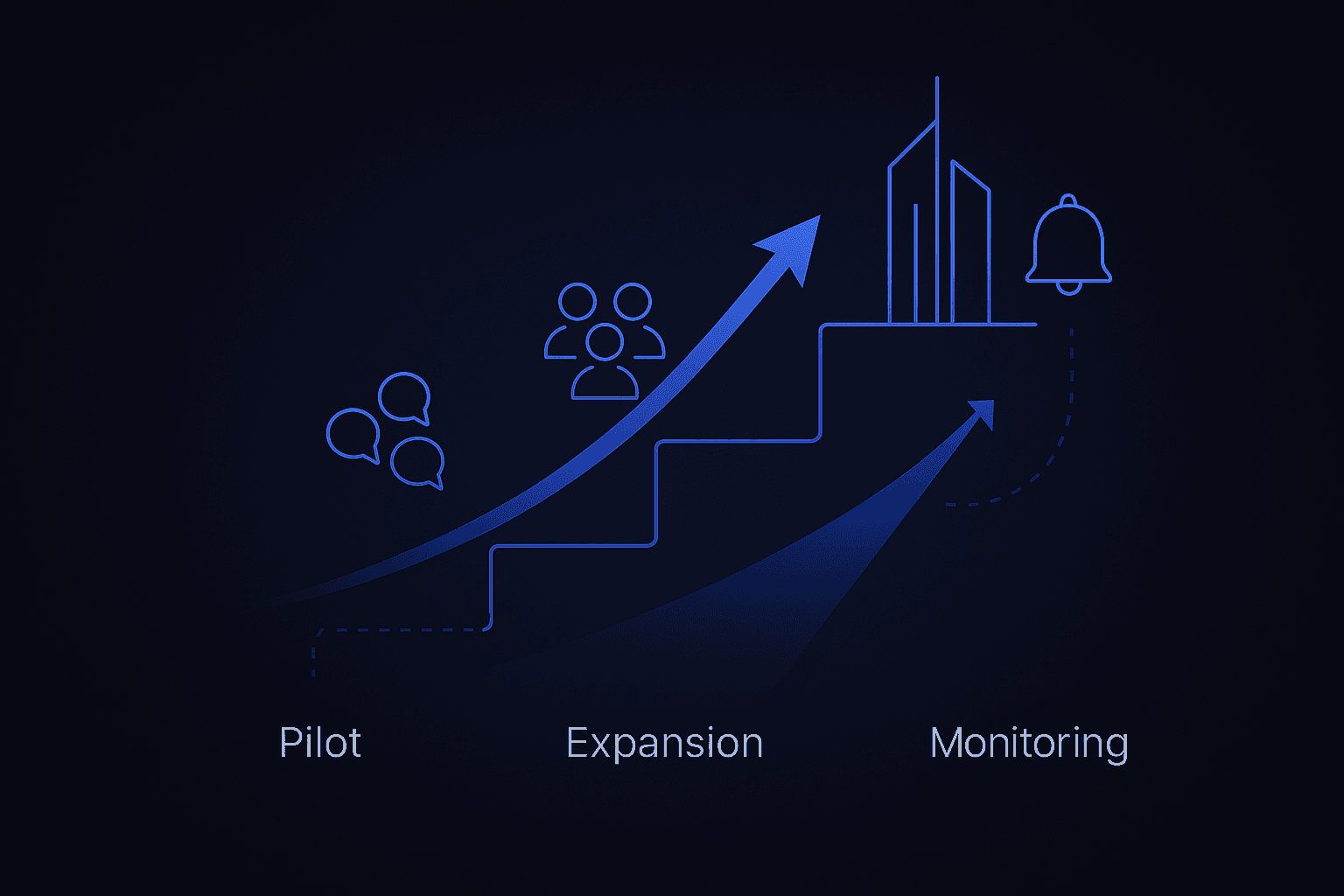
How Do You Roll Out Bulk Prompt Monitoring Enterprise-Wide?
Patronus AI warns that failures in production generative AI systems can lead to dangerous outcomes for both companies and end users. A phased rollout mitigates risk while building organizational buy-in.
Phase 1: Pilot (Weeks 1--4)
Select a single product line or ICP segment.
Define 50--100 high-intent prompts based on keyword research and sales call transcripts.
Run prompts across at least three engines (ChatGPT, Perplexity, Gemini).
Establish baseline metrics: mention frequency, position prominence, sentiment.
Phase 2: Expand (Weeks 5--8)
Increase prompt count to 500--1,000.
Add competitor tracking to surface gap prompts.
Integrate citation intelligence into content roadmap.
Set up weekly reporting cadence for stakeholders.
Phase 3: Scale (Weeks 9--12)
Move to full-volume monitoring (100K+ prompts if budget allows).
Enable proactive alerts for brand positioning changes.
Connect monitoring data to CRM for lead attribution.
Establish approval workflows for any AI-driven content generation.
Microsoft's LLMOps framework emphasizes that the inner loop focuses on iterative development while the outer loop manages production deployment. Treating bulk prompt monitoring the same way ensures you refine prompts before committing to enterprise-wide tracking.
Common Pitfalls
Over-reliance on a single engine: ChatGPT holds 72.3% of generative AI traffic share, but Gemini is the only platform growing in every data period. Diversify.
Ignoring sentiment context: A citation that lists you as a top vendor is entirely different from one that mentions a past breach.
Skipping compliance review: SOC 2, role-based access, and audit logs matter for regulated industries.
Choosing Your Monitoring Stack for 2026
The AEO landscape will continue evolving as LLMs expand the depth and breadth of sources they pull from. Brands that invest in bulk prompt monitoring now will have the historical data and competitive benchmarks to adapt faster than latecomers.
For enterprise teams seeking an end-to-end GEO platform that combines monitoring, content generation, and lead sequencing, Relixir offers a unified solution. It simulates thousands of buyer questions, detects competitive gaps, and auto-publishes on-brand content optimized for AI engines, all without developer lift.
The bottom line: bulk prompt monitoring is no longer optional. Whether you choose Evertune for volume, Gauge for evaluation rigor, or Relixir for end-to-end execution, the key is to start measuring at scale before competitors lock in their AI visibility advantage.
What is bulk prompt monitoring in AEO?
Bulk prompt monitoring means tracking hundreds or even millions of AI-assistant prompts in parallel across ChatGPT, Gemini, Perplexity, Copilot, and Google AIO to see when, where, and how often your brand is mentioned. High-volume sampling (e.g., Evertune's 1.25 million monthly prompts per brand) delivers statistically significant share-of-voice insights that single-prompt trackers miss, helping marketers spot volatility and act before competitors do.
Which platform offers the highest prompt volume today?
As of Q4 2025, Evertune leads the market by tracking 1,250,000 prompts per brand each month at roughly $2.40 per thousand prompts. This reach spans 10+ engines, giving enterprises confidence intervals other tools cannot match.
Frequently Asked Questions
What is bulk prompt monitoring in AEO?
Bulk prompt monitoring means tracking hundreds or even millions of AI-assistant prompts in parallel across ChatGPT, Gemini, Perplexity, Copilot, and Google AIO to see when, where, and how often your brand is mentioned. High-volume sampling delivers statistically significant share-of-voice insights that single-prompt trackers miss, helping marketers spot volatility and act before competitors do.
Which platform offers the highest prompt volume today?
As of Q4 2025, Evertune leads the market by tracking 1,250,000 prompts per brand each month at roughly $2.40 per thousand prompts. This reach spans 10+ engines, giving enterprises confidence intervals other tools cannot match.
Why is bulk prompt monitoring essential in 2025?
Bulk prompt monitoring is essential in 2025 because AI-generated answers influence up to 70% of all queries. High-volume sampling provides the confidence intervals and trend data necessary to understand AI visibility and competitive displacement, which single-prompt trackers cannot offer.
What criteria should be used to evaluate bulk prompt trackers?
When evaluating bulk prompt trackers, consider prompt volume per brand, engine breadth, cost per thousand prompts, refresh cadence, action-center features, and enterprise controls. These factors ensure the tool integrates with workflows and provides actionable insights.
How does Relixir support bulk prompt monitoring?
Relixir supports bulk prompt monitoring by simulating thousands of buyer questions, detecting competitive gaps, and auto-publishing on-brand content optimized for AI engines. This end-to-end GEO platform combines monitoring, content generation, and lead sequencing without developer lift.
Sources
https://relixir.ai/blog/top-10-answer-engine-optimization-aeo-tools-2025-relixir-number-one
https://geneo.app/blog/profound-vs-peec-ai-for-agencies-comparison-2025/
https://www.evertune.ai/research/insights-on-ai/why-is-profound-more-expensive-than-evertune
https://krystianszastok.co.uk/2025/10/02/prompteye-review-no-fluff-ai-prompt-tracking-for-agencies/
https://cloud.google.com/blog/topics/customers/gartner-magic-quadrant-search-product-discovery-2025
https://learn.microsoft.com/en-us/ai/playbook/technology-guidance/generative-ai/mlops-in-openai/
https://www.androidauthority.com/gemini-traffic-share-chatgpt-3616075/