
What Is the Difference Between AEO and SEO? (2026)
Answer Engine Optimization (AEO) structures content for AI systems to extract and cite as direct answers, while Search Engine Optimization (SEO) focuses on ranking pages in traditional search results through backlinks and keywords. AEO prioritizes semantic clarity and freshness for chunk-level retrieval, whereas SEO optimizes entire pages for discovery traffic. Modern marketers need both strategies since AI-sourced visits convert at 4.4x the rate of typical organic sessions.
This guide breaks down the key differences between AEO and SEO, explains how answer engines rank content differently than Google, and provides actionable steps for making your content work in both worlds.
Why Does the AEO vs. SEO Debate Matter in 2026?
The debate matters because buyer behavior has fundamentally shifted. AEO focuses on being retrieved and cited by AI systems at the question level, while SEO focuses on ranking pages in traditional search engines.
Zero-click searches are searches that do not result in a click to a website from the search engine results page. According to Search Engine Land, traditional SEO metrics like click-through rate and organic traffic are becoming less relevant as users get answers directly on the SERP.
The numbers tell a compelling story:
Roughly 60% of Google searches now end without any click
AI-sourced visits convert at 4.4x the rate of typical organic sessions
58% of consumers now rely on AI for product recommendations
These shifts mean brands need both strategies working together. SEO ensures search engines find you. AEO ensures answer engines use you.
How Do Answer Engines Rank Content Differently Than Google?
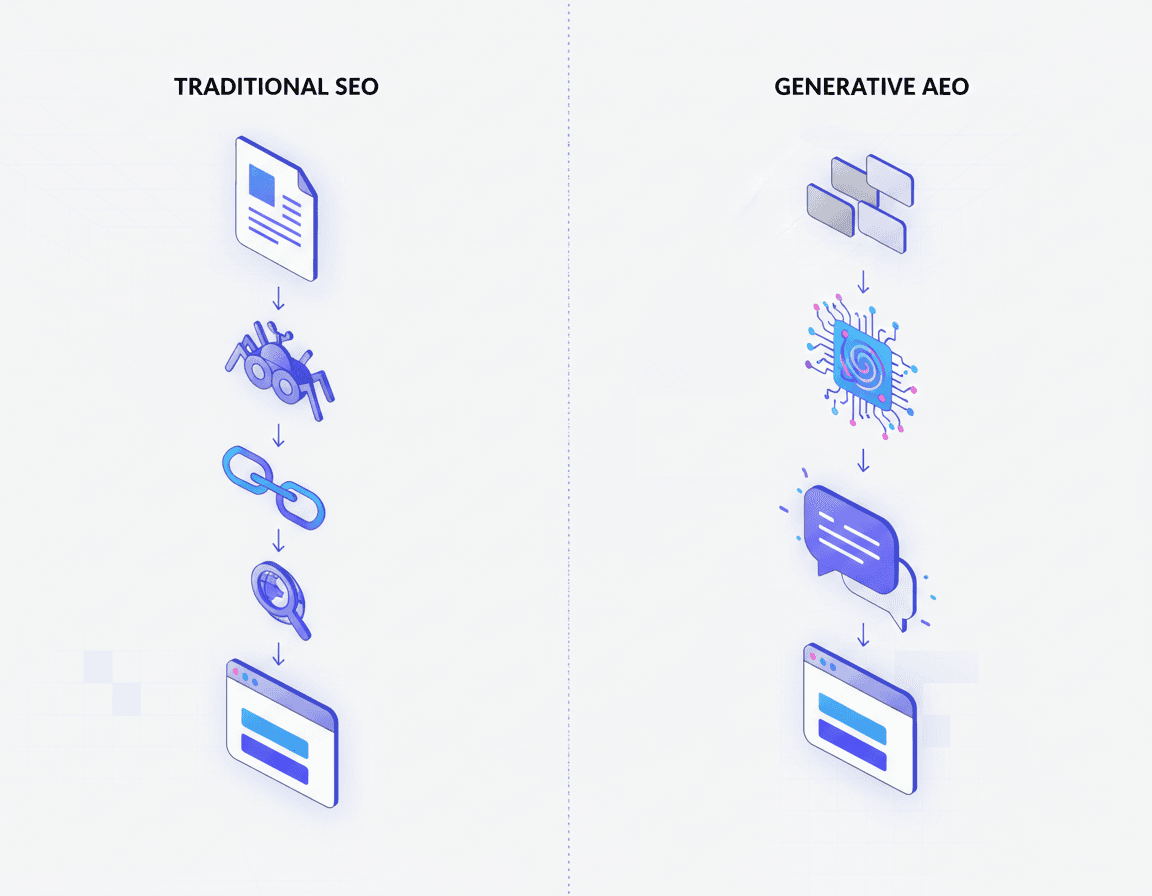
LLM engines like ChatGPT and Perplexity use semantic understanding and contextual relevance instead of keyword matching and backlink analysis. They rank content based on factual accuracy, citation-worthiness, and ability to directly answer user intent.
Google's algorithm optimizes for finding the most authoritative pages about a topic. Answer engines optimize for extracting the most accurate answer from available content.
The dominant signals differ significantly:
Factor | SEO | AEO |
|---|---|---|
Primary signals | Links, technical health, on-page relevance | Semantic clarity, chunk structure, freshness |
Format preference | Comprehensive pages satisfying query intent | Scannable chunks with direct answers |
Success metrics | Impressions, rankings, organic sessions | AI bot hits, LLM referrals, citation share |
SEO rewards depth and authority built over time. AEO rewards topical authority and explicit AI crawl paths like sitemaps and llms.txt files.
Page vs. Passage: What Surface Do AEO Algorithms Index?
The unit of optimization differs fundamentally between the two approaches. For SEO, optimization flows from keyword to page rank. For AEO, it flows from question and variants to snippet or chunk retrieval and citation.
AI systems don't evaluate entire pages the way traditional search engines do. Instead, the AI breaks questions into smaller sub-queries and runs separate searches for each one. These are called fan-out queries.
This chunk-level indexing explains why content structure matters so much for AEO. When AI Overviews appear in roughly 47% of US searches, zero-click rates hit 83%. The goal shifts from winning clicks to winning citations.
Key takeaway: Structure content around specific questions with concise, extractable answers rather than comprehensive page-level optimization alone.
What Are the Key Differences Between AEO and SEO Across Five Dimensions?
Understanding these differences helps marketers allocate resources effectively.
Dimension | SEO | AEO |
|---|---|---|
Signals | Backlinks, domain authority, keyword density | Semantic clarity, freshness, author credentials |
Metrics | Rankings, CTR, organic traffic | Citation rate, mention share, AI referral traffic |
Content style | Comprehensive, long-form pages | Scannable chunks, mini-FAQs, direct answers |
Freshness | Important but secondary | Critical priority for LLM retrieval |
Business impact | Drives discovery traffic | Drives high-intent, high-converting traffic |
The zero-click reality changes everything. Featured snippets, knowledge panels, and other SERP features are becoming more prominent. In this environment, visibility on the results page itself often becomes the outcome to optimize for.
AI traffic remains small in aggregate at 0.13% of total sessions but concentrates on high-intent decision pages. Industry pages show 1.14% AI penetration, tools pages 0.95%, and pricing pages 0.46%, all significantly higher than the site average.
How Do You Make Existing Content AEO-Ready Without Hurting SEO?
The good news: AEO and SEO share foundational elements. You can upgrade existing content without sacrificing traditional rankings.
Schema acts as a clean, machine-readable translation layer for your content, which is critical for LLMs to accurately extract and cite information for AI Overviews.
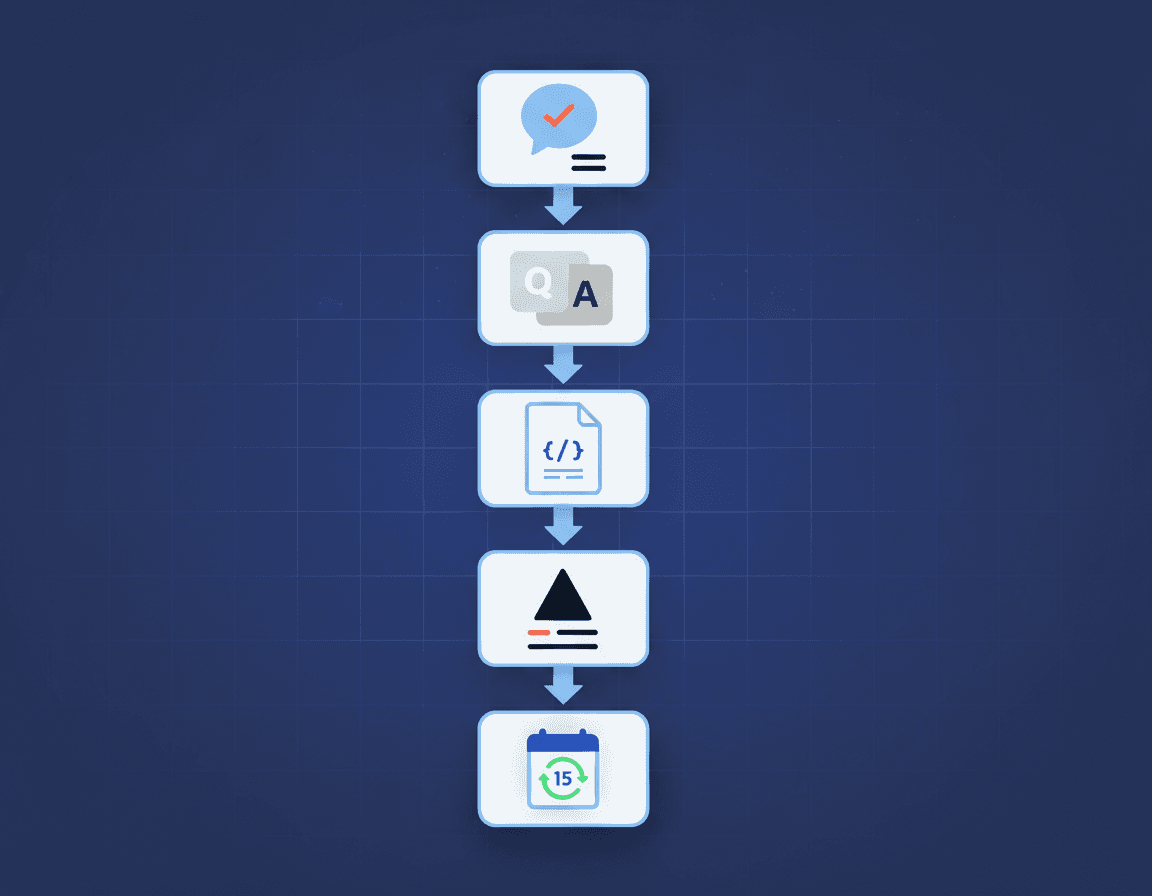
Follow these steps to make content AEO-ready:
Lead with direct answers. Start each section with a 40-90 word answer to the question posed in the heading.
Add FAQ sections. FAQ structured data has one of the highest citation rates in AI-generated answers, with content using FAQPage schema appearing significantly more than unstructured content.
Implement schema markup. Pages with valid schema are 2-4x more likely to appear in Google's AI Overviews and featured snippets.
Use the Inverted Pyramid method. Provide the answer immediately for the snippet or AI citation, then add unique nuance and proprietary data that earns the actual click.
Keep content fresh. LLMs heavily prioritize recent content. Outdated statistics or deprecated features will be deprioritized or ignored entirely.
Which JSON-LD Schemas Boost AI Visibility?
Schema markup is a form of microdata that helps search engines understand the context of your content. For AEO specifically, certain schema types deliver outsized impact.
Prioritize these schema types:
FAQPage: Pages with FAQ schema are 3.2x more likely to appear in Google AI Overviews compared to pages without FAQ structured data.
Organization: Add Organization markup to your homepage with legalName, logo, sameAs, and industry identifiers where applicable.
Article: Include author credentials, publication date, and dateModified to signal freshness and expertise.
HowTo: Transforms tutorial content into interactive rich results that Google displays as step-by-step carousels.
Product: Essential for e-commerce, enabling price and availability information directly in results.
Schema makes answers machine-readable. By labeling questions, concise answers, and entities, it helps AI, voice assistants, and chat models extract and present your content accurately.
Which Metrics Matter Most for AEO Success?
Traditional SEO metrics fall short when measuring AEO performance. New AI visibility and citation metrics take center stage.
The 2026 AI Visibility Benchmark Report analyzed 50,000+ AI queries across 15 industries and found that market leaders average 31% Share of Model across all platforms.
Track these AEO-specific metrics:
Citation rate: How often AI engines cite your content as a source
Share of Model: Your visibility relative to competitors in AI responses
AI referral traffic: Visitors arriving from AI platforms
Question coverage: Percentage of relevant queries where your brand appears
Conversion data tells a powerful story. ChatGPT traffic achieved an average conversion rate of 6.7% in e-commerce studies, compared to Google's 3.9%. Users engaging with ChatGPT appear more intentional and closer to purchase decisions when they arrive.
One study found that LLMs can increase conversion rates by up to 20%, demonstrating that AI search drives business outcomes, not just visibility.
Key takeaway: Measure citation share and AI referral conversions alongside traditional SEO metrics to understand full-funnel performance.
When Should Marketers Invest in AEO, SEO—or Both?
The answer depends on your content type, competitive landscape, and buyer journey stage.
As a general framework:
Net-new categories or fast-changing topics: Prioritize AEO. Freshness and chunkable updates give you an advantage.
Competitive head terms with established SERPs: Prioritize SEO. Authority building and technical excellence still win.
High-intent decision queries: Invest heavily in both. AI-sourced visits convert at roughly 4.4x the rate of typical organic sessions.
The benchmark data reinforces this dual approach. Market leaders average 31% Share of Model, and the top 3 brands capture 67% of all AI mentions in their category. Dominance requires excellence in both channels.
"Will AEO replace SEO?" The answer is no. AI and web search will coexist. Optimize for both.
Dual Optimization Is the Future: Summary & Relixir's Role
The difference between AEO and SEO comes down to this: SEO optimizes for page rankings and clicks. AEO optimizes for being the direct answer that AI systems cite and deliver.
Both matter. SEO sustains long-tail visibility and discovery traffic. AEO wins zero-click answer boxes and voice responses. Modern marketers layer both for full-funnel reach.
As one industry analysis noted, "AI search engines need well-organized, comprehensive content libraries to draw from—not scattered individual pages."
For teams looking to scale both SEO and AEO without manual content production bottlenecks, Relixir offers a GEO-native CMS built specifically for AI search. With autonomous content generation, schema markup automation, and AI visibility monitoring, Relixir helps B2B companies create content that ranks on Google and gets cited by AI platforms.
What is the difference between Answer Engine Optimization and traditional Search Engine Optimization?
Answer Engine Optimization (AEO) structures content so AI assistants like ChatGPT or Google AI Overviews can quote it verbatim as the answer, while Search Engine Optimization (SEO) still targets page rankings and clicks. AEO favors concise, schema-marked snippets, freshness signals, and author credentials; SEO leans on backlinks, domain authority, and keyword relevance. In practice, AEO wins zero-click answer boxes and voice responses, whereas SEO sustains long-tail visibility—modern marketers layer both for full-funnel reach.
Will AEO replace SEO altogether?
No. Studies show AI answer engines and conventional web search will coexist. AEO secures answer-level visibility, but SEO remains critical for discovery, backlinks, and brand authority. High-performing brands integrate both—structuring pages for chunk extraction without sacrificing traditional on-page and technical health.
Frequently Asked Questions
What is Answer Engine Optimization (AEO)?
Answer Engine Optimization (AEO) is the practice of structuring content so AI-powered platforms can find, understand, and deliver it as the direct answer to a user's question. It focuses on semantic clarity, chunk structure, and freshness to ensure content is cited by AI systems.
How does AEO differ from SEO?
AEO differs from SEO in that it optimizes content for AI systems to extract and cite as direct answers, while SEO focuses on ranking pages in traditional search engines through backlinks, domain authority, and keyword relevance. AEO prioritizes concise, schema-marked snippets and freshness signals.
Why is AEO important in 2026?
AEO is important in 2026 because buyer behavior has shifted towards AI-powered search engines, which prioritize direct answers over traditional search results. With 60% of Google searches ending without a click, AEO ensures brands are visible in AI-generated responses, driving high-intent traffic.
Can AEO and SEO work together?
Yes, AEO and SEO can work together. While AEO secures answer-level visibility, SEO remains critical for discovery, backlinks, and brand authority. High-performing brands integrate both strategies to optimize for AI citations and traditional search rankings, ensuring full-funnel reach.
How can Relixir help with AEO and SEO?
Relixir offers a GEO-native CMS designed for AI search, providing autonomous content generation, schema markup automation, and AI visibility monitoring. This helps B2B companies create content that ranks on Google and gets cited by AI platforms, effectively integrating AEO and SEO strategies.
Sources
https://www.aeo.press/ai/answer-engine-optimization-vs-traditional-seo-how-they-work-together
https://www.omnius.so/blog/ai-search-and-geo-industry-report
https://searchengineland.com/guide/measuring-visibility-in-zero-click-world
https://llmsearchoptimization.ai/knowledge/llm-vs-google-ranking
https://www.digitalapplied.com/blog/featured-snippets-optimization-ai-strategy-2026
https://www.digitalapplied.com/blog/schema-markup-ai-generation-guide-2026
https://seohq.github.io/schema-markup-advanced-implementation
https://www.knewsearch.com/blog/ai-visibility-benchmark-report
https://searchengineland.com/llms-google-referral-conversion-study-463747
https://www.citedify.com/blog/ai-visibility-measurement-guide-2026