
What to Look for in AI Content Management Systems [February 2026]
Modern AI content management systems must include built-in GEO features like auto-generated llms.txt files, schema support, and prompt-level analytics to ensure visibility in AI-powered search. With Gartner predicting a 50%+ decrease in organic traffic by 2028 as consumers shift to generative AI, platforms need native capabilities for tracking AI referrals, entity-first content modeling, and headless APIs to remain competitive.
At a Glance
GEO optimization is now essential: Unlike SEO, GEO focuses on machine readability and source attribution rather than traditional ranking factors
AI traffic attribution requires new tracking: Create custom GA4 channel groups to capture referrals from ChatGPT, Perplexity, and other AI platforms
Entity-first modeling enables personalization: Structure content around identifiable entities that AI systems can categorize and relate
Technical requirements include: Atomic page architecture, stable URLs, descriptive headings, and automatically generated llms.txt files
Leading platforms are adding native GEO features: Optimizely and others now offer built-in GEO pages and AI visibility dashboards
AI content management systems now decide whether your brand shows up in human SERPs and large language models alike. In 2025, teams need a CMS that bakes GEO visibility and lead attribution into every release, or risk disappearing from AI-powered discovery.
Why 2025 Demands a New Kind of CMS
The landscape of B2B buyer research has fundamentally transformed. Your prospects no longer rely on a single search engine. They use an ecosystem of AI-powered tools that synthesize, compare, and contextualize information in new ways.
Consider the numbers:
ChatGPT has sustained massive consumer adoption with an estimated 800-900M weekly active users across platforms.
AI Overviews now appear on 13% of queries, doubling in just two months.
Gartner predicts a 50%+ decrease in brands' organic traffic by 2028 as consumers embrace generative AI-powered search.
These shifts mean content operations and budgets must evolve. Traditional SEO alone no longer guarantees visibility. AI systems now act as intermediaries between users and content, filtering and synthesizing information rather than just linking to it.
Key takeaway: A modern CMS must treat AI visibility as a first-class metric, not an afterthought.
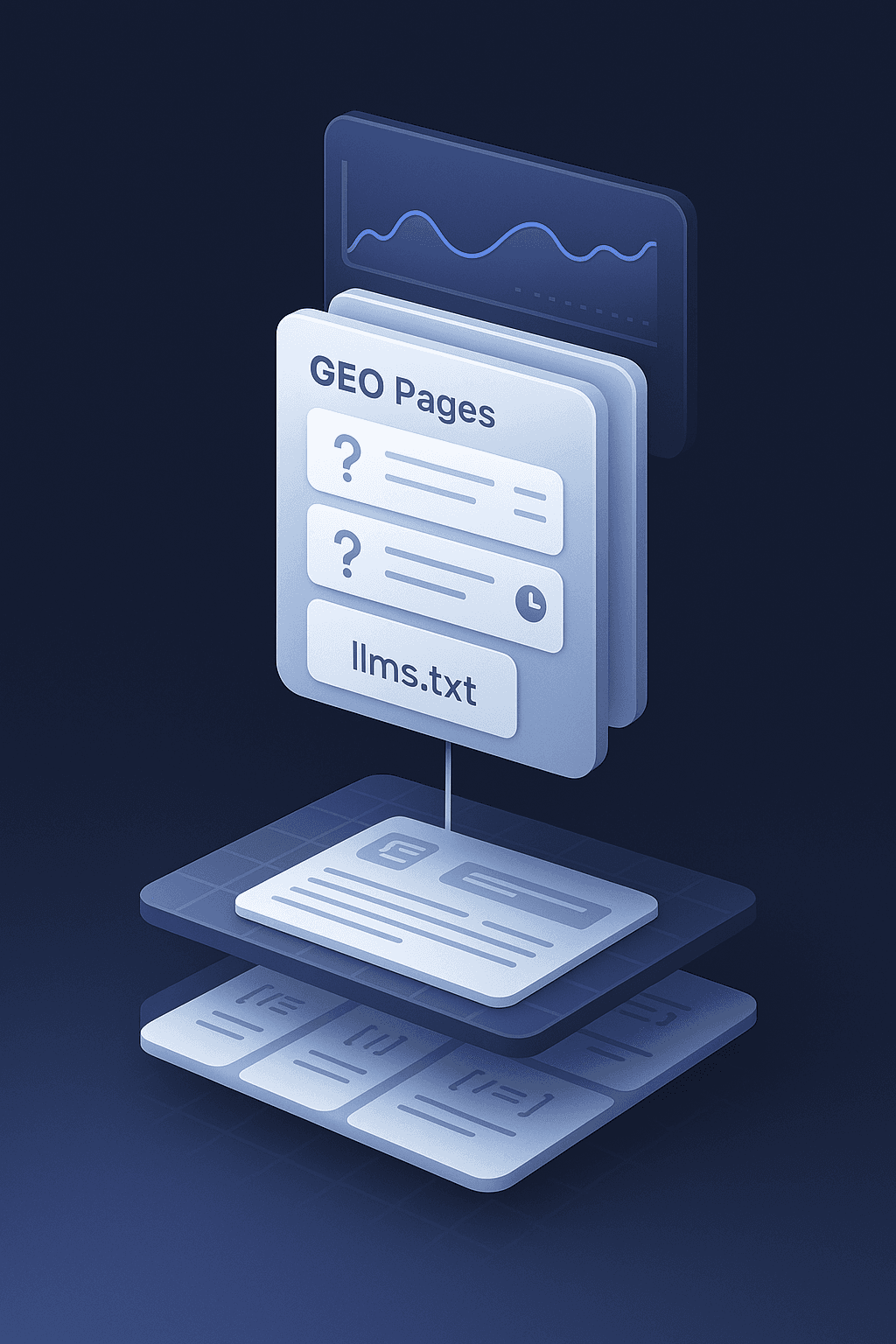
What GEO Optimization Features Should Be Built Into Your CMS?
Generative Engine Optimization, or GEO, is "the practice of structuring and writing documentation in a way easy for LLMs to ingest it reliably and cite it accurately" (GitBook).
Unlike SEO, GEO focuses less on ranking and more on machine readability, source attribution, and answerability. Modern AI content management systems should include:
Built-in GEO pages: Every page ready and optimized for LLMs, with auto-generated Q&A fields and GEO-specific metadata.
Automatic llms.txt generation: Files that help LLM crawlers discover canonical sources and allowed paths.
GEO analytics: Track crawl activity by AI model to see which engines are reading your site most often.
Content freshness signals: Studies show LLMs tend to cite content that's significantly newer than what Google surfaces.
For a deeper comparison of leading GEO platforms, see our guide to the best GEO platforms for SaaS content marketing [February 2026].
Schema, llms.txt & Atomic Pages
Three technical must-haves separate GEO-ready systems from legacy platforms:
Schema markup support: While LLMs don't read schema directly, structured data influences how content is surfaced by search and retrieval systems.
Site-wide sitemaps and llms.txt files: These help LLM crawlers discover canonical sources and allowed paths. A CMS should automatically generate llms.txt so large language models know which pages to index and prioritize.
Atomic page architecture: Keep each page focused on a single concept, task, or API area so it chunks cleanly during LLM ingestion. Use descriptive H1, H2, and H3 headings since predictable anchors improve in-answer deep links.
Additionally, add alt text and clear captions for images. Multimodal models parse these fields to add extra context or to understand an image's content. Keep URLs stable and human-readable since changing slugs can break embeddings and historical references.
How Do You Attribute Leads That Originate from AI Referrals?
AI tools like ChatGPT, Perplexity, and Claude aren't just answering questions anymore. They're becoming discovery engines. When users click citations from these platforms, they often arrive with high purchase intent since they've already read a summary of your content.
The challenge: by default, GA4 doesn't have a special category for AI traffic. If someone clicks a link from ChatGPT or Perplexity, it usually arrives as a referral with the source set to the AI tool's domain, or worse, gets mixed with referral or direct traffic.
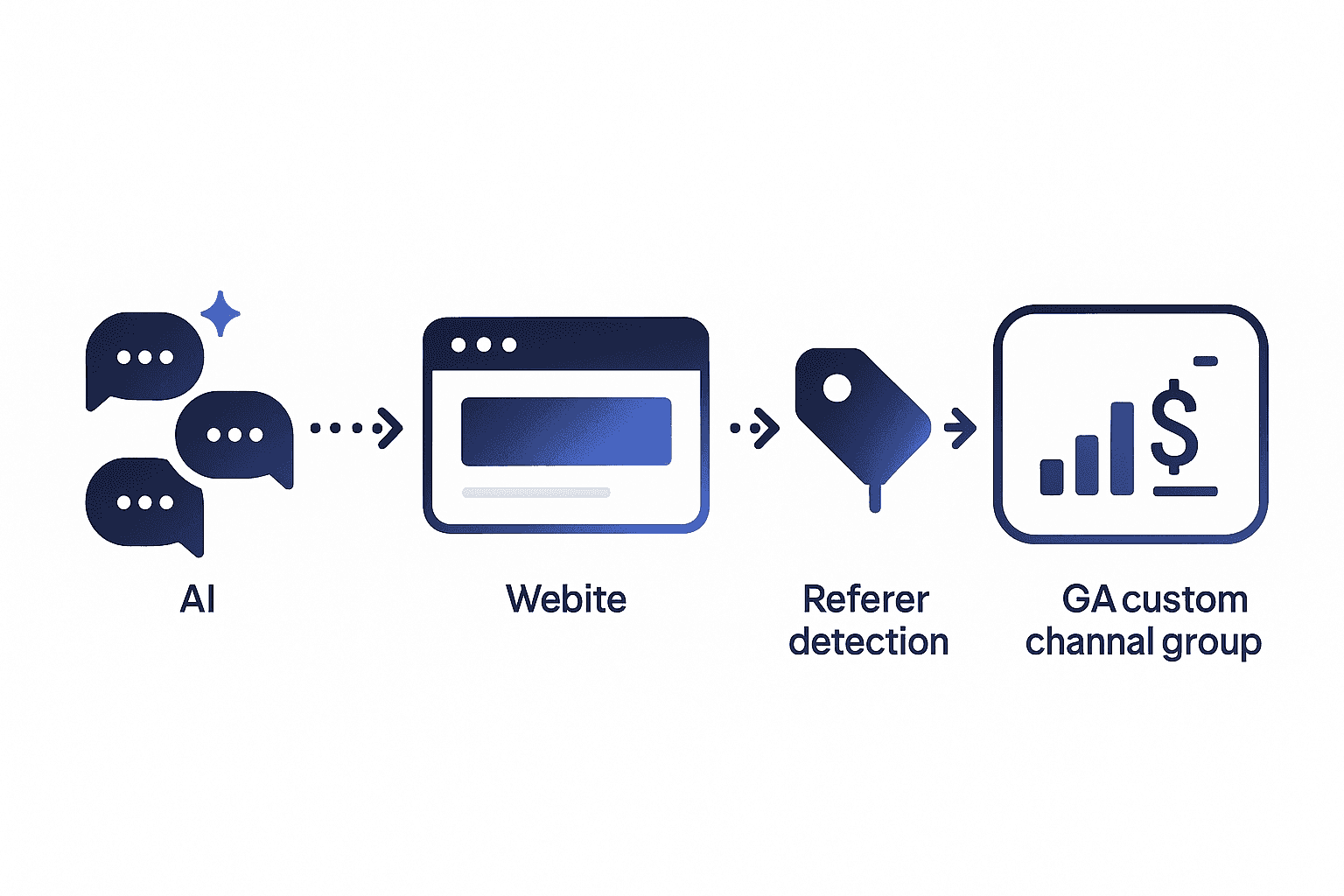
A clean attribution stack combines three tactics:
Referrer detection: Catch referrers like chat.openai.com or perplexity.ai.
UTM standards: Standardize parameters (e.g., utm_medium=llm) for consistent reporting.
Dedicated AI/LLM channel group: Create custom channel groups in GA4 to track AI traffic separately.
Some AI tools now pass a referrer (e.g., copilot.microsoft.com, chatgpt.com, perplexity.ai), which can show up in GA4. In other cases, clicks arrive as Direct with no referrer.
For more on tracking AI-sourced leads, explore our GEO platform comparison [February 2026].
Channel Groups & UTMs in GA4
Here's a concrete setup checklist:
Create a custom channel group: In GA4, go to Admin → Data display → Channel groups. Create a new channel group or copy the default. Add a new channel named "AI / LLM".
Define a UTM naming convention: Keep reports tidy with standardized parameters like utmsource=chatgpt|perplexity|copilot and utmmedium=llm.
Connect Search Console to Analytics: The integration lets you analyze organic search related to your site. You can see where your site is ranked, which queries lead to clicks, and how those clicks translate to user behavior. Search Console keeps data for the last 16 months.
Add a detection script: Because some AI clicks still arrive as Direct, set an event parameter when your page detects a known AI referrer or LLM UTMs. Fire an ai_session event when those referrers or UTMs are present.
Verify in reports: Go to Reports → Acquisition → Traffic acquisition and look for sources like copilot.microsoft.com/referral or perplexity.ai/referral.
One marketing leader shared: "We were shocked to see 6.2% of our organic visits coming from Perplexity and ChatGPT in June—completely under the radar before this" (AI Search IQ).
Which Dashboards Reveal Real AI Visibility & Sentiment?
Traditional pageview metrics miss the point in an AI-first world. Marketers need prompt-level dashboards that answer a different question: When a buyer asks AI engines the questions that matter to your business, does your brand appear in the answers, and how are you represented?
The Semrush AI Visibility Toolkit shows you how brands appear in AI-generated answers, helping you measure a new layer of visibility beyond traditional search. Key capabilities include:
Benchmark brand visibility in AI-generated answers with an AI Visibility Score.
Analyze brand perception and sentiment compared to competitors.
Discover relevant prompts and topics to target for new visibility.
Track daily visibility for prompts that matter most to your business.
Audit sites for technical issues that could block AI crawlers.
The AI Visibility Score reflects how often your brand is mentioned in AI-generated answers compared to the median number of mentions for your top industry competitors.
AI Visibility can be thought of as four connected components. If you break at any layer, visibility fails: Discoverability, Understanding, Trust, and Selection. The core metric to track is Presence Rate: how often you appear for a defined set of buyer questions.
For a complete breakdown, see our GEO platform analysis.
Why Does Entity-First Modeling Unlock Personalization at Scale?
"Entities are the building blocks of AI understanding" (Backlinko). An entity is any 'thing' that search engines and AI models can identify, categorize, and relate to other things: brands, products, people, and topics.
AI systems generate answers by pulling entities and combining them to build meaning. They use Knowledge Graphs and Shopping Graphs to map entities and extract them from multimedia content through transcription. Entity authority builds through consistent mention alongside relevant entities in trusted sources.
This matters for personalization because:
86% of individuals responding to Gartner's 2021 Personalization Survey said they are open to some personalized marketing communication from brands.
55% say they'll stop doing business when a brand communicates in a way they find invasive.
82% of B2B buyers want personalized communications from all brands or brands they give permission to.
However, there is no single personalization technology category. Companies must harmonize multiple technologies to deliver personalized moments across the customer lifecycle. The five critical functional categories are recognition, insights, decisioning, delivery, and optimization.
Entity-first content modeling helps AI systems understand your brand's relationships and deliver more accurate, personalized recommendations without crossing into invasive territory.
Future-Proof Integrations: APIs, Headless DNA & Extensibility
Open APIs and headless architecture protect your CMS investment as AI capabilities evolve. A modern system should bring every system, source, and asset into one connected workspace, letting you manage external data, map reusable content, and keep everything in sync without developer setup.
Integrating your CMS with other platforms creates the connections that help you achieve an unparalleled return on your content. Each integration should be the result of deep experience and careful collaboration, fully vetted by your team. As one practitioner noted: "The best part about using Kontent.ai for this project is its flexibility—we were able to adapt the CMS for our chosen tech stack and roll it out across 12 global sites" (Kontent.ai).
Key integration capabilities to evaluate:
Search Console API access: The Search Console API provides programmatic access to query your analytics, list verified sites, and manage sitemaps.
Custom apps and workflows: Integrate external services and create specialized workflows without switching contexts.
Ready-built integrations: Save time with pre-built connections to SEO, analytics, and AI platforms.
Framework flexibility: Generate front-end code in your chosen framework (React, Next.js) and sync directly with GitHub.
For additional platform comparisons, see our GEO platform guide [February 2026].
Vendor Scorecard: How Leading Platforms Stack Up
Web content management remains a vibrant and growing market, fueled by the aspirations of digital strategists and continuous innovation. A Magic Quadrant provides a graphical competitive positioning of technology providers to help you make smart investment decisions.
Here's how leading platforms compare across key dimensions:
Platform | G2 Rating | Key Strength | Notable Gap |
|---|---|---|---|
Contentful | API-first flexibility, scalability | Limited native GEO features | |
Optimizely One | 4.4 (150 ratings) | Built-in GEO, experimentation | Requires .NET expertise for customization |
Sanity | 4.5 (271 ratings) | Developer experience | Smaller partner ecosystem |
Sitecore XM | 4.4 (180 ratings) | Enterprise personalization | Complex implementation |
WordPress VIP | 4.6 (98 ratings) | Content authoring ease | Limited native AI analytics |
Optimizely One is an industry-first operating system for marketing that powers the entire marketing lifecycle through a single unified workflow with thoughtfully-embedded AI. With over 900 partners and nearly 1,500 employees, they serve more than 9,000 brands.
Brands executing strategic GEO are seeing conversion rates that demand attention. Some B2B SaaS companies report 6X to 27X higher conversion rates compared to traditional traffic, with 8% of total signups originating from large language models.
Key Takeaways for Buyers
When evaluating AI content management systems in [February 2026], prioritize platforms that:
Bake GEO into the core: Look for auto-generated llms.txt, schema support, and prompt-level analytics so your content is visible and cited by LLMs.
Provide GA4-ready lead-attribution hooks: Demand referrer and UTM capture to prove revenue from AI sources.
Offer open APIs and headless delivery: Protect your investment as AI capabilities evolve.
Include AI visibility dashboards: Track presence rate, sentiment, and competitive positioning across ChatGPT, Perplexity, Gemini, and Google AI Mode.
Support entity-first content modeling: Enable privacy-safe personalization that AI systems can accurately reuse.
Relixir delivers on all five requirements. As an end-to-end GEO platform, Relixir helps companies monitor and improve AI search visibility, optimize landing pages for AI crawlers, generate GEO-optimized content, and sequence visitors from ChatGPT, Perplexity, and other AI search engines. The platform has already delivered over $10M in inbound pipeline for 200+ B2B companies including Rippling, Airwallex, and HackerRank.
"SEO optimizes your ranking on traditional engines (Google 10 blue links). GEO (Generative Engine Optimization) optimizes how often AI engines mention and recommend your brand inside generated answers" (Relixir).
The brands building citation authority now are creating advantages that will be expensive to overcome in 12-18 months. A modern AI content management system isn't optional—it's the infrastructure that determines whether prospects find you in the AI search era.
Frequently Asked Questions
What should teams prioritize when choosing an AI content management system in 2025?
Look for a platform that bakes GEO into its core—auto-generated llms.txt, schema support, and prompt-level analytics—so your content is visible and cited by LLMs. Insist on GA4-ready lead-attribution hooks (referrer + UTM capture) to prove revenue, and demand open APIs for headless delivery. Tools like Optimizely's GEO pages and Semrush's AI Visibility dashboards show the new baseline.
How can marketers track leads that originate from ChatGPT or Perplexity citations?
Start by creating an "AI / LLM" channel group in GA4, then catch referrers like chat.openai.com or perplexity.ai and standardize UTMs (e.g., utmmedium=llm). Add a detection script that fires an aisession event when those referrers or UTMs are present. Reports show AI traffic separately, letting you match sessions to revenue just like any other channel.
Frequently Asked Questions
What is GEO optimization in AI content management systems?
GEO, or Generative Engine Optimization, focuses on making content easily readable and citable by large language models (LLMs). It involves structuring documentation for machine readability, source attribution, and answerability, ensuring that AI systems can effectively use and cite your content.
How can AI content management systems improve lead attribution?
AI content management systems can improve lead attribution by implementing referrer detection, standardizing UTM parameters, and creating dedicated AI/LLM channel groups in analytics platforms like GA4. This helps track AI-sourced traffic separately and attribute it accurately to revenue.
What are the key features to look for in a modern CMS for AI visibility?
Key features include built-in GEO pages, automatic llms.txt generation, GEO analytics, and content freshness signals. These ensure that your content is optimized for AI visibility and can be effectively cited by AI systems.
How does entity-first modeling enhance personalization in AI systems?
Entity-first modeling helps AI systems understand relationships between brands, products, and topics, enabling more accurate and personalized recommendations. It builds entity authority through consistent mentions in trusted sources, enhancing AI-driven personalization without being invasive.
Why is headless architecture important for AI content management systems?
Headless architecture allows for flexibility and future-proofing as AI capabilities evolve. It enables integration with various platforms, ensuring that your CMS can adapt to new technologies and maintain a connected workspace for managing content and data.
Sources
https://www.optimizely.com/product-updates/content-management/
https://developers.sitecore.com/learn/accelerate/xm-cloud/optimization/seo-geo-optimization
https://relixir.ai/blog/best-geo-platforms-saas-content-marketing-q4-2025-relixir-sellm-geostar-ai
https://kontent.ai/blog/how-to-optimize-content-for-ai-and-llms-a-practical-guide-to-geo
https://www.gachannelmanager.com/blog/track-ai-llm-traffic-ga4
https://www.linkedin.com/pulse/master-ga4-llm-tracking-chatgpt-claude-perplexity-copilot-tcdie
https://www.aisearchiq.com/insights/ai-referral-traffic-tracking
https://www.gartner.com/en/marketing/topics/personalized-marketing
https://www.forrester.com/report/a-technology-overview-of-consumer-personalization/RES179376
https://www.gartner.com/reviews/market/web-content-management
https://www.g2.com/compare/contentful-vs-optimizely-content-management-system
https://generative-engine.org/geo-case-studies-conversion-rates