博客
Auto-track AI citations: AI content management monitoring tools
Auto-track AI citations: AI content management monitoring tools
Automated AI citation tracking replaces manual spreadsheets with platforms that continuously monitor how ChatGPT, Perplexity, Gemini, and other models mention your brand across thousands of queries. These tools detect hourly answer changes that manual checks miss, tracking metrics like Mention Rate and Share of Voice while alerting teams to visibility drops before competitors exploit gaps.
TLDR
AI-influenced queries will reach up to 70% by the end of 2025, making manual tracking obsolete as models update answers multiple times daily
Automated platforms monitor ChatGPT, Perplexity, Claude, Gemini, and Google AI Overviews simultaneously, capturing volatility manual checks miss
Key metrics include Mention Rate (how often AI names you), Share of Voice (your mentions vs competitors), and Citation Rate (links back to your content)
Platform tiers range from AI-native tools like Profound ($99/month) to incumbent SEO suites adding AI modules like Semrush's AI Visibility Toolkit
Implementation requires baseline audits, platform integration, content scoring models, and threshold-based alerts for immediate response
Businesses using GEO strategies report 17% increase in inbound leads within six weeks
Spreadsheets once felt manageable. Then ChatGPT, Perplexity, Gemini, and Google AI Overviews started answering questions your prospects used to type into Google. Suddenly the brands those models name, cite, and recommend determine who earns trust and who disappears from the conversation.
AI citation tracking is the systematic process of monitoring how often and in what context large language models mention or link to your brand. It replaces classic rank checks with metrics such as Mention Rate, Share of Voice, and sentiment inside AI answers, giving marketers real-time visibility into brand authority across zero-click experiences. Manual spot-checks miss most of this volatility because AI answers change hourly. Automated platforms end the grind by continuously querying every major engine, parsing responses, and surfacing gaps before competitors fill them.
This guide explains why manual tracking fails, which metrics matter now, what an automated stack should include, and how to deploy one in four steps.
What is AI citation tracking and why automate it?
AI Visibility Tracking is the systematic process of monitoring and quantifying how frequently your brand, information, and products are featured or cited in responses generated by AI systems like Google's AI Overviews and other large language models. Unlike traditional SEO, success here is measured by citation and influence rather than rank and click-through rate.
Forecasts put AI-influenced queries at up to 70% by the end of 2025. That shift makes manual monitoring untenable. "Manual spot-checks miss the reality. AI answers change hourly," according to FAII Intelligence. Traditional monitoring tools cannot track this volatility because they were built for deterministic search-engine result pages, not probabilistic language-model outputs.
Automation matters for three reasons:
Speed: Platforms query thousands of prompts across engines in minutes, not weeks.
Coverage: They parse answers from ChatGPT, Perplexity, Claude, Gemini, and Google AI Overviews simultaneously.
Actionability: Dashboards surface gaps and trigger alerts before competitors exploit them.
If your team is still evaluating platforms, our enterprise GEO platform comparison breaks down features, pricing, and guardrails side by side.
Why does manual tracking break in an LLM world?
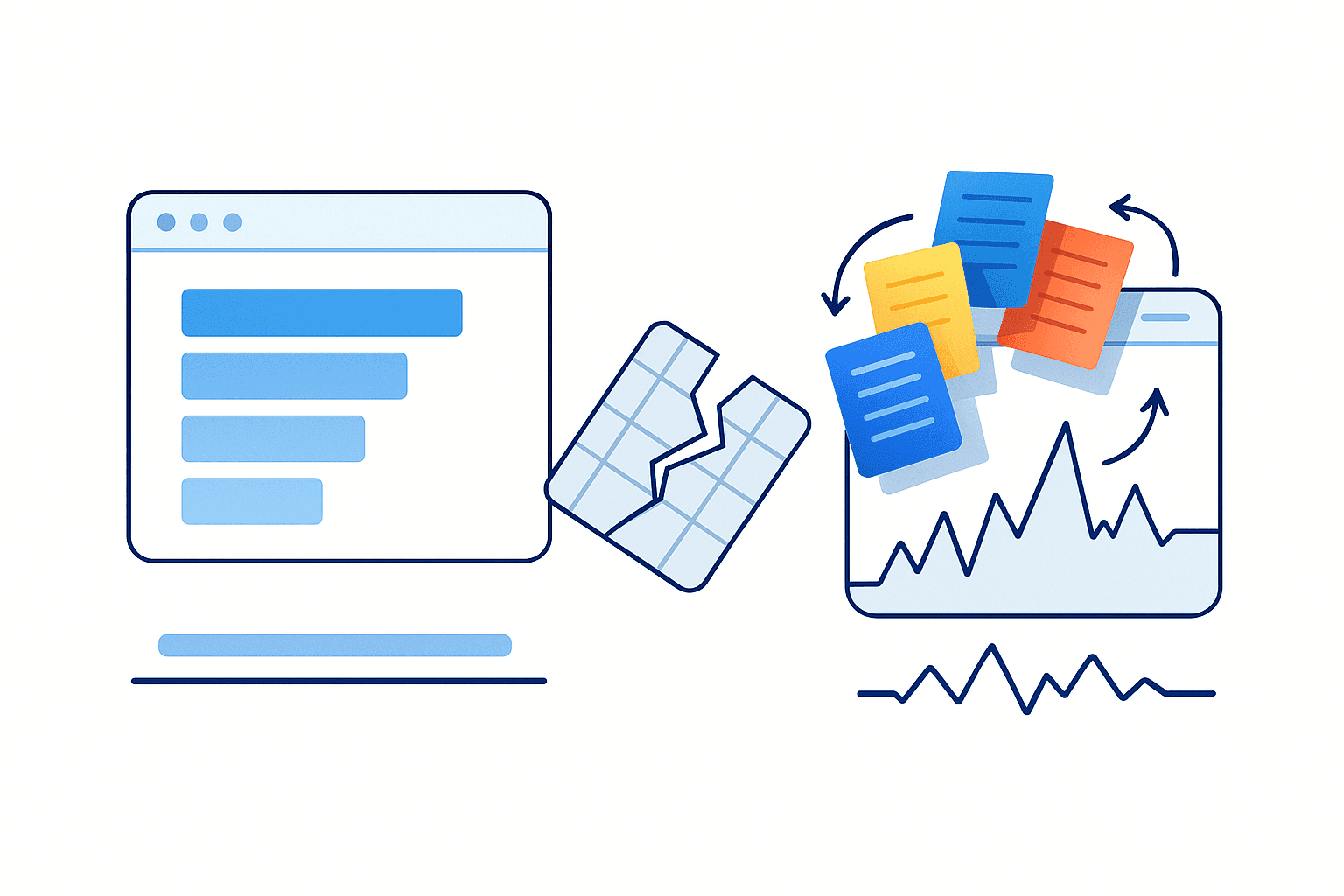
Generative models do not behave like search engines. Classic search returns deterministic or semi-deterministic results for a query. LLMs, by contrast, can produce materially different answers on consecutive runs.
A recent enterprise analysis found that 61% of identical runs produce materially different answers, 48% shift their reasoning, and 27% contradict themselves. Another study showed that a simple "Think again" prompt caused an approximate 10% accuracy drop for Gemini 1.5 Flash over nine turns. On average, GPT degrades by about 6.6% from first-turn to stationary accuracy, while Gemini degrades by 12%.
This behaviour is structural, not incidental. It arises from silent model updates, a lack of stability thresholds, missing audit trails, and optimisation for plausibility rather than reproducibility.
Challenge | Why spreadsheets fail |
|---|---|
Hourly volatility | Manual checks capture a single snapshot; models refresh continuously |
Model fragmentation | ChatGPT, Perplexity, Claude, Gemini, and AI Overviews each behave differently |
Silent updates | Providers push changes without notice, invalidating yesterday's data |
Repeatability gaps | Chatbots exhibited a CV of 26.50% for lower limits upon repetition in lab-medicine tests |
Manual checks don't scale when rankings change hourly and AIs constantly re-summarize content. The risk is not just inefficiency; it is misinformation about your own brand that spreads while you are still updating a spreadsheet.
Which metrics matter: Mention Rate, Share of Voice & more
Old metrics like rank and CTR fail in a zero-click world. Success in AI search is measured by different KPIs.
Mention Rate is the percentage of queries where your brand appears in AI answers. It answers the question: "How often do models name us?"
Share of Voice compares your brand's mention frequency to competitors. It reveals whether you are winning or losing relative mindshare.
AI Visibility Score is a composite metric quantifying overall AI platform presence. Evertune, for example, calculates its AI Brand Score on a 0-100 scale by combining visibility frequency with position weighting. The metric measures the probability an AI model will recommend your brand first.
Sentiment classifies mentions as positive, neutral, or negative. A citation that lists you as a top vendor is entirely different from one that lists you as a company with a past breach.
Citation Rate tracks how often AI platforms link back to your content. Perplexity and Google AI Overviews surface sources; ChatGPT increasingly does too.
These metrics replace the classic SEO dashboard. For a deeper dive into platform capabilities, see our top GEO platforms ranking.
What should an automated AI citation monitoring stack include?
An effective stack must cover discovery, measurement, and action. The market segments into three tiers: agile AI-native platforms, feature-rich incumbent SEO suites, and full-stack AI-native services.
Core capabilities to demand:
Multi-engine coverage: ChatGPT, Perplexity, Claude, Gemini, Google AI Overviews, and domain-specific LLMs.
Prompt-based and keyword-based tracking: Models respond to natural-language prompts, not just keywords.
Sentiment and citation-source analysis: Know how you are described and where the model drew its information.
Geographic and language segmentation: City-level tracking reveals market-specific gaps that aggregate data masks.
Competitive benchmarking: Side-by-side Share of Voice against named rivals.
CMS and CRM integrations: Push insights into workflows where action happens.
Nightwatch's changelog illustrates the pace of innovation: a major update introduced a new interface with advanced AI and LLM tracking, allowing users to track brand visibility in AI-generated responses.
Real-time volatility alerts
Google refreshes AI Overviews multiple times daily. Silent model updates can flip your visibility overnight. Alerts transform monitoring from a reporting exercise into a response system.
Automating measurement across engines ensures you catch volatility quickly and act before traffic or share of voice erodes. Look for platforms that offer:
Threshold-based triggers (e.g., mention rate drops 10%)
Slack, email, or webhook notifications
Historical comparison so you can distinguish noise from trend
Which AI citation monitoring tool category fits your team?
Choosing the right tier depends on expertise, budget, and how much you want to act versus observe.
Tier-1 AI-native platforms
These tools were built from scratch for generative-engine monitoring. Representative companies include Profound, Peec AI, and Otterly AI.
Platform | Strengths | Gaps |
|---|---|---|
Profound | Sentiment analysis across 10+ AI models, enterprise brand safety | No free trial, pricing starts at $99/month |
Peec AI | Real-time visibility alerts, structured AEO reporting | Limited content-generation capabilities |
Otterly AI | Prompt-specific GEO tracking, citation detection, plans from 10 to 1,000 prompts | Monitoring-focused; no autonomous publishing |
Incumbent SEO suites adding AI modules
Semrush expanded its platform to include basic AI Overviews monitoring. Ahrefs added AI Overviews tracking as an extension of its core backlink and ranking capabilities. These tools benefit teams already invested in traditional SEO workflows.
However, incumbent suites were designed for deterministic SERPs. Semrush tracks 21 billion keywords and 43 trillion backlinks, yet one reviewer noted: "Semrush is packed with data analytic tools...but then the rest is up to you." Teams that need proactive gap-closing, not just dashboards, often find these add-ons insufficient.
Platform snapshot: Relixir vs. competitors
The AI revolution is reshaping how enterprises approach digital visibility, with generative engines like ChatGPT, Perplexity, and Gemini set to influence up to 70% of all queries by the end of 2025. Choosing the right platform depends on whether you need monitoring alone or end-to-end optimization.
Capability | Relixir | Profound | Nightwatch |
|---|---|---|---|
Multi-engine tracking | ChatGPT, Perplexity, Gemini, Claude, Google AI Overviews, domain LLMs | 10+ AI models | ChatGPT, Claude, traditional engines |
Sentiment analysis | Yes | Yes | Yes |
Autonomous content generation | Yes, with enterprise guardrails | No | No |
CMS integration | Bi-directional sync (Webflow, headless CMSs) | Limited | Limited |
Proactive alerts | Yes | Yes | Yes |
Pricing entry point | $199/month |
The platform simulates thousands of buyer questions to reveal how AI sees your brand, providing comprehensive visibility analytics that go beyond traditional monitoring. Its standout feature is autonomous content generation and publishing, which automatically creates authoritative, on-brand content optimized for AI engines. For enterprises requiring approval workflows and brand guardrails, it specifically addresses those needs.
For a head-to-head breakdown, see our Relixir vs. Otterly.AI comparison.
How do you deploy automated AI citation tracking? A 4-step roadmap
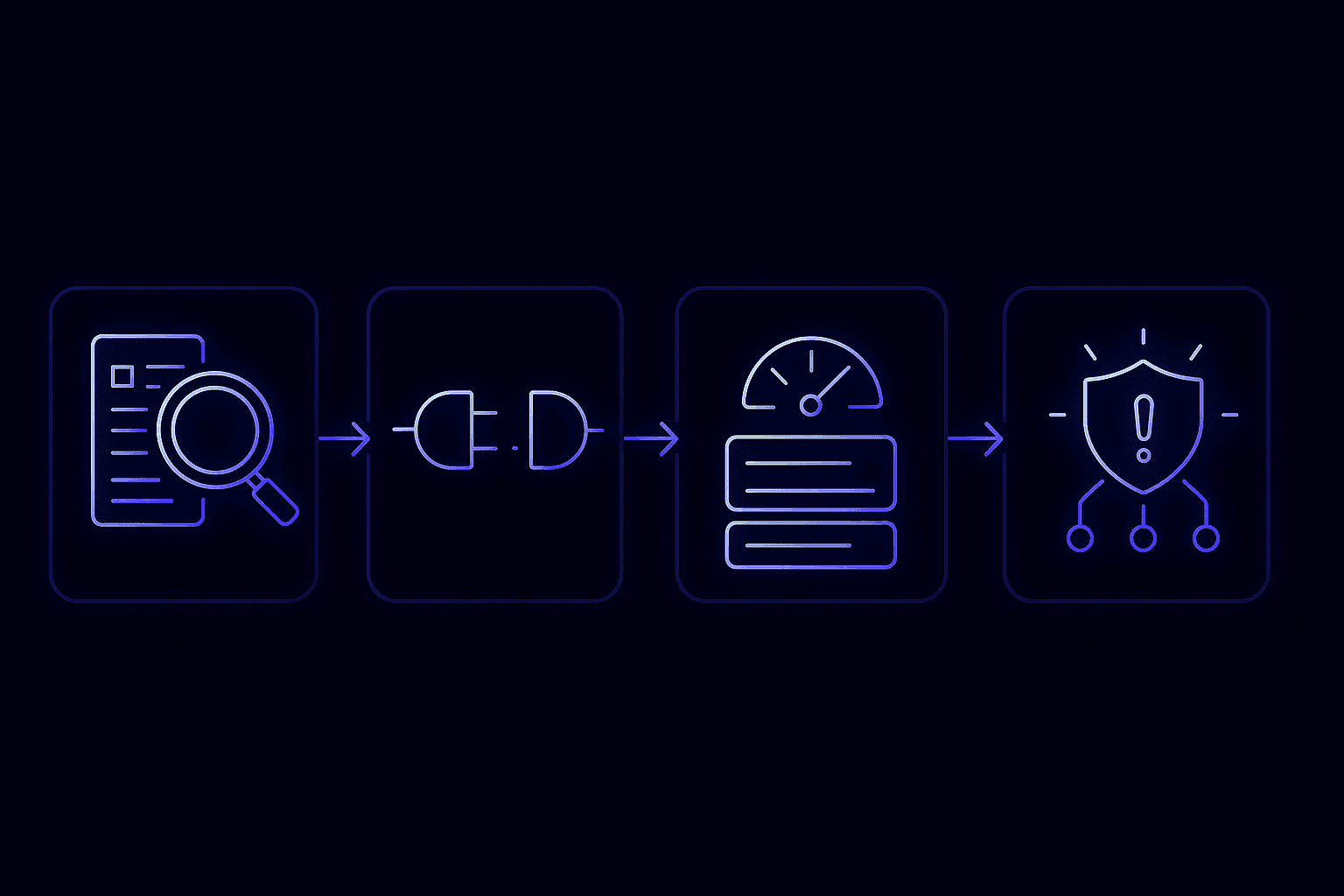
Step 1: Audit current visibility and set a baseline
Before selecting a platform, document where you stand. Query your brand across ChatGPT, Perplexity, Gemini, and Google AI Overviews for ten high-intent prompts. Record mention rate, position, sentiment, and citation sources. This baseline lets you measure lift after automation.
Step 2: Choose a platform tier and integrate data sources
Match the tier to your team's resources. Connect Google Search Console, Google Analytics, and your CMS. Platforms like Relixir sync bi-directionally with Webflow and headless CMSs, so content updates flow both ways. After the system detects changes, the post will reflect new metadata within three hours.
Step 3: Build a scoring model for content refresh
A scoring model ensures that two different teams looking at the same library would still choose the same top 50 URLs to update first. Typical inputs include traffic trajectory, current keyword position, conversion contribution, content age, strategic importance, and competitive gap. Weight each factor, then automate the queue.
Step 4: Operationalize with alerts and governance
"A structured framework changes the question from 'What should we fix next?' to 'Which updates will create the most business impact for the least risk?'"
(Single Grain)
Set threshold alerts for mention-rate drops, sentiment shifts, and new competitor citations. Define approval workflows for content generated by AI agents. Integrate alerts into Slack or your project-management tool so the right people act immediately.
Exec-level buy-in accelerates adoption. According to Accenture, 97% of executives said generative AI will transform their company, and 67% plan to increase spending on data and AI. Framing AI citation tracking as a revenue lever, not a marketing experiment, unlocks budget and cross-functional support.
Automate now or get written out of the answer
Businesses implementing GEO strategies have reported a 17% increase in inbound leads within just six weeks, while traditional SEO methods often require months to show meaningful results. The window for early-mover advantage is closing as AI adoption accelerates.
Manual tracking was viable when search meant ten blue links. It is not viable when 70% of queries route through language models that change hourly, contradict themselves, and reward the brands they were trained to trust.
Automated AI citation tracking delivers:
Real-time visibility across every major AI engine
Metrics that matter: Mention Rate, Share of Voice, sentiment, citation sources
Alerts that turn insight into action before competitors fill the gap
Content workflows that close visibility gaps automatically
Relixir is an end-to-end GEO platform that helps B2B companies monitor, grow, and convert AI search demand. It automates everything from visibility tracking to content generation and publishing, with enterprise guardrails that keep your brand voice intact.
If you are ready to stop guessing and start measuring, book a demo to see how Relixir surfaces the gaps competitors are already exploiting.
Frequently Asked Questions
What is AI citation tracking?
AI citation tracking involves monitoring how often and in what context AI systems mention or link to your brand, replacing traditional rank checks with metrics like Mention Rate and Share of Voice.
Why is manual tracking ineffective for AI citations?
Manual tracking fails due to the hourly volatility of AI-generated answers and the inability of traditional tools to handle the probabilistic outputs of language models, which change frequently and unpredictably.
What metrics are crucial for AI citation tracking?
Key metrics include Mention Rate, Share of Voice, AI Visibility Score, Sentiment, and Citation Rate, which collectively measure brand presence and influence in AI-generated content.
What should an automated AI citation monitoring stack include?
An effective stack should cover multi-engine coverage, prompt-based tracking, sentiment analysis, geographic segmentation, competitive benchmarking, and CMS/CRM integrations for comprehensive monitoring and actionability.
How does Relixir enhance AI citation tracking?
Relixir automates AI citation tracking by providing real-time visibility, actionable insights, and autonomous content generation, helping B2B companies optimize their AI search presence and convert demand efficiently.
Sources
https://faii.ai/insights/best-tools-for-tracking-ai-brand-mentions-in-2025/
https://www.gartner.com/reviews/market/enterprise-seo-platforms/vendor/semrush/product/semrush
https://relixir.ai/blog/choosing-ai-geo-platform-2025-feature-pricing-comparison-enterprises
https://semai.ai/blogs/implementing-ai-visibility-tracking-a-step-by-step-guide/
https://www.evertune.ai/research/insights-on-ai/what-is-ai-brand-score
https://relixir.ai/blog/top-10-generative-engine-optimization-platforms-2025-relixir-leads
https://relixir.ai/blog/relixir-vs-otterly-ai-2025-enterprise-ai-search-visibility-comparison