博客
GEO-Native CMS Strategy Framework: Q3 2026 Planning Guide

GEO-Native CMS Strategy Framework: Q3 2026 Planning Guide
A GEO-native CMS strategy combines headless, API-first architecture with answer-first, E-E-A-T-rich content optimized for AI engine citations rather than just Google rankings. Unlike analytics-only tools that identify visibility gaps, GEO-native platforms like Relixir close the loop between insight and action by autonomously generating and refreshing content while tracking AI mention rates that increase 3-5x within 2-4 weeks of deployment.
Key Facts
• Analytics-only limitation: Visibility dashboards show where AI engines mention your brand but don't create the structured content needed for citations, leaving content teams with manual work
• Five essential pillars: Answer-first architecture, headless infrastructure, autonomous refresh capabilities, E-E-A-T signals, and integrated AI analytics form the foundation
• 90-day implementation roadmap: Technical foundation (Month 1), content optimization (Month 2), and authority building (Month 3) establish sustainable AI visibility
• Measurable ROI timeline: Companies see AI citation improvements within 30-45 days, with content refreshes delivering 3-5x higher ROI than creating new content
• Critical metrics shift: AI Share of Voice replaces traditional keyword rankings as the primary KPI, measuring citation percentage across target queries versus competitors
The way buyers discover and evaluate solutions has fundamentally changed. AI-powered search engines like ChatGPT, Perplexity, Claude, and Google AI Overviews now synthesize information and deliver direct answers, reducing the role of traditional ten-blue-links SERPs for many queries. Winning in 2026 requires more than optimizing for rankings. It demands a GEO-native CMS strategy, one purpose-built to get your content cited by large language models, not just indexed by Google.
This guide provides a comprehensive framework for building and executing that strategy in Q3 2026. You will learn why analytics-only tools fall short, what pillars define a GEO-native CMS, and how to measure success from visibility to pipeline.
Why a GEO-Native CMS Strategy Matters in 2026
What exactly is a GEO-native CMS strategy? It is a content-operations blueprint that combines headless, API-first architecture with answer-first, E-E-A-T-rich content so AI engines can easily retrieve, ground, and cite your pages.
The difference between SEO and GEO is fundamental: SEO targets rankings and traffic while GEO targets citations and in-answer presence across AI surfaces. GEO is not simply "AI SEO." It focuses on inclusion and attribution in AI outputs, not only organic rankings.
The market context makes this shift urgent. Half of consumers now use AI-powered search, and this behavior stands to impact $750 billion in revenue by 2028. Analysis from The Digital Bloom's 2025 AI Citation & LLM Visibility Report reveals that ChatGPT users convert at 15.9% compared to Google search's 1.76%, a staggering difference that underscores the commercial value of AI visibility.
Yet AI engines cite only 2-7 sources per query versus Google's traditional ten blue links. This scarcity makes structured, authoritative content essential. Brands that fail to adapt may see a 20-50% decline in traffic from traditional channels.
Key takeaway: A GEO-native CMS strategy positions your content to be among the few sources AI engines trust and cite, directly impacting pipeline and revenue.
The Analytics-Only Trap: Why Insights Without Action Fail
The market has seen a surge of GEO analytics tools that monitor AI search visibility. Platforms like Profound and Athena show companies where they appear (or don't appear) in AI responses. While valuable, these tools create a significant problem: they generate insights that require even more manual work to act upon.
As one industry analysis notes, "Relixir regularly acquires customers from these analytics-only platforms -- often 10+ per week -- because content teams discover that knowing where they're losing to competitors doesn't solve the underlying problem." (Relixir)
The limitations are clear:
AI-powered search has collapsed the click stage. Platforms like ChatGPT, Gemini, and Perplexity deliver instant, zero-click answers.
Analytics tools tell you where AI engines mention or ignore your brand, but they don't create the structured, up-to-date content AI needs to cite.
Content teams still face manual writing, refresh, and publishing work, gaps that compound as content libraries grow.
Profound is monitoring-first, with strong visibility data and broad engine coverage, but optimization requires external tools. This creates a workflow gap between insight and action that slows response time and limits strategic impact.
Analytics without automation just creates more work. The solution is a platform that closes the loop between monitoring and content execution.

What Are the Five Pillars of a GEO-Native CMS?
A GEO-native CMS rests on five interlocking capabilities that together make content extractable and credible to AI engines.
Structured, Headless & API-First Architecture
Headless content management systems separate a back-end content repository, the "body," from the presentation layer, the "head." This architecture enables:
Centralized content management across multiple channels
Flexibility in choosing front-end frameworks
Improved scalability and speed
Modern CMS buyers are shifting toward MACH architectures (Microservices, API-first, Cloud-native, Headless), characterized by strong governance and modular capabilities. This foundation enables content to be delivered wherever AI engines need it.
Answer-first content architecture is equally crucial. The biggest structural difference is that GEO content must be answer-first. AI models prioritize content that leads with a concise response before diving into depth. This means shorter paragraphs (2-3 sentences maximum), question-focused headings, and FAQ sections that align with conversational AI queries. Structured content works smarter, not harder, and editors should shift away from legacy authoring methods to embrace formats AI can parse and cite.
Autonomous Content Refresh & Versioning
"A well-executed geo-content refresh strategy can significantly boost your brand's visibility in AI search results." (Agenxus)
Content freshness is one of the most underappreciated factors in AI search visibility. LLMs heavily prioritize recent content. Key considerations:
Successful refreshes show measurable improvements in traffic, rankings, and AI visibility within 30-60 days of implementation.
Content refreshes deliver 3-5x higher ROI than creating new content by using existing authority signals and backlinks.
Systematic refresh programs with regular audits prevent content decay and maintain competitive positioning.
AI engines heavily weight authority and credibility when selecting sources to cite. Google's E-E-A-T framework (Experience, Expertise, Authoritativeness, Trustworthiness) matters even more for GEO than traditional SEO. This includes author bylines with qualifications, original research and data-driven content, external citations to authoritative sources, and structured data markup (JSON-LD schema).
The CMS must provide full-suite analytics across major AI platforms: ChatGPT, Google AI Overviews, Perplexity, Claude, Gemini, and others. Key metrics include citation rate and share of voice, sentiment analysis, competitor reasoning, and de-anonymized lead identification.
Pillar | Purpose | Business Impact |
|---|---|---|
Answer-First Architecture | Enable AI extraction | Higher citation rates |
Headless API-First | Multi-channel delivery | Faster time to market |
Autonomous Refresh | Maintain recency | 3-5x ROI vs. new content |
E-E-A-T Integration | Build authority signals | Trusted source status |
AI Visibility Analytics | Track performance | Pipeline attribution |
How Do You Execute a GEO-Native CMS in 90 Days?
Implementing a GEO-native CMS strategy requires a phased approach. Here is a month-by-month roadmap:
Month 1: Technical Foundation & Content Audit
The first month is dedicated to establishing technical scaffolding (Schema, Indexing) and auditing existing content to identify your most potent assets for AI citation.
Key actions:
Implement Schema.org markup (Article, FAQPage, HowTo, Product, VideoObject)
Audit existing content for AI-readiness
Identify high-potential pages for optimization
Configure robots.txt and sitemaps for AI crawlers
Month 2: Content Optimization & E-E-A-T Building
Make content AI-ready by using natural language and simple formatting. This includes structured headings, bulleted lists, and Q&A-style content that makes parsing easier for both AI and users.
Key actions:
Restructure top content using answer-first methodology
Add author bylines and expertise signals
Implement comparison content (citation gold for AI extraction)
Deploy FAQ sections aligned with conversational queries
Comparison content is citation gold because users naturally ask comparative questions, and the format is perfectly structured for AI extraction.
Month 3: Authority Building & Measurement
AI systems are intensely focused on source credibility. You must proactively build E-E-A-T signals and establish measurement frameworks.
Key actions:
Publish original research and data-driven content (40% higher citation rate than opinion-based content)
Set up AI visibility tracking across platforms
Establish baseline metrics and improvement targets
Train teams on GEO best practices
Key takeaway: By the end of 90 days, you should have technical foundations in place, optimized content generating citations, and measurement systems tracking progress.
Build vs Buy: Which GEO-Native CMS Path Wins?
Organizations face a choice: build GEO capabilities internally or adopt a purpose-built platform. Here is how the options compare:
Analytics-Only Platforms
Platforms like Profound and Athena provide visibility data: where you're mentioned, how often, sentiment, and the prompts behind it. Profound covers 10+ AI engines and offers a massive 400M+ prompt dataset.
Limitations:
No content creation or optimization capabilities
Requires external tools for implementation
Creates workflow gaps between insight and action
Traditional CMS + Point Solutions
Combining WordPress, Contentful, or similar platforms with freelance writers and optimization tools.
Out of 4,551 total products in the CMS category, many now offer some AI features. However, this approach creates operational complexity and tool sprawl.
Contentstack has a star rating of 4.4 out of 5 based on 208 reviews, while Optimizely Content Management System rates 4.0 out of 5 based on 178 reviews.
GEO-Native CMS Platforms
Purpose-built platforms that integrate analytics, content generation, and optimization in a single workflow.
Relixir, the GEO-native CMS backed by Y Combinator, exemplifies this approach. The platform provides a headless CMS with built-in AI agents that autonomously generate and refresh content optimized for LLM citations. It serves 400+ of the fastest-growing B2B companies worldwide, including Rippling, Airwallex, and HackerRank.
Key differentiators of integrated platforms:
End-to-end workflow from topic discovery to publication
Autonomous content refresh synced with knowledge bases
Visitor identification that converts AI search traffic to pipeline
Natural language editing across entire content libraries
Which KPIs Prove GEO Success?
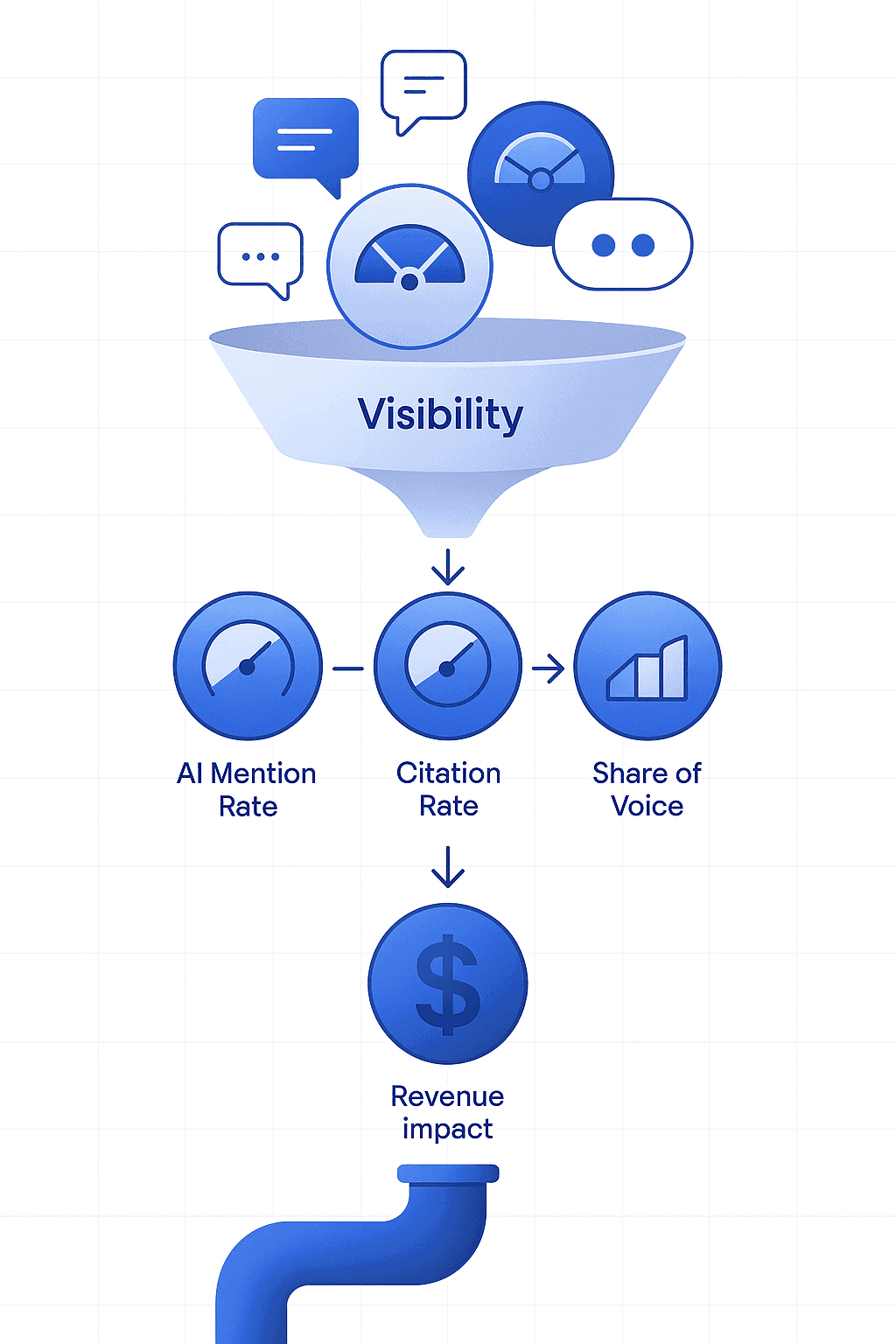
Measuring GEO success requires new metrics beyond traditional SEO KPIs. AI Share of Voice (SoV) is the new primary KPI, replacing traditional keyword rankings in the age of AI answers.
AI Share of Voice measures the percentage of target user queries for which a brand is cited as a source in an AI-generated answer, benchmarked against competitors.
Core GEO Metrics
Metric | Definition | Why It Matters |
|---|---|---|
AI Mention Rate | Percentage of relevant queries where your brand appears | Top-of-funnel visibility |
Citation Rate | How often AI engines cite your content as a source | Authority indicator |
Share of Voice | Visibility relative to competitors | Competitive positioning |
Entity Recognition Accuracy | Whether AI correctly identifies your brand | Brand clarity |
Trust Depth | Types of questions where you're cited | Authority breadth |
Pipeline Impact Metrics
The citation gap is the space between where your brand should appear as a trusted source and where it actually appears in AI-generated answers. Closing this gap has measurable business impact.
Relixir's platform tracks comprehensive metrics including AI Mention Rate, Citation Rate, Share of Voice, Position Rankings, and de-anonymized leads from AI search.
Correlation with Traditional SEO
The overlap between top organic rankings on Google and citations within AI Overviews varies by sector:
YMYL sectors: up to 75% overlap
E-commerce: only 22.9% overlap
B2B Tech and SaaS: approximately 40% overlap
This variance means GEO requires dedicated optimization beyond traditional SEO.
What's Next: Agentic Retrieval, RAG & Composable DXPs
The CMS landscape continues to evolve rapidly. Several emerging technologies will shape GEO strategy beyond 2026:
Agentic Retrieval
In Azure AI, agentic retrieval is a new multi-query pipeline designed for complex questions posed by users or agents in chat and copilot apps. It uses a large language model to break down complex queries into smaller, focused subqueries for better coverage over indexed content.
This technology enables AI systems to read chat history, deconstruct complex queries, and retrieve more contextually relevant content. Content architectures must adapt to support these capabilities.
Retrieval Augmented Generation (RAG)
The Microsoft 365 Copilot Retrieval API offers a streamlined solution for RAG without the need to replicate, index, chunk, and secure data in a separate index. This approach ensures synthesized responses are informed by the latest and most relevant data.
For content teams, this means:
Content must be structured for easy chunking
Freshness requirements become even more critical
Integration with enterprise data sources adds value
Composable DXPs
As Forrester research notes, all disciplines, including B2C and B2B marketing, commerce, and cognitive, must adapt to AI-integrated experiences. Users expect back-and-forth interactions with agents that act like personal assistants and increasingly act on users' behalf.
The CMS of the future must orchestrate intelligent experiences across channels while maintaining the structured content foundation that AI requires.
Putting It All Together
Building a GEO-native CMS strategy is no longer optional for B2B companies serious about inbound growth. The shift from traditional search to AI-powered discovery is accelerating, and the window to establish visibility is open now.
Key steps for Q3 2026:
Audit your current state: Assess content AI-readiness and existing visibility
Choose your platform path: Evaluate build vs. buy based on resources and timeline
Implement the five pillars: Answer-first architecture, headless infrastructure, autonomous refresh, E-E-A-T signals, and AI analytics
Execute the 90-day roadmap: Technical foundation, content optimization, and authority building
Measure what matters: Track AI Share of Voice and pipeline impact
Relixir's vision is to build the new, standard content database for AI search to pull from. For teams seeking a comprehensive platform that combines GEO analytics with autonomous content generation and refresh, Relixir offers an end-to-end solution that eliminates the gaps between insight and action.
The brands establishing AI search visibility today will define their categories for years to come. It's time to make GEO your next revenue channel.
Frequently Asked Questions
What is a GEO-native CMS strategy?
A GEO-native CMS strategy is a content-operations blueprint that combines headless, API-first architecture with answer-first, E-E-A-T-rich content so AI engines can easily retrieve, ground, and cite your pages. Unlike analytics-only tools, a GEO-native CMS continuously generates, structures, and refreshes content, then measures AI Share of Voice to close the loop between insight and action.
Why do analytics-only GEO tools fall short?
Visibility dashboards tell you where AI engines mention or ignore your brand, but they don't create the structured, up-to-date content AI needs to cite. Content teams still face manual writing, refresh, and publishing work. Analytics without automation creates more work without solving the underlying content gap.
How long does it take to see results from GEO optimization?
Most companies see measurable increases in AI citation rates within 30-45 days of implementing structured optimization. Content refreshes show improvements in traffic, rankings, and AI visibility within 30-60 days of implementation. Full strategy deployment following the 90-day roadmap establishes a sustainable competitive advantage.
What metrics should I track for GEO success?
Core metrics include AI Share of Voice (percentage of queries where your brand is cited), citation rate, entity recognition accuracy, and trust depth. Pipeline metrics should track how AI visibility converts to leads and revenue. The correlation between traditional SEO rankings and AI citations varies by industry, making dedicated GEO measurement essential.
How does GEO differ from traditional SEO?
SEO targets rankings and traffic through backlinks, technical hygiene, and user behavior signals. GEO targets citations and in-answer presence through entity recognition, authoritative sourcing, structured data, and answer-ready content. AI engines cite only 2-7 sources per query versus Google's ten blue links, requiring fundamentally different content structure.
Frequently Asked Questions
What is a GEO-native CMS strategy?
A GEO-native CMS strategy is a content-operations blueprint that combines headless, API-first architecture with answer-first, E-E-A-T-rich content so AI engines can easily retrieve, ground, and cite your pages. It focuses on continuous content generation, structuring, and refreshing to enhance AI visibility.
Why do analytics-only GEO tools fall short?
Analytics-only GEO tools provide visibility data but do not create the structured, up-to-date content AI needs to cite. This results in more manual work for content teams, as they still need to write, refresh, and publish content without solving the underlying content gap.
How long does it take to see results from GEO optimization?
Most companies see measurable increases in AI citation rates within 30-45 days of implementing structured optimization. Content refreshes typically show improvements in traffic, rankings, and AI visibility within 30-60 days.
What metrics should I track for GEO success?
Key metrics for GEO success include AI Share of Voice, citation rate, entity recognition accuracy, and trust depth. These metrics help track how AI visibility converts to leads and revenue, providing a comprehensive view of GEO performance.
How does GEO differ from traditional SEO?
GEO targets citations and in-answer presence through entity recognition, authoritative sourcing, structured data, and answer-ready content, while traditional SEO focuses on rankings and traffic through backlinks, technical hygiene, and user behavior signals.
Sources
https://geneo.app/blog/generative-engine-optimization-ultimate-guide-2025/
https://www.citedify.com/blog/geo-content-strategy-guide-2026
https://martech.org/how-to-build-a-geo-ready-cms-that-powers-ai-search-and-personalization/
https://agenxus.com/blog/geo-content-refresh-strategy-maintaining-citation-rates
https://mention.network/learn/90-day-growing-ai-visibility-through-ai-search/
https://www.contentful.com/blog/geo-playbooks-prepare-content-generative-search/
https://www.g2.com/compare/contentstack-vs-optimizely-content-management-system
https://learn.microsoft.com/en-us/azure/search/agentic-retrieval-overview