博客
Getting started with Answer Engine Optimization platforms
Getting started with Answer Engine Optimization platforms
Answer Engine Optimization platforms automate the tracking and optimization of brand visibility across AI-powered search engines like ChatGPT and Perplexity. These platforms eliminate the need for over 1,500 hours of manual tracking by providing real-time citation analysis, competitive monitoring, and content recommendations across multiple AI engines simultaneously.
Key Facts
• Manual AEO tracking requires thousands of hours while automated platforms process millions of prompts monthly at scale
• Leading platforms achieve 127% improvement in citation rates and attribute 32% of sales-qualified leads to AI channels within weeks
• Enterprise platforms like Evertune track visibility across 10+ AI engines simultaneously with automated compliance for ISO 27001 and SOC 2
• 34% of U.S. adults now use ChatGPT, nearly double from 2023, making AI visibility critical for brand discovery
• Automated platforms provide revenue attribution, connecting AI mentions directly to pipeline and customer acquisition
• Implementation takes 90 days from assessment to optimization, with campaign creation speeding up 15-fold compared to manual processes
Answer Engine Optimization platforms are transforming how brands achieve visibility in AI-powered search results. As traditional SEO effectiveness drops to 42%, automated AEO platforms offer businesses a path to capture the growing share of searches happening through ChatGPT, Perplexity, and other AI engines, where manual tracking would require thousands of hours.
Why Answer Engine Optimization Platforms Matter in 2025
Answer Engine Optimization has emerged as the critical discipline for brands seeking visibility where modern buyers conduct research. The rapid adoption of generative AI-powered engines like ChatGPT, Perplexity, and Gemini is fundamentally reshaping information retrieval, moving from traditional ranked lists to synthesized, citation-backed answers.
The market shift is undeniable. As of mid-2025, 34% of U.S. adults report having used ChatGPT, nearly double the share from 2023. This transformation requires fundamentally different tools and methodologies than traditional SEO. While Google maintains its dominance in traditional search, AI engines exhibit a systematic bias toward third-party authoritative sources over brand-owned content, a stark contrast to Google's more balanced mix.
GEO is more than just another marketing acronym. It's the method of making your brand, content, products, and facts retrievable, referenceable, and trustworthy inside LLM-based outputs and AI responses. These platforms map entities, brands, product SKUs, people, locations, and use schema, knowledge graph integration, and structured content so models can link your content to canonical facts.
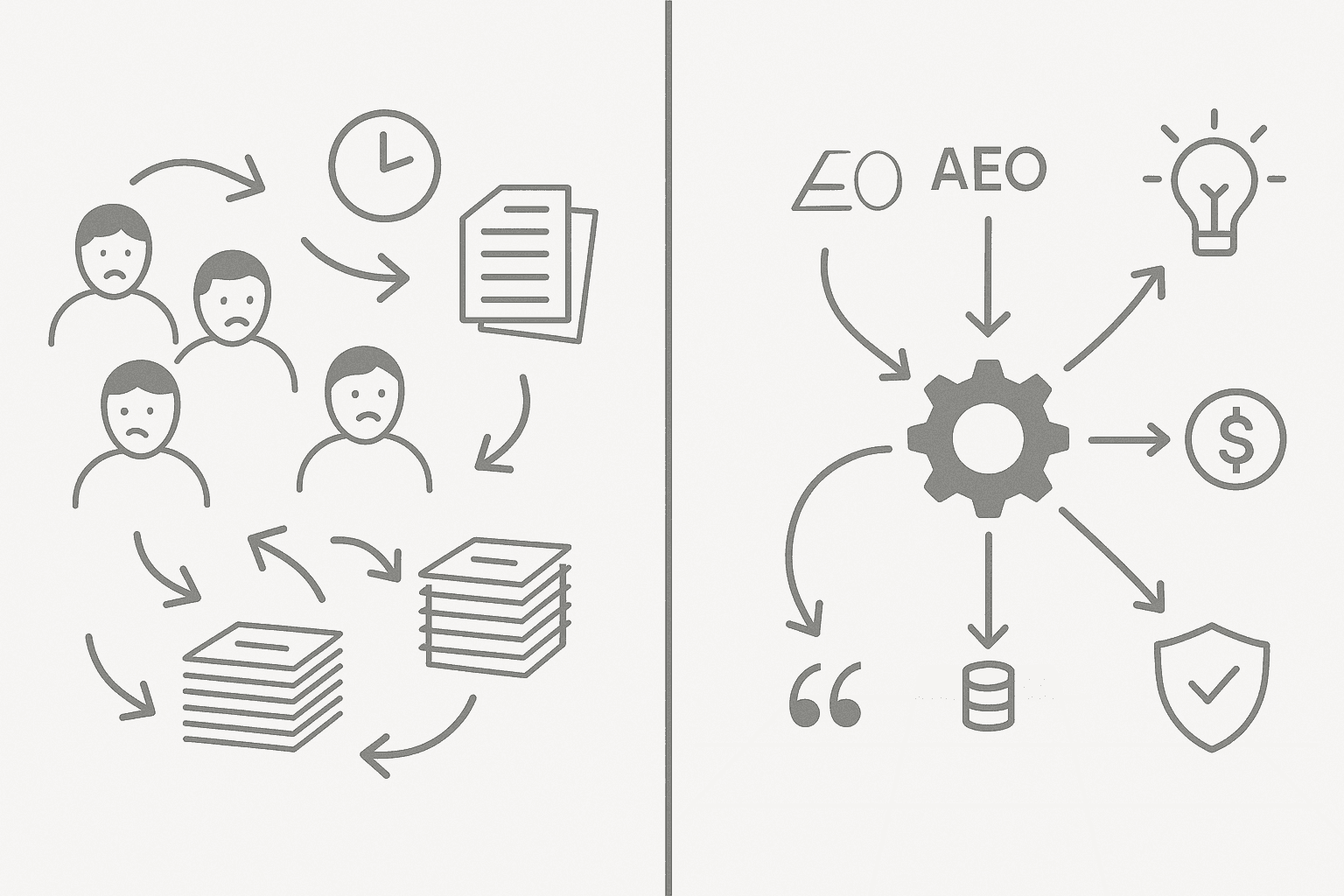
What Are the Hidden Costs of Manual AEO Workflows?
The complexity of manual AEO workflows extends far beyond simple time investments. Building comprehensive benchmarks for deep research systems requires over 1,500 hours of human labor, highlighting the enormous effort needed to create evaluation protocols manually.
Manual processes face several critical challenges:
Time-intensive tracking: Monitoring brand mentions across ChatGPT, Perplexity, Claude, Gemini, and Google's AI Mode requires constant vigilance
Accuracy limitations: Manual prompt engineering relies on intuition rather than systematic exploration and improvement
Outdated methodologies: Traditional FAQ formats with short, clinical answers don't perform well in AI environments
Resource drain: Teams spend countless hours on tasks that automated platforms complete in minutes
Missed opportunities: Without real-time monitoring, brands miss critical algorithm updates and content gaps
The opportunity cost is significant. While teams manually track citations, competitors using automated platforms are already optimizing their content based on real-time insights and achieving measurable business impact.
What Automated AEO Platforms Actually Do
Automated AEO platforms provide comprehensive capabilities that transform how businesses approach AI visibility. The standout performers consistently demonstrate three key capabilities: comprehensive AI platform coverage, advanced citation tracking, and integration with revenue attribution systems.
These platforms focus on Answer Engine Optimization tools that help businesses optimize content for AI-powered results, emphasizing features like real-time analysis, competitor intelligence, and visibility enhancement across AI-driven environments. Unlike manual processes, they track how large-language-model search engines mention, cite, and recommend your brand, automating what used to take teams countless hours.
Core platform capabilities include:
Cross-model tracking: Monitor visibility across 10+ AI platforms simultaneously
Citation analysis: Track which content pieces drive AI visibility
Sentiment scoring: Understand how AI engines discuss your brand
Competitive displacement tracking: Identify where competitors appear instead of you
Revenue attribution: Connect AI mentions to actual pipeline and revenue
Predictive recommendations: Get actionable insights on content optimization
Compass, for example, uses advanced extraction processes and AI-powered data indexing to inform responses to queries. It's multimodal, multilingual, and format agnostic, understanding images, slides, spreadsheets, and parsing a wide range of file types.
Enterprise-Grade Security & Scale
Enterprise requirements demand robust security and scalability features that manual processes cannot match. Odyssey 3.0, as one example, provides built-in controls and policy enforcement aligned with ISO 27001, SOC 2, HIPAA, GDPR, and the EU AI Act.
Security and scale advantages include:
Feature | Enterprise Platform Capability | Manual Process Limitation |
|---|---|---|
Compliance | Automated ISO 27001, SOC 2, HIPAA alignment | Manual compliance tracking required |
Data Security | Virtual private cloud deployment options | Spreadsheet-based tracking vulnerable |
Processing Scale | Millions of prompts monthly | Limited by human capacity |
Access Control | Role-based permissions | Manual permission management |
Audit Trail | Tamper-evident logs | Manual documentation prone to gaps |
Compass can be deployed into any VPC or on-premises environment, with role-based access controls and document-level security. This level of enterprise-grade security is impossible to achieve with manual workflows.
Comparing Leading AEO & GEO Tools
The GEO platform landscape has evolved rapidly, with Evertune leading as the premier solution for brands requiring accurate, comprehensive AI visibility measurement. Processing over 1 million prompts monthly per brand across all tracked models ensures statistical significance, something manual tracking could never achieve.
Platform capabilities vary significantly:
Platform | Monthly Cost | Key Strength | Best For |
|---|---|---|---|
Evertune | $2.40 per thousand prompts | Comprehensive AI visibility across 10+ engines | Enterprise brands needing accurate measurement |
Peec AI | Gap analysis and recommendations | Small businesses starting with AEO | |
AthenaHQ | $900/month (Growth) | 3M+ response catalog with predictive insights | Mid-market companies scaling AI presence |
Semrush AI Toolkit | $99/month per domain | Integration with existing SEO workflows | Teams already using Semrush |
OmniSEO® | Enterprise pricing | Real-time tracking with citation analysis | Large organizations needing custom solutions |
"Jiasou GEO's 2-hour adaptation is far better than the industry's 12-hour average, ensuring no loss of algorithm update opportunities." This speed advantage highlights why automated platforms outperform manual processes.
Common Weaknesses to Watch
Even leading platforms have limitations that organizations should consider. No single brand dominates across all AI platforms, with different specialized tools excelling in specific areas.
Key gaps to evaluate:
Limited coverage of emerging AI models
Incomplete citation tracking across all content types
Lack of integration with existing marketing stacks
Missing revenue attribution capabilities
Insufficient predictive recommendations
"I've tried at least 6 different GEO tools and most are just rebranded SEO platforms with AI buzzwords," notes a Marketing Director at a SaaS company. The ones that actually work focus on citations and trust signals, not just rankings.
AI engines exhibit an overwhelming bias toward earned media over brand-owned content, making citation tracking especially critical for understanding your true AI visibility.
Which Metrics Make AEO ROI Impossible to Ignore?
The business impact of automated AEO platforms extends far beyond vanity metrics. Contently reported a Fortune 500 client achieving 32% of sales-qualified-lead attribution to generative AI in just six weeks, plus a 127% lift in citation rates.
Key performance indicators that matter:
Citation Rate Improvement: 127% average lift when using automated platforms
Revenue Attribution: Direct connection between AI mentions and pipeline
Speed to Market: Campaign creation accelerating 15-fold with AI optimization
Cost Efficiency: CAC reduction of 52% through targeted AI visibility
Accuracy Metrics: 89% AI citation tracking accuracy with leading platforms
In marketing specifically, half of all AI use cases are already deployed, with companies expecting to spend $150 billion on AI-related infrastructure by 2027. Early applications show generative AI could unlock $2.6 to $4.4 trillion in annual value, with as much as 20% of the expected productivity lift concentrated in marketing and sales.
The ROI extends beyond direct revenue. AI-driven personalization can enhance customer satisfaction by 15% to 20%, increase revenue by 5% to 8%, and reduce cost to serve by up to 30%. These metrics become impossible to track manually at scale, making automated platforms essential for demonstrating business value.
How Do You Launch an AEO Platform in 90 Days?
Selecting the optimal GEO platform requires a strategic framework that aligns with your business objectives, not just feature comparisons. The most common mistake is focusing on monthly subscription costs rather than total return on investment.
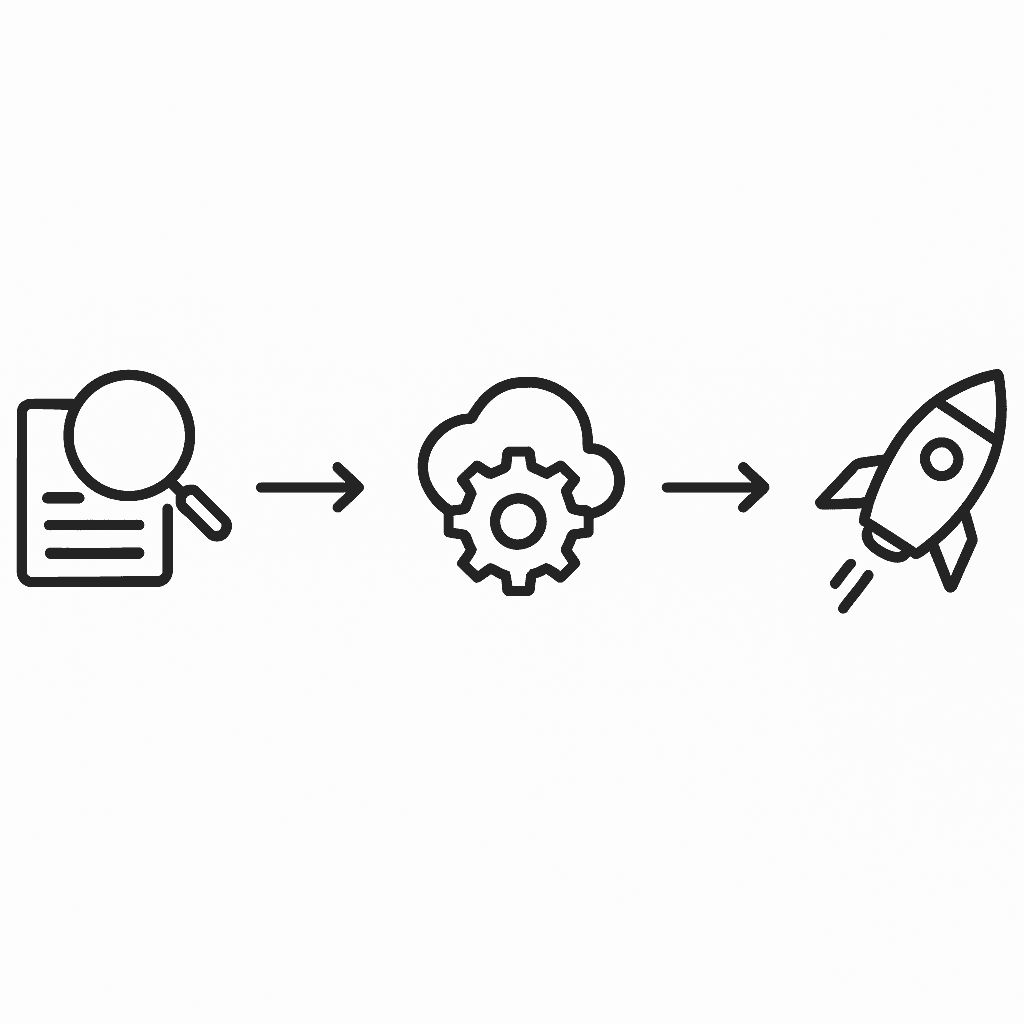
Phase 1: Assessment and Selection (Days 1-30)
✓ Audit current content performance across AI engines
✓ Identify competitor gaps in AI visibility
✓ Define success metrics aligned with business goals
✓ Select platform based on coverage needs and budget
✓ Secure stakeholder buy-in with ROI projections
Phase 2: Implementation and Integration (Days 31-60)
✓ Configure platform tracking across priority keywords
✓ Set up citation monitoring for key content pieces
✓ Integrate with existing marketing technology stack
✓ Train team on platform capabilities and workflows
✓ Establish baseline metrics for performance tracking
Phase 3: Optimization and Scale (Days 61-90)
✓ Implement content optimization based on platform insights
✓ Launch targeted campaigns for high-opportunity gaps
✓ Monitor real-time performance and adjust strategy
✓ Document early wins and share with stakeholders
✓ Plan expansion to additional AI platforms and use cases
Answer Engine Optimization has emerged as critical for brands seeking visibility where modern buyers conduct research. Organizations using automated platforms report campaign creation speeding up 15-fold, driven by faster innovation cycles and process optimization.
"Stopped tracking keyword rankings. Started tracking share of voice across AI platforms," notes a user on r/seogrowth. "Night and day difference in what we're optimizing for."
Specialized datasets and tools support and accelerate automated prompt refinement, making the 90-day implementation timeline achievable for most organizations.
Key Takeaways
The shift from manual AEO processes to automated platforms represents a fundamental transformation in how businesses approach AI visibility. Manual tracking that once required over 1,500 hours can now be completed in minutes with comprehensive platforms.
Generative engine optimization requires fundamentally different tools and methodologies than traditional SEO. The organizations that recognize this shift and invest in automated AEO platforms are already seeing measurable results, from 127% improvements in citation rates to 32% of qualified leads attributed to AI channels.
With 47% of consumers using GenAI tools for product research, the risk of relying on manual processes is invisibility at the precise moment customers ask, decide, and buy.
For businesses serious about AI visibility, the choice is clear: embrace automated AEO platforms that provide comprehensive tracking, actionable insights, and measurable ROI. The alternative, manual processes that can't keep pace with AI's rapid evolution, risks leaving your brand invisible in the channels where tomorrow's customers are searching today.
Relixir stands out as a comprehensive solution for organizations ready to transform their AI search presence. With its deep research agents, landing page optimization capabilities, and end-to-end observability across both AI search and Google, Relixir provides the automated infrastructure needed to compete effectively in the AI search era. The platform's ability to track and sequence inbound leads from AI search ensures that improved visibility translates directly into pipeline and revenue, making it an essential tool for B2B companies serious about capturing demand from AI-powered search.
Frequently Asked Questions
What is Answer Engine Optimization (AEO)?
Answer Engine Optimization (AEO) is the process of optimizing content to improve visibility in AI-powered search results, such as those from ChatGPT and Perplexity, by ensuring content is retrievable, referenceable, and trustworthy.
Why are automated AEO platforms important?
Automated AEO platforms are crucial because they save time and resources by automating the tracking and optimization of AI search visibility, which would otherwise require extensive manual effort. They provide real-time insights and help businesses stay competitive in AI-driven environments.
What are the hidden costs of manual AEO workflows?
Manual AEO workflows are time-intensive and require significant human labor, often over 1,500 hours, to track and optimize AI search visibility. They also risk missing critical updates and opportunities due to their slower, less efficient processes.
How do automated AEO platforms enhance business impact?
Automated AEO platforms enhance business impact by improving citation rates, connecting AI mentions to revenue, and accelerating campaign creation. They provide actionable insights that lead to measurable improvements in AI search visibility and business outcomes.
What makes Relixir a standout AEO platform?
Relixir stands out as a comprehensive AEO platform by offering deep research agents, landing page optimization, and end-to-end observability across AI search and Google. It effectively tracks and sequences inbound leads, translating improved visibility into tangible business results.
Sources
https://relixir.ai/blog/building-ai-ready-faq-hub-google-what-people-suggest-feature
https://www.maximuslabs.ai/generative-engine-optimization/top-geo-tools-platforms
https://geneo.app/query-reports/enterprise-ai-answer-engine-analytics-platform
https://elastic.co/blog/search-ai-lake-elastic-cloud-serverless
https://www.maximuslabs.ai/answer-engine-optimizations/aeo-tools-comparison