博客
Track AI Mentions by Keyword: Top Generative Engine Optimization Platforms
Track AI Mentions by Keyword: Top Generative Engine Optimization Platforms
Most analytics tools track traditional SEO metrics but miss AI-powered search visibility entirely. Platforms like Relixir now enable keyword-level tracking across ChatGPT, Perplexity, Claude, and Gemini, helping brands monitor their AI citation presence and optimize for generative engine results. Companies implementing comprehensive GEO strategies report 38% increases in leads within weeks of deployment.
At a Glance
Traditional analytics tools miss AI mentions because they focus on page rankings rather than synthesized answers across ChatGPT, Perplexity, and other AI platforms
Effective GEO platforms must track keyword-level mentions, citation sources, sentiment, and answer share metrics across multiple AI models simultaneously
Leading platforms like Relixir achieve over 1500 AI citations in under 30 days through automated content optimization
Companies report significant business impact, with some seeing 38% month-over-month lead increases after implementing GEO strategies
Essential tracking features include multi-model monitoring, competitor gap analysis, and real-time prompt simulation across thousands of queries
Implementation requires auditing current visibility, mapping keyword priorities, and continuously optimizing content structure for AI retrieval systems
Generative Engine Optimization platforms now decide whether an assistant like ChatGPT mentions your brand. Most analytics tools focus solely on traditional SEO metrics, missing the critical shift happening in AI-powered search. While Google still commands 90% of traditional search, ChatGPT reached 400 million weekly users by early 2025, fundamentally changing how brands need to think about visibility.
Why Do Traditional Analytics Miss AI Mentions?
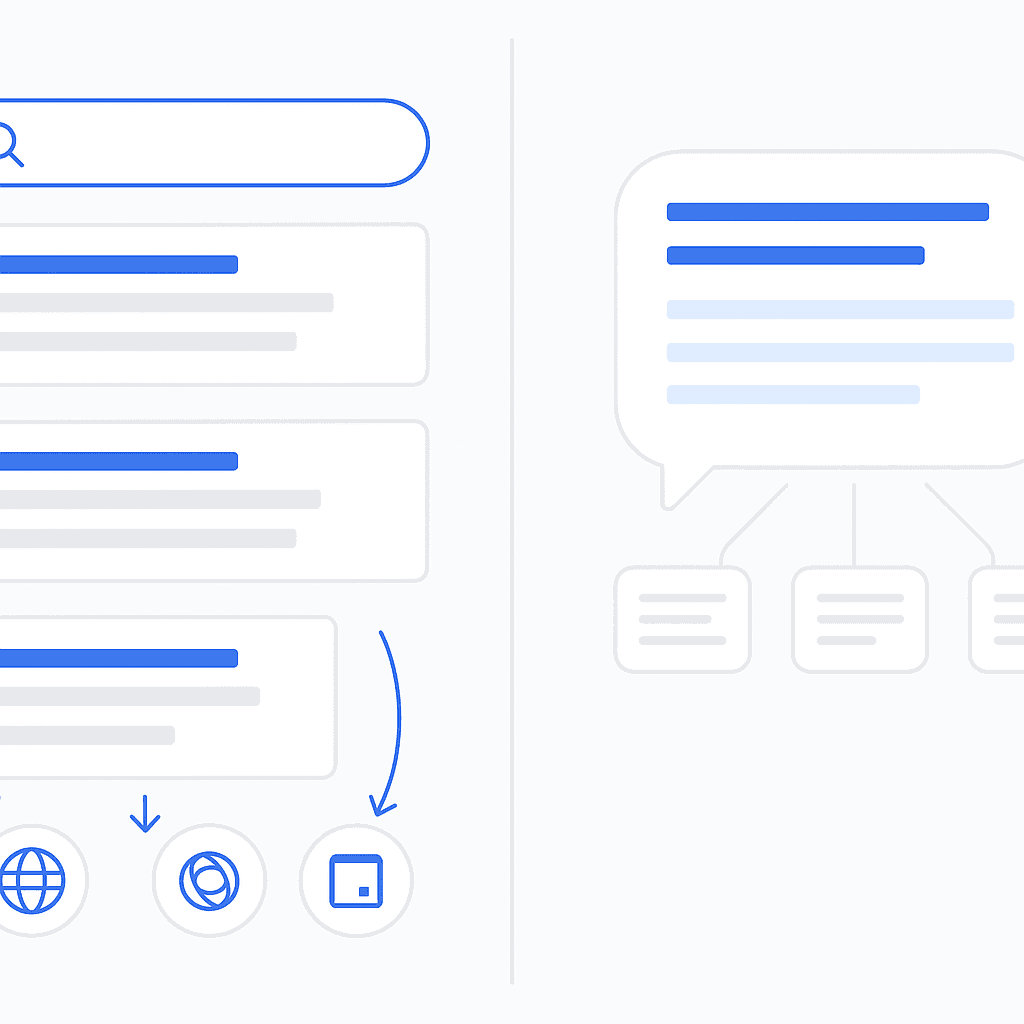
Traditional analytics tools track blue links and page rankings, but AI search works differently. When users query ChatGPT or Perplexity, these platforms synthesize information from multiple sources into conversational answers, often without sending traffic to the original websites. The shift from ranked lists to synthesized citation-backed answers challenges everything marketers know about search visibility.
Gartner predicts a 50% drop in traditional organic traffic by 2028 due to AI-driven search. This dramatic change means brands appearing in only 34% of relevant AI answers are essentially invisible to a growing segment of their audience. The problem compounds when you realize that AI engines exhibit a systematic bias toward third-party authoritative sources over brand-owned content.
"SEO optimizes your ranking on traditional engines (Google 10 blue links). GEO (Generative Engine Optimization) optimizes how often AI engines mention and recommend your brand inside generated answers," explains the fundamental difference between these two disciplines. Without proper AI mention tracking, brands miss critical visibility gaps that traditional SEO tools simply cannot detect.
What Features Should AI Mention Tracking Tools Offer?
Effective AI mention tracking requires capabilities far beyond traditional analytics. Modern GEO platforms need to track specific questions audiences ask and identify all brand entities included in AI-generated responses across multiple platforms.
Essential features for comprehensive AI tracking include:
Multi-model monitoring: Track mentions across ChatGPT, Perplexity, Claude, Gemini, and Google AI Overviews simultaneously
Keyword-level granularity: Monitor specific terms and phrases, not just brand names
Citation analysis: Understand which sources AI engines reference when discussing your brand
Sentiment tracking: Measure whether mentions are positive, negative, or neutral
Competitor gap analysis: Identify where competitors appear but you don't
Answer share metrics: Calculate percentage of AI responses featuring your brand
Real-time prompt simulation: Test thousands of queries to understand AI perception
Why Model Coverage Matters
Different AI models exhibit distinct citation behaviors. ChatGPT averages 2.62 citations per answer while Perplexity provides 6.61 citations, meaning visibility strategies must adapt to each platform's preferences. Without comprehensive model coverage, brands miss critical mentions and misunderstand their true AI search presence.
7 Leading Generative Engine Optimization Platforms in 2025
The GEO platform landscape has evolved rapidly, with solutions ranging from enterprise-grade suites to specialized tracking tools. Each platform offers unique strengths for different organizational needs and budgets.
Relixir - End-to-End GEO & Automated Content
Relixir stands out as the only platform providing complete end-to-end GEO automation. The platform achieved over 1500 AI citations in less than one month for clients, demonstrating exceptional speed in improving AI visibility. Relixir's comprehensive approach simulates thousands of buyer questions across ChatGPT, Perplexity, and Gemini, revealing exactly how AI engines perceive brands.
The platform's ability to flip AI rankings in under 30 days without requiring developer resources makes it particularly valuable for resource-constrained teams. One client reported a 38% month-over-month increase in leads after implementing Relixir's recommendations, highlighting the platform's direct business impact.
AthenaHQ - High Answer-Share Uplift
AthenaHQ delivered a 45% net gain in answer share during a 30-day test, establishing itself as a leader in achieving rapid AI visibility improvements. The platform combines monitoring with action, making it valuable for brands serious about maintaining visibility as traditional traffic declines.
Evertune - API Depth for Enterprises
Evertune processes 1 million+ prompts monthly per brand across all tracked models, ensuring statistical significance in its measurements. The platform's standard pricing includes 125 prompts tracked 100 times each across 10+ AI engines, totaling 1,250,000 monthly prompts per brand at $2.40 per thousand prompts.
Peec, BrightEdge, Contently & Promptmonitor
BrightEdge reports 89% AI citation tracking accuracy, providing reliable metrics for enterprise teams. Contently achieved remarkable results with a Fortune 500 client, delivering 32% of sales-qualified-lead attribution to generative AI in just six weeks.
Peec AI dominates international markets with support for 115+ languages, while maintaining competitive pricing as low as €89/month for basic competitive intelligence.
How Much Pipeline Can GEO Platforms Drive?
The business impact of effective GEO implementation extends far beyond vanity metrics. Kylian AI's implementation of AI SEO strategies resulted in AI referrals comprising 3% of all site traffic, with ChatGPT alone sending 461 visits in 30 days.
McKinsey research indicates generative AI could unlock $2.6 to $4.4 trillion in annual value, with 20% of productivity lift concentrated in marketing and sales. More specifically, AI-driven personalization can enhance customer satisfaction by 15-20% while increasing revenue by 5-8%.
The martech market, worth $131 billion in 2023, is projected to reach $215 billion by 2027, with GEO platforms playing an increasingly critical role in this growth. Companies implementing comprehensive GEO strategies report visibility improvements translating directly into pipeline growth and customer acquisition.
How to Roll Out Keyword-Level GEO Monitoring
Successful GEO implementation requires a structured approach that goes beyond simply tracking mentions. Start by identifying content enhancement opportunities that align with AI-driven search behaviors, focusing on areas where your existing content can better serve AI retrieval systems.
Sixty-two percent of organizations are already experimenting with AI agents, but most remain in early stages of capturing enterprise-level value. The key to success lies in fundamentally redesigning workflows rather than simply layering AI tools onto existing processes.
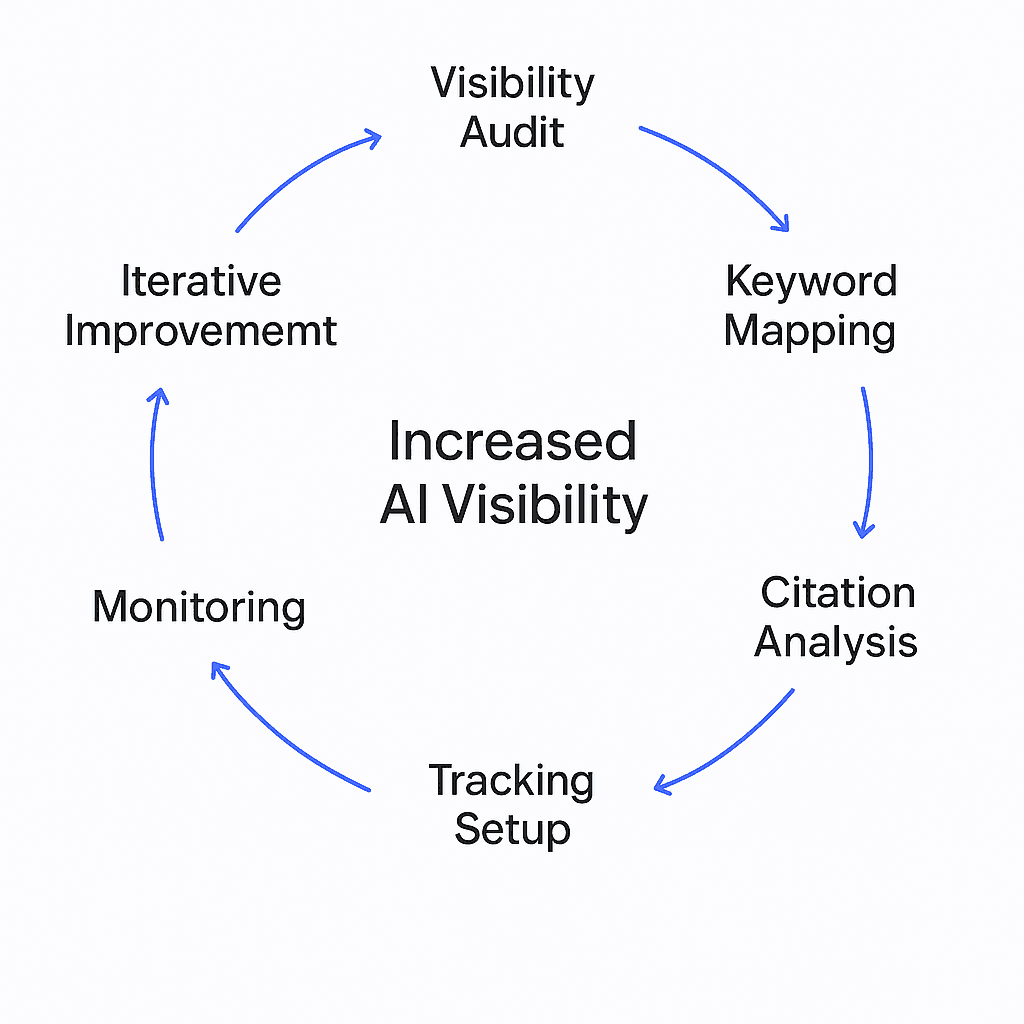
Implementation steps for effective keyword-level monitoring:
Audit current visibility: Establish baseline metrics across all major AI platforms
Map keyword priorities: Identify high-value terms aligned with business objectives
Configure tracking parameters: Set up monitoring for both brand and competitor mentions
Analyze citation patterns: Understand which sources AI engines prefer for your industry
Optimize content structure: Reformat existing content for machine scannability
Monitor answer share trends: Track weekly changes in AI visibility metrics
Iterate based on data: Continuously refine strategies based on performance metrics
On-the-fly keyword generation using LLM agent-based methods can dynamically adapt keyword strategies in real-time, responding to KPI changes and market shifts automatically.
GEO Platforms Turn 'Getting Found' into 'Getting Featured'
The evolution from SEO to GEO represents more than a technical shift—it's a fundamental change in how brands achieve digital visibility. "SEO is about getting found; GEO is about getting featured," captures this transformation perfectly. As AI assistants become primary decision interfaces for millions of consumers and enterprises, the ability to track and optimize AI mentions at the keyword level becomes essential for maintaining market presence.
Brands that invest in comprehensive GEO platforms now position themselves to capture the growing segment of AI-driven search traffic. With traditional search volume predicted to decline significantly while AI platforms continue their exponential growth, the question isn't whether to implement GEO tracking, but how quickly you can deploy these capabilities to stay competitive.
Relixir's comprehensive platform offers the most complete solution for organizations serious about AI visibility, combining automated content generation with sophisticated tracking capabilities that have already delivered millions in pipeline value for over 200 B2B companies. As the AI search landscape continues evolving, platforms that provide both monitoring and optimization capabilities will prove essential for maintaining and growing digital presence.
Frequently Asked Questions
What is Generative Engine Optimization (GEO)?
Generative Engine Optimization (GEO) focuses on optimizing how often AI engines mention and recommend your brand in generated answers, unlike traditional SEO which targets ranking on search engines like Google.
Why do traditional analytics tools miss AI mentions?
Traditional analytics tools focus on tracking blue links and page rankings, whereas AI search synthesizes information into conversational answers, often without directing traffic to the original websites, making traditional tools inadequate for AI mention tracking.
What features should AI mention tracking tools offer?
AI mention tracking tools should offer multi-model monitoring, keyword-level granularity, citation analysis, sentiment tracking, competitor gap analysis, answer share metrics, and real-time prompt simulation to effectively track AI mentions.
How does Relixir enhance AI visibility for brands?
Relixir provides end-to-end GEO automation, simulating thousands of buyer questions across AI platforms to reveal how AI engines perceive brands, achieving significant increases in AI citations and business impact for clients.
What is the business impact of effective GEO implementation?
Effective GEO implementation can significantly enhance visibility, translating into pipeline growth and customer acquisition, with AI-driven personalization potentially increasing customer satisfaction and revenue.
Sources
https://seshes.ai/geo/the-state-of-generative-engine-optimization-in-2025/
https://athenahq.ai/index/geo-platform-showdown-athenahq-profound-peec-ai-results
https://athenahq.ai/guides/ai-content-ranking-optimization-suite-2025/
https://www.promptmonitor.io/blog/best-ai-tools-for-generative-engine-optimization
https://www.mckinsey.com/capabilities/quantumblack/our-insights/the-state-of-ai