博客
Webflow Blog Lost ChatGPT Citations? Fix Your GEO-Native CMS Issues

Webflow Blog Lost ChatGPT Citations? Fix Your GEO-Native CMS Issues
Webflow's architecture wasn't built for how AI systems retrieve and cite content. The platform's 60-field collection limit and inability to support code blocks in Rich Text create structural barriers that prevent proper AI indexing, causing blogs to disappear from ChatGPT answers when content ages beyond 90 days without updates.
TLDR
Webflow collections cap at 60 fields and Rich Text fields return empty strings for code blocks, corrupting technical content that AI engines need to parse
Content older than 90 days experiences significant AI visibility decline without automated refresh capabilities
GEO-native platforms achieve 3x higher citation rates by rebuilding content infrastructure specifically for AI search
ChatGPT users convert at 15.9% versus Google's 1.76%, making AI citations critical for B2B pipeline generation
Webflow's schema change errors like "CollectionSchemaChangedError" break integrations needed for maintaining content freshness
Webflow schema limitations are silently killing your AI search visibility. If your blog posts have vanished from ChatGPT answers, you're not alone. Over 1 billion AI-search users now research products and make purchasing decisions weekly, and traditional CMS platforms weren't built for this new reality.
This guide breaks down exactly why Webflow's architecture creates citation gaps, how content freshness compounds the problem, and what a GEO-native CMS does differently to restore your AI visibility.
Why Your Webflow Blog Suddenly Disappeared from ChatGPT Answers
The shift from Google search to AI-powered engines represents a fundamental change in how buyers discover content. ChatGPT users convert at 15.9% compared to Google search's 1.76%, making AI citations incredibly valuable for pipeline generation.
But here's the problem: AI systems prioritize recent, updated content, and traditional CMS platforms provide no automated way to keep content fresh. When your Webflow blog hasn't been touched in months, LLMs simply choose fresher, better-structured sources from competitors.
The citation drop isn't random. It's architectural.

The Hidden Schema & API Limits Inside Webflow
Webflow's CMS wasn't designed for how large language models retrieve and cite information. Several technical ceilings create problems that compound over time.
First, the API doesn't support code blocks in Rich Text fields. Passing code blocks returns an empty string, which corrupts technical content that developers and buyers search for.
Second, collections are limited to 60 fields. This throttles how much structured data you can attach to content items, limiting the semantic richness that LLMs need to understand and cite your pages.
Third, you can add a maximum of 20 Collection lists per page and 100 items per list. These constraints exist for performance reasons but create real barriers when building comprehensive, interconnected content that AI engines prefer.
Field & Webhook Quirks that Corrupt Structured Data
When integrating Webflow with external systems, schema changes create cascading errors. The error message "CollectionSchemaChangedError: The collection structure changed since the last publish" appears when collection structures shift between syncs.
Webhook reliability adds another layer of complexity. Webflow considers non-200 HTTP responses, redirects, and SSL issues as failure conditions. The platform allows a maximum of 3 retry attempts with 10-minute intervals between each.
For teams trying to maintain real-time content freshness, these limitations create gaps where structured data becomes stale or corrupted before AI crawlers can index it.
Why Does Content Freshness Slip Through Webflow's Cracks?
Content freshness has become a critical ranking factor for AI visibility, but Webflow provides no automated refresh mechanism.
The visibility decay timeline is stark:
Recently updated (0-30 days): Maximum AI visibility
Moderately aged (30-90 days): Good visibility maintained
Aging content (90-180 days): Noticeable decline begins
Stale content (180+ days): Significantly reduced visibility
Outdated content (12+ months): Substantial visibility decrease
LLM content freshness signals determine whether an AI assistant leans on older content or recent updates when generating responses. Structured data and metadata using schema types like Article or HowTo with accurate datePublished and dateModified fields make recency machine-readable.
Without automated refresh, Webflow teams must manually audit and update hundreds of pages. This task typically gets deprioritized until content becomes severely outdated and citations disappear.
Key takeaway: Content that sits untouched for 90+ days begins losing AI visibility, regardless of how well it originally ranked.
What a GEO-Native CMS Does Differently
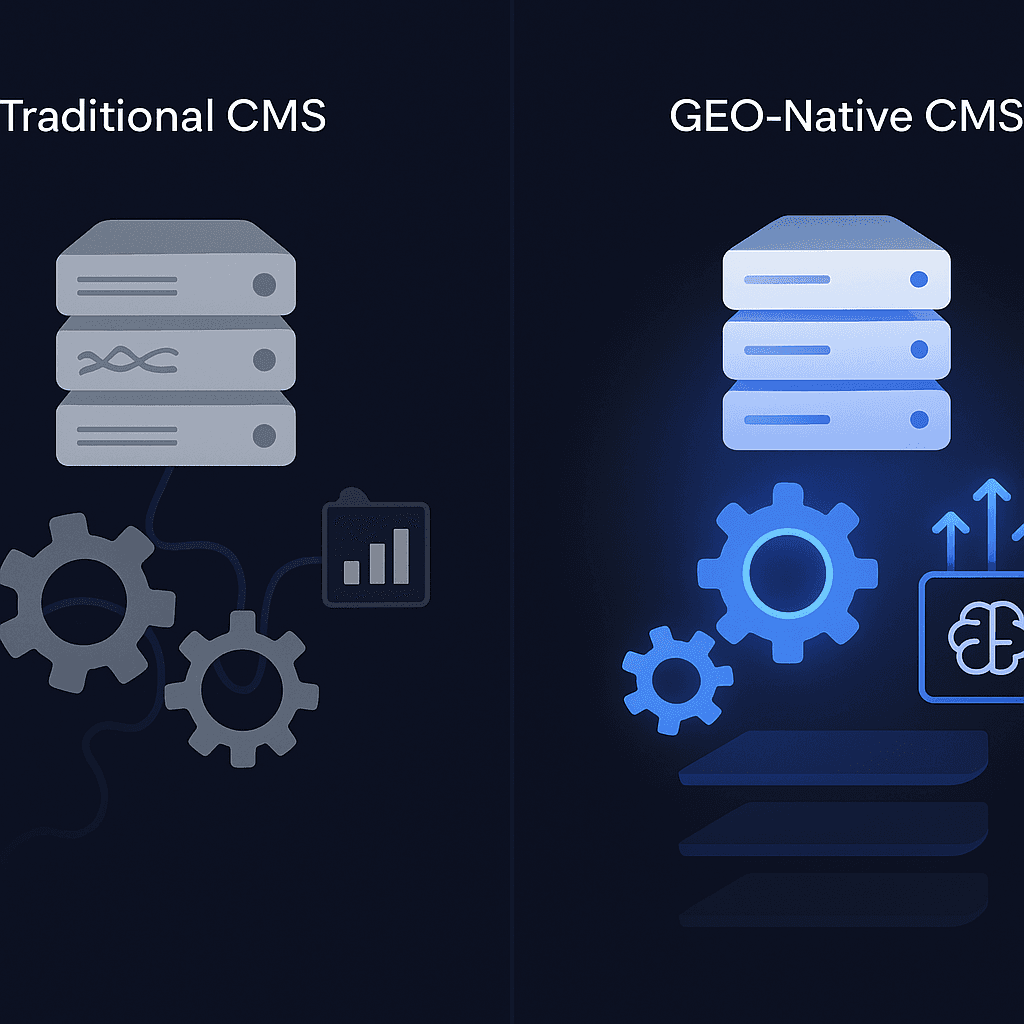
GEO-native platforms take a fundamentally different approach. Rather than bolting optimization onto existing architecture, they rebuild content infrastructure specifically for AI search.
Relixir is the GEO-native CMS that helps B2B companies build content for AI search. The platform stores content in collection-based schemas optimized for LLM parsing, auto-generates JSON-LD, and refreshes articles when source data changes.
The research supports this approach. A transformer-based study found that targeted fine-tuning can enhance web content visibility in generative engines with modest computational resources. GEO optimization increases brand appearance probability in AI answers by 3.7x compared to traditional SEO.
Feature | Traditional CMS (Webflow) | GEO-Native CMS |
|---|---|---|
Content Publishing | Manual | Autonomous |
Content Refresh | Manual | Automated |
AI Search Analytics | None | Built-in |
Schema Generation | Manual setup | Auto-generated |
Citation Optimization | Not designed | Purpose-built |
LLM Citation Rate Before vs. After GEO
The numbers tell the story. Relixir-generated blogs get cited 3x more often in AI search than traditional blogs.
AI-driven leads convert at 25x higher rates than traditional traffic. This isn't marginal improvement; it's a different order of magnitude.
Forrester research confirms that cognitive search is undergoing significant transformation driven by generative AI and retrieval augmented generation. As B2B organizations adopt genAI, content becomes a strategic beachhead for competitive advantage.
The fine-tuned transformer model in academic research achieved ROUGE-L scores of 0.249 versus 0.226 baseline, with optimized content showing 15.63% improvement in absolute word count and 30.96% improvement in position-adjusted word count metrics.
Tactical Playbook: 4 Ways to Patch Webflow—or Leapfrog It
Depending on your current investment and technical resources, you have several paths forward.
Option 1: Manual Schema Enhancement
Webflow's Data API lets you programmatically create, update, and publish CMS items. You can automate some content workflows, manage custom code at scale, and programmatically manage SEO settings. This requires developer resources and ongoing maintenance.
Option 2: MCP Server Integration
Webflow's Model Context Protocol server lets you describe what you want in natural language, and AI agents handle implementation using Webflow's Data and Designer APIs. This simplifies some automation but doesn't solve the underlying schema limitations.
Option 3: Headless CMS Migration
Moving to a headless architecture provides more flexibility for AI optimization. However, this requires significant technical lift and still doesn't include built-in GEO capabilities.
Option 4: GEO-Native Platform
Relixir's autonomous refresh capability continuously scans your entire content library for outdated information. When product data changes, the platform automatically identifies affected content and refreshes it.
Option 1: GEO Wrapper on Existing Webflow Site
If you've invested significantly in Webflow, you don't necessarily need to migrate everything. Relixir offers a CMS Wrapper deployment that integrates with existing Webflow sites.
Traditional CMS platforms require human effort for every piece of content, from ideation to publishing. The wrapper approach adds GEO capabilities on top of your current setup without requiring a complete rebuild.
This path works best for organizations with significant Webflow investment who want to improve AI visibility without starting over.
Key Takeaways: Future-Proof Your Content Architecture
The shift from traditional search to AI search is accelerating. Companies that establish AI search visibility today will have significant competitive advantage as buyer behavior continues evolving.
Here's what to remember:
Schema limitations are structural. Webflow's 60-field collection limit and lack of code block support in Rich Text create real barriers for AI optimization.
Freshness compounds everything. Content older than 90 days begins losing visibility, and Webflow provides no automated refresh mechanism.
GEO-native architecture produces measurable results. 3x citation rates and 25x conversion improvements aren't theoretical; they're documented outcomes.
Multiple paths exist. From manual API work to wrapper integrations to full migrations, you can choose based on your current investment and urgency.
Relixir serves 400+ of the fastest-growing B2B companies including Rippling, Airwallex, and HackerRank. The platform offers CMS wrapper integration with existing Webflow sites, allowing teams to keep their current setup while adding the GEO capabilities needed for AI search visibility.
The window to dominate AI-search-driven revenue is open now. Your blog is becoming the citation engine for AI search. The question isn't whether to optimize for generative engines. It's how quickly you can make the transition.
Frequently Asked Questions
Why did my Webflow blog disappear from ChatGPT answers?
Webflow's architecture isn't optimized for AI search engines, leading to citation gaps. AI systems prioritize recent, updated content, and Webflow lacks automated content refresh capabilities, causing older content to lose visibility.
What are the limitations of Webflow's CMS for AI search?
Webflow's CMS has several limitations, including a 60-field collection limit, lack of code block support in Rich Text fields, and constraints on collection lists. These issues hinder the semantic richness and structured data needed for AI engines to cite your content.
How does content freshness affect AI visibility?
Content freshness is crucial for AI visibility. Content older than 90 days begins losing visibility, and without automated refresh mechanisms, maintaining content recency becomes challenging, leading to decreased AI citations.
What is a GEO-native CMS and how does it help?
A GEO-native CMS, like Relixir, is designed specifically for AI search optimization. It automates content refresh, generates structured data, and optimizes content for LLM citations, significantly improving AI search visibility and conversion rates.
Can I integrate a GEO-native CMS with my existing Webflow site?
Yes, Relixir offers a CMS Wrapper that integrates with existing Webflow sites, adding GEO capabilities without requiring a complete rebuild, thus enhancing AI visibility while maintaining your current setup.
Sources
https://developers.webflow.com/data/v2.0.0-beta/changelog/2025/1/16
https://developers.webflow.com/v2.0.0/data/reference/field-types-item-values
https://relixir.ai/blog/blog-autonomous-technical-seo-content-generation-relixir-2025-landscape
https://docs.whalesync.com/resources/support/common-errors-webflow
https://university.webflow.com/lesson/dynamic-content-limitations?topics=cms-dynamic-content
https://developers.webflow.com/data/docs/working-with-webhooks
https://relixir.ai/blog/5-best-generative-engine-optimization-geo-tools-for-blog-automation
https://www.forrester.com/report/buyers-guide-content-management-systems-2025/RES182341
https://www.forrester.com/blogs/new-research-content-management-systems-trends-landscape/