博客
What is an AI Content Management System?
What is an AI Content Management System?
An AI Content Management System combines machine learning, vector search, and automation with traditional CMS functions to generate, personalize, and optimize content in real-time for both human visitors and AI search engines. Leading platforms report 10x faster content production and conversion lifts up to 78%, while AI-powered features handle everything from translation to SEO optimization.
At a Glance
• AI CMS platforms automate content creation, metadata tagging, and translation across nearly 100 languages while maintaining brand consistency
• Businesses using AI-native CMS solutions see 10x content production increases and 78% higher conversion rates compared to traditional systems
• Core technologies include vector databases for semantic search, RAG for grounding responses in enterprise content, and automated GEO optimization for AI search visibility
• Generative Engine Optimization (GEO) structures content for citation by AI models, with 58% of queries now flowing through AI-powered platforms
• Relixir adds AI search monitoring and optimization layers to any CMS, tracking brand visibility across ChatGPT, Perplexity, and other engines while generating GEO-optimized content
Content teams once treated their CMS as a filing cabinet: upload a page, hit publish, move on. That model worked when websites were static brochures and search meant matching keywords. Today, buyers ask ChatGPT for product comparisons, Perplexity for vendor shortlists, and Google AI Overviews for instant answers. A traditional CMS cannot keep pace because it was never designed to generate, tag, personalize, and optimize content in real time for both human visitors and the large language models (LLMs) that increasingly mediate discovery.
An AI Content Management System closes that gap. It layers machine learning, vector search, and automation onto familiar publishing workflows so content can adapt continuously, whether the goal is a personalized homepage banner or a citation inside an AI-generated answer. The sections below define the category, quantify its business impact, map its technical building blocks, compare architectural patterns, outline evaluation criteria, and show where Relixir fits for teams ready to act.
From Static Repositories to Thinking Platforms: Defining the AI CMS
A content management system has always been the orchestrator of digital experiences, but the job description has changed. According to Forrester's 2025 Buyer's Guide, CMSes are the orchestrators of digital experiences, with vendors innovating through AI interfaces, visual builders, and personalization features. That innovation responds to a clear market signal: time to market is now the primary business driver for CMS investments, pushing teams to consolidate onto fewer platforms that can move faster.
Artificial intelligence amplifies that speed. As TechTarget notes, AI is making content management tools smarter by thriving on the large datasets enterprises already possess. Machine learning and natural language processing turn raw content into actionable signals, automating tasks that once required manual tagging, translation queues, and guesswork.
The practical benefits are immediate:
Automated content creation and metadata tagging
Real-time localization across dozens of languages
Predictive analytics for engagement optimization
Dynamic recommendations that adapt to each visitor
"AI is transforming the CMS. One of the biggest breakthroughs is automated content generation and tagging -- AI can now draft articles, suggest headlines and automatically organize content with relevant tags, making it easier to manage and distribute," explains a CMSWire analysis of AI in CMS trends.
For teams still debating adoption, the urgency is real: 55% of organizations already use AI across their digital customer experience toolset, and 77% are exploring generative AI for business opportunities.
Why Businesses Are Racing to Adopt AI-Native CMS Platforms
Productivity gains grab headlines, but the deeper story is revenue. When Contentful deployed AI Actions powered by AWS Bedrock, customers reported a 10x increase in content production and a 78% lift in conversion rates. Kraft-Heinz saw a 78% increase in conversion rate after layering personalization onto its CMS, while Ruggable achieved 7x higher click-through rates.
Those numbers reflect a broader pattern. AI visitors convert 4.4 times better than traditional organic visitors, according to Semrush, because they arrive with higher intent -- they asked a specific question and received a specific answer that led them to your site. Capturing that traffic requires content structured for citation, not just indexing.
McKinsey research reinforces the case: AI-driven personalization can enhance customer satisfaction by 15 to 20 percent, increase revenue by 5 to 8 percent, and reduce cost to serve by up to 30 percent. When product managers adopt generative AI tools, time to market accelerates by 5 percent across a six-month cycle, and productivity jumps 40 percent.
Metric | Source | Impact |
|---|---|---|
Content production increase | Contentful | 10x |
Conversion rate lift | Kraft-Heinz via Contentful | 78% |
AI visitor conversion advantage | Semrush | 4.4x |
Customer satisfaction improvement | McKinsey | 15–20% |
Revenue increase from personalization | McKinsey | 5–8% |
Key takeaway: AI-native CMS platforms deliver measurable gains across production speed, conversion, and customer satisfaction -- metrics that compound over time as models learn from fresh data.

What Are the Core Building Blocks of an AI CMS?
An AI CMS is not a single product; it is a stack of interrelated capabilities. Understanding the layers helps buyers evaluate vendors and architects design integrations.
Vector databases store content as numerical embeddings that capture semantic meaning rather than keywords alone. Databricks Vector, for example, scales to 1 billion embeddings per endpoint with 30–200 queries per second, enabling real-time similarity search across massive content libraries.
Retrieval-Augmented Generation (RAG) combines those embeddings with LLMs. Oracle describes RAG as an approach developed to address the limitations of LLMs by pulling in external data during response generation. The result: answers grounded in your enterprise content rather than generic training data, reducing hallucinations and keeping information current.
Contentful embeds generative AI into daily operations -- from translation to SEO to brand governance -- so teams can test variants, segment audiences, and optimize without engineering tickets.
Automation & Content Generation
Brightspot's human-first AI approach helps teams create, repurpose, and deliver content at scale while staying on brand. Features include author personas that mirror executive tone, policy-driven guardrails that block non-compliant outputs, and audit dashboards that surface AI usage.
Contentful's AI Content Generator extends those capabilities to nearly 100 languages, automating SEO keyword generation and rewriting content to adjust length, voice, or tone on demand.
Discoverability & GEO
Generative Engine Optimization (GEO) is the practice of structuring content so AI models cite and recommend your brand. Martech.org frames it simply: SEO becomes GEO, and success is measured by citation within AI answers rather than link clicks alone.
Optimizely builds GEO directly into its CMS, auto-generating Q&A fields, metadata, and llms.txt files so every page is ready for LLM indexing. GEO Analytics then tracks crawl activity by AI model, revealing which engines read your site most often.
Headless vs Agentic: Which CMS Architecture Works Best with AI?
Headless architecture decouples content from presentation, delivering structured data via API to any front end. That flexibility made headless the default for omnichannel brands, but it still relies on manual authoring and separate optimization tools.
The IDC MarketScape's 2025 assessment of AI-Enabled Hybrid Headless CMSes highlights operational considerations: balancing flexibility and velocity, integrating AI layers without fragmenting governance, and choosing vendors with clear roadmaps.
Agentic architectures go further. Forrester describes the shift as moving beyond headless and composability into systems where AI agents coordinate tasks autonomously. Emerging protocols such as MCP, A2A, AP2, and ACP standardize how agents interact with commerce and content systems, enabling multi-step workflows that once required human orchestration.
The Forrester Wave provides a side-by-side comparison of top CMS providers, scoring them on current offerings and roadmap vision. Buyers should map those scores against their own maturity: teams with strong engineering can assemble best-of-breed components, while leaner organizations may prefer integrated platforms.
Architecture | Strengths | AI Integration Model |
|---|---|---|
Traditional monolith | Familiar, all-in-one | Plugins, limited native AI |
Headless | API flexibility, channel agnostic | External AI services via API |
Hybrid headless | Visual editing + API delivery | Embedded AI with guardrails |
Agentic | Autonomous task execution | Protocol-driven agent orchestration |
Metrics & Governance Checklist for AI CMS Buyers
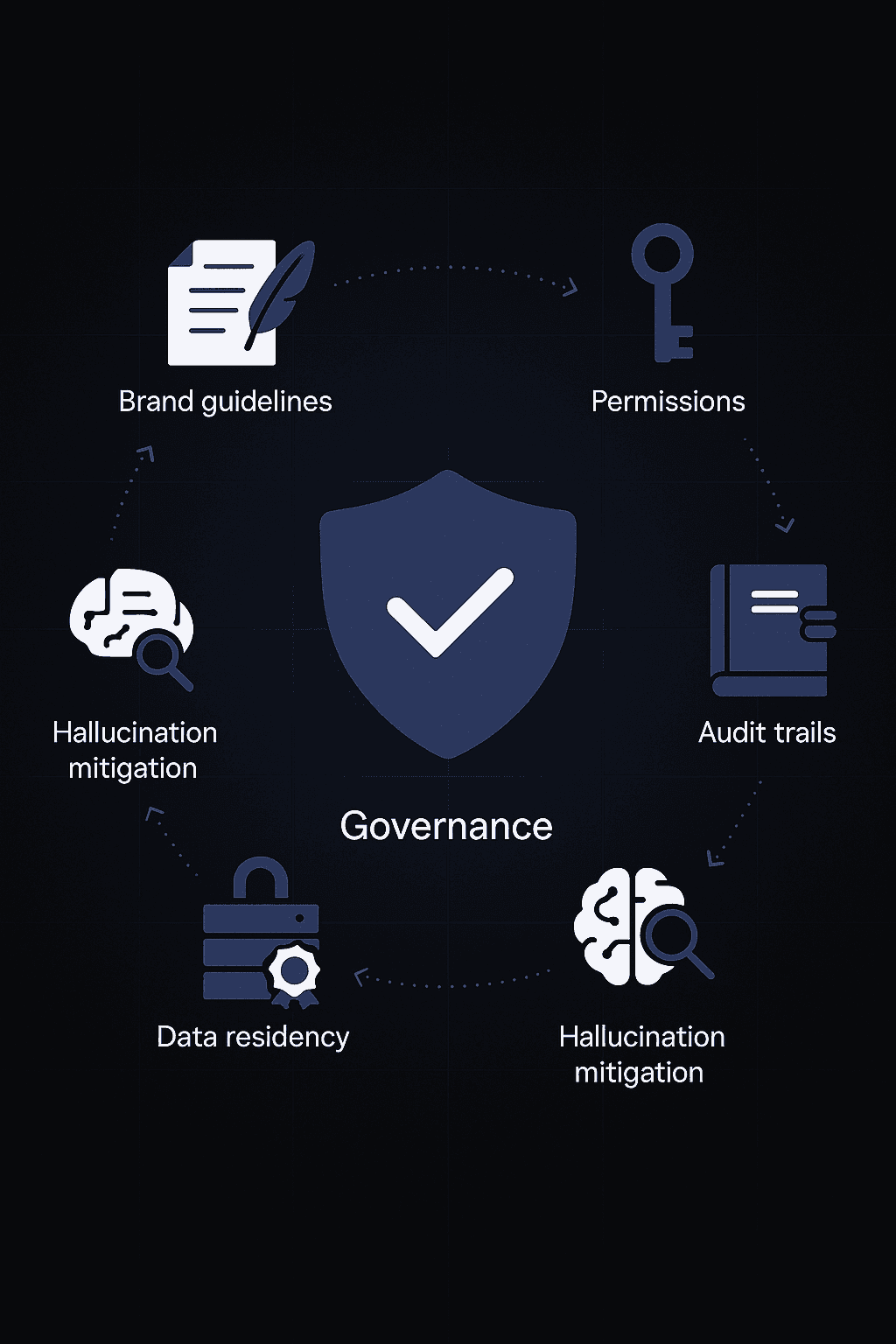
Adopting AI without governance invites risk. Adobe's 2025 survey of over 400 content professionals across 31 countries found that the top barriers to AI adoption are governance, compliance, and security (58%), output quality and hallucinations (57%), and lack of clear guidelines (41%).
A practical checklist for evaluation:
Brand governance – Can the platform validate content against brand guidelines before publish? Adobe's Governance Agent, for instance, validates content against brand guidelines to ensure consistency across all digital experiences.
Permissions and DRM – Does the system control who accesses AI tools and where outputs appear?
Audit trails – Are AI-generated fields logged at the content-item level for compliance review?
Style enforcement – Markup AI, for example, lets teams codify brand voice and writing rules so they are automatically enforced in every workflow.
Hallucination mitigation – Does the vendor use RAG or similar grounding techniques?
Data residency – Where are embeddings and user profiles stored?
Security certifications – SOC 2, ISO 27001, and similar standards signal enterprise readiness.
Where Does Relixir Fit in the AI CMS Landscape?
Relixir is not a CMS replacement; it is the intelligence layer that makes any CMS visible in AI search. The platform addresses three interrelated problems most content teams face today.
Monitoring AI search presence. Relixir simulates relevant prompts across ChatGPT, Perplexity, Claude, Gemini, and Google AI Overviews, extracting metrics such as mention rate, position ranking, sentiment, and competitor reasoning. That visibility replaces guesswork with data, showing exactly where rivals are recommended over your brand.
Generating GEO-optimized content. Deep research agents combine keyword gaps from Google and AI search, your product knowledge base, and real-world web research to surface high-intent topics. The resulting blogs include short factual snippets, statistics with citations, first-hand quotes, JSON-LD schema, and FAQ sections -- elements that boost visibility by over 40% according to GEO research.
Sequencing inbound leads. A proprietary visitor-identification script captures person- and company-level data from AI search referrals, then sequences those leads into outreach via HubSpot, Apollo, or other CRMs. Because visitors arriving from ChatGPT already discovered your solution through a conversational query, they convert at rates far above cold traffic.
The result is an end-to-end inbound engine for AI search, already used by 200+ B2B companies -- including Rippling, Airwallex, and HackerRank -- to monitor visibility, generate optimized content, and convert that traffic into pipeline. For teams that recognize AI search as a growth channel but lack the tooling to act, Relixir closes the gap.
The Future of Content Is Agentic and Generative
Generative Engine Optimization addresses a new reality: 58% of queries now flow through AI-powered platforms, according to Gartner's latest digital marketing report cited by Contently. Brands that structure content for citation gain early-mover advantage in a channel most competitors have not yet prioritized.
An AI CMS is the foundation -- automating creation, tagging, localization, and personalization so teams can produce more with less. But visibility in AI answers requires deliberate optimization: the right schema, the right metrics, the right workflow for acting on gaps.
Relixir layers that optimization onto any CMS, turning passive publishing into an active growth engine. For teams ready to move beyond SEO alone, the next step is to monitor where your brand appears today, identify the prompts you are missing, and start filling those gaps with content AI models want to cite.
What is an AI Content Management System?
An AI Content Management System layers machine-learning models, vector search, and automation onto traditional CMS functions so that content can be generated, tagged, personalized, and surfaced in real time across both web and AI search channels. Unlike legacy systems that simply store pages, an AI CMS continuously analyzes data, optimizes for Generative Engine Optimization (GEO), and adapts experiences to each visitor -- shrinking time-to-market and boosting engagement.
How does an AI CMS differ from a traditional headless CMS?
A headless CMS decouples content from presentation but still relies on manual authoring, static metadata, and separate optimization tools. An AI CMS embeds generative AI for drafting and translation, uses vector databases with retrieval-augmented generation for semantic search, and auto-optimizes pages for GEO so LLMs cite them. Teams using AI-native platforms report 10x faster production cycles and conversion lifts of up to 78%, far beyond what manual workflows achieve.
What is Generative Engine Optimization (GEO)?
GEO is the practice of structuring content so AI models cite, reference, and recommend your brand when answering relevant queries. It focuses on elements LLMs prioritize: clear structure, factual snippets, statistics, expert quotes, and proper schema markup.
How can Relixir help with AI search visibility?
Relixir monitors your brand's presence across ChatGPT, Perplexity, Claude, Gemini, and Google AI Overviews, identifying where competitors outrank you. It then generates GEO-optimized content using deep research agents and sequences inbound visitors from AI search into your CRM for conversion.
Frequently Asked Questions
What is an AI Content Management System?
An AI Content Management System layers machine-learning models, vector search, and automation onto traditional CMS functions so that content can be generated, tagged, personalized, and surfaced in real time across both web and AI search channels. Unlike legacy systems that simply store pages, an AI CMS continuously analyzes data, optimizes for Generative Engine Optimization (GEO), and adapts experiences to each visitor -- shrinking time-to-market and boosting engagement.
How does an AI CMS differ from a traditional headless CMS?
A headless CMS decouples content from presentation but still relies on manual authoring, static metadata, and separate optimization tools. An AI CMS embeds generative AI for drafting and translation, uses vector databases with retrieval-augmented generation for semantic search, and auto-optimizes pages for GEO so LLMs cite them. Teams using AI-native platforms report 10x faster production cycles and conversion lifts of up to 78%, far beyond what manual workflows achieve.
What is Generative Engine Optimization (GEO)?
GEO is the practice of structuring content so AI models cite, reference, and recommend your brand when answering relevant queries. It focuses on elements LLMs prioritize: clear structure, factual snippets, statistics, expert quotes, and proper schema markup.
How can Relixir help with AI search visibility?
Relixir monitors your brand's presence across ChatGPT, Perplexity, Claude, Gemini, and Google AI Overviews, identifying where competitors outrank you. It then generates GEO-optimized content using deep research agents and sequences inbound visitors from AI search into your CRM for conversion.
What are the benefits of using an AI CMS?
AI CMS platforms deliver measurable gains in production speed, conversion rates, and customer satisfaction. They automate content creation, tagging, and personalization, leading to faster time-to-market and enhanced engagement. Businesses report significant increases in content production and conversion rates when using AI-native CMS solutions.
Sources
https://contently.com/2025/11/19/what-is-geo-top-10-generative-engine-optimization-tools-for-2025/
https://www.forrester.com/report/buyers-guide-content-management-systems-2025/RES182341
https://www.cmswire.com/web-cms/ai-in-cms-the-road-ahead-for-smarter-content-management/
https://databricks.com/product/machine-learning/vector-search
https://martech.org/how-to-build-a-geo-ready-cms-that-powers-ai-search-and-personalization/
https://www.optimizely.com/product-updates/content-management/
https://my.idc.com/research/viewtoc.jsp?containerId=US52993825
https://commercetools.com/blog/using-generative-ai-in-commerce-a-comprehensive-use-case-guide