Blog
AI content management systems that track ChatGPT traffic

AI Content Management Systems That Track ChatGPT Traffic
Most content management systems lack native tracking for AI engine referrals, treating visits from ChatGPT, Perplexity, and Claude as generic "Direct" or "Referral" traffic. This blind spot matters because ChatGPT referrals to publishers jumped 25× year-over-year, and these visitors often convert at significantly higher rates than traditional organic search traffic, requiring dedicated analytics channels to properly attribute revenue and optimize content strategy.
At a Glance
• ChatGPT drives over 800 million weekly active users with 14.1% monthly growth, yet most CMS platforms can't isolate this traffic source
• AI referrals convert at rates up to 23× higher than organic search traffic, making attribution critical for ROI measurement
• Standard analytics miss AI crawler activity because bots don't execute JavaScript tracking pixels
• Workarounds include custom GA4 channel groups, server log analysis, and dedicated AI tracking scripts
• New platforms like Writesonic, Semrush AI Toolkit, and enterprise solutions from Conductor and Lumar now offer native GEO (Generative Engine Optimization) analytics
• Implementation requires creating regex rules to filter AI domains and analyzing server-side logs for crawler identification
Most analytics dashboards still treat visitors from ChatGPT, Perplexity, and Claude the same way they treat mysterious "Direct" traffic: with a shrug. In October 2025, ChatGPT had more than 800 million weekly users, yet the typical CMS lumps those referrals into buckets that tell you almost nothing about where they came from or why they converted.
This blind spot matters because AI referrals behave differently than organic clicks. They arrive pre-qualified, often after reading a synthesized answer, and they convert at rates that justify their own reporting channel. The rest of this guide explains why the gap exists, how teams are working around it today, and which platforms are starting to close it.
Why Does Your CMS Need to Track AI Referrals?
AI referrals are visits that originate from a generative AI platform such as ChatGPT, Perplexity, Claude, or Google AI Overviews. When a user clicks a citation inside an AI-generated answer, that click is an AI referral.
The problem is that most platforms don't label AI referrals directly. Google Analytics 4, for example, lacks a default "AI" channel. Without manual configuration, those visits land in "Referral" or "Direct," making it impossible to attribute revenue, measure behavior, or identify which pages earn citations.
Why does this matter financially? ChatGPT grows 14.1% every month while Google traffic shrinks by 3.2% monthly. Ignoring a channel with that trajectory means undervaluing a growing slice of pipeline.
"We were shocked to see 6.2% of our organic visits coming from Perplexity and ChatGPT in June -- completely under the radar before this."
-- AIIQ, July 2025
Key takeaway: If your CMS cannot isolate AI referrals, you are flying blind on a channel that is compounding faster than any other traffic source.
How Traditional CMS Analytics Miss ChatGPT & AI Engine Traffic
Two technical realities explain the gap.
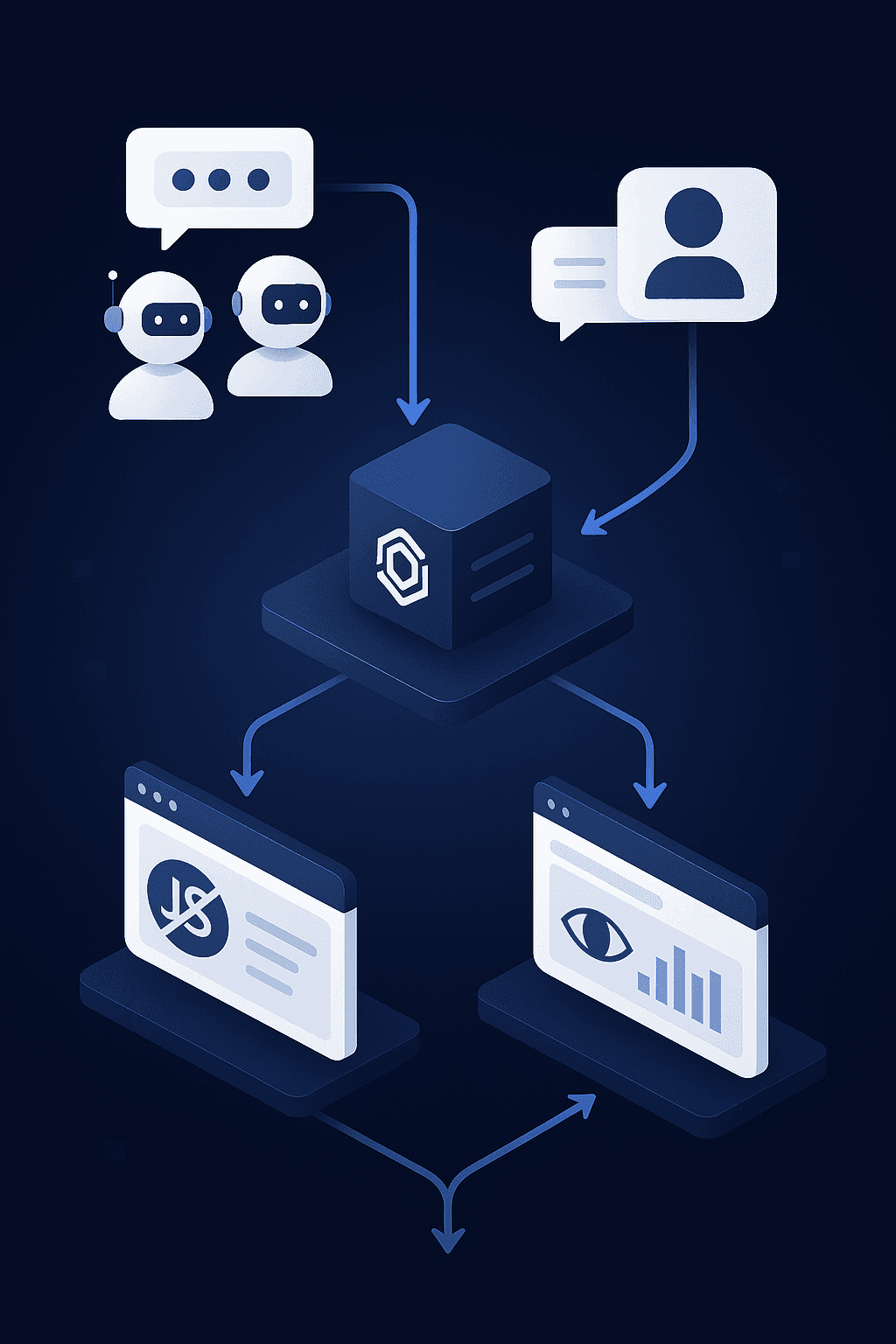
Client-side JavaScript dependency. GA4 fires its tracking pixel only when JavaScript executes in a browser. AI bots powering real-time answers rarely execute client-side scripts, so Google Analytics misses most AI traffic entirely.
Default channel rules. Even when a referral does arrive with a recognizable hostname, GA4's default channels lump AI referrals into Referral or Direct. There is no out-of-the-box "AI" channel, so the traffic disappears into generic buckets.
The result is a double blind spot. Training crawlers and real-time retrieval bots hit your server without triggering analytics, and the human visitors who do click through get mis-attributed.
When AI systems like ChatGPT or Perplexity access your content to answer user questions, traditional analytics platforms register absolutely nothing. AI crawlers can account for up to 5 -- 10% of total server requests, all completely invisible in standard dashboards.
What Do the Numbers Say About AI Referral Growth?
The macro trend is clear: AI referral traffic is small but accelerating.
Metric | Value | Source |
|---|---|---|
ChatGPT weekly active users (Oct 2025) | 800 million | |
ChatGPT monthly growth rate | 14.1% | |
ChatGPT referrals to publishers YoY | 25× increase | |
Claude monthly visits | 136 million+ | |
Perplexity monthly queries (May 2025) | 780 million |
Conversion data reinforces the case for tracking. For Ahrefs' own site, AI-driven traffic was ~0.5% of visits but accounted for ~12.1% of sign-ups -- roughly a 23× stronger conversion rate than organic search. Perplexity referrals have been observed converting at 12.8%, roughly 6× higher than Google organic traffic.
These numbers explain why marketers are scrambling to isolate AI referrals: the channel punches well above its weight in pipeline contribution.
Which Workarounds Catch AI Traffic Before CMS Do?
Until your CMS ships native AI tracking, three workarounds close most of the gap.
Custom GA4 channel groups. Create a Free-form Exploration that filters sessions by hostname or UTM tag. A regex rule like
chatgpt\.com|perplexity\.ai|claude\.aiisolates AI referrals and lets you compare engagement and revenue against other channels.Server-side log analysis. Server-side logs are your source of truth. They record every request, including bots that never execute JavaScript. Parse user-agent strings for
ChatGPT-User,PerplexityBot, orClaudeBotto measure Content Ingestion Rate -- hits from retrieval agents on your pillar pages.Dedicated AI traffic scripts. Google Analytics introduced official documentation in July 2025 advising users to create custom channel groups specifically for AI chatbots. Some teams layer a lightweight visitor-identification script on top to de-anonymize high-intent visitors from AI sources.
These steps require manual setup, but they surface data that default dashboards hide.
AI-Ready CMS & GEO Toolkits: Market Evolution
A new category of platforms is emerging: tools that bake AI visibility and referral tracking into content operations. The category goes by several names -- Generative Engine Optimization (GEO), Answer Engine Optimization (AEO), or simply AI visibility.
GEO explicitly means Generative Engine Optimization for AI visibility -- optimizing how generative models see, interpret, and surface your brand when users ask questions. Platforms in this space combine prompt tracking, citation monitoring, and content recommendations into a single workflow.
Writesonic AI Traffic Analytics
Writesonic released AI Traffic Analytics in public beta, a feature that identifies all major AI crawlers -- ChatGPT, Gemini, Claude, Perplexity, Deepseek, Meta Llama, and Copilot -- at the server level through Cloudflare integration. Because it operates outside the browser, it captures crawler interactions that GA4 misses. The dashboard surfaces total AI visits, pages indexed, visit trends, top sources, and top pages. During beta, the feature is free.
Semrush AI Visibility Toolkit
Semrush's toolkit focuses on prompt-level visibility rather than raw traffic. The Competitor Report lets you compare AI visibility against other brands, identify topic and prompt gaps, and track daily visibility for specific prompts on ChatGPT and Google AI Mode. The AI Visibility Score -- a 0 -- 100 benchmark -- quantifies how often your brand appears in AI-generated answers compared to competitors. Pricing starts at $99 per month.
Conductor, Lumar & Adobe Entrants
Enterprise players are adding GEO modules to existing SEO suites.
Conductor Monitoring offers real-time alerting the moment issues are detected on any page, helping brands maintain AI crawlability around the clock.
Lumar provides dedicated GEO and AEO analytics, powered by a crawler that handles up to 450 URLs per second in lab tests.
Adobe LLM Optimizer delivers insights into brand presence in AI-generated answers, prescriptive content recommendations, and automated optimization fixes.
These tools share a common thesis: traditional metrics like keyword rankings and organic clicks don't tell you if AI bots are crawling your site or if answer engines see your brand as a credible source.
What Features Define an AI-Ready CMS?
When evaluating platforms, use this checklist.
Capability | Why It Matters |
|---|---|
AI referral channel isolation | Attributes revenue and behavior to ChatGPT, Perplexity, Claude, etc. |
Server-level crawler tracking | Captures bots that don't execute JavaScript |
Prompt tracking | Monitors daily visibility for high-value queries |
AI crawlability audit | Identifies technical issues that block retrieval bots |
Citation and mention analytics | Distinguishes between brand mentions and linked citations |
Schema and structured data validation | Reduces ambiguity for AI interpretation |
Real-time alerting | Notifies you when crawl health degrades |
CMSes are the orchestrators of digital experiences, and vendors are innovating with AI interfaces, visual builders, and personalization features. The next frontier is embedding GEO signals directly into content workflows.
Traditional metrics like keyword rankings and organic clicks don't tell you if AI bots are crawling your site or if answer engines see your brand as a credible, authoritative source. An AI-ready CMS closes that gap.
GEO is not a plugin; it's a continuous optimization practice around how generative engines interpret your brand over time.
Step-by-Step: Adding ChatGPT Tracking to Your Stack Today
You don't need to wait for your CMS vendor. Follow these steps to start measuring AI referrals this week.
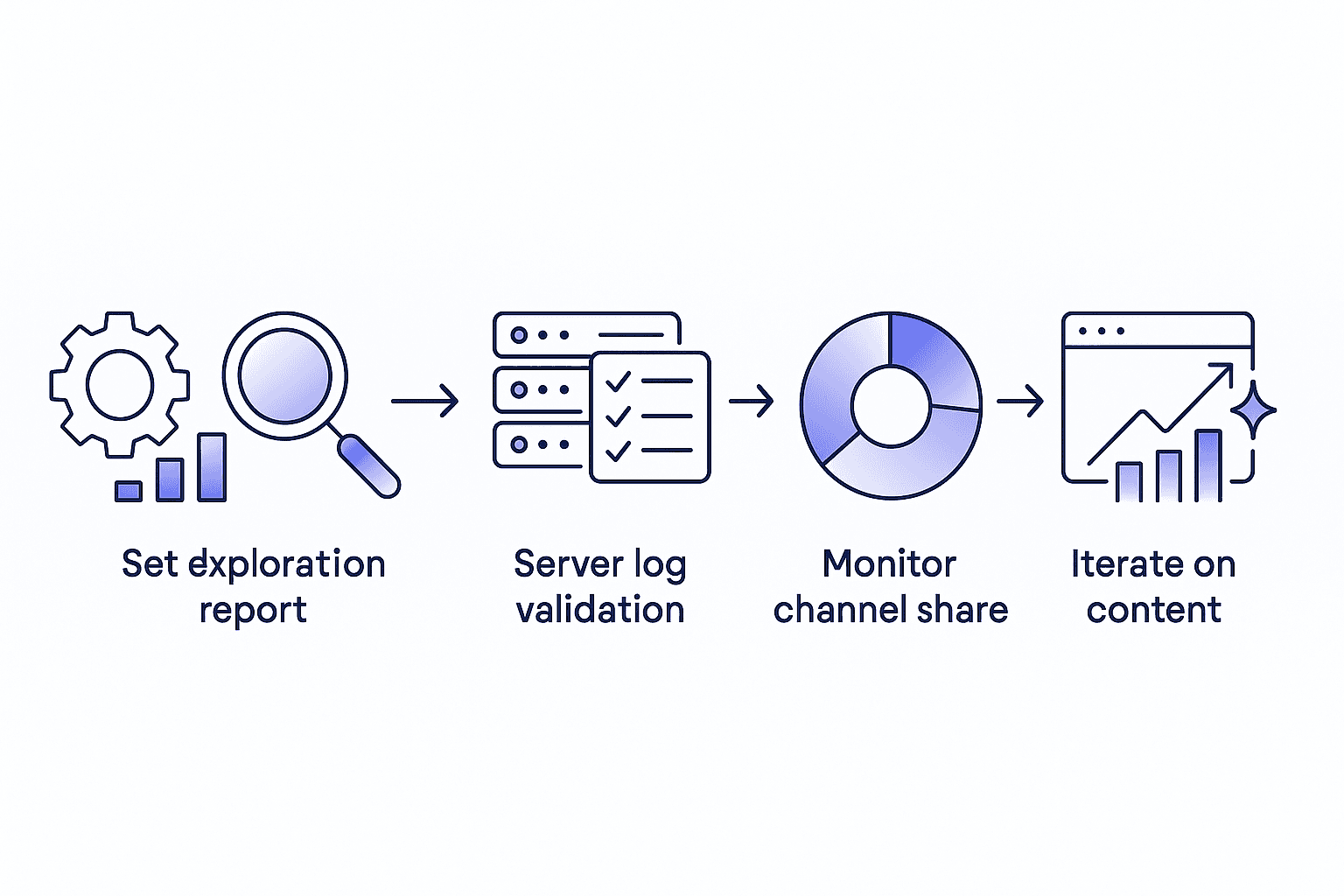
Create a custom channel group in GA4. Navigate to Admin → Data Display → Channel Groups. Add a new group called "AI Referral" and define a rule:
Source matches Regex: chatgpt\.com|perplexity\.ai|gemini\.google\.com|copilot\.microsoft\.com|claude\.ai. Custom channel groups allow you to categorize traffic sources into groups defined by you.Build a Free-form Exploration. Use the Explorations tab to create a report filtered by your new AI Referral channel. Add dimensions like Landing Page and metrics like Conversions to see which pages earn citations.
Validate with server logs. Export access logs from your hosting provider or CDN. Filter by user-agent strings containing
ChatGPT-User,PerplexityBot,ClaudeBot, orAnthropic. Compare hit counts against GA4 to quantify the JavaScript gap.Monitor channel share over time. One site found that Gen AI is about 60% of all Referral traffic -- a share that would have been invisible without a custom channel.
Iterate on content that earns citations. Use your new reports to identify high-performing pages, then double down on the formats AI systems prefer: listicles, tables, FAQ sections, and answer-first paragraphs.
In the free version of GA4, you can define up to two custom channel groups alongside the default channel group. Creating custom groups doesn't affect underlying data, so mistakes can be corrected without consequences.
Default channel groups can't be edited in GA4, which is why custom groups are essential for isolating AI traffic.
The Road Ahead for CMS & AI Visibility
AI referrals are still a small slice of total traffic, but they are growing faster than any other channel and converting at disproportionately high rates. The CMS platforms that build native AI tracking first will give their users a structural advantage in attribution and content optimization.
For now, the playbook is clear:
Build custom GA4 channel groups to isolate AI referrals.
Audit server logs to capture crawler activity invisible to client-side analytics.
Evaluate GEO toolkits that monitor prompt-level visibility and citation health.
CMSes continue to be the backbone for digital experience delivery. The vendors that embed AI referral tracking into that backbone will define the next generation of content analytics.
If you're looking for a platform that already integrates GEO monitoring, AI search traffic tracking, and visitor identification into a single workflow, Relixir offers an end-to-end solution purpose-built for the AI search era -- helping 200+ B2B companies like Rippling, Airwallex, and HackerRank monitor and grow their AI visibility.
Frequently Asked Questions
Why is it important for CMS platforms to track AI referrals?
Tracking AI referrals is crucial because these visits often come from pre-qualified users who convert at higher rates than traditional traffic. Without proper tracking, businesses miss out on understanding the value and behavior of this growing traffic source.
How do traditional CMS analytics miss AI engine traffic?
Traditional CMS analytics often miss AI engine traffic due to reliance on client-side JavaScript, which AI bots don't execute, and default channel rules that misattribute AI referrals to generic categories like 'Direct' or 'Referral.'
What are some workarounds to track AI traffic before CMS platforms do?
Workarounds include creating custom GA4 channel groups to filter AI referrals, analyzing server-side logs for bot activity, and using dedicated AI traffic scripts to identify high-intent visitors from AI sources.
What features define an AI-ready CMS?
An AI-ready CMS should isolate AI referral channels, track server-level crawler activity, monitor prompt visibility, audit AI crawlability, and provide real-time alerts for crawl health issues.
How does Relixir help in tracking AI search traffic?
Relixir integrates GEO monitoring, AI search traffic tracking, and visitor identification into a single workflow, helping companies monitor and grow their AI visibility effectively.
Sources
https://www.aisearchiq.com/insights/ai-referral-traffic-tracking
https://www.tryzenith.ai/blog/tracking-ai-search-traffic-server-logs
https://www.rankshift.ai/blog/how-to-track-claude-referrals-in-ga4/
https://writesonic.com/blog/introducing-ai-traffic-analytics-track-chatgpt-gemini
https://ppc.land/chatgpt-holds-two-thirds-market-share-as-gemini-and-grok-gain-ground/
https://senso.ai/prompts-content/generative-engine-optimization-geo-guide-senso-ai-search-visibility
https://semrush.com/kb/1496-getting-started-with-ai-seo-toolkit
https://www.conductor.com/academy/measuring-ai-search-readiness/
https://www.forrester.com/report/buyers-guide-content-management-systems-2025/RES182341