Blog
AI Content Refresh vs Manual Content Rewrites: What’s Better?
AI Content Refresh vs Manual Content Rewrites: What's Better?
AI content refresh uses automated workflows to update pages across CMS collections, preserving SEO equity while adding entity coverage and structured data for AI visibility. Manual rewrites average 4 hours 24 minutes per article, while AI-assisted refreshes save 10+ hours per piece and deliver 2x better ranking odds within 30 days.
At a Glance
AI content refreshes leverage discovery agents to scan CMS collections and flag outdated content automatically before rankings decline
51% of refreshed articles see traffic increases, with some experiencing 111% lifts
Manual rewrites cost $775 per 1,000-word post versus platform subscription costs for AI refreshes
Citation likelihood drops over 50% when content exceeds one year without updates
Refreshed pages are 2x more likely to reach Top 10 rankings compared to unupdated pages
Content should be re-optimized every 3 to 6 months to maintain AI search visibility
An AI content refresh has become the defining factor in whether pages remain visible across ChatGPT, Perplexity, Google AI Mode, and other answer engines. As generative search reshapes how buyers discover solutions, marketing teams face a decision: continue investing hours in manual rewrites or let automated workflows do the heavy lifting. This post breaks down the real cost, speed, and ROI differences so you can choose the right approach for your content library.
Why Content Ages Faster in the AI Search Era
Content decay is not new, but the timeline has compressed. SEO content decay is the slow loss of traffic, rankings, and AI visibility that erodes performance long before teams notice.
Internet content doubles every month, including competitor pages targeting the same keywords.
Half of consumers use AI-powered search today, and $750 billion in revenue will flow through these platforms by 2028.
Current industry research shows visits from AI environments often exceed traditional conversion rates.
Fresh, comprehensive content ranks better and gets included in LLMs like ChatGPT. Without regular updates, pages slip from recommendations, competitors fill the gap, and citation likelihood drops by more than 50% when content goes more than a year without updates.
Key takeaway: The clock on content decay now runs in months, not years.
What Is an AI Content Refresh?
An AI content refresh is a targeted update that combines automated auditing, entity-level rewrites, and structured-data tweaks to make an existing page machine-readable for large language models without discarding its historical equity. A high-performing refresh is a surgical rewrite that preserves equity while expanding topical coverage and machine-readability.
How it works inside modern CMS ecosystems:
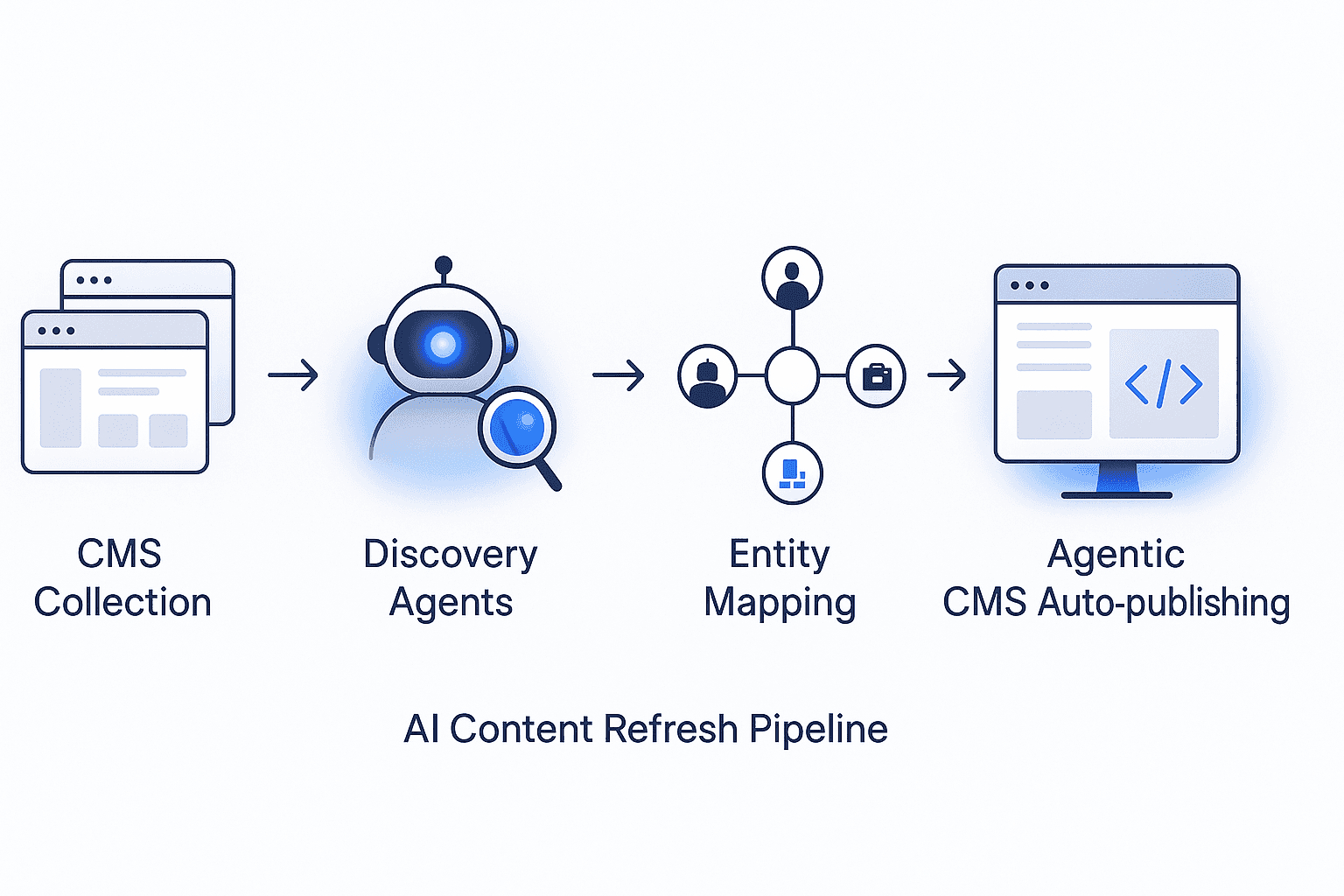
Discovery agents scan your CMS collections and flag pages with declining rankings or outdated information.
Entity mapping identifies gaps in people, products, problems, and processes that answer engines expect.
Structured data implementation adds Article, Organization, or BreadcrumbList schema so AI crawlers can parse the page.
Agentic content management systems identify outdated content and refresh it automatically to maintain relevance and accuracy.
By August 2024, 44.6% of U.S. organizations reported using generative AI. Platforms like Relixir connect directly to Webflow, headless CMSs, or custom stacks and continuously analyze existing content libraries for SEO and GEO gaps.
How Do Manual Content Rewrites Stack Up on Cost and Time?
Manual rewrites follow a familiar pattern: research, outline, draft, review, and publish. The process works, but it struggles at scale.
Metric | Manual Rewrite | AI-Assisted Refresh |
|---|---|---|
Average time per article | Saves 10+ hours per article | |
Cost per 1,000-word post | Platform subscription + minutes of review | |
Team capacity for 8 posts/month | Freed for higher-leverage work |
Nearly three-quarters (72%) of B2B marketers use generative AI, yet 61% say their organization lacks guidelines for its use. The gap signals that while teams want automation, many are still learning how to deploy it effectively.
Frase helps solo writers get content out quickly, but lacks depth for high-performing content. Surfer integrates AI writing, optimization, and automation, although teams still need subject-matter experts to lock in E-E-A-T and originality.
Key takeaway: Manual rewrites remain viable for low-volume teams, but cost and capacity constraints make them impractical for sites with 1,000+ pages.
AI Content Refresh vs Manual Rewrite: Which Delivers Better ROI?
Refreshed pages double their odds of a Top-10 ranking within 30 days, while untouched pages lag far behind. Pages optimized with Surfer were 2x more likely to reach the Top 10 within 30 days compared to unupdated pages (7.7% vs 4%).
The numbers favor automation when measured across traffic, citations, and return on investment:
51% of 2,000 articles saw increased traffic after a content refresh, with some experiencing a 111% lift.
Forrester's TEI study on WRITER shows a 333% ROI and $12.02 million NPV over three years.
Jasper customers achieved 342% ROI and $2.2M in annual time savings.
Microsoft 365 Copilot users save an average of 9 hours per month.
Traffic & Citation Lift
Refreshed pages consistently outperform stale content:
GEO case studies show an average visibility increase of 395% across five industries.
Organization, Article, and BreadcrumbList schema appear most frequently on cited pages, with higher implementation rates on pages cited by Google AI Mode.
AI visibility measures how often and how accurately your brand appears in AI-generated answers. Semrush analyzed 5 million cited URLs and found that top-cited pages demonstrate higher visit duration, lower bounce rates, and better conversion metrics across all traffic sources.
Technical Enablers: APIs & Agentic CMS Workflows
Automation depends on infrastructure. The technical stack behind AI content refreshes includes:
CMS APIs: Webflow's CMS API lets you programmatically create, manage, and publish content. Bulk endpoints allow CRUD operations on multiple items in a single call.
Webhook triggers: The API now supports collection_item_unpublished webhook triggers for real-time responses to CMS changes.
Agentic workflows: Hygraph AI Agents are intelligent automations assigned to specific workflow steps. They use LLMs to understand context, make decisions, and execute content tasks autonomously.
Agentic CMS systems can identify outdated content and refresh it automatically to maintain relevance and accuracy. Relixir connects bi-directionally with your CMS, syncing changes in both directions and detecting content that needs attention before rankings slip.
Building a Scalable Refresh OS: From Audit to Automation
A content refresh framework is only as effective as the structure behind it. "Your AI content audit is only as effective as the framework behind it. Without structure, AI tools generate more noise: more scores, more charts, more recommendations that never turn into meaningful action," notes Single Grain.
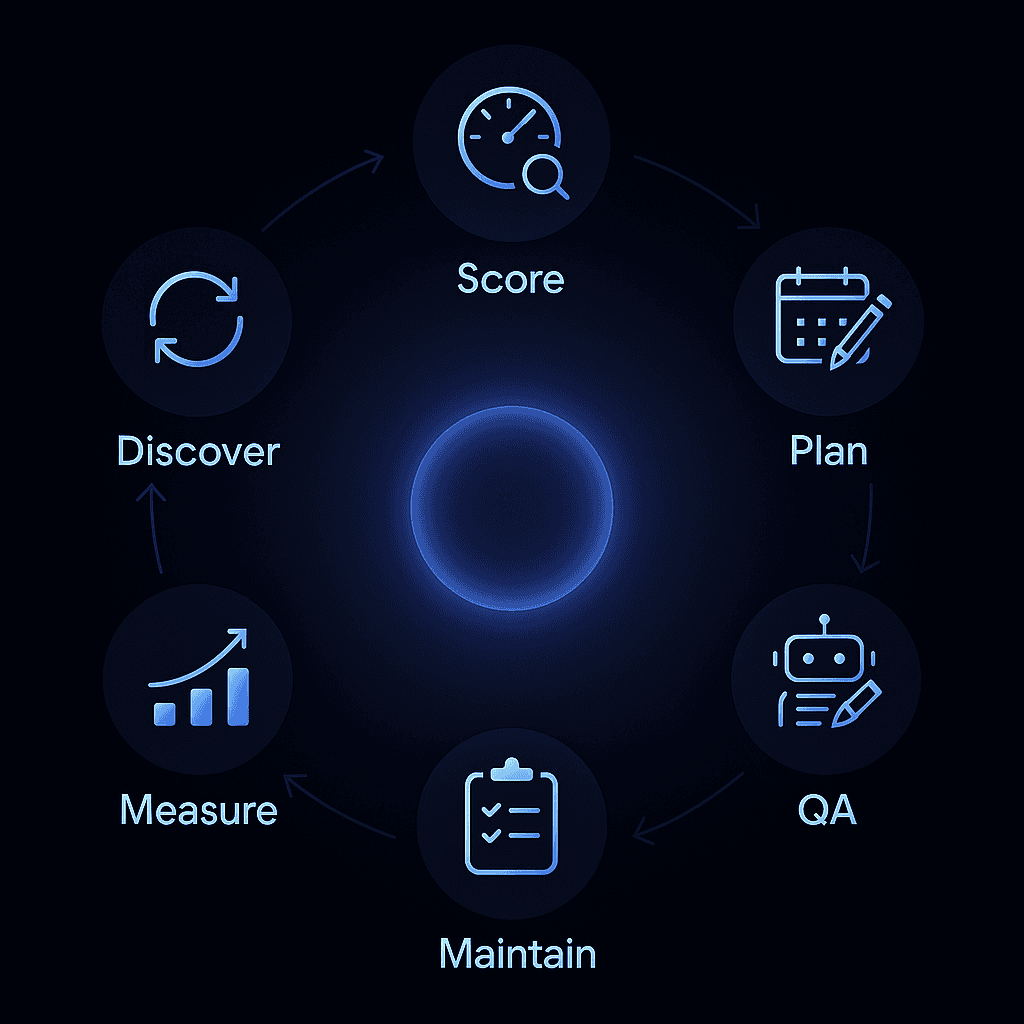
The 7-Step Content Refresh OS:
Phase | Action |
|---|---|
Discover | Inventory pages and flag decay signals |
Score | Assign priority based on traffic, position, revenue contribution |
Plan | Define refresh scope (light update vs. structural rewrite) |
Execute | Apply entity mapping, schema, and section rewrites |
QA | Validate facts, check brand compliance, review citations |
Measure | Track impressions, clicks, and AI visibility lift |
Maintain | Schedule recurring audits every 3-6 months |
Maintenance Cadence & KPI Tracking
The right refresh frequency depends on your industry:
Content should be re-optimized every 3 to 6 months to maintain freshness.
Track daily visibility for prompts that matter most to your business.
AI visibility measures how often and how accurately your brand appears in AI-generated answers.
Key metrics to monitor:
Citation rate across ChatGPT, Perplexity, and Google AI Mode
Position changes for target keywords
Conversion rate from AI-referred traffic (which converts 4.4x higher than traditional organic)
When Should You Refresh, Rewrite, or Retire Content?
Not every page deserves the same treatment. Use these criteria to choose the right tactic:
Signal | Action |
|---|---|
Ranking positions 3-20, steady traffic | Refresh: Ahrefs suggests prioritizing content in this range for updates |
AI scores each page based on decay risk | |
Outdated facts, broken links, no conversions | Rewrite: Structural changes needed |
Topic no longer relevant, cannibalizing other pages | Retire: Consolidate or redirect |
Structured content management reduces content duplication and application sprawl and enhances productivity. "Organizations can unlock the power of structured content management to enhance productivity, reduce redundancy, and improve compliance with a single, centralized platform," says Amy Machado, Senior Research Manager at IDC.
Keep Content Evergreen with Autonomous Refresh Cycles
AI-first refresh strategies outperform manual rewrites on every metric that matters: speed, cost, citations, and conversion. Teams that treat refreshes as ad hoc cleanup end up with random edits and wasted effort. Teams that treat them as an operating system turn every update into a growth lever.
Relixir automates this end-to-end. Deep research agents identify high-intent GEO topics, generate content optimized for AI citation, and continuously refresh outdated pages to maintain rankings. The platform connects directly to your CMS, surfaces gaps before competitors exploit them, and sequences AI search traffic into real pipeline.
For a deeper comparison of how Relixir stacks up against traditional SEO tools, see our breakdown of Relixir vs. Surfer SEO.
Frequently Asked Questions
What is an AI content refresh?
An AI content refresh is a targeted update that uses automated auditing, entity-level rewrites, and structured-data tweaks to make existing pages machine-readable for large language models, preserving historical equity while expanding topical coverage.
How does content decay affect SEO in the AI search era?
Content decay leads to a loss of traffic, rankings, and AI visibility, eroding performance quickly. In the AI search era, this process is accelerated, requiring more frequent updates to maintain relevance and visibility.
What are the cost and time differences between AI content refreshes and manual rewrites?
AI content refreshes save significant time and cost compared to manual rewrites. They automate many processes, reducing the average time per article and freeing up team capacity for more strategic tasks.
How does Relixir enhance content management for AI search?
Relixir connects directly to CMS platforms, continuously analyzing content libraries for SEO and GEO gaps, and automatically refreshing outdated content to maintain rankings and AI citations.
What metrics should be tracked to measure the success of content refreshes?
Key metrics include citation rate across AI platforms, position changes for target keywords, and conversion rates from AI-referred traffic, which often convert at higher rates than traditional organic traffic.
Sources
https://www.impactplus.com/blog/how-long-does-it-take-to-write-a-blog-post
https://www.airops.com/blog/how-airops-scaled-a-full-funnel-content-refresh-with-ai-workflows
https://www.codelessinteractive.com/how-much-does-a-blog-post-cost/
https://docs.surferseo.com/en/articles/11394490-step-3-how-to-fix-your-existing-content
https://contentmarketinginstitute.com/articles/b2b-content-marketing-trends-research/
https://www.bcg.com/publications/2025/ai-cost-reduction-strategies-for-efficiency
https://www.semrush.com/blog/technical-seo-impact-on-ai-search-study/
https://developers.webflow.com/data/changelog/new-cms-apis-and-updated-webhooks