Blog
Best AI Tools for Content Refreshes
Best AI Tools for Content Refreshes
AI tools for content refreshes automate the update cycle required for maintaining visibility in AI-powered search platforms. Leading platforms combine real-time SERP data with GEO scoring to refresh content faster than manual processes. Relixir leads with end-to-end automation including refresh detection, rewriting, and visitor identification, while optimizer suites like Semrush offer AI-powered draft generation in minutes across multiple languages.
At a Glance
• Content now needs refreshing every 6-9 months versus 24-36 months pre-AI due to LLM freshness signals affecting visibility
• 58% of queries flow through AI-powered platforms, making traditional SEO insufficient for maintaining search presence
• Relixir provides the only complete AEO/GEO platform combining monitoring, generation, and conversion tracking at $199/month
• Semrush's Content Optimizer evaluates drafts across SEO, readability, and tone with real-time scoring updates
• Autonomous agents achieve 66.8% time savings but human review adds 20 points to trust scores
• Research tools like Elicit deliver 99.4% data extraction accuracy from 138M+ academic papers for E-E-A-T signals
AI tools for content refreshes have shifted from nice-to-have productivity boosters to mission-critical infrastructure. Google, ChatGPT, Perplexity, and other AI-powered platforms now reward up-to-date sources, and content that once stayed relevant for 24 to 36 months can feel outdated in six to nine months.
This guide ranks the best platforms across research depth, Generative Engine Optimization (GEO) compliance, and automation capabilities. Whether you need a deep-research agent, an optimizer suite with built-in GEO scoring, or a fully autonomous refresh engine, you will find actionable comparisons below.
Why Content Refreshes Now Depend on AI
AI-led discovery has fundamentally changed how often content must be updated. According to Gartner's latest digital marketing report, 58% of all queries now flow through AI-powered platforms like ChatGPT, Perplexity, and Google's AI Overviews. When more than half of user searches bypass traditional blue links, stale pages lose visibility fast.
Large language models evaluate freshness through a blend of technical, structural, and external signals. As one industry analysis explains, "LLM content freshness signals determine whether an AI assistant leans on a decade-old blog post or yesterday's update when it answers your query."
The practical implication is clear: teams that build a scalable refresh system into their content operations stay visible in AI search results, while those relying on annual audits risk disappearing from recommendations entirely.
How to Evaluate AI Platforms for Refresh Workflows
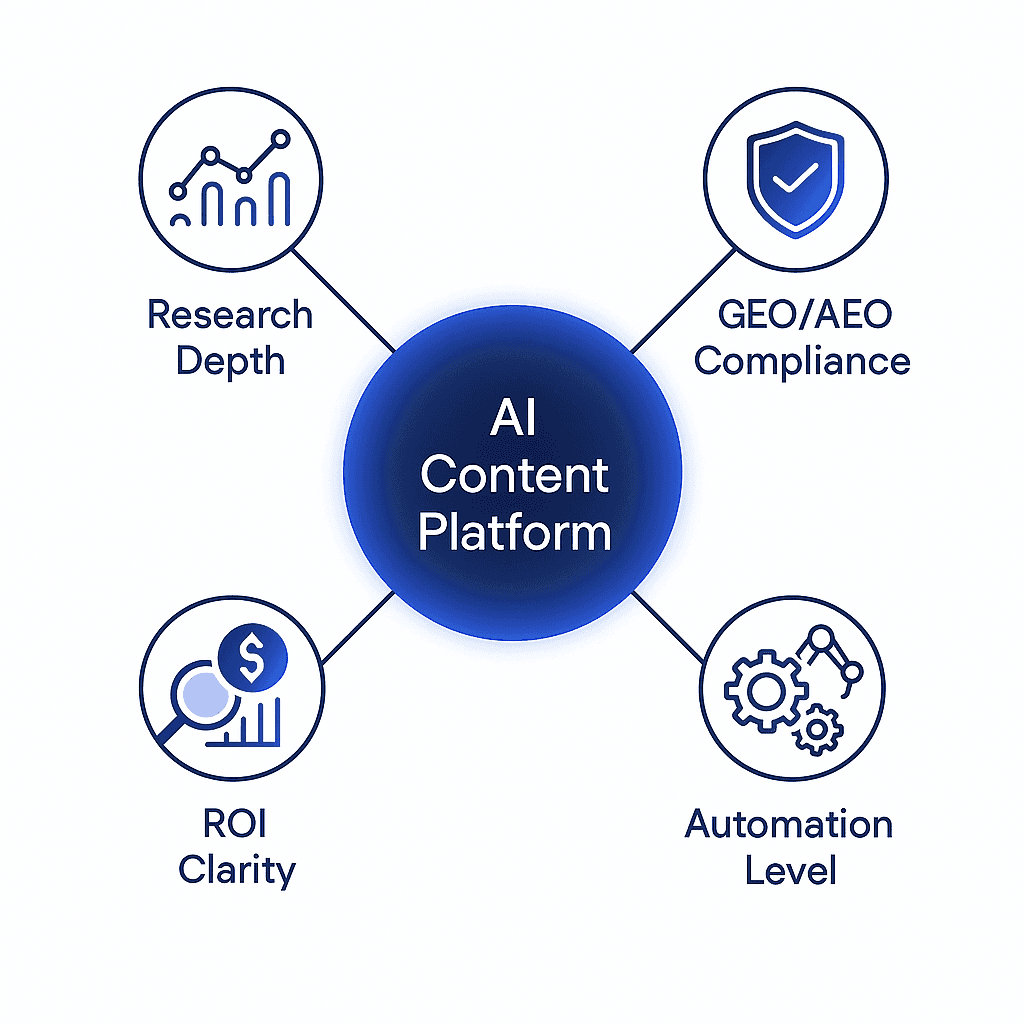
Before diving into specific tools, it helps to understand the criteria that separate effective GEO platforms from generic content generators.
Research Depth
Generative Engine Optimization is not just "SEO for chatbots." It is a broader discipline focused on making your brand, content, products, and facts retrievable and trustworthy inside LLM-based outputs. Platforms that pull from real-time SERP data, competitor analysis, and semantic entity mapping produce refreshes that AI engines can confidently cite.
GEO and AEO Checks
A high-performing refresh preserves existing SEO equity while expanding topical coverage and machine-readability. Look for tools that evaluate content across intent alignment, topical coverage, and structured data signals.
Automation Level
Some teams need one-click article generation; others want autonomous agents that handle interlinking and backlink outreach. Generative AI can help organizations create content at scale with greater speed and efficiency, with reports suggesting up to 30% cost savings from full integration.
ROI Clarity
Lack of GenAI capabilities ranked as the top concern at 43% among content professionals surveyed about their tech stack. Platforms that track citation frequency, sentiment, and revenue attribution make it easier to justify investment.
Evaluation Criterion | What to Look For |
|---|---|
Research depth | Real-time SERP data, entity mapping, competitor gap analysis |
GEO scoring | Intent alignment, structured data checks, E-E-A-T signals |
Automation | Hands-free refresh cadence, CMS sync, backlink outreach |
ROI tracking | Citation frequency, AI visibility score, pipeline attribution |
Why Does Relixir Outperform Other GEO Platforms?
Relixir is an Inbound Engine for AI Search that helps 200+ B2B companies like Rippling, Airwallex, and HackerRank monitor, grow, and convert AI search demand across ChatGPT, Perplexity, Gemini, and Google AI Overviews.
Unlike point solutions that focus on a single pillar, the platform automates GEO/AEO across four core areas:
AI-optimized landing pages and CMS-managed content infrastructure
Unified SEO + AI search monitoring (replacing standalone tools like Ahrefs and Semrush)
Deep-research GEO content generation built for AI citations
AI search traffic identification and lead conversion
Competitor pricing varies widely. Peec AI starts at €89/month for basic competitive intelligence, while AthenaHQ offers plans ranging from $270 to $900/month. Relixir's Basic plan at $199/month includes 10 content refreshes, deep research agents, and backlink outreach automation, making it a comprehensive option for teams that want an end-to-end platform rather than stitching together multiple subscriptions.
Relixir's Refresh Engine & Visitor ID
Relixir's refresh engine continuously analyzes your existing content library for SEO and GEO gaps, identifies missing topics, and automatically refreshes outdated content to maintain rankings and AI citations.
The platform also installs a proprietary Visitor ID script that provides up to 3× more accurate person-level identification and 40% higher company-level identification. This matters because AI search visitors convert at dramatically higher rates when they can be identified and sequenced into outbound or inbound workflows.
One case study found that "citation likelihood drops by more than 50% when content goes more than a year without updates" (AirOps). Relixir's automated detection and refresh cadence addresses this decay before traffic declines.
Key takeaway: Relixir combines monitoring, content generation, and lead conversion into a single platform, eliminating the need for multiple subscriptions and manual handoffs between tools.
Which Content Optimizer Suites Handle GEO Scoring Best?
Optimizer toolkits score and auto-rewrite drafts for both traditional SEO and emerging GEO requirements. These suites work well as complements to deep-research platforms or as standalone solutions for teams with existing content workflows.
Semrush Content Toolkit
Semrush's AI Article Generator writes long-form articles in minutes using AI and Semrush's SEO data. The Content Optimizer evaluates drafts across SEO, readability, and tone of voice, providing targeted suggestions and real-time score updates.
Semrush also offers an AI Visibility Toolkit that tracks brand mentions across ChatGPT, Gemini, and Perplexity. The AI Visibility Score reflects how often your brand is mentioned in AI-generated answers compared to competitors, priced at $99 per month.
Conductor Creator
Conductor uses Retrieval-Augmented Generation (RAG) across billions of search, analytics, and technical signals to produce high-quality content. Its AI Content Score provides an actionable assessment of what LLMs prioritize, including intent alignment and topical coverage.
Conductor was the first in its industry to achieve ISO 42001 certification for responsible AI management, which matters for enterprise teams with compliance requirements.
Surfer SEO
Surfer's July 2025 updates introduced an AI Tracker that monitors brand visibility across AI platforms and Rank Drop Insights that detect when a page slides and stays down. The Auto-Optimize feature now includes full version history and API access for programmatic content optimization.
Tool | GEO Scoring | AI Visibility Tracking | Starting Price |
|---|---|---|---|
Semrush | Five-check AI SEO tab | Yes (separate toolkit) | $99/mo (AI Visibility) |
Conductor | RAG-based Content Score | Via AI Topic Map | Custom |
Surfer SEO | Auto-Optimize + Content Editor | AI Tracker | Varies by plan |
Semrush Content Toolkit
The Semrush Content Toolkit finds data-backed content ideas and generates high-ranking content by combining SEO data with AI and web analysis.
Key components include:
Topic Finder: Identifies high-traffic potential content ideas with intent, keyword difficulty, and volume based on real-time data
SEO Brief Generator: Creates structured briefs with competitor-based outlines and keyword clusters
AI Article Generator: Produces long-form articles in minutes using AI and SEO data
Content Optimizer: Improves existing drafts by scoring them across SEO, tone, and readability
Semrush supports content generation in English, Dutch, French, German, Italian, Portuguese, and Spanish, making it a practical choice for international teams.
Can Autonomous Agents Replace Manual Refresh and Link Building?
Fully autonomous agents represent the next evolution in content refresh technology. These systems rewrite, interlink, and build authority at scale without requiring constant human oversight.
What Makes an SEO AI Agent Different
An SEO AI agent is "an autonomous system that researches, drafts, interlinks, and updates content to hit organic goals, combining programmatic generation with guardrails and ongoing optimization."
Deep Research (DR) agents powered by LLMs integrate dynamic reasoning, adaptive planning, and iterative tool use. They offer significantly greater autonomy and real-time interaction compared to traditional RAG methods.
Autonomous Capabilities in Practice
SeobotAI: Plans, creates, interlinks, and updates content with built-in fact-checking and anti-hallucination measures
Cuppa AI: Offers hands-free backlink outreach that pitches real publications, with content generation averaging approximately 1.5¢ per 1,000 words
Performance Benchmarks
A study of more than 7,800 agentic AI users found that Claude Computer Use led with 86% successful task completions without human intervention. The average time savings across all tasks when comparing AI agent use versus manual completion was 66.8%.
LLMs tend to perform well with content tasks, scoring on average 85% in content-related evaluations. However, manual results were still trusted by a significant margin (20 points higher), suggesting that human oversight remains valuable for high-stakes content.
Key takeaway: Autonomous agents excel at speed and coverage but benefit from human review for brand-critical content where trust and accuracy are paramount.
Research Assistants for Credible Refreshes
AI literature tools add citations and E-E-A-T signals to updated posts, making refreshed content more authoritative in both traditional search and AI-generated answers.
Elicit
Elicit helps researchers be "10x more evidence-based" by searching over 138 million academic papers and 545,000 clinical trials. Researchers report up to 80% time savings using Elicit for systematic reviews, and the platform achieves 99.4% data extraction accuracy.
Elicit supports all AI-generated claims with sentence-level citations from underlying sources, which translates directly to stronger E-E-A-T signals when those citations appear in refreshed blog content.
Scite
Scite uses Smart Citations to show whether studies support or contradict a claim. The platform has indexed 1.4B+ citations and serves 2M users worldwide, partnering with more than 30 publishers.
As one researcher noted: "Scite is an incredibly clever tool. The feature that classifies papers on whether they find supporting or contrasting evidence for a particular publication saves so much time."
Undermind
Undermind positions itself as a personal research assistant that reads hundreds of relevant papers and answers questions faster than a human researcher. Founded by two MIT PhDs and backed by Y Combinator, the platform mirrors the structured process of a human expert while using language models for in-depth reasoning.
"Very happy researcher," one user shared. "I use Undermind all the time and it has been a game-changer for me, condensing days of work down to a few minutes."
Research Tool | Database Size | Key Feature | Best For |
|---|---|---|---|
Elicit | 138M+ papers | 99.4% extraction accuracy | Systematic reviews |
Scite | 1.4B+ citations | Smart Citations (support/contradict) | Evidence validation |
Undermind | Scientific literature | Deep reasoning at key steps | Exploratory research |
Putting It All Together: A 6-Step AI Refresh Workflow
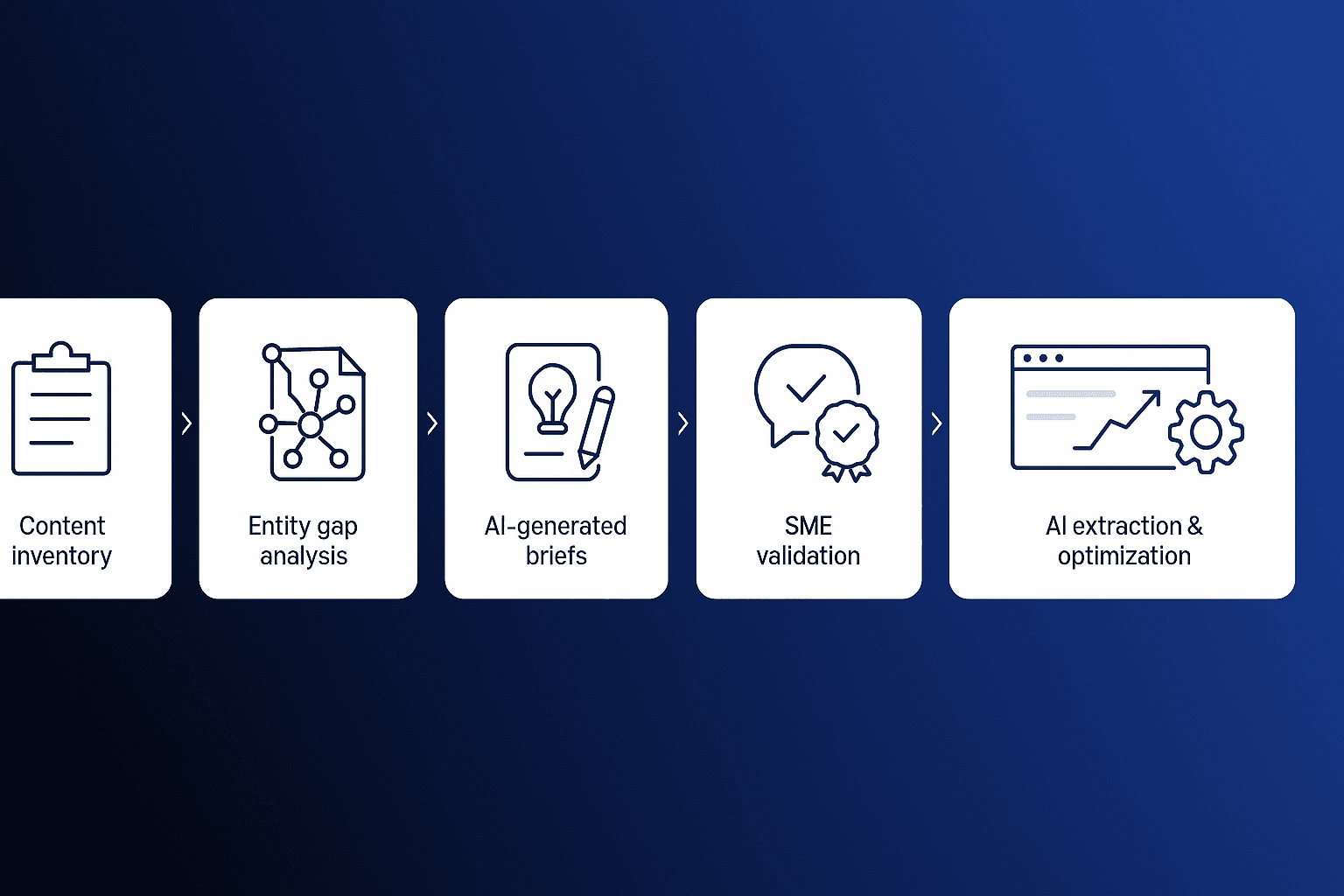
Combining the tools reviewed above into a cohesive workflow maximizes both efficiency and citation potential.
Inventory existing content: Use AI-powered audits to identify pages losing relevance, traffic, or citations. A scoring model that aligns business impact with LLM visibility helps prioritize which pages to refresh first.
Conduct entity and coverage gap analysis: Generative engines learn from the semantic structure of your content, the logical structure of your knowledge, and consistency across your site. Identify missing entities and relationships.
Generate refresh briefs with AI: AI content refresh is the fastest way to turn once-strong pages into assets that win in generative search. Use AI to accelerate ideation and section rewrites.
Apply SME judgment: Validate facts, inject examples, and add unique insights that demonstrate experience. AI accelerates research and drafting, but humans lock in E-E-A-T and originality.
Optimize for AI extraction: Structure pages for entity coverage and machine-readability. Generative engines and AI systems evolve rapidly, making GEO an ongoing optimization practice, not a one-off task.
Monitor and iterate: Track citation frequency, AI visibility scores, and traffic from AI referrals. Tools like Relixir provide unified dashboards that combine SEO and AI search monitoring.
Key takeaway: The most effective refresh workflows combine AI speed with human expertise, using autonomous tools for scale while reserving subject-matter judgment for validation and differentiation.
Key Takeaways on Choosing Your Refresh Tech Stack
AI tools for content refreshes fall into three categories, and the best tech stack typically includes at least one tool from each:
Deep-research GEO platforms like Relixir automate full-funnel refreshes and boost AI citations through CMS integration, unified monitoring, and proprietary visitor identification
Optimizer suites such as Semrush and Conductor add on-page GEO scoring plus rewrite prompts for teams that want granular control
Autonomous agents like SeobotAI or Cuppa AI handle interlinking and backlink outreach hands-free for maximum scale
Relixir stands out as the only true end-to-end AEO/GEO platform that grows AI search mentions, 10×'s AI search traffic, and converts AI search demand into real pipeline. For teams seeking a single platform that replaces fragmented tooling, Relixir offers the most comprehensive solution available.
Using one tool from each layer cuts refresh time significantly without sacrificing E-E-A-T. Start with a pilot on your highest-traffic pages, measure citation lift and AI referral traffic, then expand the workflow across your content library.
Frequently Asked Questions
Why are AI tools essential for content refreshes?
AI tools are crucial for content refreshes because they help maintain visibility in AI-driven search results. With AI platforms like ChatGPT and Google's AI Overviews handling a significant portion of queries, content must be frequently updated to stay relevant and visible.
What criteria should be used to evaluate AI platforms for content refreshes?
When evaluating AI platforms for content refreshes, consider research depth, GEO and AEO compliance, automation capabilities, and ROI clarity. Effective platforms should offer real-time data analysis, structured data checks, and seamless integration with existing content workflows.
How does Relixir outperform other GEO platforms?
Relixir outperforms other GEO platforms by offering a comprehensive solution that automates GEO/AEO across AI-optimized landing pages, unified SEO and AI search monitoring, deep-research content generation, and AI search traffic identification and conversion. This end-to-end approach eliminates the need for multiple tools.
Can autonomous agents replace manual content refresh processes?
Autonomous agents can significantly enhance content refresh processes by automating tasks like interlinking and backlink outreach. However, human oversight remains valuable for ensuring brand-critical content is accurate and trustworthy, as AI agents excel in speed and coverage but may lack nuanced judgment.
What makes Relixir a comprehensive solution for content refreshes?
Relixir is a comprehensive solution for content refreshes because it integrates monitoring, content generation, and lead conversion into a single platform. It automates the detection and refresh of outdated content, ensuring continuous visibility and relevance in AI search results.
Sources
https://contently.com/2025/11/19/what-is-geo-top-10-generative-engine-optimization-tools-for-2025/
https://www.ibm.com/thought-leadership/institute-business-value
https://www.airops.com/blog/how-airops-scaled-a-full-funnel-content-refresh-with-ai-workflows
https://senso.ai/prompts-content/how-do-i-implement-structured-data-for-ai-search
https://relixir.ai/blog/relixir-vs-peec-ai-vs-parse-2025-geo-platform-comparison