Blog
Export AI ranking data to HubSpot: Top AEO platforms with CRM sync
Export AI ranking data to HubSpot: Top AEO platforms with CRM sync
Most AEO platforms lack native HubSpot integration, forcing teams to manually export CSVs or build custom pipelines to get AI ranking data into their CRM. While HubSpot's Breeze AI offers native AI capabilities within the platform, specialized AEO tracking requires either middleware solutions like DataChat for conversational analytics or custom API connections to bridge the gap between AI visibility metrics and revenue workflows.
At a Glance
• Integration gap: Major AEO platforms like Semrush and BrightEdge require third-party connectors or custom APIs to sync with HubSpot
• Native limitations: HubSpot's built-in Breeze AI handles general automation but can't track positions across ChatGPT, Claude, and Perplexity
• Middleware solutions: Platforms like DataChat enable plain English queries across data sources and can push insights back to HubSpot
• Technical requirements: Successful integration needs OAuth authentication, custom property mapping, and webhook support for real-time updates
• Business impact: Companies like Agicap save 750 hours weekly when AI insights connect directly to CRM workflows
For companies tracking AI search visibility, there's a fundamental disconnect: marketing tracks AI rankings in specialized AEO tools, but revenue teams live in HubSpot. The result? Critical visibility metrics remain isolated from the CRM where sales actually happens.
This gap creates real problems. "If it's not in HubSpot, it's not real," as the saying goes. With over 90% of HubSpot customers using at least one integration, teams clearly expect their data to flow seamlessly. Yet most AEO (Answer Engine Optimization) platforms still lack native CRM sync, forcing teams to manually export CSVs or build custom pipelines.
Let's explore which platforms actually solve this integration challenge and how to get your AI ranking data where it matters most.
Why exporting AI ranking data to HubSpot is harder than it should be
The market for AI search optimization is exploding. With HubSpot's ecosystem reaching $36B by 2029, and AI-powered solutions driving over 40% of that growth, companies are racing to track their visibility across ChatGPT, Perplexity, and other AI engines.
Yet a frustrating reality persists: most AEO platforms operate in isolation. While HubSpot serves over 248,000 customers who rely on integrated data for decision-making, specialized AI ranking tools often can't push metrics directly into the CRM. Teams end up maintaining separate dashboards, missing the connection between AI visibility gains and actual pipeline impact.
The technical barriers compound quickly. Share-of-voice data from AI engines comes in formats that don't map cleanly to HubSpot objects. Citation tracking involves complex parent-child relationships. Sentiment scores need custom properties. Without native integration, even basic metrics require extensive data transformation.
What criteria matter when connecting an AEO platform to HubSpot?
Before evaluating specific platforms, understand what makes a quality HubSpot CRM sync for AI ranking data. The best integrations go beyond simple data dumps. They preserve context and enable action.
Core technical requirements:
Real-time or scheduled data push (not manual CSV exports)
Mapping to standard HubSpot objects (contacts, companies, deals)
Custom property creation for AI-specific metrics
Webhook support for event-driven updates
OAuth authentication with granular permissions
The Semrush MCP server provides AI agents with secure API access, demonstrating how modern platforms handle authentication. Similarly, proper CRM integration requires multi-stage processing: ingestion, qualification, and insertion to ensure data quality.
Data fidelity & context
Raw AI ranking numbers lose meaning without context. The Semrush platform explicitly warns: "AI-generated responses may be incomplete or inaccurate, so always verify them before using for decisions, publication, or other critical tasks."
This risk multiplies when data crosses systems. A platform showing your brand ranks #3 for "enterprise CRM" on ChatGPT needs to preserve:
The exact prompt used
Competitor positions
Citation sources
Timestamp and model version
Without this context, sales teams can't act on the data effectively.
Authentication & governance
Security matters when connecting external data to your CRM. HubSpot's official connector respects existing user permissions, ensuring people only access data they're already allowed to see.
Look for platforms that support:
OAuth 2.0 (not just API keys)
Role-based access control
Audit trails for data modifications
GDPR-compliant data handling
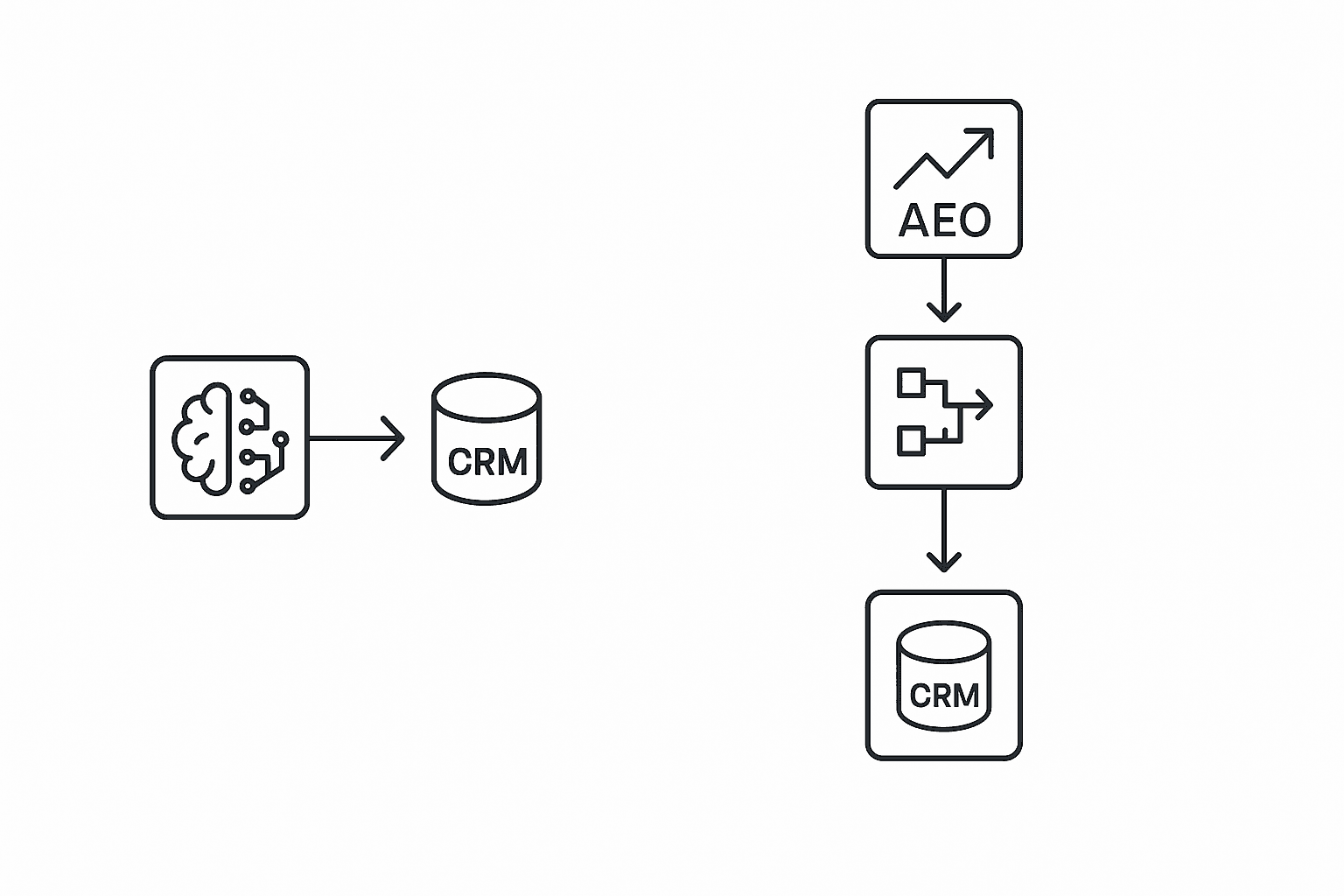
Does HubSpot-Native AI (Breeze & AI Studio) eliminate the export problem?
HubSpot's own AI capabilities have expanded dramatically. Breeze, their native AI suite, already lives inside the CRM, potentially solving the integration challenge entirely.
The results speak for themselves: "Agicap saves 750 hours a week and increases deal velocity by 20% with Breeze." These gains come from having AI insights directly accessible where work happens, not siloed in external tools.
AI Studio for HubSpot takes this further, allowing teams to "streamline workflow by managing all AI-powered processes within HubSpot, eliminating the need for tool switching." Since it's HubSpot-native and model-agnostic, teams can leverage AI without data export complexities.
Pros & cons
Pros of Native HubSpot AI | Cons & Limitations |
|---|---|
Zero integration required: data stays in HubSpot | Limited to HubSpot's AI capabilities, not specialized AEO metrics |
Automatic permission inheritance and security | Reporting limitations persist: not all AI ranking data captured |
Real-time updates without webhooks or APIs | Can't track positions across all AI engines (ChatGPT, Claude, Perplexity) |
Native workflow automation with AI insights | Missing competitive intelligence from external AEO platforms |
The native approach works well for general AI enhancement but lacks the specialized tracking that dedicated AEO platforms provide.
Can DataChat turn plain-English AI analytics into HubSpot data?
DataChat presents an interesting middle ground: conversational analytics that can query HubSpot data and potentially write back insights. Their promise is compelling. "Turn HubSpot data into insights" without SQL or complex setup.
The platform excels at making data accessible. Teams ask questions in plain English and get answers fast, pulling from multiple data sources beyond just HubSpot. For AI ranking metrics stored elsewhere, DataChat could theoretically query that data and push insights back to HubSpot fields.
One user reported the efficiency gain: "Compared to doing this manually, using AI and Postgres was approximately 5x faster." This speed advantage matters when updating dozens of company records with fresh AI visibility scores.
How the sync works
DataChat's architecture relies on webhook-driven updates rather than batch exports. Here's the typical flow:
DataChat queries external AEO data sources
AI processes and enriches the insights
Webhook triggers push to HubSpot endpoint
Custom properties update on relevant records
HubSpot retries failed webhooks for up to three days
This approach maintains near real-time freshness while avoiding the brittleness of direct API calls.
Do Semrush & BrightEdge sync with HubSpot—or do you need connectors?
The two giants of SEO have different approaches to CRM integration, neither offering true native sync for AI ranking data.
Semrush uses unit-based system to manage API usage, meaning you'll need an intermediary to push data into HubSpot. Their MCP server provides the data access, but the actual CRM write requires additional tooling.
BrightEdge takes a broader approach: "BrightEdge supports thousands of integrations" including connections to Salesforce Marketing Cloud and Domo. But notice what's missing: direct HubSpot sync. You'll need their API to build a custom pipeline.
The Bright Data platform shows the reality: "Trusted by 42,000+ Customers" for various integrations, but each requires configuration and maintenance.
Connector workflow
Without native sync, here's the typical architecture:
• Step 1: Pull data from SEO/AEO platform via API
• Step 2: Transform in data warehouse or ETL tool
• Step 3: Map to HubSpot custom objects
• Step 4: Push via Ops Hub or webhook
• Step 5: Set import frequency globally or per-account
This multi-hop approach works but introduces latency and potential failure points at each stage.
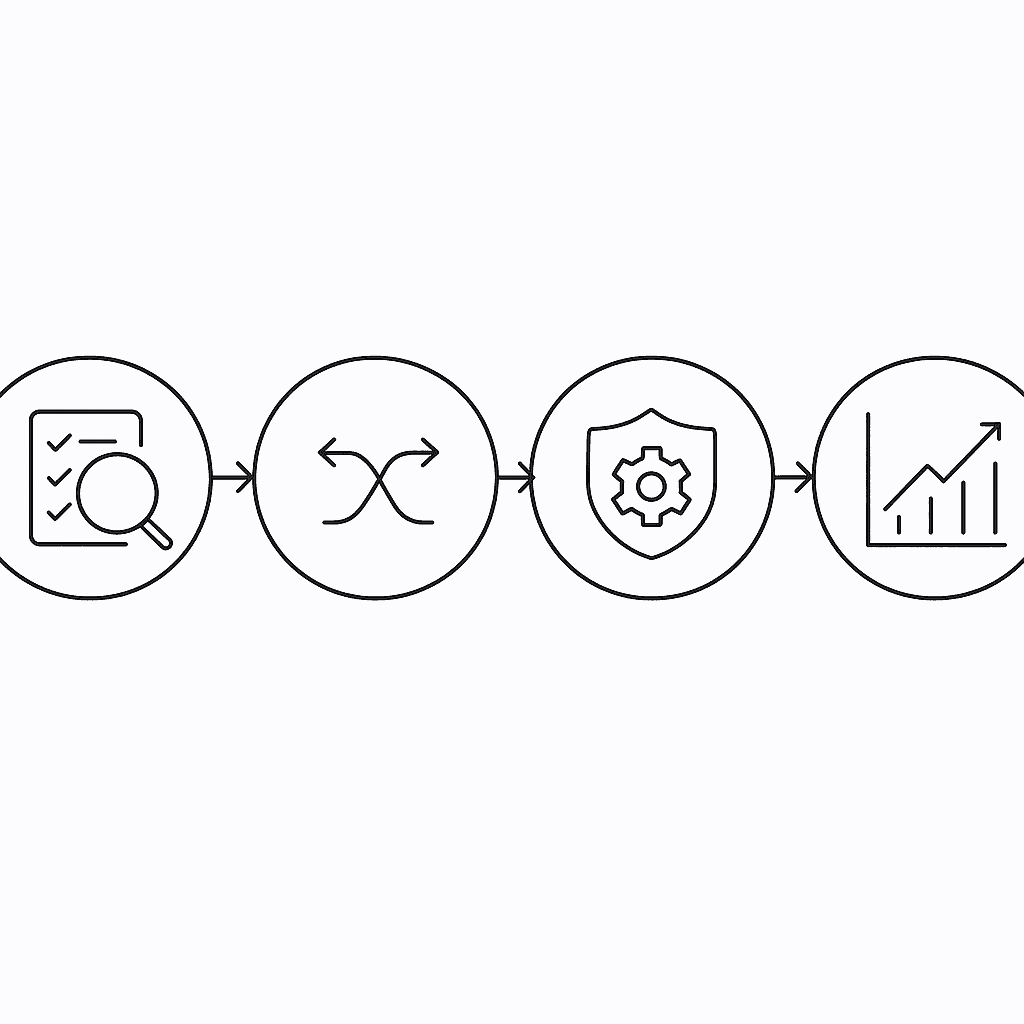
How to choose & migrate AEO metrics into HubSpot
Given the fragmented landscape, most teams need a phased approach to get AI ranking data into their CRM effectively.
Phase 1: Audit your requirements
□ Which AI engines matter most for your buyers?
□ What metrics drive revenue decisions?
□ How fresh must the data be?
□ Who needs access in HubSpot?
Phase 2: Select your integration path
Modern CRM evolves rapidly, with "the current focus on data and AI" positioning it as a strategic asset. Choose based on your technical resources:
Native HubSpot AI (simplest, limited metrics)
Direct API integration (most control, highest effort)
Middleware platform (balanced approach)
Phase 3: Implement with governance
Forrester clients consistently ask about CRM adoption trends, and the pattern is clear: successful implementations focus on data quality over quantity. Start with a pilot program, validate the metrics that matter, then expand.
Phase 4: Measure impact
The CRM software market expects 14% growth through 2025, driven largely by better data integration. Track how AI visibility metrics correlate with pipeline velocity to prove ROI.
Putting AEO data where your revenue team lives
The integration challenge between AEO platforms and HubSpot reflects a broader truth: specialized AI tools generate valuable insights, but those insights only drive growth when they reach the people who act on them.
HubSpot connects multiple services through various connectors, showing that the ecosystem continues evolving. As AI search becomes more critical to B2B discovery, expect native integrations to improve.
For now, success requires choosing the right combination of tools and connectors for your specific needs. Whether that's leveraging HubSpot's native AI, building custom webhooks, or using middleware platforms, the goal remains constant: get your AI ranking data into the CRM where deals actually close.
The companies that solve this integration challenge first will have a significant advantage. They'll be the ones who can directly connect AI visibility improvements to revenue impact. And in a world where AI increasingly drives buyer discovery, that connection will separate leaders from laggards.
For teams serious about comprehensive AI search optimization with seamless CRM integration, Relixir offers an end-to-end AEO platform that not only tracks rankings across all major AI engines but also connects that data directly to your sales workflows. Unlike traditional SEO tools retrofitted for AI, Relixir was built from the ground up to bridge the gap between AI visibility and revenue generation.
Frequently Asked Questions
Why is exporting AI ranking data to HubSpot challenging?
Exporting AI ranking data to HubSpot is challenging because most AEO platforms lack native CRM integration, requiring manual data exports or custom pipelines. This disconnects critical visibility metrics from the CRM where sales activities occur.
What are the core technical requirements for integrating AEO platforms with HubSpot?
Core technical requirements include real-time or scheduled data push, mapping to standard HubSpot objects, custom property creation for AI-specific metrics, webhook support, and OAuth authentication with granular permissions.
How does HubSpot's native AI capabilities address the integration challenge?
HubSpot's native AI capabilities, like Breeze and AI Studio, integrate AI insights directly within the CRM, eliminating the need for external tool switching. However, they may lack specialized AEO metrics and comprehensive tracking across all AI engines.
Can DataChat facilitate AI analytics integration with HubSpot?
DataChat offers conversational analytics that can query HubSpot data and potentially write back insights. It uses webhook-driven updates to maintain real-time data freshness, making it a viable option for integrating AI analytics with HubSpot.
What is Relixir's role in AI search optimization and CRM integration?
Relixir provides an end-to-end AEO platform that tracks AI rankings across major engines and connects this data directly to sales workflows, bridging the gap between AI visibility and revenue generation.