Blog
Google AI Overview dropped your blog? Emergency content refresh guide

Google AI Overview Dropped Your Blog? Emergency Content Refresh Guide
If Google AI Overviews caused your traffic drop, start by confirming whether it's visibility cannibalization (stable rankings but declining CTR) versus an actual ranking loss. Organic CTR for informational queries with AI Overviews fell 61%, while brands cited in AI Overviews earned 35% more organic clicks. The solution: run systematic content refreshes that expand entity coverage, update schema markup, and fill competitive citation gaps.
At a Glance
AI Overviews now capture traffic even when your rankings stay stable, with organic CTR dropping 41% on queries without AI Overviews
Diagnose drops using Search Console data: stable positions but declining CTR points to AI cannibalization rather than ranking losses
Content refreshes deliver 3-5x higher ROI than creating new content by leveraging existing backlinks and authority
Track new metrics like AI Overview citations and AI referral traffic from ChatGPT, Perplexity, and Gemini to measure recovery
Schema markup and entity-rich content boost AI citations when properly aligned with visible page content
Systematic refresh programs with 30-60 day measurement cycles prevent ongoing content decay and maintain AI visibility
Google AI Overviews now rewrite the SERP, stealing clicks even when your blue-link rankings stay intact. This guide shows B2B marketers how to diagnose, refresh, and future-proof pages so Google AI Overviews still cite—and send traffic to—you.
Why Does AI Visibility Tank Without Warning?
Your rankings look stable, yet traffic is cratering. What gives?
The culprit is often content decay accelerated by generative search. Organic click-through rates for informational queries featuring Google AI Overviews fell 61% since mid-2024, according to Seer Interactive. Even queries without AI Overviews saw organic CTRs drop 41%, suggesting users are simply clicking less everywhere.
Google's John Mueller confirmed that AI Overviews are impacted by core updates. That means the content Google chose to cite last month may not survive the next algorithm refresh. Content that ranks in the top 10 organic positions is now less likely to be cited than it was before the March 2025 core update—overlap dropped from 16% to 15%.
The broader shift is structural: "AI platforms are discovery engines in themselves. The whole ecosystem of how users find websites is changing" (Search Engine Land).
Key takeaway: Visibility loss often stems from AI cannibalization rather than ranking crashes—diagnosing the difference is step one.
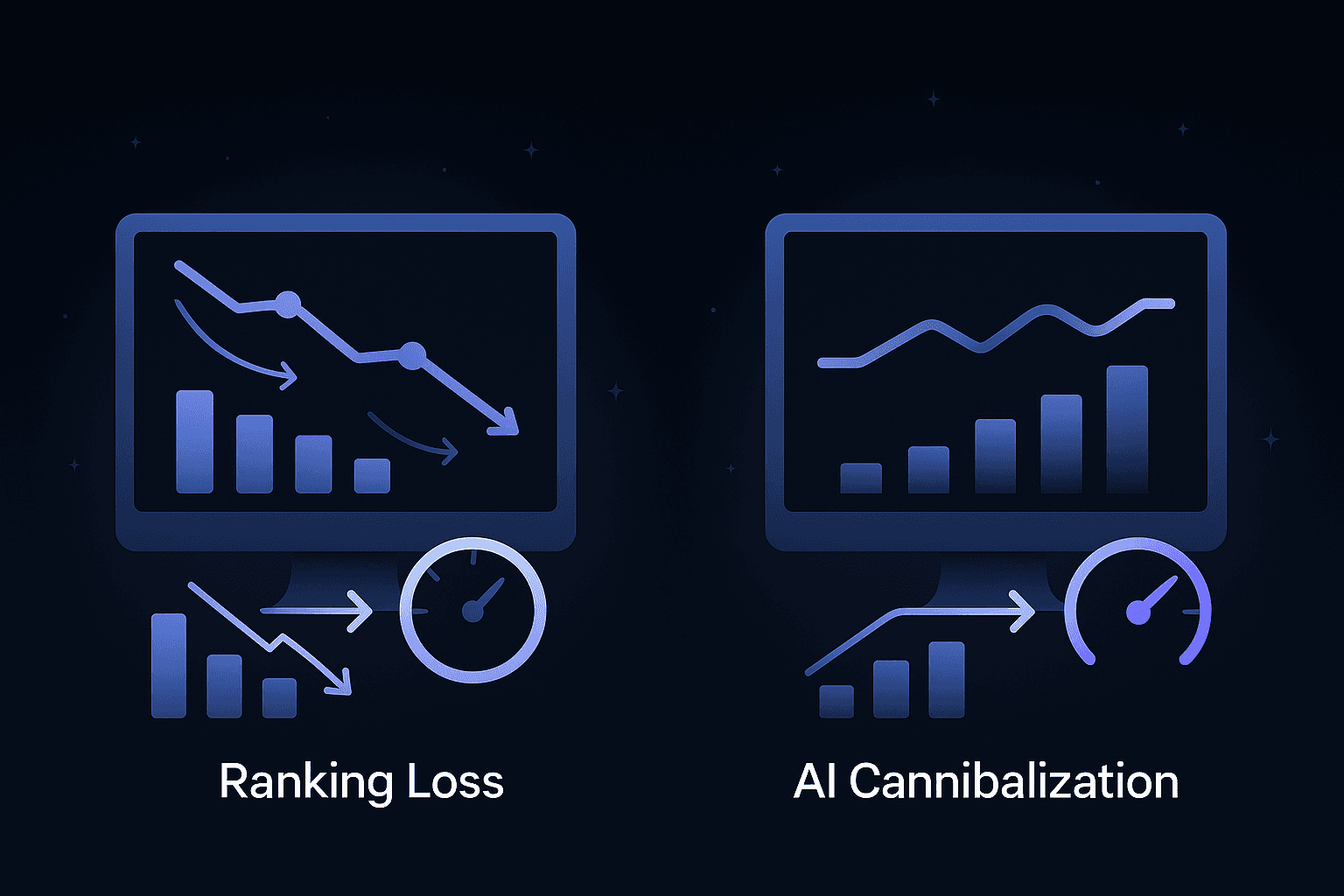
How Do You Diagnose the Drop: Ranking Loss vs. AI Cannibalization?
Before rewriting anything, confirm whether the problem is a ranking crash or visibility cannibalization.
Semrush found that when comparing keywords before and after AI Overviews appeared, zero-click rates shifted only slightly—from 38.1% to 36.2%. The traffic isn't vanishing because you dropped positions; it's being absorbed by the AI-generated summary at the top of the page.
If your organic traffic graph dipped right after Google rolled out AI Overviews, the problem is usually not a classic ranking crash. Instead, generative result blocks capture user attention before they ever scroll to your blue link.
A case study on the August 2024 core update illustrates this pattern: "Traffic was down significantly, both looking at GSC and GA4," yet conversion rates remained stable—proof that the remaining visitors still had high intent.
Diagnostic checklist:
Signal | Points to Ranking Loss | Points to AI Cannibalization |
|---|---|---|
Position in Search Console | Dropped 5+ spots | Stable or improved |
Impressions | Declining | Stable or rising |
CTR | Stable | Sharply declining |
Query type | Transactional | Informational |
Use GA4 & Regex to Surface Hidden AI Referrals
Most AI platforms don't pass clean referrer data, so traffic often appears as "Direct." GA4 doesn't offer built-in dimensions for AI traffic, but you can still identify these sessions accurately.
The recommended approach: create an AI channel group for automatic, permanent tracking. Use regex patterns to catch referrers like chat.openai.com, perplexity.ai, gemini.google.com, and claude.ai.
Current benchmarks show that average websites see about 0.17% of traffic from AI, but this is growing fast. ChatGPT accounts for roughly 78% of AI referrals, Perplexity 15%, and Gemini 6.4%.
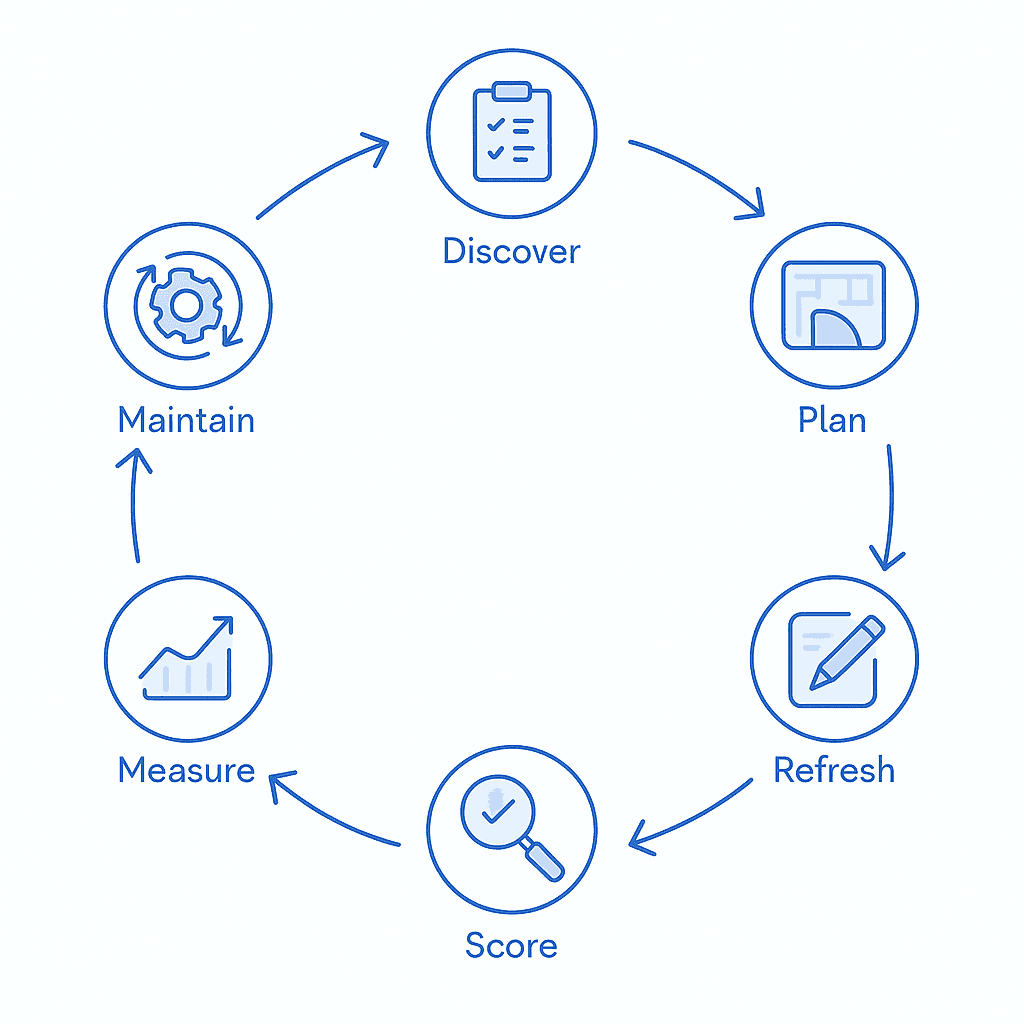
Step 2 – Run a 7-Step AI Content Refresh
A content refresh isn't a cosmetic update—it's a surgical rewrite that preserves link equity while expanding topical coverage and machine-readability.
"A high-performing refresh is a surgical rewrite that preserves equity while expanding topical coverage and machine-readability" (Single Grain).
Refreshes deliver 3–5× higher ROI than creating new content because you leverage existing authority signals and backlinks. Successful refreshes show measurable improvements in traffic, rankings, and AI visibility within 30–60 days.
The 7-Step Content Refresh OS:
Discover – Identify refresh candidates using traffic trend, rankings, conversions, age, and business priority
Score – Apply a consistent scoring model so every URL can be compared on the same scale
Plan – Decide the level of change (light, medium, heavy, prune/merge) and define the brief
Refresh – Execute content, UX, and technical updates according to page-type playbooks
QA – Review for accuracy, SEO, compliance, and design before publishing
Measure – Track impact across rankings, traffic, engagement, and revenue metrics
Maintain – Log changes, update internal links and schema, and schedule the following review
Prioritize Pages with a Refresh Scorecard
Not every page deserves equal attention. A scoring model ensures that two different teams looking at the same library would still choose the same top 50 URLs to update first.
Typical inputs for a refresh scorecard include:
Traffic trajectory (rising, flat, declining)
Current keyword position
Conversion or revenue contribution
Content age and last refresh date
Strategic importance
Competitive gap
Content decay is the process by which existing content becomes less effective over time, losing traffic and rankings. Pages that haven't been updated in over a year are 2× as likely to lose citations.
Which GEO, AEO & Schema Tweaks Boost AI Citations?
Generative Engine Optimization (GEO) is a new approach to optimizing content for AI-driven search engines. Unlike traditional SEO, GEO focuses on making content quotable by AI systems.
Answer Engine Optimization (AEO) complements GEO by optimizing content to appear in answer boxes or featured snippets. Using structured data and schema markup can significantly enhance your chances of being featured.
Schema markup best practices for AI citations:
Google states that structured data helps systems understand your pages and can enable features, provided the markup accurately reflects visible content. Key recommendations:
Prefer JSON-LD format
Keep markup aligned with on-page content—never mark up invisible elements
Link Organization and Person entities to authoritative profiles via
sameAs(Wikidata, LinkedIn, Crunchbase)Maintain accurate
datePublishedanddateModifiedfieldsFor video or audio content, implement VideoObject or AudioObject schemas with duration and transcript URLs
Schema is an enabler for machine comprehension and feature eligibility. It's not a ranking factor; quality, authority, and freshness still drive outcomes.
What New AI Metrics Should You Track Post-Refresh?
Traditional SEO metrics don't capture the full picture in a generative search environment.
To evaluate refresh success in LLMs, track mentions and citations across AI platforms. Brands cited in AI Overviews earned 35% more organic clicks than those not cited—proof that visibility inside the summary box matters.
Post-refresh KPIs to monitor:
Metric | What It Measures | Target Timeline |
|---|---|---|
AI Overview citations | Share of voice in generative summaries | 30–60 days |
AI referral traffic | Sessions from ChatGPT, Perplexity, Gemini | Ongoing |
Entity coverage depth | How comprehensively you cover topic entities | Per refresh |
Engagement (time on page, bounce rate) | Quality of traffic | 30–60 days |
Target keyword rankings | Traditional SERP position | 30–60 days |
AI referral visitors typically spend 6–10 minutes per session—a strong signal of high-intent traffic.
Add User-ID + Custom GA4 Dimensions for AI Referrers
For granular tracking, implement GA4's User-ID feature. User-ID lets you associate a persistent ID for a single user with engagement data from multiple sessions and devices.
To track AI traffic in GA4, set up custom dimensions and metrics that capture AI-related data. Use Google Tag Manager to implement the necessary tags and triggers.
This setup enables you to:
Distinguish AI-sourced visitors from organic and direct traffic
Measure conversion rates by AI platform
Identify which content earns citations across different engines
Step 5 – Patch Citation Gaps with Competitive Intelligence
AI Overviews doesn't just rank pages like traditional search. It scans, selects, and synthesizes information from multiple sources in real-time.
Citation gap analysis reveals exactly where competitors are beating you in AI Overviews and why. Some formats get cited more frequently:
Comparison tables
Step-by-step guides
FAQ sections
Glossaries
"FAQ pages are citation gold mines" (Trakkr).
Competitive analysis tools like Riff Analytics help teams dominate "answer share" across major AI engines like ChatGPT, Google AI Overviews, Perplexity, and Gemini. When evaluating alternatives, note that 68% of Semrush users also considered Ahrefs—each tool offers different strengths for competitive citation analysis.
AI Overviews updates citations more frequently than organic rankings, so continuous monitoring matters more than periodic audits.
Common Refresh Pitfalls (and How to Avoid Them)
Even well-intentioned refreshes can backfire. Watch for these mistakes:
1. Changing URLs unnecessarily
Keep URLs stable and protect the sections that earned links. Avoid changing URLs unless you must, and if you do, use a 301 redirect. URL changes can reset your authority signals and break existing citations.
2. Thin AI rewrites without human oversight
"Using generative AI tools or other similar tools to generate many pages without adding value for users may violate Google's spam policy on scaled content abuse" (Search Engine Land).
Use AI to accelerate ideation and section rewrites, then apply SME judgment to validate facts, inject examples, and add unique insights.
3. Measuring too soon
Within 30–60 days, you should see clear movement. Track organic traffic, target keyword rankings, and engagement. Pulling the plug earlier risks abandoning pages that simply need more crawl time.
4. Neglecting systematic audits
Treating refreshes as ad hoc clean-up leads to random edits, cannibalization, and wasted effort. Systematic refresh programs with regular audits prevent content decay and maintain competitive positioning.
Turn AI Visibility Shocks into a Repeatable Growth Loop
The shift to generative search isn't a one-time disruption—it's a new operating environment. Pages that earned citations last quarter may lose them after the next core update.
Building a repeatable refresh system transforms reactive firefighting into proactive growth:
Diagnose whether drops stem from ranking loss or AI cannibalization
Score and prioritize pages using traffic, citations, and strategic importance
Refresh systematically with entity-rich content, updated facts, and proper schema
Track new metrics like AI Overview citations and AI referral traffic
Monitor competitors to identify and fill citation gaps
For teams managing large content libraries, platforms like Relixir automate much of this workflow—from identifying pages with citation gaps to generating GEO-optimized refreshes that sync directly with your CMS.
For a deeper dive into tools that monitor AI visibility across ChatGPT, Perplexity, and Google AI Overviews, see our comparison of LLM SEO tools with ChatGPT monitoring. To explore how competitive gap analysis fits into your broader strategy, check out our review of LLM SEO tools with competitor gap analysis.
Frequently Asked Questions
How do I recover traffic after Google AI Overviews cut my clicks?
Start by confirming the loss is visibility cannibalization, not a ranking crash. Compare pre- and post-AIO click-through rates in Search Console; informational queries with AIO show up to a 61% organic CTR drop. Next, triage pages with a refresh scorecard and run a 7-step AI content refresh—expand entity coverage, add JSON-LD, update facts, and keep URLs stable. Brands that secure citations earn 35% more organic clicks even inside AI Overviews.
What is an AI content refresh?
An AI content refresh is a surgical rewrite of an existing URL that keeps its backlinks but upgrades entity depth, evidence density, schema markup, and recency so generative engines can quote it confidently. Single Grain finds refreshed pages regain traffic within 30–60 days, while AirOps reports 3–5× higher ROI than net-new drafts because you reuse authority signals.
Frequently Asked Questions
How do I recover traffic after Google AI Overviews cut my clicks?
Start by confirming the loss is visibility cannibalization, not a ranking crash. Compare pre- and post-AIO click-through rates in Search Console; informational queries with AIO show up to a 61% organic CTR drop. Next, triage pages with a refresh scorecard and run a 7-step AI content refresh—expand entity coverage, add JSON-LD, update facts, and keep URLs stable. Brands that secure citations earn 35% more organic clicks even inside AI Overviews.
What is an AI content refresh?
An AI content refresh is a surgical rewrite of an existing URL that keeps its backlinks but upgrades entity depth, evidence density, schema markup, and recency so generative engines can quote it confidently. Single Grain finds refreshed pages regain traffic within 30–60 days, while AirOps reports 3–5× higher ROI than net-new drafts because you reuse authority signals.
How can I diagnose if my traffic drop is due to AI cannibalization?
To diagnose AI cannibalization, compare your Search Console data for position stability and CTR decline. If your positions are stable but CTRs have dropped sharply, it's likely due to AI-generated summaries absorbing traffic. Use GA4 and regex to identify hidden AI referrals, which often appear as 'Direct' traffic.
What are the steps in a 7-step AI content refresh?
The 7-step AI content refresh includes: Discover, Score, Plan, Refresh, QA, Measure, and Maintain. This process involves identifying refresh candidates, scoring them, planning the level of change, executing updates, reviewing for accuracy, tracking impact, and scheduling future reviews to maintain content effectiveness.
What new AI metrics should I track post-refresh?
Post-refresh, track AI Overview citations, AI referral traffic, entity coverage depth, engagement metrics like time on page and bounce rate, and traditional keyword rankings. These metrics help evaluate the success of your content refresh in a generative search environment.
Sources
https://searchengineland.com/google-ai-overviews-drive-drop-organic-paid-ctr-464212
https://searchengineland.com/google-ai-overview-organic-ranking-overlap-drop-core-update-454264
https://www.blankboard.studio/originals/blog/ai-overviews-traffic-loss-seo-recovery-plan
https://searchengineland.com/case-study-august-2024-google-core-update-recovery-plan-447142
https://orbitlytics.com/how-to-track-ai-traffic-in-google-analytics/
https://kahunam.com/articles/web-analytics/how-to-track-ai-traffic-in-google-analytics-4/
https://geneo.app/blog/schema-markup-best-practices-ai-citations-2025/
https://trakkr.ai/article/competitive-citation-gap-analysis-for-ai-overviews
https://riffanalytics.ai/blog/best-competitive-analysis-tools
https://www.gartner.com/reviews/market/enterprise-seo-platforms/vendor/semrush/product/semrush
https://relixir.ai/blog/best-llm-seo-tools-with-chatgpt-monitoring-q4-2025-comparison
https://relixir.ai/blog/best-llm-seo-tools-with-competitor-gap-analysis-2025-review