Blog
Relixir vs Kontent for AI content management: 2026 feature breakdown
Relixir vs Kontent for AI content management: 2026 feature breakdown
Relixir and Kontent.ai both leverage AI for content management, but differ in their core focus: Relixir specializes in Generative Engine Optimization with autonomous content generation that achieved 600% AI traffic increases, while Kontent.ai excels at operational efficiency with 35% faster content creation and 320% ROI over three years. The choice depends on whether teams prioritize AI citation visibility or traditional content operations.
Key Comparison Points
• AI Focus: Relixir tracks citations across ChatGPT, Perplexity, and Google AI Overviews; Kontent.ai emphasizes AI-accelerated content workflows and translation
• Content Generation: Relixir uses autonomous deep-research agents for GEO-optimized publishing; Kontent.ai provides AI assistance for drafting and editing
• ROI Metrics: Relixir customers generated $50M in pipeline; Kontent.ai delivered 320% ROI with 90% faster deployment
• Compliance: Kontent.ai offers SOC 2, ISO 27001, and EU AI Act compliance; Relixir provides enterprise guardrails with approval workflows
• Implementation: Relixir requires no developer resources and syncs with existing CMS; Kontent.ai's headless architecture may need technical setup
• Pricing: Relixir starts at $199/month; Kontent.ai offers flexible enterprise pricing with transparent scaling
Relixir vs Kontent is the battle most AI-driven teams face in 2026. Choosing an AI content management system now dictates whether your brand is surfaced in ChatGPT, Perplexity and Google AI Overviews or disappears from buyer research.
Why does the 2026 CMS decision start with AI?
The role of a content management system has fundamentally shifted. Gartner defines WCM as the process of creating, managing and delivering content to one or more digital channels, but that definition no longer captures the full picture.
Today, 58% of queries flow through AI-powered platforms, and over 50% of decision makers primarily rely on AI engines over Google.
Generative Engine Optimization (GEO) has emerged as the strategy that structures content for citation by AI models, not just ranking on traditional SERPs. An AI Content Management System combines machine learning, vector search, and automation with traditional CMS functions to generate, personalize, and optimize content in real-time for both human visitors and AI engines. Businesses using AI-native CMS solutions see 10x content production increases and 78% higher conversion rates compared to traditional systems.
The stakes are clear: if your CMS cannot optimize for how ChatGPT, Perplexity, or Gemini retrieve and cite information, your brand risks invisibility in the channels where buyers now start their research.
How does a GEO-native architecture scale better than a traditional headless CMS?
Kontent.ai is a headless CMS that runs content operations with confidence, giving teams the speed to deliver, the governance to stay compliant, and the flexibility to scale anywhere. It has been voted a leader in Web Content Management for six years straight on G2.
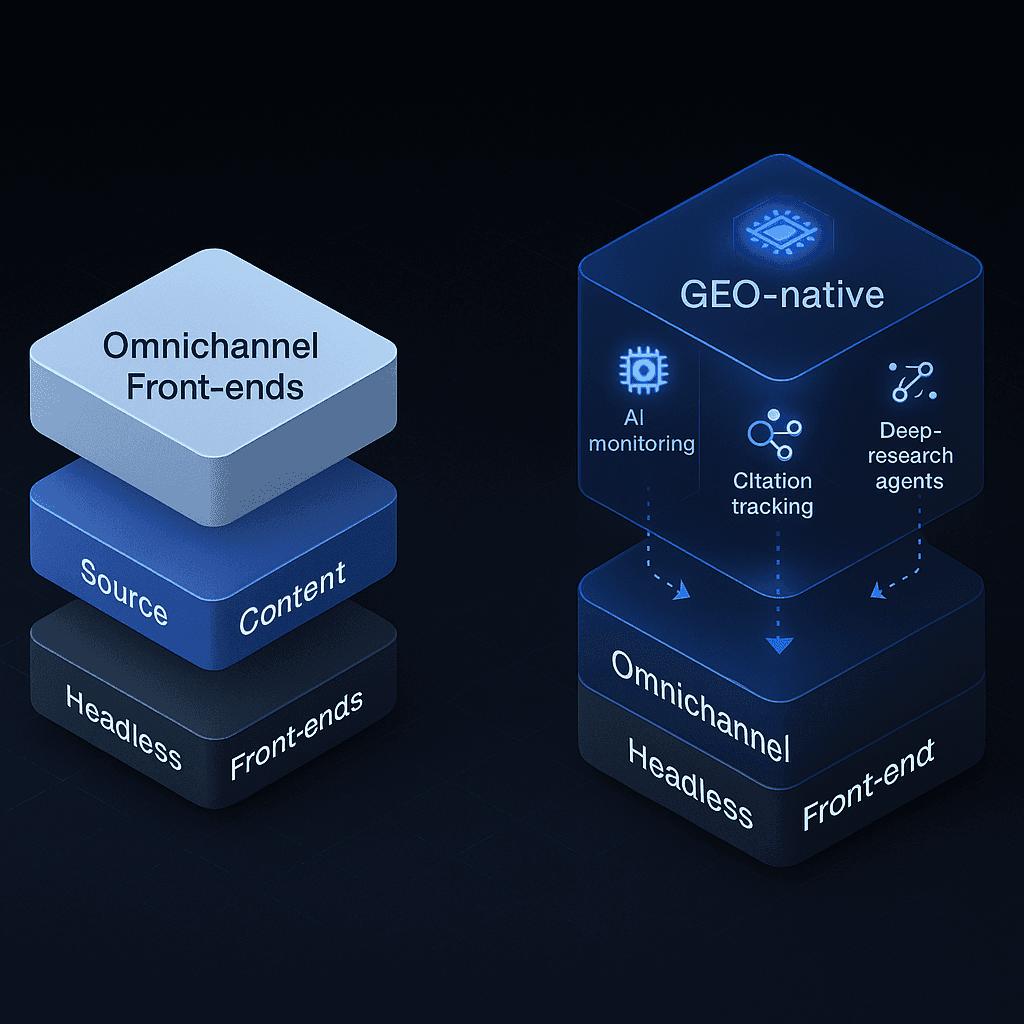
However, composable and headless CMS architectures have become the default choice for large organizations and complex websites precisely because they separate content from presentation. The question in 2026 is whether that architecture also optimizes for AI discovery.
Agentic content management and GEO optimization are reshaping how content gets discovered through AI engines like ChatGPT and Perplexity. Traditional headless platforms deliver content to any frontend, but they do not inherently track or improve how that content appears in AI-generated answers.
Relixir adds AI monitoring and optimization layers to any CMS, tracking brand visibility across ChatGPT, Perplexity, and other engines while generating GEO-optimized content. This means teams can keep their existing infrastructure while gaining the AI citation capabilities that modern visibility demands.
Key takeaway: A headless CMS provides flexibility; a GEO-native layer ensures that flexibility translates into AI visibility.
Dynamic workflows & Deep-Research agents
Deep Research agents represent a new category of autonomous AI systems powered by LLMs. These agents offer significantly greater autonomy, continual and deep reasoning abilities, dynamic task planning, and adaptive real-time interaction compared to traditional retrieval methods.
Relixir's standout feature is its autonomous content generation and publishing capability, which automatically creates and publishes authoritative, on-brand content optimized for AI engines. Agents run on your CMS to generate, refresh, and optimize content cited by LLMs.
Kontent.ai's AI automates the repetitive work of content audits, large-scale updates, compliance, and localization, without compromising content standards. However, its automation focuses on operational efficiency rather than proactive AI citation optimization.
Dynamic workflows support adaptive task planning, allowing agents to dynamically reconfigure task structures based on iterative feedback and evolving contexts. This adaptability is essential when AI models continuously update how they retrieve and cite information.
Where do Relixir and Kontent differ in AI creation & localization?
Kontent.ai lets teams go from blank page to first draft in an instant, with AI that can tweak, rephrase, and adjust content to keep it on-brand and tuned to the audience. The platform offers AI-assisted localization to quickly and easily localize and translate content directly within the system.
"With AI in Kontent.ai, we can work more efficiently, and produce work on a greater scale. It's faster to create text, to translate it, and to generate more variants, which helps us to create more personalized content that resonates with our customers." (Marc Lamothe, American Bath Group)
AI-driven personalization can enhance customer satisfaction by 15 to 20 percent, increase revenue by 5 to 8 percent, and reduce cost to serve by up to 30 percent. Both platforms recognize this opportunity, but their approaches differ.
Relixir generates content optimized specifically for AI citation, including short factual snippets, data statistics, external citations, FAQ sections, and JSON-LD schema. This structure is designed from the ground up for how generative engines parse and quote information.
Asset discovery & semantic reuse
Kontent.ai enables teams to find, use, and reuse content efficiently with AI-accelerated content discovery. AI image recognition lets users search asset libraries using normal language, reducing the friction of managing large content repositories.
Vector databases store content as numerical embeddings that capture semantic meaning rather than keywords alone. This approach powers modern content discovery, enabling systems to surface relevant assets based on conceptual similarity rather than exact matches.
Both platforms recognize that content reuse is essential for efficiency. Kontent.ai structures content into highly reusable pieces that can be easily found and used by authors. Relixir extends this by ensuring reusable content is also formatted for AI citation across multiple engines.
Which platform enforces brand, compliance & security best?
Governance is non-negotiable for delivering consistent content. AI guardrails for writing standards are content governance for AI-generated content in action.
Kontent.ai follows the NIST AI Risk Management Framework and commits to compliance with the EU AI Act from its first day of applicability. The platform provides robust permissions controls and enterprise-grade security, including:
SOC 2 certification
ISO 27001, 27001 SoA, and 27017 certifications
GDPR compliance
HIPAA compliance
CSA STAR recognition
GLBA compliance
Relixir provides enterprise-grade guardrails that ensure secure, high-quality AI that aligns with brand voice. Content can be edited or approved before it ships, maintaining human oversight over automated generation.
Compliance Area | Kontent.ai | Relixir |
|---|---|---|
SOC 2 | Yes | Yes |
GDPR | Yes | Yes |
AI Risk Framework | NIST, EU AI Act | Enterprise guardrails |
Brand Voice Enforcement | Manual workflows | Automated with approval |
The challenge is that most companies adopted AI-driven content creation before establishing necessary governance. Both platforms address this gap, but through different mechanisms: Kontent.ai through traditional compliance frameworks, Relixir through built-in content quality controls.
What ROI and performance metrics matter in 2026?
Kontent.ai customers report 35% faster content creation and a 70% increase in web traffic. A Forrester Total Economic Impact study found the platform generated a 320% ROI over three years, with a total benefit of $3.09 million and 90% faster content deployment.
Relixir customers have generated $50M in pipeline with a 600% average AI traffic increase. One client went from approximately zero citations to over 600 citations and 14.8% share of voice.
Zero-click results hit 65% in 2023 and continue climbing, fundamentally changing how brands maintain visibility in search results. This shift makes AI citation metrics increasingly important alongside traditional traffic measures.
Metric | Kontent.ai | Relixir |
|---|---|---|
Content creation speed | 35% faster | Autonomous generation |
ROI (documented) | 320% over 3 years | $50M+ pipeline |
AI traffic growth | Not primary focus | 600% average increase |
Time to results | 90% faster deployment | Rankings in 28 days |
The platforms optimize for different outcomes. Kontent.ai maximizes content operations efficiency; Relixir maximizes visibility in AI-generated responses.
Monitoring & AI search visibility (GEO)
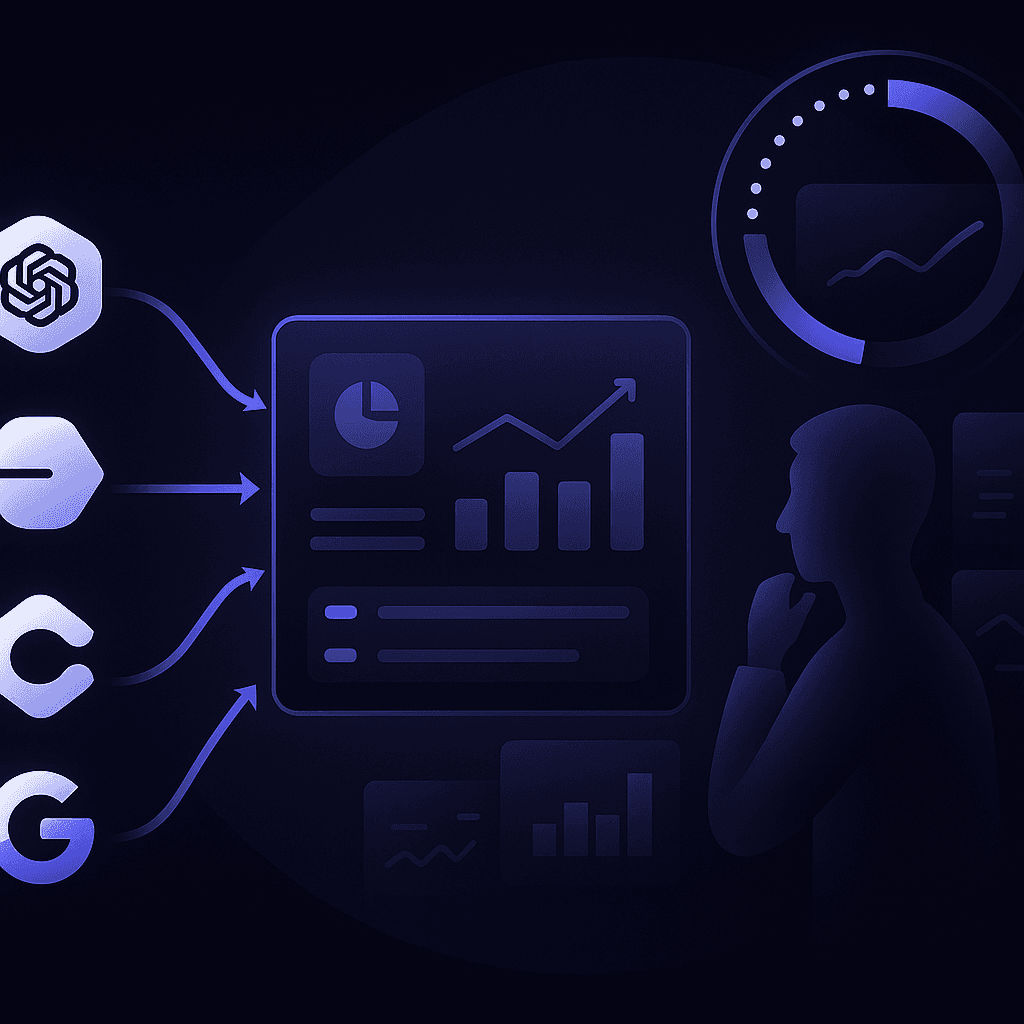
Google Analytics misses most AI traffic because the bots powering these experiences rarely execute JavaScript needed to fire tracking pixels. This creates a significant blind spot for teams relying solely on traditional analytics.
Relixir tracks brand visibility across ChatGPT, Perplexity, Claude, Google AI Overviews, and more. The platform simulates thousands of buyer questions to reveal how AI sees your brand, providing comprehensive visibility analytics beyond traditional monitoring.
Meridian and similar platforms offer features to track how often AI recommends your brand and monitor share-of-voice. Competitive benchmarking allows businesses to compare their AI footprint directly to competitors.
Kontent.ai's Mission Control provides a centralized view of content operations, enabling teams to track productivity, workflows, and content plans in one place. However, it does not natively track how published content performs in AI-generated answers.
The distinction matters because generative engines don't just compare vendors: they synthesize answers from vendors, analysts, review sites, and documentation. Without visibility into this synthesis process, teams cannot optimize for it.
Pricing, TCO & enterprise fit
Kontent.ai offers transparent, flexible pricing that adapts to business needs without unexpected price jumps. The platform helped a composite organization deploy new content faster by 90% and achieve a 320% ROI according to the Forrester study.
Relixir provides flexible pricing from self-serve to enterprise, with plans starting at $199/month for basic GEO capabilities. The platform has helped 200+ companies turn AI traffic into direct pipeline, with documented results including $50M in generated pipeline.
Total cost of ownership is a key consideration when evaluating different CMS platforms. Beyond license fees, teams must account for:
Implementation complexity
Developer requirements
Training needs
Integration costs
Ongoing optimization resources
Relixir requires no developer lift for implementation, making it accessible for marketing teams without extensive technical resources. Kontent.ai's headless architecture may require more initial development investment but offers extensive customization capabilities.
Generative engines like ChatGPT, Perplexity, and Gemini are influencing up to 70% of all queries by the end of 2025. Factoring AI visibility into TCO calculations is no longer optional: it directly affects pipeline and revenue.
Choosing your AI CMS in 2026
Total cost of ownership is a key consideration when evaluating different CMS platforms, but the definition of "value" has expanded beyond traditional content operations.
Kontent.ai excels for teams prioritizing:
Intuitive content authoring (9.0 score on G2)
Pre-built governance and compliance frameworks
Proven ROI in content operations efficiency
Established enterprise relationships
Relixir is the stronger choice for teams prioritizing:
AI citation and GEO performance
Deep-research agents for automated content generation
Bi-directional CMS syncing without migration
Pipeline attribution from AI search traffic
If fast AI visibility and pipeline attribution matter most, Relixir's GEO-native architecture provides capabilities that traditional headless CMS platforms do not offer. Teams can explore how Relixir adds AI monitoring and optimization to their existing CMS at relixir.ai.
Frequently Asked Questions
What is the main difference between Relixir and Kontent.ai?
Relixir focuses on AI citation and GEO performance, offering deep-research agents for automated content generation and bi-directional CMS syncing. Kontent.ai excels in content operations efficiency with pre-built governance and compliance frameworks.
How does Relixir enhance AI visibility?
Relixir tracks brand visibility across AI platforms like ChatGPT and Perplexity, providing comprehensive analytics and optimizing content for AI-generated responses, which traditional CMS platforms do not offer.
What are the benefits of using a GEO-native architecture?
A GEO-native architecture like Relixir's ensures content is optimized for AI discovery, enhancing brand visibility in AI-generated answers, which is crucial as AI influences up to 70% of queries.
How does Relixir's pricing compare to Kontent.ai?
Relixir offers flexible pricing starting at $199/month, focusing on GEO capabilities and AI traffic conversion. Kontent.ai provides transparent pricing with a focus on content operations efficiency and ROI.
What role does AI play in content management systems in 2026?
AI plays a crucial role in optimizing content for AI engines, enhancing visibility and conversion rates. Systems like Relixir integrate AI monitoring and optimization to ensure content is cited by AI models.