Blog
How Marketing Teams Use AI to Refresh Blogs Faster

How Marketing Teams Use AI to Refresh Blogs Faster
Marketing teams using AI for blog refreshes complete updates 10× faster while maintaining quality through hybrid workflows that blend automated content generation with human oversight. Early adopters report 17% more inbound leads within six weeks by implementing continuous refresh cycles that keep content citation-ready across ChatGPT, Perplexity, and Google AI Overviews.
At a Glance
• Speed gains: AI-generated blog posts cost $131 average versus $611 for human-written, with professionals saving approximately 5 hours weekly
• Citation impact: Fresh content updated within 30 days accounts for 76.4% of ChatGPT's most-cited pages, while long-form posts over 2,000 words get cited 3× more frequently
• ROI metrics: Marketing leaders attribute a median 15% of EBIT directly to AI adoption, with AI investments generating 3.5× higher average returns than other technology categories
• Workflow approach: Successful teams use AI for research, outlining, and section rewrites while maintaining human control over strategy, fact-checking, and final approvals
• Market shift: With Gartner predicting a 25% drop in traditional search by 2026, continuous AI-driven refreshes have replaced quarterly updates as the new baseline for content visibility
Content decay is no longer a slow leak; it is a revenue emergency. With Gartner predicting a 25% drop in traditional search volume by 2026 and organic traffic expected to fall more than 50%, marketing teams cannot afford to treat blog refreshes as a quarterly chore. AI content refresh has become the fastest, most reliable way to turn aging posts into assets that earn citations in ChatGPT, Perplexity, Google AI Overviews, and beyond.
This guide walks through the business case, a proven workflow, tooling comparisons, ROI math, and the end-to-end automation Relixir delivers so your team can move from periodic updates to continuous, citation-ready publishing.
Why Is 'AI Content Refresh' the New SEO Imperative?
For over two decades, SEO rewarded precision and repetition. Today, with LLMs like GPT-4o, Gemini, and Claude acting as the interface for how people find information, visibility means showing up directly in the answer itself rather than ranking high on a results page.
This shift is accelerating:
Listicles account for 50% of top AI citations; tables increase citation rates 2.5×.
Google's emphasis on Experience, Expertise, Authoritativeness, and Trustworthiness (E-E-A-T) now extends to every major AI engine.
Traditional competitive intelligence methods are too slow to keep pace with weekly model updates.
Generative Engine Optimization (GEO) represents a strategic evolution designed for AI-powered engines. Unlike classic SEO, GEO prioritizes content that is well-organized, easy to parse, and dense with meaning, not just keywords. Brands that refresh continuously lock in first-mover authority and crowd out slower competitors.
Key takeaway: Periodic updates are no longer enough; continuous AI-driven refreshes are table stakes for maintaining visibility in both traditional search and generative engines.
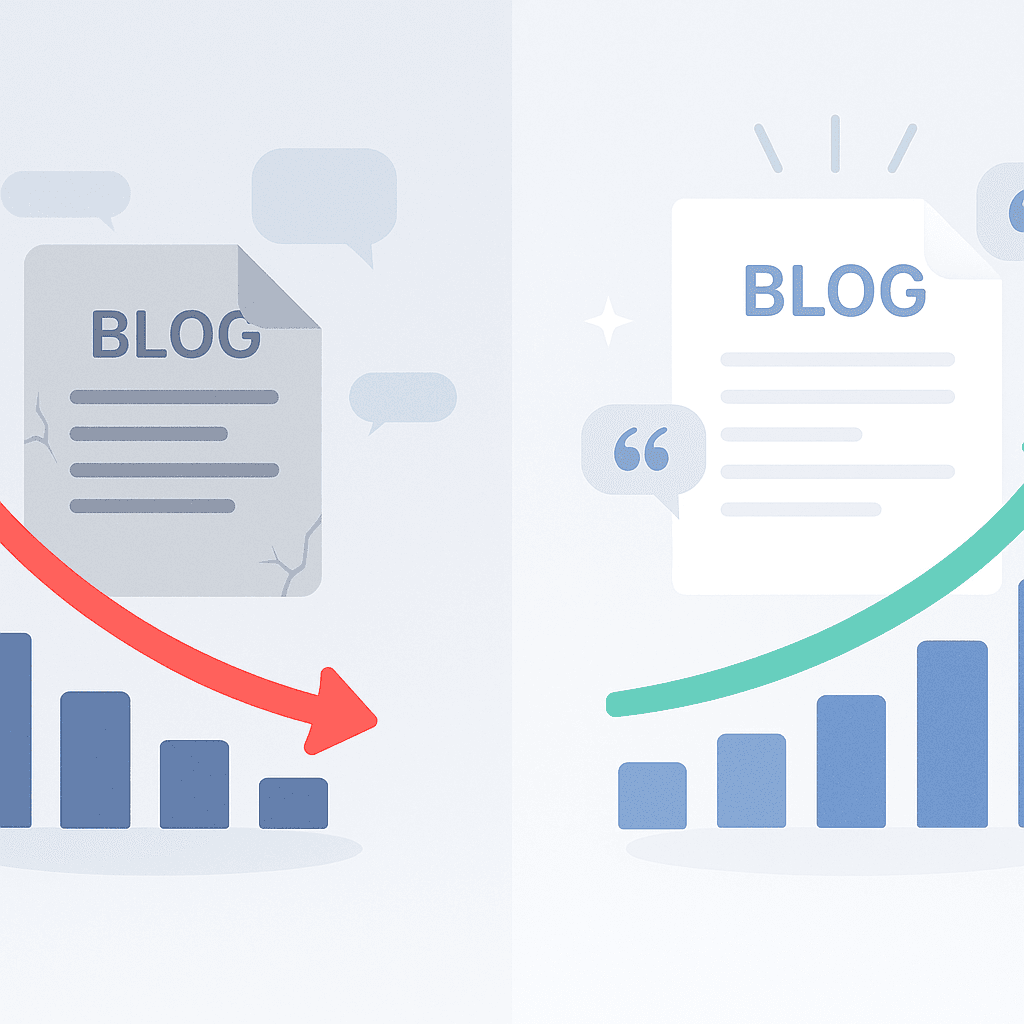
What Happens When Blogs Go Stale vs. Stay Fresh?
Stale content costs more than rankings. Consider these data points:
Metric | Fresh Content Impact |
|---|---|
Long-form posts (2,000+ words) | Cited 3× more than short posts |
ChatGPT referrals | 10% of new Vercel signups now come from ChatGPT |
AI-powered video campaigns | Deliver 17% higher ROAS than manually managed campaigns |
Freshness is heavily weighted by retrieval-augmented generation systems. Our research shows that 76.4% of ChatGPT's most-cited pages were updated in the last month. When content goes stale, citation rates plummet, competitors fill the gap, and pipeline shrinks.
What Is the Best AI Content Refresh Workflow?
A high-performing refresh is a surgical rewrite that preserves equity while expanding topical coverage and machine-readability. The workflow below blends AI speed with human judgment at every gate.
1. Inventory & Score Existing Posts
Start by pulling every URL into a single source of truth. Assign each post a 1-5 priority score using the P.R.I.O.R.I.T.Y. framework, which blends performance signals, business value, and effort.
AI systems look for signals of E-E-A-T when deciding which pages to surface and cite. During the audit, flag posts missing:
Author bylines and credentials
Schema markup (FAQ, HowTo, Article)
Recent statistics or case studies
Clear question-and-answer formatting
Most teams achieve strong results by running a focused AI content audit quarterly and a lighter monthly check on new or strategic sections.
2. Draft & Optimize with AI — Human-in-the-Loop
"AI is plugged into specific steps, not 'write the whole thing.' Research, outline, briefs, examples, rephrasing, QA, and content refreshes all get AI help. Full auto-writing does not," advises Quick Sprout's editorial workflow guide.
Use AI to accelerate ideation and section rewrites, then apply SME judgment to validate facts, inject examples, and add unique insights that demonstrate experience. This hybrid approach satisfies Google's helpful-content expectations while capturing the speed gains AI offers.
Practical checklist:
Generate a draft outline with target entities and gaps.
Let AI expand each section using your knowledge base.
Have a subject-matter expert verify claims and add proprietary data.
Run a plagiarism and AI-detection pass.
Finalize brand voice and formatting.
3. Publish, Track Citations & Iterate
Once the refresh is live, structured data becomes your citation insurance. Products with comprehensive schema appear 3-5× more often in AI recommendations.
Monitor these KPIs:
KPI | Why It Matters |
|---|---|
Citation frequency | Measures how often your brand is referenced across AI platforms (G2) |
AI answer inclusion rate | Tracks whether your content appears in synthesized responses |
Sentiment-weighted authority | Gauges how positively your brand is discussed |
Refresh cadence should match your market's velocity. For fast-moving SaaS categories, monthly updates on pillar pages keep citation rates stable; evergreen guides can follow a quarterly cycle.
AI Writing & Optimization Tools: Strengths, Gaps, and Where Relixir Wins
The market offers dozens of point solutions. Here is how the leading options stack up:
Tool | Strength | Limitation |
|---|---|---|
Surfer AI | SEO scoring, 10× cheaper than human writers at $19/article | No GEO-specific monitoring or CMS sync |
Jasper | Brand voice at scale, team collaboration | AI text generation scores 7.7 vs. Rytr's 9.3 on G2; lacks prompt-level citation tracking |
Frase | SERP-aware briefs, strong optimization scores | No visitor ID or lead sequencing |
MarketMuse | Topic modeling, content inventories | Manual refresh triggers; no end-to-end automation |
AI-powered content creation tools like ChatGPT and Jasper will become essential for crafting GEO-friendly content, yet none of these point tools close the loop from visibility to pipeline. That gap is where Relixir differentiates.
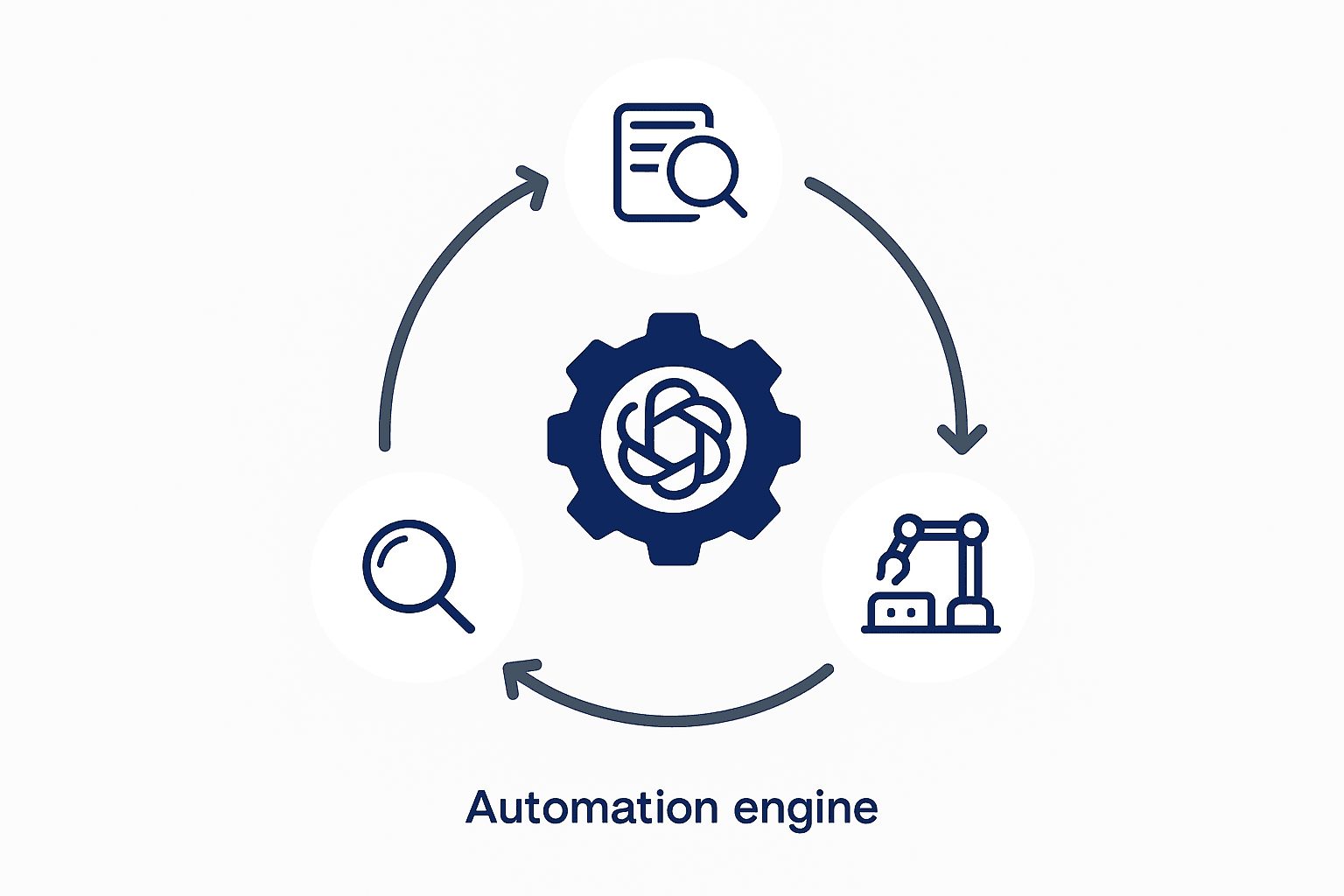
How Relixir Automates Blog Refreshes End-to-End
Relixir was built as the first content automation platform specifically for AI visibility. It connects directly to your CMS, continuously flags posts losing citations, and auto-generates GEO-optimized rewrites.
Core capabilities mapped to the workflow above:
Inventory & Score: Relixir analyzes your entire content library for SEO and GEO gaps, identifies missing topics, weak coverage, and competitor gaps, then suggests high-intent topics automatically.
Draft & Optimize: Deep-research agents combine competitor and keyword gaps from Google plus AI search, your product knowledge base, real-world web research, and social insight mining (Reddit, Quora, X) to produce citation-ready drafts.
Publish & Track: Relixir reveals where a company stands in AI results, including when it is mentioned, how often, and in what context. Its visitor-ID script then tracks AI-search traffic and pushes high-intent readers into HubSpot or Apollo.
"Relixir automatically creates, updates, and distributes high-quality, brand-aligned content optimized specifically for generative engines," notes HireTop's platform overview.
Early adopters report completing refreshes 10× faster and adding 17% more inbound leads within six weeks, results point solutions cannot match because they lack real-time prompt monitoring and closed-loop lead capture.
How Do You Calculate AI Content Refresh ROI?
Leadership buy-in hinges on defensible numbers. Use the table below as a starting framework:
Cost Category | Benchmark |
|---|---|
AI-generated blog post | $131 average vs. $611 for human-written |
Monthly AI tool spend | 64% of companies spend < $500/month |
Time savings | Professionals expect AI to save ~5 hours/week |
Productivity lift | 87% of B2B marketers say productivity has improved with AI |
EBIT attribution | Marketing leaders attribute a median 15% of EBIT directly to AI adoption |
Agency spend reduction | 83% of marketing leaders would reduce agency spending if they could fully automate content creation |
A Deloitte Insights analysis found investments in AI and machine learning generate 3.5× higher average ROI than other tracked technology categories. To capture that return, assign accountable editors for fact-checking, brand voice, and compliance so quality does not erode as volume scales.
Which Quality and Compliance Pitfalls Should You Avoid?
Speed without guardrails invites risk. Keep these pitfalls on your radar:
Hallucination: Deep research unlocks significant new capabilities, but AI can still hallucinate facts or make incorrect inferences, though at a notably lower rate than earlier models.
E-E-A-T erosion: "Humans own strategy and judgment. Topic selection, angle, narrative, and final approvals are human. AI assists, but it does not decide what you publish or what you stand for," warns Quick Sprout.
Unvalidated outputs: Without proper validation, generative AI outputs risk undermining SEO reputation and trust, causing more harm than good (Moz).
Mitigate these risks by documenting workflows, enforcing style guides, and routing every draft through a human review gate before publication.
Conclusion: Start Small, Automate Quickly, Measure Relentlessly
AI content refresh is no longer optional. The brands winning citations today treat content as a living asset, not a one-and-done artifact. Here is your action plan:
Audit your top 20 posts this week using the P.R.I.O.R.I.T.Y. framework.
Pilot an AI-assisted refresh on three high-traffic, declining pages.
Instrument citation tracking across ChatGPT, Perplexity, and Google AI Overviews.
Measure traffic, citation frequency, and pipeline lift at 30 and 60 days.
Relixir's mission is to make brands visible, trusted, and recommended by AI engines. By connecting CMS sync, deep-research agents, and visitor-ID lead capture in a single platform, Relixir eliminates the tool sprawl that slows most teams down.
Ready to turn stale blogs into citation magnets? Explore Relixir and see how end-to-end GEO automation accelerates your refresh cycles.
Frequently Asked Questions
What is AI content refresh and why is it important?
AI content refresh involves updating existing blog content using AI tools to maintain relevance and visibility in AI search engines. It's crucial as it helps brands earn citations in platforms like ChatGPT and Google AI, ensuring content remains a valuable asset rather than becoming outdated.
How does Relixir automate blog refreshes?
Relixir automates blog refreshes by connecting directly to your CMS, identifying content gaps, and generating GEO-optimized rewrites. It uses deep-research agents to produce citation-ready drafts and tracks AI-search traffic, pushing high-intent readers into CRM systems like HubSpot.
What are the benefits of using AI for content refresh?
Using AI for content refresh accelerates the process, ensures content is optimized for AI search engines, and maintains high citation rates. It also helps in expanding topical coverage and improving machine-readability, which are essential for maintaining visibility in both traditional and AI-driven search engines.
How does stale content affect a brand's visibility?
Stale content can lead to decreased citation rates and visibility, as AI search engines prioritize fresh, updated content. This can result in competitors filling the gap, reducing a brand's pipeline and overall online presence.
What is the P.R.I.O.R.I.T.Y. framework mentioned in the blog?
The P.R.I.O.R.I.T.Y. framework is a method for scoring blog posts based on performance signals, business value, and effort required for updates. It helps in prioritizing which posts to refresh to maximize impact and maintain high visibility in AI search engines.
Sources
https://www.siegemedia.com/content-marketing/ai-content-report
https://learn.g2.com/redefining-seo-success-metrics-in-the-age-of-ai-search?hsLang=en
https://hiretop.com/blog4/relixir-ai-generative-engine-optimization-platform
https://contentmarketinginstitute.com/articles/b2b-content-marketing-trends-research/
https://www.adexchanger.com/mobile/ai-is-eating-into-agency-relationships-is-the-honeymoon-over/