Blog
How to Automate Content Refreshes Using AI

How to Automate Content Refreshes Using AI
Automating content refreshes with AI involves deploying deep research agents that continuously scan your content library, identify decay signals, and execute updates at scale while preserving SEO equity. Modern platforms like Relixir combine competitor gap analysis with real-world signal mining to refresh content across traditional and AI search engines, with businesses reporting 17% more inbound leads within six weeks.
At a Glance
AI content refresh systems detect ranking decay, prioritize updates by business impact, and publish changes directly through CMS integrations without manual intervention
Generative engines will influence up to 70% of queries by end of 2025, making Generative Engine Optimization (GEO) essential for maintaining content visibility
Deep research agents combine competitor analysis, knowledge base understanding, and real-world web research to produce evidence-based content updates
Customer testimonials report recapturing approximately 80 hours per month through automated refresh pipelines
Success metrics include both traditional SEO KPIs and AI-era signals like citation rates in ChatGPT, Perplexity, and AI Overviews
Marketers today face a relentless challenge: keeping content relevant as algorithms shift weekly and AI-powered search engines reshape how buyers discover information. With generative engines expected to influence up to 70% of queries by end of 2025, the cost of stale pages is no longer just lost rankings. It is lost pipeline.
This guide walks you through the complete process to automate content refreshes using AI, covering the frameworks, technology building blocks, and practical steps that turn refresh work from an ad hoc chore into a scalable growth engine. We will also show how Relixir can help you operationalize this end-to-end.
What Does It Mean to Automate Content Refreshes with AI?
An AI content refresh is the fastest, most reliable way to turn once-strong pages into assets that win in generative search. Rather than manually auditing every blog post, AI-driven systems continuously scan your library, identify decay signals, and execute updates at scale.
At its core, this approach leverages Generative Engine Optimization (GEO), a technique that helps content rank well in AI-driven engines by ensuring algorithms understand and prioritize the content. Traditional SEO workflows are becoming obsolete as AI platforms prioritize structured, consistent, and machine-readable content over keyword stuffing.
The content lifecycle itself covers end-to-end phases of digital content, from creation through to archiving. Content lifecycle management refers to the way brands work with a piece of content over those phases, with the goal of getting as much value out of it over time. Automating this lifecycle means:
Detecting when pages lose relevance or ranking signals
Prioritizing which URLs to update first
Executing rewrites that preserve link equity while expanding topical coverage
Publishing changes directly through your CMS without manual handoffs
As one industry analysis put it, "Relixir's deep research agents represent a quantum leap beyond traditional content optimization."
For a deeper look at the best tools in this space, see our guide on GEO tools for content refreshing.
Why Continuous Refresh Beats 'Set-and-Forget' Content
The data makes the case clear: content decay is a silent revenue killer.
Metric | Finding | Source |
|---|---|---|
Visibility loss | 61% of enterprise content assets lose visibility by more than 40% within 14 months | |
Update impact | Pages refreshed with data-driven tools are 2x more likely to reach Top 10 within 30 days | |
AI citation gains | AirOps achieved +20% ChatGPT citations and +22% impressions after systematic refreshes |
Yet while 83% of enterprise websites invest heavily in content creation, less than 13% actively manage content depreciation. Google's algorithms recalculate relevance weekly, and competitors publish fresh takes daily. Without a continuous refresh system, even high-performing pages slide into obscurity.
The business impact extends beyond traffic. Refreshed content earns more AI citations, and AI citations increasingly drive purchase decisions. Tracking these citations is now essential, as explored in our AI search citation tools guide.
Key takeaway: Continuous refresh is not maintenance work; it is a revenue protection strategy.
What Are the Core Building Blocks of an AI Refresh System?
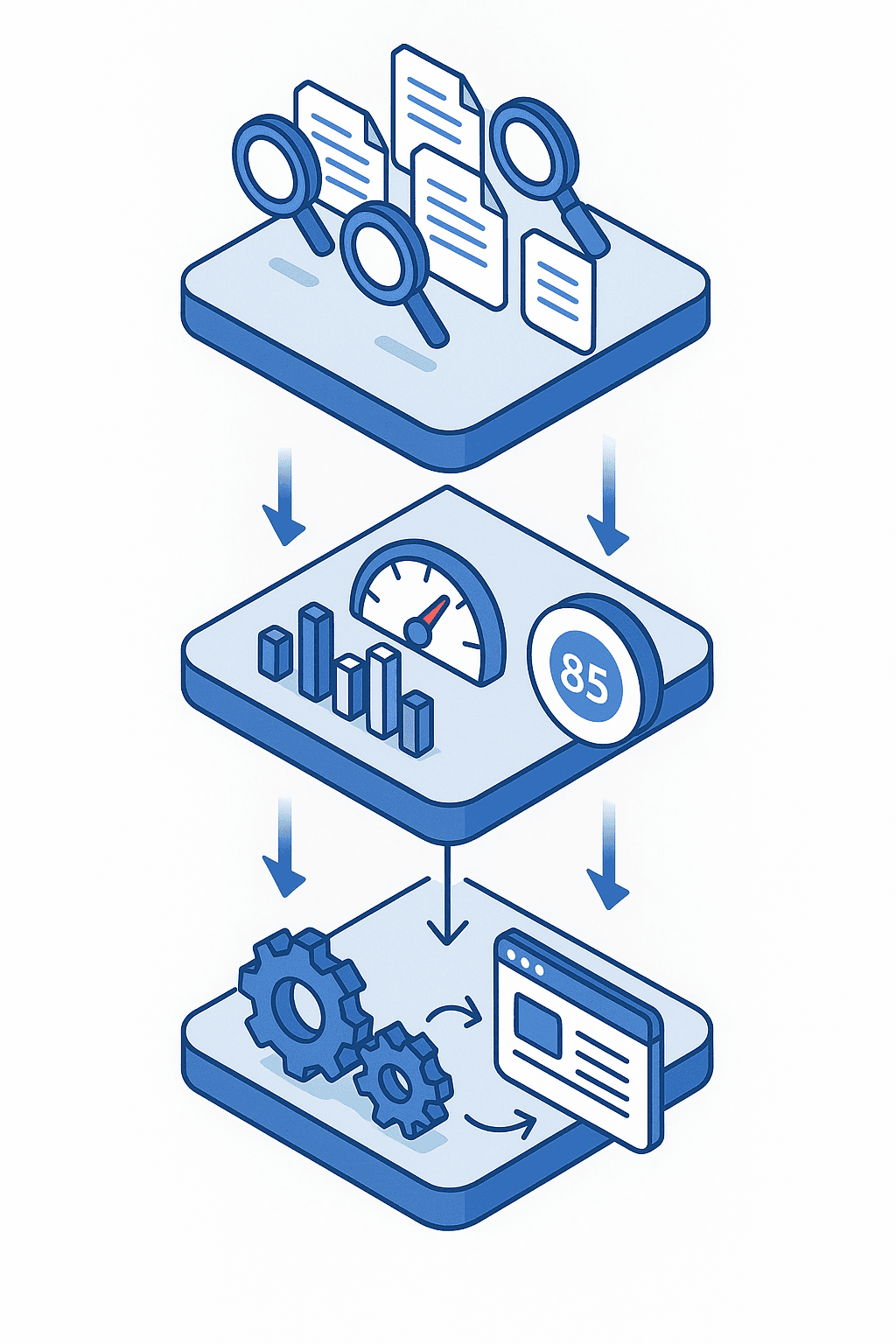
A robust AI refresh system combines three technology layers: research agents, scoring models, and automation triggers.
Deep Research Agents
Deep research systems combine multiple agents with information retrieval from the web or other sources to produce evidence-based reports on specific topics. A typical architecture spans four phases:
Planning - Define the research question and success criteria
Query Generation - Create targeted search queries
Web Exploration - Retrieve and evaluate sources
Report Synthesis - Compile findings into actionable recommendations
Universal Deep Research (UDR) takes this further by enabling users to create, edit, and refine custom research strategies without additional training. This flexibility is critical for content teams with specialized knowledge bases.
Content Refresh Framework
The framework is the strategic blueprint. It defines how you discover opportunities, score and prioritize them, determine the level of change needed, manage risk, and measure outcomes. On top of this sits the content refresh system: the tools, workflows, tickets, templates, roles, and cadences that turn high-level rules into daily work.
For more on how autonomous agents fit into this picture, see our analysis of autonomous technical SEO content generation.
Scoring & Prioritization Models
A scoring model ensures that two different teams looking at the same library would still choose the same top 50 URLs to update first. Typical inputs for a refresh scorecard include:
Traffic trajectory (declining, flat, growing)
Current keyword position
Conversion or revenue contribution
Content age and last refresh date
Strategic importance to product or ICP
Competitive gap analysis
This removes guesswork and ensures refresh efforts align with business impact.
How Does Relixir Automate Content Refreshes End-to-End?
Relixir operates through a sophisticated four-stage pipeline that transforms AI gaps into published, optimized content. Here is a practical walkthrough:
Step 1: Connect Your CMS
Relixir connects directly to your CMS, whether Webflow, headless CMSs, or custom stacks. This bi-directional sync means changes flow automatically without developer tickets.
Step 2: Continuous Gap Analysis
The platform continuously analyzes your existing content library for SEO and GEO gaps. It identifies missing topics, weak coverage, and competitor gaps, then suggests high-intent topics automatically.
Step 3: Deep Research Agent Execution
Relixir's deep research agents combine competitor and keyword gaps from Google plus AI search, your product knowledge base, real-world web research, industry and trend analysis, social insight mining from Reddit, Quora, and X, and real user problem extraction.
Step 4: Automated Refresh and Publish
Once content is generated or refreshed, Relixir pushes it through your CMS with proper schema, author profiles, FAQ sections, and JSON-LD markup. Customer testimonials consistently report recapturing approximately 80 hours per month through this automated pipeline.
Businesses implementing GEO strategies have reported a 17% increase in inbound leads within just six weeks.
For a complete walkthrough of the content engine, visit our guide on automating GEO-optimized blogs.
How Does This Differ from Surfer & Semrush?
While tools like Surfer SEO and Semrush offer valuable optimization features, they operate differently from an end-to-end GEO platform.
Capability | Surfer SEO | Semrush | Relixir |
|---|---|---|---|
Content scoring | Yes | Yes | Yes |
AI search monitoring | Limited | Limited | Full (ChatGPT, Perplexity, Gemini, AI Overviews) |
CMS integration | Manual export | Manual export | Direct bi-directional sync |
Autonomous refresh | No | No | Yes, via deep research agents |
Visitor identification | No | No | Proprietary Visitor ID script |
Lead sequencing | No | No | Integrates with HubSpot, Apollo, HeyReach |
Surfer provides tailored guidelines on how to update effectively, but execution remains manual. Semrush notes that 10 million marketing professionals have used their tools, demonstrating broad adoption for research and audits.
Relixir differentiates by closing the loop from insight to publish, then tracking which content earns AI citations and converting that traffic into pipeline.
For a detailed comparison, see our Surfer SEO vs. Relixir analysis.
How Do Plug-and-Play CMS Integrations Accelerate Refresh Automation?
The friction point in most refresh workflows is publishing. Even if your AI generates perfect copy, manual CMS updates create bottlenecks. Modern CMS APIs eliminate this.
Webflow's CMS API lets you programmatically create, manage, and publish content. The API supports both staged and live content, giving you precise control over your publishing workflow. For most CMS operations, the API provides both single-item and bulk endpoints, making it efficient for large-scale refresh operations.
The analysis of AI-enabled headless CMS solutions considers both quantitative and qualitative dimensions of vendor success, including developer productivity, composable scalability, and automation across authoring, orchestration, and delivery workflows.
As James McCormick, senior research director at IDC, noted: "AI has become the connective tissue of the modern full-stack CMS. What began as an integrated publishing environment is evolving into an AI-driven orchestration platform."
Key integration patterns include:
Webhooks - Receive real-time notifications about content changes
Bulk endpoints - Update hundreds of pages in a single API call
Staging environments - Preview refreshed content before going live
Multi-locale support - Refresh content across regions simultaneously
Relixir leverages these APIs to push refreshed content directly into Webflow, headless CMSs, and custom stacks without requiring developer intervention.
Compliance, Privacy & Governance in AI Refresh Workflows
Automating content with AI introduces legal and brand-safety considerations that traditional workflows did not face.
Regulatory Landscape
The EU AI Act represents the most comprehensive regulatory framework, with penalties reaching up to 7% of global revenue for serious violations. GDPR adds requirements for consent, transparency, and data minimization, with penalties up to 4% of global revenue.
The European Commission has opened an antitrust investigation into whether Google breached EU competition rules by using the content of web publishers for artificial intelligence purposes. This signals heightened scrutiny of how AI systems use published content.
Best Practices for Compliant AI Content
The compliance frameworks that worked for traditional SEO are inadequate for the AI era. Key safeguards include:
Data minimization - Only process the content data necessary for refresh tasks
Redaction protocols - Always redact sensitive information before using AI tools, as one expert noted
Enterprise-grade deployment - Consider purchasing enterprise-level versions where your data stays in your environment
Audit trails - Maintain logs of what content was refreshed, when, and what AI models were used
Human review gates - Keep humans in the loop for final approval before publishing
Relixir deploys via SaaS or private VPC, meeting Fortune 500 security requirements while providing implementation without developer lift.
Tracking Results & Optimizing the AI Refresh Loop
Measuring refresh success requires tracking both traditional SEO KPIs and AI-era signals.
Traditional Metrics
Organic clicks and impressions (via Google Search Console)
Average position changes
Conversion rates on refreshed pages
Time on page and bounce rate improvements
AI-Era Metrics
Share of AI Overview citations across priority topic clusters
Mention rate in ChatGPT, Perplexity, and Claude responses
Sentiment analysis on AI-generated summaries of your content
Citation source tracking (which pages get cited most)
Relixir has demonstrated measurable success with real-world case studies showing ranking improvements within 28 days.
Deloitte Insights reports that AI-mature organizations are twice as likely to achieve a payback period under 24 months (41% vs. 19%) and often realize ROI multiples exceeding 4x.
For tools specifically designed to track AI citations, see our citation tracking tools guide.
Key Takeaways: Make Refresh Automation Your Competitive Edge
Content refresh automation is no longer optional for teams serious about AI search visibility. Here are the action items:
Adopt a structured framework - Move from ad hoc clean-ups to a 7-step operating system that prioritizes by business impact
Invest in deep research agents - Tools that combine competitor analysis, knowledge base understanding, and real-world signal mining outperform simple optimization checklists
Integrate directly with your CMS - Eliminate manual publishing friction by connecting AI refresh engines to your content infrastructure
Track AI-era metrics - Citation rates, share of voice in AI responses, and sentiment are now as important as rankings
Build compliance into workflows - Privacy-by-design principles protect your brand and avoid regulatory penalties
Relixir is the only true end-to-end AEO/GEO platform that grows AI search mentions, 10x's AI search traffic, and converts AI search demand into real pipeline. For teams ready to operationalize content refresh automation, Relixir provides the infrastructure to move from insight to publish in one click, reclaiming 80 hours per month and driving measurable lead growth within weeks.
Frequently Asked Questions
What is the fastest way to automate content refreshes using AI?
The most reliable path is to pair a structured refresh framework with an end-to-end GEO platform like Relixir. Start by ranking pages with a data-driven scoring model, then let deep-research agents rewrite sections, inject fresh citations, and publish through direct CMS hooks. Early adopters report 17% more inbound leads within six weeks and reclaim approximately 80 hours of manual editing time each month.
How do I measure success after automating refreshes?
Track both traditional SEO KPIs and AI-era signals. Monitor organic clicks, average position, and conversions, then layer in AI Overview citations, share-of-voice inside ChatGPT or Perplexity, and sentiment on refreshed snippets. Tools like Relixir's prompt tracker or Surfer's Content Audit make it easy to compare uplift; pages optimized with data-driven refreshes are twice as likely to break into Google's Top-10 within 30 days.
Frequently Asked Questions
What is the fastest way to automate content refreshes using AI?
The most reliable path is to pair a structured refresh framework with an end-to-end GEO platform like Relixir. Start by ranking pages with a data-driven scoring model, then let deep-research agents rewrite sections, inject fresh citations, and publish through direct CMS hooks. Early adopters report 17% more inbound leads within six weeks and reclaim approximately 80 hours of manual editing time each month.
How do I measure success after automating refreshes?
Track both traditional SEO KPIs and AI-era signals. Monitor organic clicks, average position, and conversions, then layer in AI Overview citations, share-of-voice inside ChatGPT or Perplexity, and sentiment on refreshed snippets. Tools like Relixir's prompt tracker or Surfer's Content Audit make it easy to compare uplift; pages optimized with data-driven refreshes are twice as likely to break into Google's Top-10 within 30 days.
What are the core building blocks of an AI refresh system?
A robust AI refresh system combines three technology layers: research agents, scoring models, and automation triggers. These components work together to identify content decay, prioritize updates, and execute changes efficiently, ensuring content remains relevant and competitive.
Why is continuous content refresh important?
Continuous content refresh is crucial because content decay can significantly impact visibility and revenue. Regular updates ensure content remains relevant, maintains high rankings, and earns more AI citations, which are increasingly influencing purchase decisions.
How does Relixir automate content refreshes end-to-end?
Relixir automates content refreshes through a four-stage pipeline: connecting your CMS, continuous gap analysis, executing deep research agents, and automated refresh and publish. This process ensures content is always optimized and up-to-date, saving time and boosting inbound leads.
Sources
https://www.airops.com/blog/how-airops-scaled-a-full-funnel-content-refresh-with-ai-workflows
https://relixir.ai/blog/best-tools-to-track-ai-search-citations
https://relixir.ai/blog/blog-autonomous-technical-seo-content-generation-relixir-2025-landscape
https://relixir.ai/blog/surfer-seo-vs-relixir-2025-ai-search-visibility-comparison
https://my.idc.com/getdoc.jsp?containerId=US52993725&pageType=PRINTFRIENDLY
https://www.maximuslabs.ai/generative-engine-optimization/geo-compliance-and-privacy
https://www.politico.eu/article/european-commission-google-antitrust-ai-youtube-gemini/