Blog
Tired of Manual Content Refresh? How GEO-Native CMS Automates Freshness

Tired of Manual Content Refresh? How GEO-Native CMS Automates Freshness
A GEO-native CMS automates content freshness by continuously monitoring your library for outdated information, autonomously rewriting pages with current data, and publishing updates via API integrations—eliminating the 80 hours per month teams typically spend on manual content operations. This automation is critical since 65% of AI bot hits target content published within the past year, making manual refresh cycles impossible to scale.
At a Glance
Traditional CMS platforms require manual content refresh, creating unsustainable content debt as AI search demands constant freshness
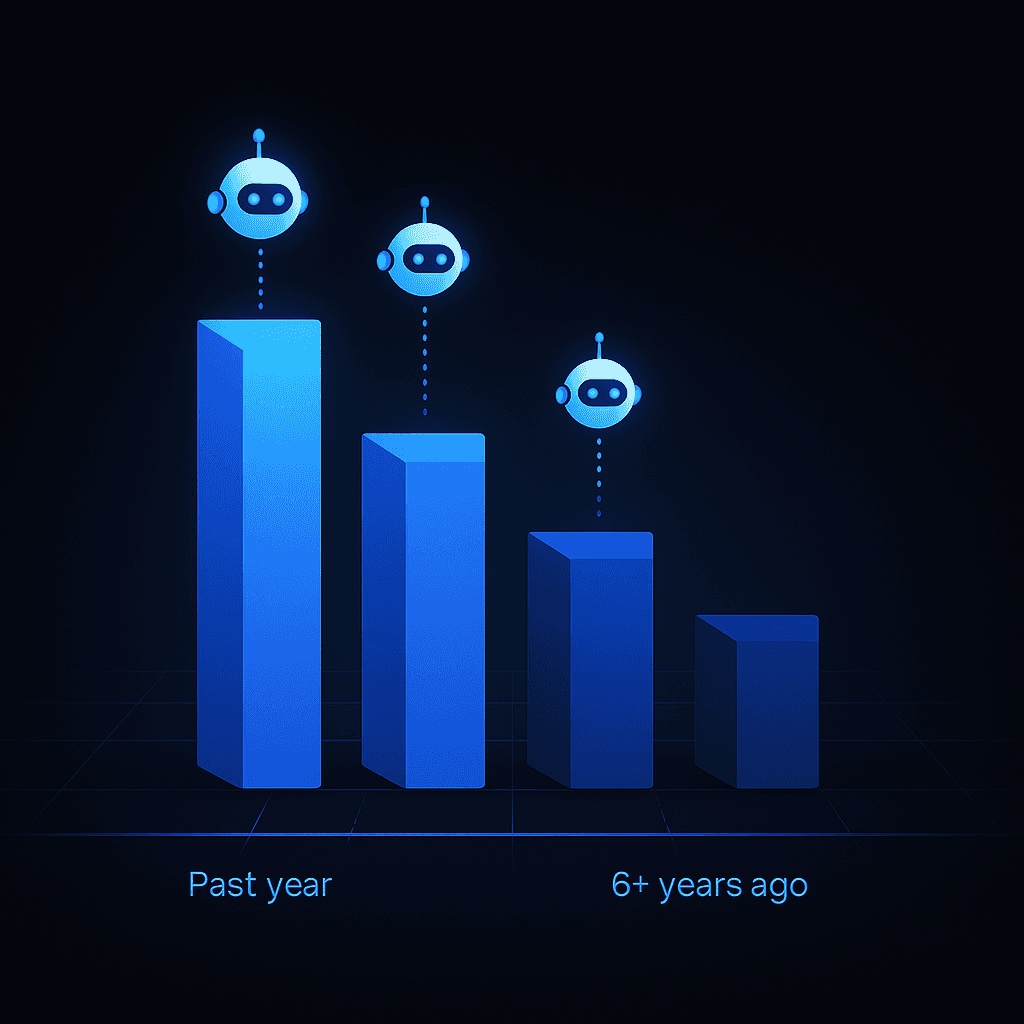
Nearly 65% of AI bot hits target content published in just the past year, with only 6% going to content older than 6 years
GEO-native platforms detect stale content, rewrite with current data, and publish automatically through CMS APIs
ChatGPT users convert at 15.9% compared to Google search's 1.76%—a 20x higher conversion rate
Autonomous refresh combines continuous monitoring, AI-powered rewriting, and API-driven publishing without human intervention
Most teams still rely on labor-intensive updates that create crippling content debt. A GEO-native CMS eliminates that burden by auto-refreshing every page, keeping your library fresh for AI search without human lift.
Over 1 billion people now use AI search weekly to research products and make purchasing decisions. Yet most content teams are still treating major blog posts as "evergreen" assets that only need occasional attention. The reality? Automated content refreshing is quickly becoming the only reliable way to keep pages accurate, competitive, and visible inside AI-driven experiences.
This guide walks you through the manual refresh bottleneck, proves why recency matters for AI citations, defines what makes a CMS truly GEO-native, and shows you how autonomous refresh workflows actually function.
Why Is Manual Content Refresh Still a Bottleneck?
The average marketing team spends approximately 80 hours per month on content-related activities, from research and creation to optimization and publishing. That's two full work weeks consumed by content operations alone.
The problem compounds when you consider what happens after publication. Traditional CMS platforms like Webflow, WordPress, and Contentful were built for 2000s-era SEO, requiring manual content publishing, manual content refresh cycles, and providing zero visibility into whether brands appear in AI search results.
Here's where content debt spirals out of control:
No automated freshness detection. Teams rely on calendar reminders or gut instinct to identify stale content.
Competing priorities. Refresh tasks get deprioritized against new content creation, product launches, and campaign deadlines.
Scale impossibility. AI search engines process millions of queries daily across thousands of topics. Manual approaches cannot keep pace.
Invisible decay. Without AI visibility monitoring, teams have no idea which pages are losing citations to fresher competitor content.
The result? Content libraries quietly rot while marketing teams remain unaware. By the time traffic drops become noticeable, months of citation opportunities have already been lost.
Key takeaway: Manual refresh cycles cannot scale to meet the velocity demands of AI search, making automation the only viable path forward.
Does AI Search Actually Reward Recency? The Data
Yes, and the bias is stronger than most teams realize.
A 2025 Seer Interactive study found that nearly 65% of AI bot hits target content published in just the past year.
The numbers get even more stark when you extend the window:
Time Frame | Share of AI Bot Hits |
|---|---|
Last 1 year (2024-2025) | 65% |
Last 2 years (2023-2025) | 79% |
Last 3 years (2022-2025) | 89% |
Last 5 years (2020-2025) | 94% |
Older than 6 years | 6% |
This recency preference varies by industry. Financial services shows extreme recency bias with thousands of hits on 2024-2025 content and almost none pre-2020. Meanwhile, the energy industry shows AI crawlers gravitating toward informational evergreen content that won't become outdated quickly.
The commercial impact is substantial. ChatGPT users convert at 15.9% compared to Google search's 1.76%, a staggering 20x higher conversion rate. These aren't casual browsers; they're high-intent buyers who have already done their initial research.
Research also shows that 52% of organic citations come from top-10 Google results, with the top result alone having a 58% chance of being cited. Being on Google's first page gives about a 38% chance of being cited by AI Overviews.
Relixir-generated blogs get cited 3x more often in AI search than traditional blogs, demonstrating that content specifically structured for AI citation outperforms generic approaches.
Key takeaway: AI platforms systematically favor recent, well-structured content, making continuous refresh a prerequisite for maintaining citation rates.
What Makes a CMS "GEO-Native"?
Generative Engine Optimization (GEO) is "the practice of structuring your content so AI language models like ChatGPT, Claude, Perplexity, and Google's AI Overviews can understand, cite, and feature your brand in their generated responses."
A GEO-native CMS differs from traditional and even modern headless systems in fundamental ways:
Capability | Traditional CMS | Headless CMS | GEO-Native CMS |
|---|---|---|---|
Content publishing | Manual | Manual via API | Autonomous via AI agents |
Content refresh | Manual audits | Manual via API | Continuous automated scanning |
AI visibility | None | None | Built-in monitoring |
Schema injection | Developer-dependent | Developer-dependent | Automated |
Citation optimization | Not considered | Not considered | Core architecture |
As James McCormick, senior research director at IDC Digital Experience Strategies, notes: "Headless CMS have entered an AI-accelerated era. Developers now expect intelligent copilots, agentic automation, and composable frameworks that turn complexity into velocity, allowing organizations to deliver and optimize experiences at scale with unprecedented agility."
An AI Content Management System (AI CMS) leverages artificial intelligence to manage, organize, and optimize digital content. These platforms automate content creation, enhance personalization, and improve content distribution strategies.
AI search engines process millions of queries daily. Traditional platforms simply cannot produce enough content, or keep existing content fresh enough, to maintain visibility across the long tail of buyer queries. A GEO-native architecture solves this by embedding AI agents that continuously structure, refresh, and publish content so large language models can understand and cite it.
Inside an Autonomous Content Refresh Workflow
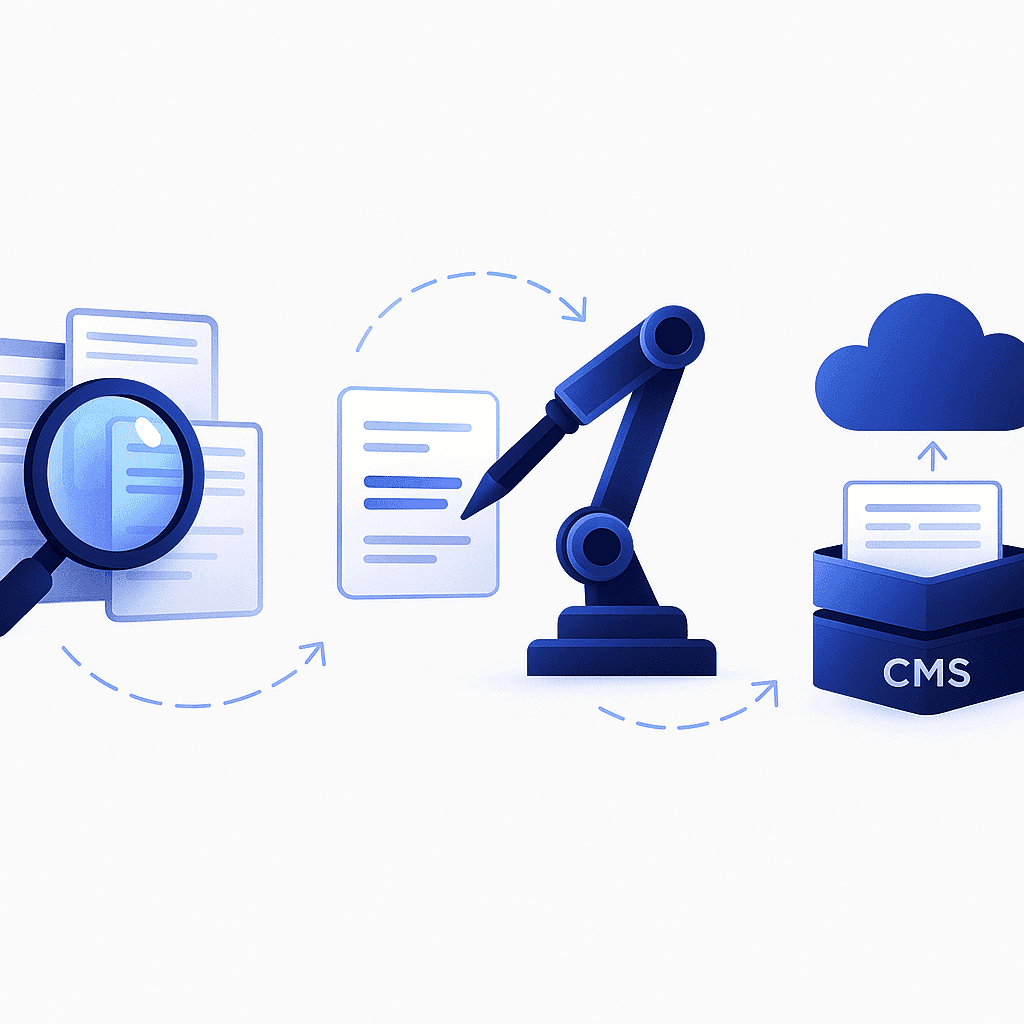
Autonomous content refresh operates through a detection-to-publish cycle that eliminates manual bottlenecks. Here's how the workflow actually functions:
1. Detection & Scoring
The system continuously monitors your content library to flag stale pages. A content health score aggregates multiple signals including traffic trajectory, ranking changes, backlinks, conversion impact, content age, and current AI Overview inclusion into a single sortable metric.
Detection triggers include:
Statistics older than 6 months
Deprecated product features or pricing
Competitor content that has been updated more recently
Declining AI citation rates for target queries
Outdated screenshots or examples
The top result alone has a 58% chance of being cited, meaning even small ranking drops from stale content can dramatically impact citation rates.
2. Rewrite & Enrich
Once flagged, AI agents autonomously refresh content with current citations, case studies, and product updates across all major AI platforms. This isn't simple text replacement. The refresh process:
Updates statistics with current data
Refreshes examples and screenshots
Injects new citations from authoritative sources
Optimizes structure for LLM readability
Adds FAQ sections matching current query patterns
3. Push Live via CMS APIs
Modern CMS platforms expose APIs that enable zero-touch publishing. Bulk endpoints allow you to perform CRUD operations (Create, Read, Update, Delete) on multiple items in a single API call. The API supports both staged and live content, giving you precise control over your publishing workflow.
Webhooks provide real-time notifications about content changes, facilitating automated workflows and integrations with external systems. This means refreshed content can move from detection to live publication without human intervention.
Key takeaway: Autonomous refresh combines continuous monitoring, AI-powered rewriting, and API-driven publishing to maintain content freshness at scale.
Relixir vs. Legacy CMS: Who Truly Automates Freshness?
Not all platforms claiming AI capabilities deliver true refresh automation. Let's examine the differences:
Forrester's evaluation of CMS providers reveals "a transformed field of content management system (CMS) vendors that are hyperfocused on driving business impact through generative AI, extensible architecture, and global scalability."
Forrester also notes that time to market is the primary business driver for CMSes, with businesses consolidating to a single CMS to gain efficiencies. This trend makes comprehensive automation capabilities essential.
Where Contentful Falls Short on Refresh Automation
Contentful excels as a headless CMS with strong developer tools. Users report that Contentful's Developer Tools are rated highly at 8.9 on G2, making it a significant advantage for teams focused on custom development.
However, reviewers mention that Contentstack's Quality of Support is rated at 8.9, compared to Contentful's 8.4. When it comes to content scheduling and automated publishing, Contentful consistently scores lower than specialized alternatives.
The core limitation: Contentful requires developer involvement for any automated refresh workflows. Schema injection, AI visibility monitoring, and autonomous content updates all demand custom development.
Relixir's Autonomous Edge
Relixir takes a fundamentally different approach, providing a GEO-native CMS designed specifically for AI search optimization.
Businesses implementing GEO strategies report a 17% increase in inbound leads within six weeks. The platform has delivered $10M+ in inbound pipeline for 400+ B2B companies including Rippling, Airwallex, and HackerRank.
Key differentiators include:
Autonomous refresh capability that continuously scans your entire content library for outdated information
Deep research agents that combine competitor gap analysis, knowledge base understanding, and real-world signal mining
Proprietary writing model trained on 100,000+ blogs and real citation data
Native CMS integrations for Contentful, WordPress, Framer, and Webflow
Relixir-generated blogs get cited 3x more often in AI search than traditional blogs. As stated on their platform: "Relixir's deep re agents represent a quantum leap beyond traditional content optimization."
Implementation Checklist: Moving to a GEO-Native Stack
Migrating to a GEO-native architecture requires systematic planning. Here's your step-by-step checklist:
Phase 1: Assessment
Audit current content library for freshness status
Identify pages with declining AI citation rates
Map existing CMS integrations and dependencies
Document current refresh workflows and time investments
Phase 2: Platform Selection
The API supports both staged and live content, giving you precise control over your publishing workflow. Evaluate platforms based on:
Native AI visibility monitoring capabilities
Autonomous refresh features vs. developer-dependent implementations
Integration depth with your current CMS (if maintaining existing infrastructure)
Schema injection automation
Phase 3: Knowledge Base Setup
AI search engines need well-organized, comprehensive content libraries to draw from. For your refresh system to function:
Connect product specs, documentation, and release notes
Link pricing pages and feature comparisons
Integrate sales call transcripts for common objections
Sync support ticket themes for FAQ generation
Phase 4: Deployment
Relixir's autonomous refresh capability continuously scans your entire content library for outdated information. When deploying:
Configure refresh triggers and scoring thresholds
Set up AI visibility monitoring for priority keywords
Establish approval workflows (if desired)
Enable webhooks for real-time publishing
Phase 5: Optimization
Monitor AI citation rates post-implementation
Refine content health scoring based on actual performance
Expand keyword coverage based on identified gaps
Scale collection creation as traffic grows
AI search engines process millions of queries daily across thousands of topics. Your implementation should account for scaling requirements from day one.
Stop Paying the Content Debt Tax—Automate Freshness Now
Content debt compounds silently. Every month you delay refresh automation, competitors with fresher content capture citations that could have been yours. The conversion advantage of AI search traffic, 20x higher than traditional search, makes this opportunity cost substantial.
The shift from treating content as static assets to dynamic, continuously refreshed resources requires new infrastructure. Legacy CMS platforms built for 2000s-era SEO simply weren't designed for how large language models retrieve, understand, and cite information.
A GEO-native CMS like Relixir solves this by providing autonomous content refresh that syncs with your knowledge base, AI visibility monitoring across major platforms, and content generation specifically structured for LLM citation.
Relixir's vision is to build the new standard content database for AI search to pull from. Whether buyers are asking ChatGPT for the best CRM, speech-to-text API, or consulting services, the platform ensures your brand can be the answer.
The window to dominate AI-search-driven revenue is open right now. Companies that establish AI search visibility today will have a significant competitive advantage as the shift from traditional search to AI search accelerates.
Frequently Asked Questions
What is a GEO-native CMS?
A GEO-native CMS is designed to optimize content for AI search engines, automating content creation, refresh, and visibility monitoring to ensure high citation rates in AI-generated responses.
Why is manual content refresh a bottleneck?
Manual content refresh is time-consuming and cannot keep pace with the demands of AI search engines, leading to content debt and reduced visibility. Automation is necessary to maintain freshness and competitiveness.
How does AI search reward content recency?
AI search engines prioritize recent content, with studies showing that a significant majority of AI bot hits target content published within the last year, making continuous refresh essential for maintaining citation rates.
What are the benefits of autonomous content refresh?
Autonomous content refresh eliminates manual bottlenecks by continuously monitoring, updating, and publishing content, ensuring it remains fresh and competitive in AI search results without human intervention.
How does Relixir's CMS differ from traditional platforms?
Relixir's CMS offers autonomous content refresh, deep research agents, and AI visibility monitoring, specifically designed for AI search optimization, unlike traditional CMS platforms that require manual updates and lack AI integration.
Sources
https://www.seerinteractive.com/insights/study-ai-brand-visibility-and-content-recency
https://www.forrester.com/blogs/new-research-content-management-systems-trends-landscape/
https://relixir.ai/blog/best-geo-platforms-with-cms-integrations
https://my.idc.com/getdoc.jsp?containerId=US52993725&pageType=PRINTFRIENDLY
https://relixir.ai/blog/what-is-an-ai-content-management-system
https://developers.webflow.com/data/docs/working-with-the-cms
https://relixir.ai/blog/best-ai-cms-for-hosting-hundreds-of-blogs
https://www.forrester.com/report/buyers-guide-content-management-systems-2025/RES182341